
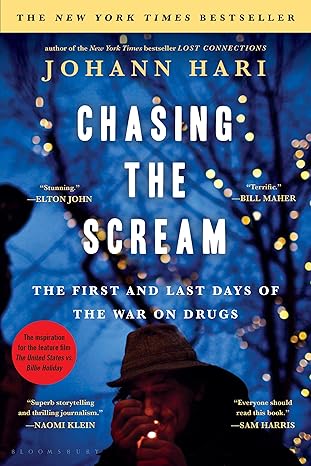
Chasing the Scream
by Johann Hari
Link blocked? Copy it and paste in a new browser tab.
Your Rating
All ratings are anonymous
Help others by sharing
The book talks discusses how the war on drugs began, how we misunderstand addiction, and how countries that have ended their war on drugs have been impacted. We have a lot of misconceptions about drug use. A LOT.
The start of the war on drugs, according to the book, revolved around three people: Harry Anslinger, Billie Holiday, and Arnold Rothstein.
1) Harry Anslinger
Harry Anslinger was the head of the Federal Bureau of Narcotics and had a vendetta against drugs, the mafia, and jazz. Plus he was hella racist. At the time the mafia was regarded more as a fable than reality but Harry was convinced otherwise and basically proved its existence. The fact that his conspiracy theory was correct most likely led him to the conclusion that he knew better than others, a conclusion which also led him to believe, against all evidence minus the exceptional experience, that all drugs were bad (probably didn't help that at the time drugs were becoming less regulated and his job was at stake). Plus the culture of America at the time was primed to look for a scapegoat for their fears as World War 1 started around the same time. Cocaine and heroin were made illegal in 1914 as that scapegoat despite both commonly used substances by all races and social classes before then, so much so that it was found in over the counter medicines. The win wasn't enough for Harry and he started a vendetta against marijuana.
2) Billie Holiday
Billie Holiday was a famous jazz musician that had a tortured childhood including being forced into prostitution to survive, besides the troubles brought upon by obvious and blatant racism at the time. Understandably, she turned to heroin at some point to help ease her emotional suffering (having worked as a mental health therapist in addiction for 3 years with the homeless, I can effectively say that many addicts have lived very difficult lives generally starting in childhood). Harry Anslinger attempted to arrest all jazz musicians by first targeting weed as the source of all evil, despite 29 of 30 medical doctors refuting the claim that weed was dangerous. "He reassured politicians that his crackdown would affect not 'the good musicians, but the jazz type.'" After realizing that he would never succeed with marijuana, he focused his attention on Billie Holiday and her heroin use. Billie was a rising star, and a badass by the way, whose life was, at least in part, cut short by continued harassment and unlawful persecution. She was the critical casualty in what cascaded eventually into a worldwide policy.
According to the author, "the main reason given for banning drugs - the reason obsessing the men who launched this war - was that blacks, Mexicans, and Chinese were using these chemicals, forgetting their place, and menacing white people." Black people were public enemy #1 and the chief users of dangerous substances according to Harry. Ironically his agents used drugs in tandem with those they were trying to incriminate and also spiked innocent people's drinks with drugs for their own purposes. Not the best bunch. Apparently they could use drugs and be stand up citizens because they were doing it in order to arrest others who did it. Unsurprisingly they didn't target white drug users. So, much of the war on drugs was about racism.
But racism wasn't even all of it. As throughout history, power played a crucial role in the war on drugs.
Turns out, Harry Anslinger's officers supported the war on drugs because they were being paid off by the mafia. While there has been no evidence of Anslinger's involvement in the mafia plots and his motives were likely pure fanaticism, his officers were involved. The mafia wanted sole control of the drug trade because they could increase the cost of drugs by a thousand percent if they were made illegal. The mafia charged a dollar for morphine that was produced at two cents at the time. That's 50 times the cost. Coincidentally, here is an article from The National Library of Medicine about medical companies being able to charge 50 times the cost of life-saving medicine.
A doctor named Henry Williams, who once stated that people who used drugs were valueless, was the one who realized what was going on. He started to investigate Harry Anslinger when his brother was arrested for prescribing opiates, a legal prescription at the time, along with 20,000 other doctors doing the same. 95% of those doctors were convicted for doing something legal. Henry was upset not only because his brother was arrested, but because morphine at the time was used routinely at all levels of society in small doses. The good news was that in his search for truth, Henry eventually repented from his views on drug users, eventually making large efforts to help them. The bad news is that his personal investigation concluded that not only was the war on drugs creating an illegal smuggling ring, but it also made those who used the drugs unable to afford them, leading them to be involved in other criminal activities. "'The United States government, as represented by its anti-drug officers,' Henry explained, had just become 'the greatest and most potent maker of criminals in any recent century.'" The war on drugs created the dangerous culture surrounding drug use by making it illegal and unaffordable. Previous to banning drugs, not only were drugs not a big deal, but people didn't have to commit crimes to get them.
Anslinger then used the wave of fear around Communism to claim that China was secretly trying to undermine America's society by infusing it with drugs, a claim that his agents negated but Anslinger ignored. Many countries disagreed and refused to ban substances until Anslinger's agents started threatening economic repercussions and the cessation of trade with America. Anslinger's dogmatic and completely delusional perspectives almost single-handedly pushed the world to ban drugs along with the United States. I should mention that he was committed to a mental institution after he started claiming that addiction was contagious the same way a virus is, his paranoia having reached unprecedented levels.
When confronted with facts that went against his ideas, Anslinger would go on the attack and, when disproven, would go on diatribes attacking the characters of the doctors that challenged him. One of the doctors that refuted him said that Anslinger "[has] led this country to treat scientific questions the way such matters were handled in the Middle Ages."
3) Arnold Rothstein
The final character, Arnold Rothstein, is credited for making the modern gang what it is today. When drugs became illegal he took control of the entire East coast's heroin and cocaine trade. He was the initial kingpin of modern gangs and emphasized the bottom line and violence to achieve his goals. His murder disintegrated his empire and started the gang feuds that epitomize the current drug trade with each new gang becoming more vicious than the last by necessity in order to achieve supremacy. When trade is put into the realm of the illegal, the only recourse for control is violence. And when violence is the only path, the only way to beat out the competition is by becoming more violent than they are.
There are many fallacies about drug use according to studies on drugs. Let me go over a few of them mentioned:
- 1Most killings are drug-use related, as in the drug users go postal and kill someone. "Professor Paul Goldstein of the University of Illinois conducted a detailed study in which he and his team looked at every killing identified as drug-related in New York City in 1986." 7.5% of killings are done after a person took a drug with about 2% of those being addicts who were trying to fund their addiction. The other 92.5% of the cases that were designated as drug-influenced centered around gang violence due to the prohibition of drugs. Drugs don't make people kill people but the drug trade sure does!
- 2Most drug users are non-white. "In fact, the evidence suggests white people are slightly more likely to use and sell drugs." Harry Anslinger was focused on the wrong group of people it would seem.
- 3Murder rates are consistent across time. "Professor Jeffrey Miron of Harvard University has shown that the murder rate has dramatically increased twice in U.S. history - and both times were during periods when prohibition of drugs was dramatically escalated." Drugs are not the reason for violence, the prohibition of them is responsible for those deaths. "Take the drug trade away from criminals, he calculates, and it would reduce the homicide rate in the United States by between 25 and 75 percent." That is substantial.
- 4Arresting drug dealers will resolve the violence. The book goes over a situation where 80% of drug dealers in a particular area were arrested within a two span. Within a week of the arrests the drug activity was back to pre-arrest levels. There will always be people willing to fill drug vacancies when they feel it's one of their only options in overcoming poverty.
- 5Not very many people use drugs. "More than 50% of Americans have breached the drug law." Yup, more than half of all Americans have done drugs illegally. Even if that statistic is incorrect, it shows that drug use is far more prevalent than many people think. Minorities are targeted because "where a law is that widely broken, you can't possibly enforce it against every lawbreaker... so you keep targeting the weak." This is part of the main message of the book, that the rich can get away with murder. Literally. We just happen to be talking about the drug trade right now... In fact, "'the ubiquity of drug use is so striking... it must represent a basic human appetite" said physician Andrew Weil. It's all over the world, in many revered cultures and religions, and it's not going away. Alcohol and caffeine are also drugs just fyi. Morning coffee is an addiction for a good portion of the people I know. So is soda.
- 6Prisons are full of murderers and rapists. Actually, "some 90 percent of the inmates... are here because of a drug-related problem[s]." The book doesn't say how many of them are in for violence but the greatest casualty in the war on drugs has been lay people who just happen to fall within the 50% of American users who got caught doing it. Those who are caught are severely socially handicapped once they leave prison in terms of jobs and options which leads to a higher likelihood of breaking the law again. Those that choose gang life, for one reason or another, possibly influenced by the degree of legal repercussions and lack of options once arrested, have very little choice but to continue their path once they've started. The cartels are a great example of this who threaten to not only kill someone who steps out of line, but everyone related to them as well. Hardly a choice when it's between saving everyone you know and the person in front of you that you don't know. Speaking of the cartel, they are documented as killing in the most public of places but do you know what the conviction rate is? In Juarez, Mexico, one of the most violent, drug-controlled cities of the world, the conviction rate is 2%. The rich, and their henchmen, can get away with murder apparently. Additionally, the book has multiple stories of people in drug based cities in Mexico that talk about the unfathomable level of violence present there. People are so regularly killed in some places, like Juarez, that people literally don't even stop walking down the street when someone is shot on the same street. There are bodies hanging from poles, head on pikes, and murders so often that people are desensitized to it. "In 2012... Michele Leonhart, the head of the U.S. Drug Enforcement Administration, said that the level of violence and death in Mexico is in fact 'a sign of success in the fight against drugs.'" Increased deaths = success… who would that make sense to? Just the person in charge of the DEA... no conflict of interest at all.
- 7The war on drugs is working. Nope. Drug use has increased in America, a statistic that will be elaborated on later.
- 8Drug users are dangerous. "All we see in the public sphere are casualties. The unharmed 90 percent use drugs in private, and we rarely hear about it or see it. The damaged 10 percent, by contrast, are the only people we ever see using drugs out on the streets." It's the psychological principle called visibility bias that says the loudest are the most heard. Another psychological principle is called negativity bias which says that humans weigh negative experiences more heavily than positive ones. The 90% of drug users chillin' in their home watching Netflix hardly makes for a good story.
- 9Anyone can get addicted to drugs. Actually, the Vietnam war is famous for its drug use among American soldiers. It's estimated that 75% of soldiers used drugs during the Vietnam war, with 20% being reported as addicted, but 95% of them stopped using within a year of returning home. These are traumatized soldiers we are talking about here that just stopped taking drugs like a person might stop eating Snickers bars. What is the proposed reason for this unexplainable lack of addiction then? The people that get addicted were terribly damaged (emotionally) before they ever took the drug. Drugs help people feel better. Why do you think people crave them in the first place? One addict said, "it meets a need. It takes away the pain, for a while." It's not the biology, it's the psychology of the person involved.
- 10Drug addiction is primarily biological. The book refers to a point in time in Vancouver around the 1970's when the police were able to successfully blockade any heroin from getting into the city. They proved this by testing the street heroin, which had 0% heroin. Want to know what happened to the addicts? Nothing. They continued the exact same behaviors, without any withdrawal symptoms. Nothing had changed psychologically even though everything had changed biologically. One of the most famous experiments with drugs is called the "Rat Park" experiment. A scientist named Bruce Alexander decided to test the idea that drugs were biologically addictive and tested it with mice. He conducted an experiment where a single mouse was left alone in a cage with free continual access to morphine and a second cage which made a rat paradise with a thriving rat community that had free access to morphine as well. They both had a 24 hour, free drink policy, supply of morphine yet the use of morphine was 1/5 the rate in the mouse paradise cage as the solitary cage. Bruce Alexander continued his experiments and showed that even the mouse in the solitary cage, once placed in the paradise cage, would take substantially less morphine. So how does this all make sense then? Addiction isn't biological, it's a result of the environment and feeling alone, powerless, and purposeless. Humans are social creatures. That's why social isolation is the ultimate criminal punishment within our penal system. "Addiction is a disease of loneliness." "Human beings only become addicted when they cannot find anything better to live for and when they desperately need to fill the emptiness that threatens to destroy them." Btw, what happened to Bruce Alexander's Rat Park experiment? It was defunded and has never been funded since. "Professor Carl Hart from Columbia University is one of the leading experts in the world on how drugs affect the brain. He tells me that when you explain these facts to the scientists who have built their careers on the simplistic old ideas about drugs, they effectively tell you... "leave me alone"... they just ignore you." In fact, "Eric Sterling is the lawyer who wrote the drug laws for the United States between 1979 and 1989. ...He told [Hari] that if any government-funded scientist ever produced research suggesting anything beyond the conventional drugs-hijack-brains theory, [Sterling] knows exactly what would happen. The head of the NIDA would be called before a congressional committee and asked if she had gone mad. She might be fired. She would certainly be stopped." Is this starting to paint an odd picture? Cigarettes are one of the most addictive of all drugs beating out heroin and meth. The addicts I worked with commonly reported smoking as a more challenging vice to quit than the substances they were in treatment for. If the addiction is purely nicotine based then the nicotine patch should solve all problems with smoking. How effective is the nicotine patch for smokers? "The office of the Surgeon General has found that 17.7 percent of nicotine patch wearers were able to stop smoking." Impressively ineffective considering chemical replacement didn't work for 82.3% of smokers. Addiction is not biological.
Want to know another fallacy? Only humans seek drugs. Apparently many animals and insects, when given the option, seek drugs. The book says that water buffalo in Vietnam typically don't eat the opium plants, but after they were traumatized, they would eat the opium plants. Consider how this same principle applies to humans. Trauma among addicts is rampant. Addiction isn't primarily biological, it's primarily psychological. Addicts need treatment, not punishment. They need community, not isolation. They need purpose, not more trauma.
Let's talk about other countries' experience with changing their perception and treatment of drug use and see what happened.
John Marks, a doctor in Liverpool, Britain, set out to study what worked for an anti-drug campaign directed by Margaret Thatcher. He noticed that most people who used heroin were normal, law abiding citizens when they were prescribed heroin from a clinic as opposed to buying heroin off the streets which can be mixed with all kinds of substances including brick dust, coffee, bleach crystals, or anything else they feel like throwing in there. Turns out, pure heroin doesn't destroy the body like we are told. More importantly though, those that received heroin from a clinic led normal, stable lives with jobs and families and everything. John decided to experiment with this further and offered heroin as a prescription to see if street addicts could also maintain a normal life. Turns out they can. Oh, and crime in the area fell 93%.
The next logical fallacy that most people fall into is the slippery slope fallacy, the idea that if drug use remains unchecked, then users will use it forever. Also incorrect. John found that "most addicts simply stopped of their own accord. They mature out of addiction... possibly because the stresses and strains of life are becoming stabilized for them and because the major challenges or adulthood have passed.'" "They usually do so after around ten years of use." So most drug users don't use forever and naturally phase out of use.
Wouldn't drug users use as much as humanly possible if it's freely available? Also no. They often do ask for more to start, but "within a few months, most addicts stop asking for more and choose, of their own free will, to stabilize their doses. After that, 'most of them want to go always down.'" A similar study in Switzerland showed that the average time that addicts remained in a free access program was three years with only 15% of users using it everyday after the three years elapsed. Turns out that most drug users stop using when it's legalized. Also HIV transference among drug users fell from 68% of new infections to about 5%. Oh, and crime fell dramatically yet again.
Wouldn't everyone become an addict if everyone has access to drugs? Nope. Ironically, drug use fell when it became widely available. The prevalence of heroin users went from 207.54 drug users per 100,000 people to 15.83. Free access dramatically decreased drug use. The theory to explain this is that addicts try to make money to fuel their addiction and, therefore, cut the drugs they have with other substances and try to sell it to others. If drugs are available to everyone, they don't need to try and make a quick buck by convincing others to buy drugs from them. Addicts were "94.7 percent less likely to sell drugs than before their treatment." Also, the statistics about getting addicted are skewed in the public eye. Carl Heart at Columbia University studied people who have tried crack and the percentage that became addicted, a drug whose reputation for abuse precedes it. Only 20% of users ever became addicted. That's for crack. Most other drugs are far less addictive.
A fiscally conservative person may think, "well I don't want to pay for drug users to get high." Guess what? It's actually cheaper than trying to prevent the crimes occurring from banning their use. The study in Switzerland found: "The program costs thirty-five Swiss francs per patient per day, but it spares the taxpayer from having to spend forty-four francs a day arresting, trying, and convicting the drug user. So when people ask, 'Why should I pay for this?' the pragmatic Swiss answer is: This doesn't cost you money. It saves you money." You'd be paying more money for drug users to not get high and increase crime in your area as a result. It's both financially beneficial and socially beneficial. Plus it's humanitarian as less people are dying and, instead, becoming productive members of society. There are literally zero losses except for one's prejudice and pride at being wrong.
The experiment in Liverpool expanded due to its success. Want to guess what happened? Two things.
First, the crime rate decreased yet again. Shoplifting experienced such a massive decrease that department chains openly thanked the policy and sponsored a world conference on treating addiction. Things were going great.
Second, America stepped in and told Britain to stop giving out drugs legally. They stopped.
What would happen if drugs were decriminalized entirely? Portugal gives us the answer. The use of drugs barely increased from 3.4% to 3.7% of the population. Legalization almost didn't change the population's drug habits at all. Problematic drug users went down from 100,000 to 50,000 meaning the amount of addicts decreased by half. HIV from drug use fell from 52% to 20%. The countries that continue the drug war haven't seen decreases in drug users, they've seen increases. In America, drug use has increased by quite a bit as this article shows. Know what's also interesting? For Portugal, both of the two conservative parties and two liberal parties completely agree on keeping things the same. They aren't interested in going back to criminalizing drugs because of the good results and statistics. It's just science. The Dutch also legalized weed but their citizens still use less on average than Americans; 5% compared to 6.3%. 21% of Dutch teenagers have tried marijuana while 45% of American teenagers have. How is it that more teenagers in America tried a substance that's illegal than teenagers who have legal access? Legalization actually makes access harder because access is regulated.
Here are some more facts for you. The United States alone spends 41 billion per year on legal actions to arrest and jail users. If drugs were taxed at the same rate as other legal drugs, namely alcohol and tobacco, it's estimated that it would make 46.7 billion a year. So basically we could have 87.8 billion dollars each year to help addicts rather than punish them which doesn't even include all of the various statistical benefits we've already given about decreased use, crime rates, HIV rates, and saving lives.
Here are the author's arguments for legalization in his own words:
Arguments for Legalization
- Across the world, armed criminal gangs selling drugs will be financially crippled, from the Crips to the Zetas. The survivors will be pushed into much less profitable markets, where they will be able to do much less harm. As a result, the culture of terror that currently dominates whole neighborhoods and countries - from Brownsville, Brooklyn, to Ciudad Juarez - will gradually abate (this happened after the end of alcohol prohibition).
- The murder rate will significantly fall (this also happened after the end of alcohol prohibition).
- Enormous amounts of police time will be freed up to investigate other crimes.
- Trust in the police will begin to come back to poor communities (this happened in Portugal).
- Teenagers will find it harder to get drugs (this happened in the Netherlands).
- Overdoses will significantly decline, and the rate of HIV transmission will fall dramatically (both happened in Switzerland, the Netherlands, and Vancouver).
- The drugs people use will, in the main, be milder than today (remember the iron law and the end of alcohol prohibition).
- There will be a lot more money to spend on treating addicts and dealing with the underlying causes of addiction. Many addicts who currently get worse behind bars will get better in hospitals and then new jobs. This means addiction will fall (this happened in Portugal).
- Millions of people who are currently imprisoned for nonviolent offenses, at great expense to the taxpayers and to their communities, will walk free.
- Huge numbers of African American and Latino men who are currently locked out of the workforce, student loans, and public housing will be allowed back in.
- Shaming addicts will be replaced by caring for addicts.
One last point: The drugs we have legalized, alcohol and tobacco, are two of the most deadly drugs on Earth. Both have been proven to be extremely harmful and addictive yet they're legal. In a study by Britain's leading medical journal to determine how likely a drug is to harm you as well as how likely that drug is to make you harm others, alcohol was #1 with a score of 77 (not sure how that was determined). It was followed by heroin at 55, crack at 54, and meth at 32. Alcohol was rated at 2x more harmful than meth, both to oneself and others, yet we are scared of meth? How does it make sense to legalize those and not drugs that are scientifically less harmful such as weed? The logic really isn't adding up for any of our drug policies in the United States.