
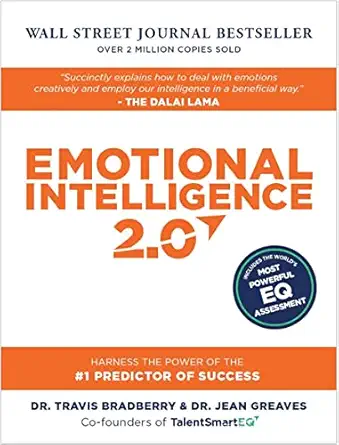
Emotional Intelligence 2.0
by Dr. Travis Bradberry and Dr. Jean Greaves
Link blocked? Copy it and paste in a new browser tab.
Your Rating
All ratings are anonymous
Help others by sharing
Emotions drive human behavior, yet society has historically discouraged emotional expression and awareness. Consequently, many individuals expend considerable energy avoiding their emotions rather than learning from them. Stanford University estimates that 95% of information the brain processes is emotionally based or influenced. A review of the literature from Harvard examines the role of emotions in decision making. The authors conclude that "emotions are, for better or worse, the dominant driver of most meaningful decisions in life."
Jonathan Haidt, a social psychologist and professor, examines whether people operate from reason or emotion in his book The Righteous Mind. Through multiple studies comprising tens of thousands of participants, he demonstrates that people not only operate primarily from emotion, but that the vast majority actively resist changing their positions even when definitively proven wrong. The evidence suggests that humans are fundamentally emotional beings, not purely logical ones.
The following are notable passages from his work:
Intuitions come first, strategic reasoning second. Our moral thinking is much more like a politician searching for votes than a scientist searching for truth. Morality binds and blinds. It binds us into ideological teams that fight each other as though the fate of the world depended on our side winning each battle. It blinds us to the fact that each team is composed of good people who have something important to say.
Anyone who values truth should stop worshipping reason.
Haidt further argues that collegiate debate courses do not cultivate truth-seeking but instead teach individuals to rationalize their emotional biases in a manner that persuades others. In essence, people become more skilled at supporting their pre-existing emotional positions with logical arguments rather than genuinely shifting perspectives based on logic alone.
According to Dr. Travis Bradberry, the author of Emotional Intelligence 2.0, only 36% of people can identify their emotions as they occur — a concerning statistic given the significance of emotions to human functioning.
In psychology, emotions are heavily emphasized as a critical factor in good psychological health. Much of therapeutic work is dedicated to helping individuals learn to coexist with their emotions rather than avoid them. Its purpose is to facilitate emotional processing rather than suppression, avoidance, or compartmentalization.
Unexpressed emotions will never die. They are buried alive and will come forth later in uglier ways.
Anyone who has experienced a disproportionate reaction to a relatively minor event — the proverbial final straw — understands this principle intuitively. Unprocessed emotions represent mounting pressure within a system that will eventually reach a breaking point. Healthy emotional processing is an indispensable component of sound psychological health, which brings the discussion to emotional intelligence.
Emotional intelligence (EQ) refers to the degree to which an individual understands their own emotions, motivations, and values; how effectively they manage and work through their emotions; and how well they perceive and respond to others' emotions and behaviors. Emotional intelligence forms the foundation of healthy emotional regulation. According to Bradberry, emotional intelligence comprises four distinct categories:
1. Self-Awareness
Your ability to accurately perceive your emotions and stay aware of them as they happen.
2. Self-Management
Your ability to use awareness of your emotions to stay flexible and positively direct your behavior.
3. Social Awareness
Your ability to accurately pick up on emotions in other people and understand what is really going on.
4. Relationship Management
Your ability to use awareness of your emotions and the others' emotions to manage interactions successfully.
The first two categories address the ability to understand and regulate one's own emotions, while the latter two concern the ability to recognize and respond to others' emotions. Emotional intelligence has tangible, real-world consequences. The following are notable findings from Bradberry's research:
- 1
Individuals with average IQs outperform those with the highest IQs 70% of the time. This discrepancy is attributed to emotional intelligence.
- 2
In a study comparing 33 workplace competencies, emotional intelligence was the strongest predictor of performance, explaining 58% of success across all job types. Emotional intelligence alone accounts for nearly 60% of workplace success, while the remaining 32 competencies combined account for approximately 40%.
- 3
90% of top job performers also score high in emotional intelligence. Conversely, only 20% of bottom performers demonstrate high emotional intelligence — suggesting that reaching top-tier professional performance without emotional intelligence is exceedingly rare.
- 4
Individuals with high emotional intelligence earn, on average, $29,000 more annually than those with low emotional intelligence. Each point increase on Bradberry's emotional intelligence scale corresponds to approximately $1,300 in additional annual salary. This finding holds across industries, levels, and regions worldwide. For reference, the average salary in the U.S. is approximately $60,000 according to the Bureau of Labor Statistics — underscoring the substantial financial impact of emotional intelligence.
- 5
No profession has been identified in which performance and compensation are not correlated with emotional intelligence.
The following are relevant perspectives on emotional intelligence from other prominent researchers in the field:
Emotional intelligence is a way of recognizing, understanding, and choosing how we think, feel, and act. It shapes our interactions with others and our understanding of ourselves. It defines how and what we learn; it allows us to set priorities; it determines the majority of our daily actions. Research suggests it is responsible for as much as 80 percent of the "success" in our lives.
In the last decade or so, science has discovered a tremendous amount about the role emotions play in our lives. Researchers have found that even more than IQ, your emotional awareness and abilities to handle feelings will determine your success and happiness in all walks of life, including family relationships.
Emotional intelligence influences success across all relationship domains — familial, social, and professional. Neglecting emotional intelligence development, or dismissing it as negligible or irrelevant, results in the deterioration of interpersonal relationships. When emotions — whether one's own or others' — are consistently ignored, relational quality inevitably suffers.
How can emotional intelligence be developed?
Bradberry proposes strategies for developing emotional intelligence within each category, which are outlined below with additional commentary.
Self-Awareness Strategies
- Cease categorizing feelings as good or bad. Emotions are inherently neutral. Judging them as positive or negative only compounds distress. Consider them as data points — they are simply information to be observed and learned from.
- Observe the ripple effect of emotions. Evaluate whether the consequences of emotional responses are constructive or detrimental to those in the surrounding environment.
- Lean into discomfort. Growth requires tolerating discomfort. The therapeutic concept of the "window of tolerance" posits that meaningful change necessitates operating at the edges of comfort. Discomfort is often the most effective catalyst for development.
- Feel emotions physically. The body serves as a primary conduit for emotional awareness. Learning to recognize somatic changes — shifts in sensation, tension, or energy — and linking them to emotional states strengthens self-awareness considerably.
- Identify personal triggers. Understanding which individuals and situations provoke strong emotional reactions is essential for self-regulation.
- Practice metacognitive observation. Metacognition — the awareness and understanding of one's own thought processes — enables individuals to become impartial observers of their own experience.
- Maintain an emotional journal. Documenting emotional experiences facilitates pattern recognition and deeper self-understanding.
- Maintain perspective during negative moods. Negative emotional states are temporary. Choosing to extract insight from them rather than becoming consumed by them is a mark of emotional maturity.
- Maintain perspective during positive moods as well. Acting impulsively during states of heightened positive emotion, such as overexcitement, can be equally detrimental. Sound decisions are best made from a place of equanimity.
- Examine the motivations behind behavior. Regularly questioning the reasons behind actions cultivates deeper self-awareness.
- Revisit core values. Core values drive behavior and create meaning. They serve as a roadmap toward what is genuinely fulfilling. Taking time to identify core values can be a clarifying exercise.
- Monitor self-presentation. Maintaining awareness of one's current emotional state and how it manifests outwardly is a foundational self-awareness practice.
- Identify personal emotions in art. Books, films, and music provide opportunities to recognize and explore one's own emotional responses in a low-stakes context.
- Seek external feedback. Individuals are inherently blind to their own blind spots. Soliciting honest feedback from trusted others is one of the most effective paths to self-knowledge.
- Observe behavior under stress. Understanding how one responds under pressure reveals patterns that are otherwise difficult to detect.
Self-Management Strategies
- Practice intentional breathing. Deep, controlled breathing activates the parasympathetic nervous system, facilitating a physiological shift toward calm and emotional regulation.
- Create an emotion vs. reason list. This exercise has limited utility unless the underlying emotions are also processed. Techniques such as EMDR or other bilateral stimulation modalities can be more effective for working through emotional conflicts rather than simply cataloguing them.
- Make goals public. External accountability significantly increases follow-through. For maximum effectiveness, ensure that consequences for non-compliance are genuinely motivating. Bradberry offers the example of paying a friend $100 for each unmet goal — a principle that can be adapted creatively to individual circumstances.
- Pause before reacting. Creating even a brief delay between stimulus and response allows the rational mind to engage before an emotional reaction takes hold.
- Allow time before making decisions. Research demonstrates that the brain processes emotions during sleep, making overnight reflection a genuinely effective strategy for emotional clarity.
- Consult a skilled self-manager. Working with a therapist or practitioner provides structured guidance for developing self-management capabilities.
- Increase positive facial expressions. Research indicates that even the deliberate act of smiling or laughing can produce measurable improvements in mood — a finding that, while counterintuitive, is well-supported in the literature.
- Dedicate time to structured problem solving. Allocating specific time for addressing challenges prevents problems from accumulating and overwhelming emotional resources.
- Take control of internal dialogue. Challenging negative thoughts as they arise is most effective when done promptly. Neuroscience research suggests a 30–90 second window exists for redirecting thought patterns before they become entrenched in longer-term neural processing.
- Engage in success visualization. Visualization is a well-documented technique with benefits supported by both psychological and performance research.
- Prioritize sleep hygiene. Sleep deficit has measurable consequences for emotional regulation. Both adequate sleep and regular physical exercise are integral to maintaining emotional equilibrium.
- Focus on freedoms rather than limitations. Gratitude is among the most physiologically beneficial emotional states. Directing attention toward what is available rather than what is restricted can have a substantial positive impact on mood and outlook.
- Cultivate emotional–behavioral congruence. Bradberry advocates controlling body language through emotional synchronization. However, a more sustainable approach involves processing underlying emotions so that body language becomes naturally congruent — an approach that is both more accessible and more effective for most individuals.
- Speak with someone emotionally uninvested in the situation. A therapist or practitioner provides the objectivity necessary for clear emotional processing.
- Extract a lesson from every interaction. Adopting this orientation toward learning from all encounters accelerates personal growth substantially.
- Schedule mental recovery periods. Research consistently demonstrates that regular breaks enhance concentration, creativity, and emotional resilience.
- Embrace the inevitability of change. As Heraclitus observed, "Change is the only constant in life." Adapting to change rather than resisting it conserves emotional energy and fosters resilience.
Social Awareness Strategies
- Address people by name. Using someone's name in conversation fosters connection and rapport, while also reinforcing memory retention. Moderation is important — overuse can feel performative.
- Observe body language. Attend to congruence between verbal and nonverbal communication. Body language is largely subconscious and serves as one of the most reliable indicators of emotional state. Research suggests it accounts for 50–70% of interpersonal communication.
- Prioritize timing. Even well-intentioned actions, when poorly timed, can produce adverse outcomes. Sensitivity to timing is a hallmark of social awareness.
- Prepare engaging questions. Having thoughtful conversation starters readily available facilitates deeper and more meaningful social interactions.
- Minimize note-taking in meetings. Bradberry argues that excessive note-taking can cause individuals to miss important nonverbal cues. While this perspective has merit, it may be more practical to balance note-taking with active observation.
- Prepare for social gatherings. Anticipating social dynamics in advance can reduce anxiety. More fundamentally, addressing the underlying sources of social discomfort through therapeutic work can eliminate the need for extensive preparation altogether.
- Remove distractions during conversations. Full engagement in dialogue requires deliberately setting aside competing thoughts and stimuli.
- Practice present-moment awareness. Being fully present in interactions enhances both comprehension and connection.
- Conduct observational walks. Bradberry suggests taking brief walks while deliberately attending to others' emotional expressions. This practice can sharpen the ability to perceive emotional states in everyday interactions.
- Study emotional intelligence in film. Movies provide a rich medium for observing and analyzing emotional dynamics in a structured context.
- Develop active listening skills. Genuine listening is more demanding than it appears. It requires processing personal biases and judgments that may otherwise create barriers to truly hearing another person.
- Observe social dynamics. Watching how people interact in public settings develops a keener understanding of social and cultural norms.
- Verify emotional perceptions. When verbal responses and body language appear incongruent, asking a follow-up question provides the other person an opportunity to share more authentically. This should be done respectfully, with sensitivity to boundaries.
- Practice perspective-taking. Deliberately attempting to understand situations from another's viewpoint is fundamental to empathy and social awareness.
- Seek comprehensive understanding. Resist drawing conclusions from incomplete information; instead, gather context before forming judgments.
- Read the emotional climate of a room. The ability to assess collective emotional states is a valuable social awareness competency.
- Maintain openness and curiosity. Approaching interactions with genuine curiosity and without preconceptions is a foundational principle for effective social engagement.
Relationship Management Strategies
- Refine natural communication style. Beyond surface-level enhancement, addressing underlying issues that impede effective communication yields more lasting improvement.
- Avoid sending mixed signals. Incongruence between words and behavior is generally perceptible to others. Authentic, respectful honesty builds stronger relational foundations than diplomatic concealment.
- Attend to small, meaningful gestures. Relationships are constructed through the accumulation of micro-interactions rather than occasional grand gestures. John Gottman's research demonstrates that healthy relationships maintain a minimum 5:1 ratio of positive to negative interactions.
- Receive feedback gracefully. Recognizing that no one is without areas for improvement enables individuals to accept constructive feedback without defensiveness.
- Build trust. Trust is established through consistent, reliable behavior over time and is the foundation of all meaningful relationships.
- Maintain accessibility. An open-door approach strengthens relationships, though it must be balanced with appropriate boundaries to preserve personal well-being.
- Express anger only with intention. Alternatively, processing anger through therapeutic work can reduce its frequency altogether. Research indicates that very few individuals respond constructively to expressions of anger.
- Address inevitable challenges proactively. Avoiding difficult conversations does not eliminate the underlying issue — it compounds it. Timely engagement prevents escalation.
- Validate the other person's emotional experience. Acknowledging another's feelings honors their subjective reality. Validation does not require agreement — it requires respect. Accepting another's emotions as valid, even when perspectives differ, is a cornerstone of emotional intelligence.
- Complement the other person's emotional state. Consistent validation communicates respect and emotional attunement, strengthening relational bonds.
- Express care openly. The capacity for vulnerability is directly proportional to the depth of connection achievable in any relationship — both with others and with oneself.
- Communicate the reasoning behind decisions. Transparency and openness in decision-making processes build trust and foster healthy relational dynamics.
- Deliver feedback that is direct and constructive. Clear, specific, and well-intentioned feedback promotes growth without damaging the relationship.
- Align intention with impact. This is a critical competency. When the impact of one's actions does not match the intended outcome, self-examination is necessary. Understanding how and why communication may be received differently than intended requires both self-awareness and audience awareness.
- Use repair statements during conflict. Focusing on collaborative problem-solving rather than assigning blame transforms adversarial dynamics into cooperative ones.
- Engage in difficult conversations promptly. Avoiding challenging discussions allows problems to escalate in both severity and scope. Addressing them directly and early minimizes long-term relational damage.
These strategies provide a strong foundation for emotional intelligence development. However, the most transformative approach involves addressing underlying emotional patterns at their root — cultivating an inner state where reactive triggers diminish and equanimity becomes the baseline. Treating every experience as information, learning from setbacks without self-condemnation, and making intentional choices about personal growth leads to lasting change. The ultimate aim is to develop an internal stability that external circumstances cannot easily disrupt — a state in which peace is not contingent upon conditions but is cultivated from within.