
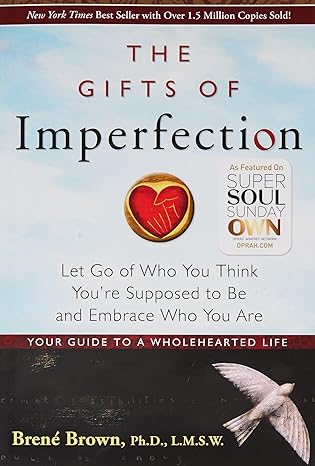
The Gifts of Imperfection
by Brene Brown
Link blocked? Copy it and paste in a new browser tab.
Your Rating
All ratings are anonymous
Help others by sharing
This book is about how to accept oneself in order to live what Brene calls a whole-hearted life, a life of courageous authenticity.
What's the point of overcoming shame and living courageously? The obvious answer is for your own happiness and peace of mind. If that isn't enough, Brene presents another argument centered around the difference between fitting in and belonging. Fitting in is defined by trying to be something other than what you are for the sake of having a community. A person whose goal is to fit in is a person who also lives in fear that their community will reject them or leave them if they dare to reveal aspects of their true self or make mistakes. Fitting in restricts its participants to shallow connections with others. Belonging is characterized by deep and intimate connections. Belonging is defined by being a part of a community in which a person feels completely safe and accepted due to the prerequisite of being their authentic self.
Because true belonging only happens when we present our authentic, imperfect selves to the world, our sense of belonging can never be greater than our level of self-acceptance.
You can only be accepted by others to the degree that you accept yourself because even the people that would fully accept you don't get the chance when you hold back. Or another way of saying the same thing, you only allow others to love and accept you as much as you love and accept yourself.
Courage and Shame
Our definition of the word "courage" has changed over time. Early definitions of courage were "to speak one's mind by telling all one's heart." Courage was fully putting yourself out there for others to accept or reject. Shame is self-judgment that prevents you from living courageously. Courage requires letting go of what others think of you by letting go of self judgment.
An important distinction is between the concepts of guilt and shame. Guilt is feeling bad about a mistake while shame is making a character judgment based on the mistake.
Guilt:
I did a bad thing
Shame:
I am bad
Shame doesn't allow for the recognition of one's flaws and imperfection.
While it can be argued that shame has benefits, it's widely accepted in the world of psychology that it's more destructive than constructive. Unfortunately, that doesn't stop most people from shaming themselves and, consequently, others. Shame is a two-sided coin. Shame begets shaming - how you shame yourself correlates with how you shame others, therefore, how you judge others is a mirror into how you judge yourself. Conversely, the judgments that you fear from others are the judgments you've already placed upon yourself. Shame begets presumed judgment.
If you have an unhealthy relationship with shame, you will engage in unhealthy ways with others' shame.
Destructive Ways to Deal with Someone Else's Shame
(reflecting your own shame):
- Sympathy vs empathy - Sympathy is disconnected caring ("sucks to be you bruh") while empathy is connected caring ("Yeah I've been there and it sucks"). Sympathy promotes shame because the subtext is "I can't relate to you" which supports shame.
- Judgment - Agreeing that what they did is shameful.
- Disappointment - Expressing that their imperfection is shameful.
- Blame/Scolding - Either response indicates your internal discomfort with their shame, which only reinforces their shame. Even scapegoating, seeking someone to blame, denies the person the opportunity to speak through their shame.
- Minimizing/Avoiding - Refusing to acknowledge their pain only results in its maintenance.
- Comparing/Competing (one upping) - Shifting the topic away from someone's shame means they won't get the opportunity to share it and work through it. This isn't about you.
- Speaking truth in power dynamics - Telling someone they shouldn't have said or done something a person in a position of power or influence told them to do.
- Advice giving/problem solving - See #6.
If you find yourself doing any of these it's time to start looking inward at your relationship with shame.
Working Through Shame
Recognizing a few base principles can help you work through shame.
- It's universal - Everyone experiences shame.
- It's scary - It's not comfortable for anyone.
- The less we talk about it, the more control it has over our lives - Voicing shame to a healthy person takes away its power.
Practicing self-compassion is another way to work through shame. "When we practice generating compassion, we can expect to experience the fear of our pain. Compassion practice is daring. It involves learning to relax and allow ourselves to move gently toward what scares us" (quote by Pema Chodron). Self-compassion requires courage because you are facing your fears and moving beyond them.
Compassion is not a relationship between the healer and the wounded. It's a relationship between equals.
Ten Steps to Whole Hearted Living
One thing that gets in people's way of being authentic is the perceived audacity of authenticity, the fear of being perceived as arrogant. Arrogance is a reaction to shame while the ideal form of authenticity is based on self-love, not on shame.
- •Perfectionism is a reaction to shame, specifically trying to control yourself and others' perception of you so that you never experience shame.
- •Perfectionism is not self-improvement. Self-improvement leaves room for imperfection, perfectionism does not.
- •Perfectionism is self-destructive because it's unattainable. Yes, perfectionism, like everything else, can have positive impacts. Heroin, for instance, makes people feel really good. A positive result doesn't mean that it's positive overall.
- •Kristin Neff is a leading researcher on self-compassion. She suggests doing three things to help foster self-compassion:
- Self-kindness - Being understanding and accepting towards oneself.
- Common Humanity - Everyone makes mistakes, some just happen to be more impactful than others and that's okay. We all mess up.
- Mindfulness - Not over-identifying with our feelings. Feeling them and letting them go.
- •Hope is not an emotion, it is a way of thinking, and it can be learned. There are three elements to cultivating hope:
- You know what you want to achieve.
- You have an idea of how to achieve it.
- You believe in yourself.
- •Practice critical awareness by challenging the notion that you are alone in your experience.
- •Numbing or avoiding emotions is a universal behavior, but like perfectionism, that doesn't mean its net impact is positive. Humans can't selectively numb emotions. When we numb the bad, we also numb the good.
Many people believe that fitting in will make them feel accepted which will then lead to them feeling good about themselves. Unfortunately, that approach doesn't work. The Greek word for joy is chairo. Chairo means "the good mood of the soul." Chairo is found with virtue and wisdom and its antithesis is fear. Fear is the ultimate destructor of joy. "The dark does not destroy the light; it defines it. It's our fear of the dark that casts our joy into the shadows." A scarcity mindset is one defined by fear, never having or being enough. The opposite mindset is that of sufficiency. Sufficiency is a declaration that whatever was done was enough, including judgments pertaining to one's character.
Brene made her own definition of intuition based on her research: "Intuition is not a single way of knowing - it's our ability to hold space for uncertainty and our willingness to trust the many ways we've developed knowledge and insight, including instinct, experience, faith, and reason." On faith, theologian Richard Rohr said: "Many religious folks insist on answers that are always true. We love closure, resolution, and clarity, while thinking that we are people of 'faith'! How strange that the very word 'faith' has come to mean its exact opposite." Faith is belief, not surety, a hope of things, not a sure knowledge of them.
"Comparison is all about conformity and competition." "The comparison mandate becomes this crushing paradox of 'fit in and stand out'! It's not 'cultivate self-acceptance, belonging, and authenticity'; it's 'be just like everyone else, but better.'" As Theodore Roosevelt put it: "Comparison is the thief of joy." According to Brene, creativity is "the only unique contribution that we will ever make in this world." Creativity is described by the writer William Plomber as "the power to connect the seemingly unconnected." Find a way to cultivate your own creativity and make something that is uniquely yours.
Stuart Brown is a researcher on play who argues that play is not an option, it's a necessity. "The opposite of play is not work - the opposite of play is depression." "Play helps us deal with difficulties, provides a sense of expansiveness, promotes mastery of our craft, and is an essential part of the creative process. Most important, true play that comes from our own inner needs and desires is the only path to finding lasting joy and satisfaction in our work. In the long run, work does not work without play."
Brene defined stillness thus: "Stillness is not about focusing on nothingness; it's about creating a clearing. It's opening up an emotionally clutter-free space and allowing ourselves to feel and think and dream and question." Freeness of the mind comes from releasing ourselves of our fears.
"Shoulding" is a thinking error. Believing that you need to, must, have to, ought to, or should do something is 1) incorrect and 2) a recipe for unhappiness. The secret to finding meaningful work is to engage in cultivating our gifts and talents and then sharing them. "As it turns out, it's not merely benign or 'too bad' if we don't use the gifts that we've been given; we pay for it with our emotional and physical well-being." Moreover, no one can decide what is meaningful for anyone else. You must decide what is meaningful to you for your own sake.
The true message of this chapter is to share joy, and don't be afraid if that makes you look "uncool." Two quotes from this chapter:
- •"The only true currency in this bankrupt world is what you share with someone else when you're uncool." - The film "Almost Famous"
- •"To watch us dance is to hear our hearts speak." - Hopi Indian saying
Real life is always tragic, and those who do not know this have never lived.
— Carl Jung
Living a real life is one that is lived in authenticity and living in authenticity will simultaneously bring ecstatic joy and crushing sadness, but that is what defines a life worth living. Is it more rewarding to live a life of conformity and face-value acceptance or to experience who you truly are? To fit in or to belong? Fear would point to the former, and whole hearted living to the latter.