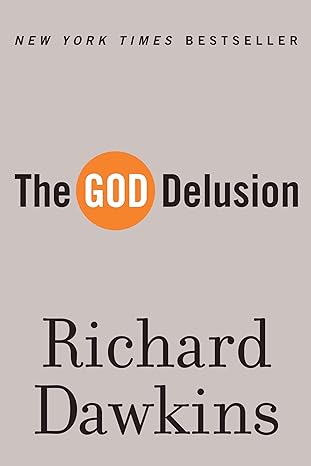
The God Delusion
by Richard Dawkins
Link blocked? Copy it and paste in a new browser tab.
Your Rating
All ratings are anonymous
Help others by sharing
The book starts by defining God as the supernatural Gods of most religions, not views of God like Einstein or Spinoza where "God" "reveals himself in the harmony of what exists, not in a God who concerns himself with fates and actions of human beings." The author believes that all things should be open to criticism, even things considered holy by some. I do want to clarify that I am in no way against religion, but to me this book is a justified criticism of religion and its prejudices as well as a book that invites you to question beliefs that people rarely tend to question.
Contrary to what many people believe nowadays, the Founding Fathers of America did not base the nation on Christianity. As stated in a treaty with Tripoli in 1796 "under George Washington and signed by John Adams in 1797":
As the Government of the United States of America is not, in any sense, founded on the Christian religion; as it has in itself no character of enmity against the laws, religion, or tranquillity, of Musselmen; and as the said States never have entered into any war or act of hostility again any Mehomitan nation, it is declared by the parties that no pretext arising from religious opinions shall ever produce an interruption of the harmony existing between the two countries.
Thomas Jefferson said that "Christianity is the most perverted system that ever shone on man." Benjamin Franklin said that "lighthouses are more useful than churches." John Adams also had strong opinions against Christianity. The point is that they believed in freedom of religion, even though they didn't believe in it themselves. It seems like we have really gotten away from the foundations upon which this country was built in our present day.
In 2006 a double-blind study was done called The Great Prayer Experiment in which 1,802 participants who had undergone coronary bypass surgery were put into three groups: "Group 1 received prayers and didn't know it. Group 2 (the control group) received no prayers and didn't know it. Group 3 received prayers and did know it." There were no effects of prayer on recovery and they actually found that those who knew they were receiving prayers had significantly more complications in their recovery.
More than anything else the author supports agnosticism, stating that we don't have enough information to determine one way or the other.
Arguments For God
This is a list of the arguments for God as stated in the book by many different sources. Not all are stated directly in the book, some are stated indirectly.
- The Unmoved Mover - Something had to create movement as nothing moves without being acted upon and it had to be God that started it.
- The Uncaused Cause - Nothing is caused on its own so God must've caused things to be/ happen.
- Cosmological Argument - "There must've been a time when no physical things existed. But, since physical things exist now, there must have been something non-physical to bring them into existence, and that is something we call God."
- The Argument from Degree - Everything is judged in relation to each other. Humans are both good and bad so there must be a perfect being that accounts for the extreme comparison of perfect goodness.
- Argument from Design - Things look like they've been designed and the designer is God.
- Argument of Beauty - Things can be incredibly moving and beautiful therefore there must be a God.
- Argument of Miracles - Highly improbable events occur therefore there must be a God.
- Historical Miracles - Old accounts spoke of miracles so God must exist (Jesus, Buddha, etc)
- Influential People - Many highly influential people in history believed in God therefore God exists.
- Pascal's Wager - Might as well gamble on God existing than not existing because you could lose more if God existed and you didn't believe.
- Bayesian Argument - Stephen Unwin created a mathematical idea of how to prove whether God exists or not based on six factors which he fed into a computer: people have a sense of goodness, people do evil things, nature does evil things, there might be minor miracles, there might be major miracles, and people have religions experiences. His study concluded a 67% chance that God exists which he then inflated to 95% by injecting a 28% estimation of faith.
The author spends a good amount of time disproving these ideas. Real proof is a nearly impossible thing to come by to prove God, if it exists at all.
Arguments Against God
Similar to the arguments for God, some of these reasons were inferred from what was said and was not specifically stated.
- Boeing 747 Argument - If a tornado was to roll through a plane scrapyard, there is a chance, albeit infinitesimally small, that a completely intact Boeing 747 plane would be created. Something being very improbable doesn't mean that it will never happen (used to combat the idea of intelligent design).
- Irreducible Complexity - Complexity can happen through improbable occurrences as well as natural selection.
- The Worship of Gaps - Not understanding something yet, a gap in knowledge, does not mean that God exists, it merely means that we don't understand something yet.
- The Anthropic Principle: Planetary and Cosmological Versions - Just because we are in the Goldilocks zone, the small window for life to exist in our solar system, that doesn't mean that it couldn't happen by chance. Same thing with the physics that make life possible. Once again, something that is highly improbable is bound to happen eventually.
- Unlikelihood of Consciousness - For God to be aware of every particle that exists in infinite space and time is pretty infeasible.
- Marketing and Social Pressure - An enormous amount of people throughout history have felt pressured to adopt a particular belief system or be ostracized by their community. Many prominent scientists and public figures have been paid by religious groups to include God in their works. The amount of people who believe in God are less than we think.
- Evil - God permits evil and death when a being of infinite love wouldn't do that. Or even worse, a loving God would punish a person eternally for benign crimes (lying, loving someone of the same sex, etc.)
- Holy Wars and Prejudice - A very large number of people have been killed in the name of God. Religions have an extensive history of prejudice and have been responsible for some of the greatest evils in history. The "by your fruits ye shall know them" idea but in reverse of how it's typically used. It also consumes a lot of money to build expensive structures, money that could be used for more humanitarian benefit.
The author uses these arguments to state that there is an alternative to divinity in our natural world. It doesn't prove God doesn't exist just as the arguments for God don't prove he does.
There is a proposed God gene that inclines humanity to seek God or something beyond themselves but the author advocates that this could've been brought about by natural selection. If those in power found people who believed in god more easily manageable and killed the ones that didn't believe, then natural selection would've taken place. If a community of people was able to unite under religion and die for their beliefs, it could be argued that they have a distinct advantage over a community without a unifying belief system. The movie The Book of Eli is about this idea. Even if it's not natural selection, communal pressure is an extremely powerful way to manipulate people into adopting beliefs, or at least make them profess that they do, even if they don't want to. Those who stand against the status quo are nearly always persecuted. Another point that the author makes is that extreme religiosity without evidence is not only supported but rewarded by that community.
Another common theory to prove God is that of altruism. The author gives multiple points to consider including the most obvious answer of kinship, natural selection again (communities that help each other are more likely to succeed) and reciprocity (I scratch your back if you scratch mine) where betrayal is dealt with harshly (furthering natural selection). Altruism could also be a show of superiority or power or to garner power such as cartels that give back to the community so that they are tolerated or even supported.
Perhaps the most flawed argument of all is to assume that morality cannot exist independently of religion. To only want to be a decent human being to avoid punishment means that you are a shitty human being. "Well, what would stop you from killing whoever you want if you aren't religious?" Uh, the fact that an average human doesn't want to go on murder sprees. Tempering innate desires to harm doesn't make you moral, it indicates immorality concealed behind a mask of righteousness. In fact, evidence shows that religion negatively correlates to morality.
While political party affiliation in the United States is not a perfect indicator of religiosity, it is no secret that the "red [Republican] states" are primarily red due to the overwhelming political influence of conservative Christians. If there were a strong correlation between Christian conservatism and societal health, we might expect to see some sign of it in red-state America. We don't. Of the twenty-five cities with the lowest rates of violent crime, 62 percent are in "blue" [Democrat] states, and 38 percent are in "red" [Republican] states. Of the twenty-five most dangerous cities, 76 percent are in red states, and 24 percent are in blue states. In fact, three of the five most dangerous cities in the U.S. are in the pious state of Texas. The twelve states with the highest rates of burglary are red. Twenty-four of the twenty-nine states with the highest rates of theft are red. Of the twenty-two states with the highest rates of murder, seventeen are red.
Higher rates of belief in and worship of a creator correlate with higher rates of homicide, juvenile and early mortality, STD infection rates, teen pregnancy, and abortion.
The evidence is not in religion's favor.
Religion often explains terrible happenings as a result of sin. For example, taking out entire cities for the actions of a select few. Wouldn't a loving God just take away a gold star from the bad ones or something? Why take out the good ones too? The Old Testament is replete with examples of very questionable morality both from God and men. In Sodom and Gomorrah the prophet Lot was demanded by a mob to give up the men of the household so that the mob could have sex with them. He offered his daughter and another woman without hesitation while proclaiming that having sex with men was wrong. Apparently raping women is acceptable though. Judges 19:29 talks about a prostitute that was cut into 12 pieces and shipped across the country because she was asleep at a man's front door. Abraham was in the act of killing his child when he was stopped, a very disturbing joke/ test for all who've read the story. Moses had 3,000 of his own people slaughtered for worshipping a golden calf and then killed and burned everyone in the Midianite cities, except for the virgin women of course. The killings and massacres ordered throughout the Old Testament by God are extensive. Immorality is a key aspect of the Bible. Even if the stories aren't true, God certainly isn't a great role model and atrocities throughout history can be attributed to religious zeal following the pattern of the Old Testament.
In an experiment by Israeli psychologist George Tamarin, Israeli children were given a passage from the book of Joshua talking about how the Israelites were commanded to kill nations and asked if they agreed with the passages. 66% gave complete approval. A control group was given the same story but the names were changed to Asian names. 7% gave complete approval. Division among sanctimonious lines alters people's perspective of morality.
The author brings up what I consider a humorous perspective about abortion. Advocates of abortion are against it because of the potential for human life (as they aren't born yet). This same logic could be used to justify that all people should say yes to any invitation for sex as any opportunity not taken is denying the potential for human life. In a less humorous version of the same logic, rape could be seen the same way which would make it admirable, not deplorable as it gives the potential for human life.
"Faith is an evil precisely because it requires no justification and brooks no argument. Teaching children that unquestioned faith is a virtue primes them" for extreme acts, sometimes which they are only too happy to do. This principle is not just about religion, it encompasses any system that demands obedience (faith) without critical analysis.
Religion should be a conscious experience, not a rigorously followed and unquestioned tradition.