
The Immortality Key
by Brian Muraresku
Link blocked? Copy it and paste in a new browser tab.
Your Rating
All ratings are anonymous
Help others by sharing
When it comes to God - a word rarely used by the mystics - there seems to be some agreement on one crucial issue of paramount importance. God does not reside in a holy book.
"For the mystics, the only way to know God is to experience God. And the only way to experience God is to unlearn everything the ego has been trying so vigorously to manufacture since our infancy. ...The simplest and most effective method is to die before you die."
This concept is also referred to by the name "ego death," a common phrase among substance users.
Professor Carl Ruck's Theory
The book investigates a theory by professor Carl Ruck from Boston University about the role of psychedelics in ancient religion comprised of two main points:
- The kukeon, a drink in the Greek Eleusinian Mysteries, a yearly initiation ritual of the cult of the gods Demeter and Persephone and the most famous secret religious rite of ancient Greece, contained psychedelics.
- Christianity was not only influenced by Greek religion, but its rites were derived from ancient Greece, including the rites used by Jesus. In other words, Western Civilization has psychedelic origins.
Ancient Greece profoundly influenced Western society, so much so that its culture remains foundational to modern civilization. One of the most prominent aspects of ancient Greece was the Mysteries of Eleusis, the "longest running and most prominent spiritual tradition in ancient Greece," which ran from 1500 BC until 392 AD. The temple had a reputation for elucidating the mysteries of the universe, and initiates universally claimed, after a single experience, that "death was not the end of our human journey. We do, in fact, survive the physical body. And underneath this mortal clothing, we are all immortals in disguise - gods and goddesses destined to the stars for eternity." At the heart of the ceremony was the kukeon, a mysterious elixir that has since been demonstrated to have possessed psychedelic properties.
Ancient Connections
Greek is inexorably related to Sanskrit, the sacred language of Hinduism, a linguistically validated fact. Within one of those sacred works, the Rigveda, there is a sacramental drink mentioned called the soma, "both a plant and the god residing in the plant." "It is referred to as the 'elixir of life' and is explicitly characterized as madira, the Sanskrit term that Watkins translates as 'intoxicant' or 'hallucinogenic.' One particularly memorable line from the Rigveda reads: 'We have drunk soma and become immortal; we have attained the light, the gods discovered.'"
Scholars have naturally assumed the kukeon and soma are connected given the shared linguistic origins. Ancient Egypt, the Syrians, Canaanites, Romans, and Israelites have also been shown to have psychedelic involvement. "According to the oldest surviving papyrus roll, which preserves the ancient Egyptian coronation ceremony in amazing detail, wine would be presented as an 'Eye of Horus' in order to cure the king of his 'spiritual blindness.'" In fact, the practice of psychedelic brewing goes back to 12,000 BC. Turns out that drugs and religion have gone hand in hand for a very, very long time.
The meaning of priests and priestesses and their purpose changes based on this idea. The Greeks put female priestesses in charge of creating the kukeon by "harvesting... ergot-infected grain," verified by science as the chemical composition of LSD, which would then reveal the mystery of death and rebirth. With this understanding Dionysus, the Greek god of wine, starts to take on a different meaning. "Dionysus wasn't symbolized by the wine... he was the wine." Similarly, Greek Orthodox priests, in the ordination ceremony, receive the secrets of initiation. The Eucharist is placed "in the hands of the properly admitted priest, saying, 'receive this Divine Trust, and guard it until the Second Coming of our Lord Jesus Christ, at which time He will demand it from you." In other words, the priests are also told that there is a secret to the Eucharist that will be necessary during the second coming of Christ, something it clearly lacks currently as it isn't manifesting powerful experiences that turn people to the divine.
The same people who invented science also invented techniques for entering the underworld and communing with the immortals, whether gods, goddesses, or ancestors. Techniques, that is, for becoming immortals themselves.
— Carl Ruck
Carl Ruck extends the argument beyond the use of drugs as spiritual amplifiers, suggesting that society must acknowledge its drug-based heritage. It is also possible, if not likely, that psychedelic substances influenced societal advancements beyond the purely spiritual. Plato participated in the kukeon rituals, and Shakespeare is known to have used drugs. The extent to which great contributors throughout history were inspired by such substances remains an open question.
Jesus and Wine
"Some of the best evidence for ancient spiked wine just happens to come from modern-day Galilee." In 2013, near Nazareth, "forty jars of herbal wine were unearthed in what become known as the 'world's oldest wine cellar,' dating to about 1700 BC. Organic residue from each of the jars was subjected to thorough testing at the Brandeis University Department of Chemistry. The results of the GC-MS analyses showed remarkable consistency across the entire batch, indicating 'a sophisticated understanding of the botanical landscape and the pharmacopeic skills necessary to produce a complex beverage that balanced preservation, palatability, and psychoactivity.'" While this does not conclusively prove that Jesus used psychedelic wine, it demonstrates that such substances had been present in the region of his ministry for millennia.
The frequent association between Jesus and wine is notable. In the Gospel of John, the first miracle Jesus performed was turning water into wine, which the author describes as "undoubtedly [trying] to establish Jesus as the new Dionysus." "John's audience would have understood that the Wedding at Cana wasn't just a party trick, and that the wine wasn't just party wine." "The changing of water into wine was Dionysus's signature miracle." The Last Supper provides another prominent example, and it is particularly significant that ergot—the psychedelic substance—was derived from grain, with the bread serving as a symbol of the wine's psychoactivity. The author argues that the Bible contains numerous references to divine wine that contemporary audiences, familiar with Greek language and history, would have recognized immediately.
In the book The Sacred Mushroom and the Cross by John Allegro, the author claims that the writers of the Bible employed extensive puns and coded language referencing mushrooms—hidden from the uninitiated but recognizable to contemporary readers. While the reliability of this particular source is debatable, the use of coded information in religious works is well established.
The Immortality Key also notes that monks in the Himalayas have reportedly, upon death, "disappeared into the ether in a burst of rainbows"—an experience reminiscent of the body of light that Christ is described as inhabiting upon his resurrection. If such experiences were not limited to Jesus, it would suggest that any person is capable of a similar transformation. For those unable to dedicate their lives to contemplative practice in the mountains, the book proposes that what Jesus may have offered was a more accessible path to a comparable state.
The Loss of the Sacred Wine
What happened to the sacred wine, and why was it lost to history? According to the book, the Catholic Church objected to the idea that God could be accessed through a simple liquid and sought to control how people experienced the divine. The method of eradication targeted women—the priestesses who held the secrets of sacred brewing and received the knowledge of its creation through oral tradition. Viewed through this lens, the Inquisition becomes more comprehensible as a concentrated effort to destroy these priestesses, labeled as witches, rather than as a campaign without discernible cause. The war on drugs, it appears, began long ago for reasons similar to those Johann Hari explores in his examination of the modern drug war: the consolidation of power.
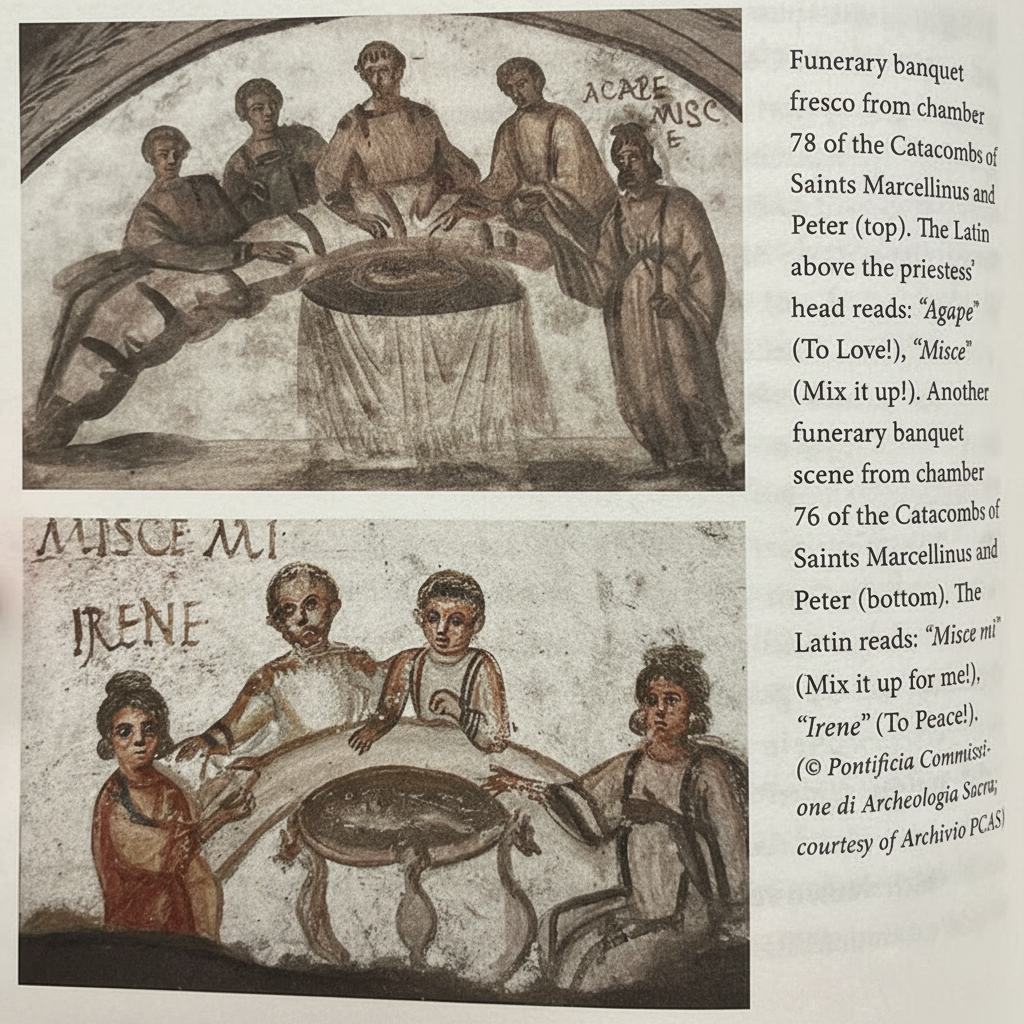
The author was granted access to Catholic-controlled frescos that display clear symbology of a sacramental substance that was more than ordinary wine. The image below is one of many such depictions. It is notable that these images exist within the very institution responsible for the substance's elimination.
Global Traditions
Many other religions and cultures have referenced their relationships with drugs. The Aztecs have a god of visions and hallucinogenic plants named Piltzintecuhtli who is depicted with mushrooms in hand. Ayahuasca has been used in South American cultures which "is sometimes referred to as the 'Vine of the Dead.'" Peyote is a common practice among Native Americans which was also attempted to be banned by the United States government at one point in time. Many societies throughout history have used drugs in rituals that help connect them to a higher power. The use of drugs and their ability to aid in connecting to the divine is ubiquitous across time and the world.
One of the most culturally recognized movements involving psychedelics was the counterculture movement in the United States in the 1960s, when LSD and other psychedelics became more mainstream. The primary result was a generation that advocated for peace, love, and opposition to war. It is notable that the substances most associated with negative cultural perception produced outcomes that were predominantly constructive.
Modern Research
Psilocybin and other substances are increasingly being used in mental health treatments and have demonstrated remarkable effectiveness in addressing trauma, anxiety, and other conditions. Ayahuasca, considered one of the most potent psychedelics, is used exclusively for healing purposes and has produced significant therapeutic outcomes. Johns Hopkins University has been at the forefront of validating the positive impact of psilocybin through rigorous clinical research.
If you take the time to comb through the fifty peer-reviewed publications on the newly launched website of the Johns Hopkins Center for Psychedelic and Consciousness Research, you'll learn that their proud statistic has remained incredibly stable over the past fifteen years. About 75 percent of the research volunteers consistently rate their one and only dose of psilocybin as either the single most meaningful experience of their entire lives, or among the top five.
Clinical psychologist William Richards, the longtime collaborator in the Johns Hopkins psilocybin trials, concludes that ethics and morality are hardwired, 'perhaps genetically encoded,' within the human organism. Psilocybin appears to unlock that code by tapping directly into what they mystics have been trying to mine over the history of Christianity with all their chanting, meditation, fasting, and prayer.
Three-fourths of participants rated their single psychedelic experience among the top five most meaningful experiences of their lives—placing it in the same category as events such as marriage, the birth of children, or major life achievements. The significance of these findings is substantial, and if William Richards is correct, psychedelics may open channels to spirituality and religious experience similar to what civilizations have accessed throughout history. If society were able to move past entrenched biases, scientific research could advance considerably—and with it, potentially, humanity as a whole.