Infinite Mind: Science of the Human Vibrations of Consciousness
by Valerie Hunt
Infinite Mind: Science of the Human Vibrations of Consciousness
Valerie Hunt was a professor of physiological science at UCLA who, after decades of research on human movement and muscle physiology, turned her attention to the study of consciousness and subtle energy. In Infinite Mind, she combines laboratory measurements, philosophical argument, and clinical anecdote to propose that human beings are fundamentally vibrational systems, and that consciousness is better understood as a field than as a by-product of brain chemistry. The book contains far more philosophical, scientific, and anecdotal detail than a summary can capture, and the full text rewards careful reading.
To believe without questioning or to dismiss without investigation is to comport oneself unscientifically.
Hunt occupies an unusual position between laboratory scientist and spiritual investigator. Rather than dismissing reports of energy healing and altered states as subjective, she attempted to measure them, using electrodes and recording equipment to track the physiological and electromagnetic changes that occur when people enter such states. Her findings are presented below as she reports them; most have not been independently replicated, and they are best read as exploratory evidence that invites further investigation rather than as settled science.
Scientific Experiments
The experiments occupy only a portion of the book, since Hunt is primarily concerned with their philosophical implications. The following studies, as she describes them, were designed to measure the vibrations associated with different states of consciousness:
- Electromyographic (EMG) electrodes, which record the electrical activity of muscles, were placed on a dancer in an altered state of consciousness. During the performance, the muscle recordings dropped out entirely even though the subject continued dancing, while sensors near the top of her head registered activity beyond the range of the equipment. As the dance ended, normal recordings resumed. The engineer supervising the study found no evidence of equipment failure.
- A dancer performed for 30 minutes without the expected rise in heart rate or blood pressure; both measures in fact decreased, the opposite of what sustained physical exertion normally produces.
- Hunt tested whether the chakras, the energy centers described in yogic and other spiritual traditions, could be detected with scientific instruments. Electrodes placed on the skin over the traditional chakra locations recorded the frequency and strength of the body's electrical field, while aura readers, people who report seeing the energy field around the body as light and color, observed the same participants at the same time and described what they saw. The two sets of observations were gathered separately, with the readers unable to see the instrument recordings, so that one could not influence the other. When the results were compared, Hunt found that the readers' descriptions matched the electronic data consistently: specific colors reported by the readers occurred alongside specific frequency patterns on the recordings, and changes the readers described appeared at the same moments as changes in the measurements. For Hunt, this agreement suggested that aura readers perceive a real, measurable phenomenon rather than imagining it, although the study has not been independently replicated.
- California's Santa Ana winds carry a high concentration of positive ions. Hunt reports that exposure to this charge correlated with contracted energy fields and psychological distress in participants, and that exposure to negative ions restored the field and relieved the distress.
- The electromagnetic fields of energy healers were recorded during sessions, and Hunt found that different styles of healing corresponded to distinct frequency patterns, which she associated with specific colors.
- The energy field changed in response to both the intensity of light and to sounds above or below the range of human hearing, suggesting that the body responds to stimuli it does not consciously perceive.
- In a Mu room, a shielded chamber in which the electromagnetic properties of the air can be altered without changing oxygen content or other physical conditions, participants were strongly affected by changes to the field. When the electrical component of the atmosphere was removed, their energy fields contracted and they experienced marked psychological distress without any apparent cause. When it was raised above normal levels, they reported an expansion of consciousness and their fields were described as turning white. Reducing the magnetic component left subjects noticeably uncoordinated, while increasing it produced marked improvements in motor ability.
- Hunt reports that exposure to coherent energy fields helped reorganize irregular heart rhythms.
- A patient whose abnormal brain-wave patterns had been confirmed at UCLA's Neuropsychiatric Institute showed normalized patterns following energy healing. The shaman's own descriptions of what was occurring, given in non-scientific language, coincided in timing with changes in the electrical recordings from the patient's body.
- During one session, a participant's field appeared to move away from her body and was located roughly eight feet away. Meanwhile, "the electronic sensors recorded only a few microvolt vibrations (millionths of a volt), rather than the 20 to 80 millivolt range (thousandths of a volt) routinely recorded." These readings were lower than those of a person in a coma. Hunt also recounts several cases in which she reports helping people emerge from comas through energetic means.
Surgery offers a related example. General anesthesia is intended to suppress normal brain function so that a patient remains unaware while being operated on, and monitoring equipment typically shows greatly reduced brain activity. Nevertheless, some patients later recount details of the operation, including conversations among the surgical team. Some of these cases may be explained by incomplete anesthesia, a recognized phenomenon known as intraoperative awareness, but Hunt argues that the more striking accounts are difficult to reconcile with the view that awareness depends entirely on measurable brain activity.
Consciousness Beyond the Brain
Hunt uses these results to challenge the assumption that consciousness is produced by the brain. She proposes instead that consciousness has its source beyond the body, an idea that would account for the apparent anomalies described above. In her model, consciousness is a field that a person can access by attuning to the necessary vibrational levels, much as a radio receives a broadcast only when tuned to the correct frequency. The signal is always present; what varies is the capacity to receive it.
To illustrate this idea, Hunt describes an experience in an anechoic chamber—a room that absorbs 99.5% of all sound. After some time inside, participants began to notice three rhythms they had never heard before, which they identified as the sounds of their neurological, circulatory, and neuromuscular systems. If such subtle internal energies go unnoticed in daily life, it raises the question of what other capabilities the body may possess that remain unrecognized.
Such claims may appear far-fetched, yet the history of science contains many ideas that seemed unthinkable before they became accepted. Hunt draws on the historian Arnold Toynbee, whose study of civilizations concluded that 26 lost civilizations all failed for the same reason; "they over-protected the tenets which first made them powerful. They eventually cracked from rigidity and sterility which accompanies a refusal to yield to an evolving world view." In Hunt's view, science faces the same risk, and her work is offered as a candidate for the next model of reality.
To find order in her complex data, Hunt turns to chaos theory. The theory is best known for the butterfly effect, the image of a butterfly's wingbeat on one side of the world contributing to a storm on the other. The image is a metaphor rather than a literal prediction; its point is that small differences in initial conditions can produce large and unpredictable outcomes, and that systems which appear random can still contain underlying order. Meteorology, where the theory originated, illustrates this well: weather appears chaotic from day to day, yet long-term records reveal recognizable patterns. By the same reasoning, observations that appear anomalous today may belong to a larger pattern that current methods are not yet equipped to recognize.
Interesting Patterns
- Robert Beck, a physicist, reported that the brain waves of mystics and healers measured consistently near 7.8 cycles per second. Hunt finds this significant because the same frequency is associated with so-called power spots and sacred sites, and it lies close to the fundamental Schumann resonance, the natural electromagnetic resonance of the Earth's atmosphere, sometimes called the planet's "heartbeat."
- Hunt cites evidence that trees communicate with one another: "When particular bugs or beetles begin to massively destroy one type of tree, other trees become immune before they are attacked. They develop a chemical which expels insects. Apparently, either the insect vibrations alert the trees, or the already contaminated trees send out field warnings to other trees."
- On a trip to Antarctica, Hunt measured the energy fields of about 80 fellow travelers before and after the journey. Before the trip, the readings were typical, stronger in some areas and weaker in others; afterward, they were evenly balanced. Some passengers reported returning to Antarctic cruises each summer because it was the only time they felt physically well. Hunt attributed these effects to the magnetic properties of the polar region and speculated that the North Pole might offer different benefits.
- Hunt also explored whether energy fields influence attraction between people. She recorded the field frequencies of a group of adults and of children who had never met them, then placed each child among the strangers and observed whom the child approached. Using the frequency readings alone, she reports that she could predict which adult each child would choose. Her interpretation is that children, being less guided by social expectations than adults, respond more directly to energetic compatibility, gravitating toward people whose fields resonate with their own. The observation is anecdotal and was not conducted as a controlled study, but it illustrates her broader view that people sense and respond to one another's energy before any conscious judgment is made.
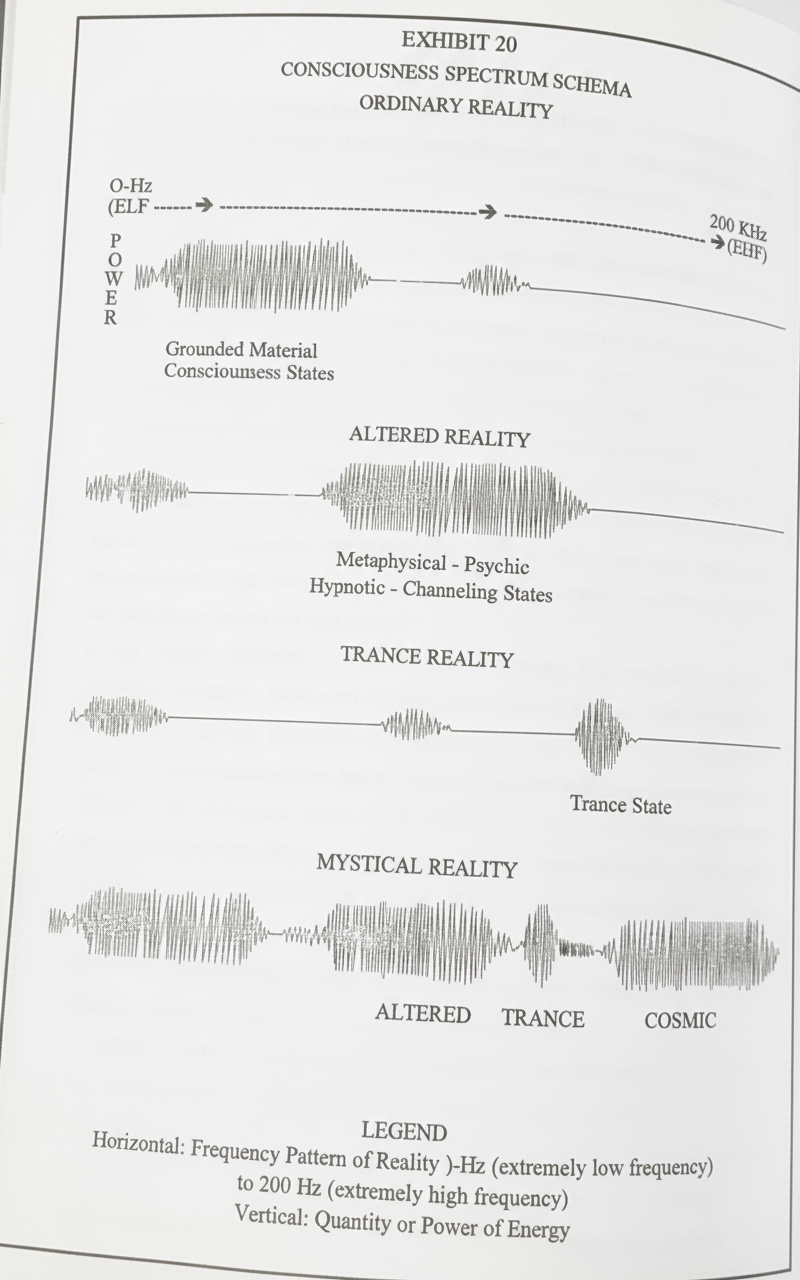
Taken together, these observations lead Hunt to argue that frequency plays a far larger role in health, science, and spirituality than is commonly acknowledged. Hunt found that the frequency of energy fields in a grounded state is 350–600 cycles per second, while altered states reach up to 200,000 cycles per second. In her studies, individuals in high-frequency states experienced transcendent altered states. From this, she hypothesizes that psychosis may result from individuals becoming stuck in high-frequency states, rendering them unable to function within conventional reality. Conversely, individuals in comas may be locked in very low frequencies. Hunt reports that through frequency healing, she helped several people emerge from comas. The graph below illustrates how frequency relates to states of being.
Frequency can also cause harm. Hunt cites research associating exposure to artificial electromagnetic fields with cancer, birth defects, miscarriage, and stillbirth. These associations remain debated, and major health agencies currently classify low-frequency magnetic fields only as a possible carcinogen, but the concern is consistent with her broader claim that the body responds to its electromagnetic environment. The book BioGeometry Symbols discusses this concept as well.
Hunt proposes that spiritual enlightenment is the next step in human evolution, and she insists that such enlightenment includes science rather than standing outside it. Her discussion of reincarnation illustrates how she brings spiritual questions into the domain of research.
Reincarnation Research
Reincarnation has been studied extensively at the University of Virginia, where researchers led by Ian Stevenson documented thousands of cases of children who reported memories of previous lives; Hunt reports that a large majority of the details in these accounts could be verified. A review in the Journal of the American Medical Association stated that Stevenson had placed "on record a large amount of data that cannot be ignored" which is 'on record a large amount of data that cannot be ignored' which is "difficult to understand on any other grounds but reincarnation." Hunt also presents anecdotal accounts in which past-life memories were later corroborated by experts. In one example, a woman recalled a ritual sacrifice that a cultural historian identified as a ritual practiced near Tripoli around 400 BC. Hunt notes that belief in reincarnation is also becoming more socially accepted: "A recent survey from the National Opinion Research Center in Chicago reported that 29% of all Americans now believe in past lives."
What Religions Believe in Past Lives?
- Hindus based on the Bhagavad Gita.
- Buddhists.
- Certain mystical currents within Islam, although mainstream Islamic teaching rejects reincarnation. Hunt cites the passage: "God generated beings and sent them back over and over again until they returned to him."
- Judaism.
- "The Kabbala, the mystical system of interpreting the scriptures." "The Kabbala presented the idea of attaining perfection through repeated rebirths."
- The Orthodox branch of Hasidic Judaism teaches it openly. "The Talmud expressed the necessity to cast a veil over the whole question of survival beyond the grave in an attempt to wean people from the idolatrous cults of the dead which preceded Judaism in the Near East." This, according to Hunt, explains why the idea is not taught openly in other Jewish communities. "Today there are many Kabbalistic rabbis, but generally it is considered dangerous and out of reach for the average Jew because of its mystical nature."
- Early Christianity. "The mystical religions and philosophical doctrines of early Christian sects, combining Greek, Jewish, and Oriental beliefs, embraced reincarnation. The Coptic copies of the original papyrus Gnostic texts documented this. But as early as 180 AD the Roman Church with all its power branded Gnosticism as heresy."
- Although not a religion, several early Greek philosophers taught forms of reincarnation, most notably Pythagoras and Plato, who presents the doctrine through the figure of Socrates.
Although reincarnation receives considerable attention, frequency remains the book's central theme. Hunt connects the two through research by the biophysicist Janusz Slawinski, available here. "All living organisms emit low-intensity light; at the time of death, that radiation is ten to 1,000 times stronger than that emitted under normal conditions. This "deathflash" is independent of the cause of death, and reflects in intensity and duration the rate of dying. The vision of intense light reported in near-death experiences may be related to this deathflash, which may hold an immense amount of information. The electromagnetic field produced by necrotic radiation, containing energy, internal structure, and information, may permit continuation of consciousness beyond the death of the body."
Infinite Mind ultimately asks readers to reconsider what a human being is. Hunt proposes a shift from a chemical model of life to an electrical and vibrational one, in which health, emotion, and consciousness are expressions of the frequencies a person can sustain and receive.
Many of her findings rest on small samples, specialized equipment, and personal observation, and they have not been widely replicated. Their value lies less in what they prove than in the questions they raise: whether consciousness can be fully explained by brain activity, and whether the body is more sensitive to its energetic environment than conventional models assume. Hunt's own guiding principle, expressed in the Margaret Mead quotation that opens this summary, applies equally to her work: it should be neither accepted without question nor dismissed without investigation.
Anonymous Comments
(0)What clicked for you in this book summary could be what makes it click for the next reader.
No comments yet. Be the first to share your thoughts!
Link blocked? Copy it and paste in a new browser tab.