
Leadership and Self-Deception
by The Arbinger Institute

Link blocked? Copy it and paste in a new browser tab.
Your Rating
All ratings are anonymous
Help others by sharing
The following is a summary of two companion works by The Arbinger Institute: Leadership and Self-Deception and The Anatomy of Peace. Both books use narrative storytelling to develop their central arguments. Leadership and Self-Deception serves as a precursor to The Anatomy of Peace and is summarized first.
Both works revolve around a single concept: being "in the box." The box is the authors' term for a fundamental way of relating to the world—one that determines whether a person sees others as human beings or as objects.
The Box Concept
- In the Box — Seeing others as objects. This means treating another person as a thing or commodity, disregarding their individuality, feelings, and personality, and reducing them to a mere tool or means to an end. Another way of understanding this is seeing oneself as the main character—the only character that truly matters—and treating everyone else as side characters whose sole purpose is to support that main character.
- Out of the Box — Seeing others as people. Recognizing that every person is a main character in their own story, with needs, hopes, and concerns that matter as much as one's own.
The way a person relates to those around them—viewing them as people or as objects—impacts both self-perception and the perception of others. The steps of self-betrayal elaborate on this idea throughout the book.
Self-Betrayal
- Self-betrayal: An act contrary to what a person feels they should do for another is called an act of "self-betrayal."
The book provides the example of the protagonist, Tom, whose son wakes up in the middle of the night. Tom's first inclination is to get up and help so that his wife can sleep. Instead, he chooses to let his wife handle it—an act of self-betrayal.
- When a person betrays themselves, they begin to see the world in a way that justifies the self-betrayal.
Tom's choice produces two immediate effects. First, he begins generating reasons to justify his decision. Second, he starts viewing his wife in a more negative light to further rationalize it.
- When a person sees the world in a self-justifying way, their view of reality becomes distorted.
Tom's automatic process of inflating his own character while diminishing his wife's character represents the mental gymnastics required to validate the initial choice.
- When a person betrays themselves, they enter the box.
This is the onset of self-deception—failing to recognize that being in the box initiated the warping of perception in the first place.
- Over time, certain boxes become characteristic, carried from situation to situation.
Habitual self-deception results in a broader pattern of distorted perception—the formation of an unempathetic and judgmental character.
- By being in the box, a person provokes others to enter their own boxes.
Blame begets blame. People begin responding in kind.
- In the box, people invite mutual mistreatment and obtain mutual justification. They collude in giving each other reason to stay in the box.
The cycle of tit-for-tat drives both parties deeper into the box. Reciprocal negative action provides ammunition for additional justification on both sides—justification being a requirement for remaining in the box with another person.
The theory of differentiation by David Schnarch emphasizes this exact point. When a person refrains from giving the other party a way to justify their negative actions—through non-reactivity and self-regulation rather than retaliation—the other party is more likely to confront their own behavior. Non-reactivity paired with firm boundary-setting serves as the most effective catalyst for helping others view themselves critically.
This is the cycle of dehumanization.
How does one get out of the box? The authors begin by identifying what does not work.
Strategies that do not work while being in the box:
- Trying to change others.
- Attempting to "cope" with others.
- Leaving.
- Communicating.
- Implementing new skills or techniques.
- Changing behavior.
These are not necessarily bad ideas in themselves (with the exception of the first), but they do not work when the other person is being viewed as the problem. Insincerity, anger, disapproval, judgment, and other negative emotions are expressed through communication and behavior regardless of intention—and they are received clearly by the other party. These strategies fail because the core issue is not what a person does, but how they perceive the other person. David Schnarch makes a complementary observation: the problem in relationships is never communication—the problem is that people communicate too well. What gets communicated is the unresolved negativity beneath the words (see differentiation). The solution is not better technique—it is getting out of the box.
How, then, does one accomplish this?
How To Get Out Of The Box
- Honor yourself by not betraying yourself.
- View others as people, not objects.
- Focus on what you are doing wrong, not what others are doing wrong.
- Focus on improvement, not perfection.
- Apologize to those you have mistreated.
- Live the golden rule.
While Leadership and Self-Deception is oriented primarily toward the self, The Anatomy of Peace extends the framework outward toward relationships with others.
The book opens with the story of Saladin, a Muslim leader who ruled between approximately 1137–1193 AD. Saladin was the most successful leader of the period, excelling in every aspect of governance to a degree that has baffled historians, many of whom attribute his success to favorable circumstance. Unlike most conquerors, Saladin was also renowned for his compassion toward both allies and adversaries—a quality that extended even to the act of conquest itself. During a period of prolonged warfare between Muslims and Christians, in which both sides had committed massacres and desecrated each other's sacred sites, Saladin conquered Jerusalem and ordered his troops to spare all Christian lives and places of worship. He prohibited plundering and negotiated a tiered ransom system based on wealth, allowing the poor to leave freely and sending widows and children away with gifts. The deposed leader of the city was also released—an act nearly unthinkable at any point in history. Saladin continued to permit Christian pilgrimages to the city and protected the pilgrims despite prevailing religious animosities. Saladin serves as a historical example of operating with a heart at peace—living outside of the box—in circumstances where dehumanizing the opposition was not only expected but encouraged.
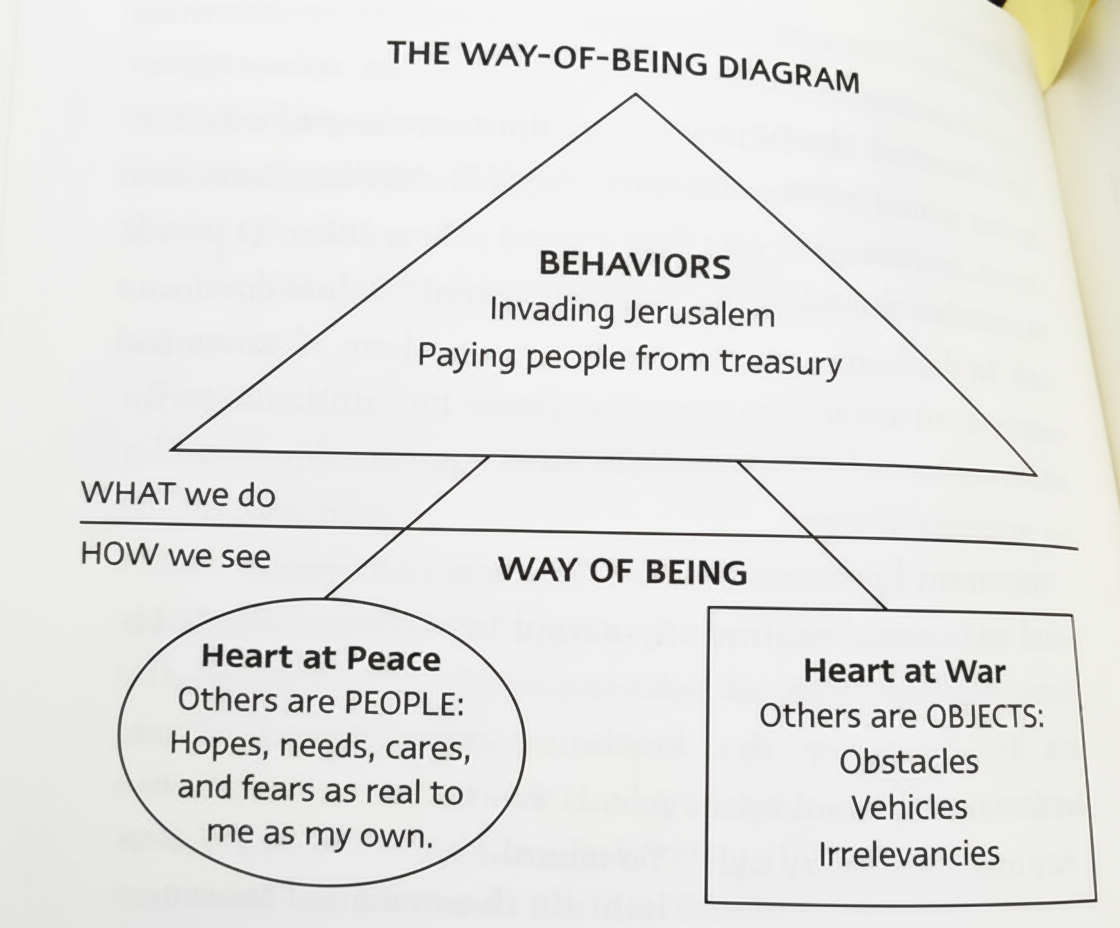
The story emphasizes that it is always possible to choose to care about others, even when justifiable reasons exist not to. It also suggests that Saladin's extraordinary success was not merely a product of luck, but a direct result of his orientation toward others.
The deepest way in which we are right or wrong, is in our way of being towards others.
René Descartes, the philosopher best known for the statement "I think, therefore I am," established what he believed to be the foundational truth of existence: the individual, thinking self. A later philosopher, Martin Heidegger, challenged this premise by observing that Descartes acquired the very words and capacity to think from others. In other words, Descartes was able to postulate the primacy of the separate self only because he acquired language in a world with others—meaning his foundational assumption is disproved by the conditions that made it possible for him to state it. These insights formed the basis for a third philosopher, Martin Buber, who built upon Heidegger's philosophy of interconnectedness and articulated the premise underlying both books: that people can relate to one another either as people or as objects—what Buber called the I-Thou way and the I-It way.
The I-It Way: The Boxes of Justification
The book describes four primary boxes used to justify treating others as objects:
- The Better-Than Box: Judging one's worth as being above another person's worth for any reason.
- The I-Deserve Box: Judging oneself as deserving of something. Entitlement.
- The Need-to-Be-Seen-As Box: Needing others to perceive you in a specific way—as smart, confident, capable, in charge, etc.
- The Worse-Than Box: Placing one's worth beneath that of others for any reason.
Getting Out Of The Box Version 2.0
In The Anatomy of Peace, the authors present four steps to exit the box:
- Look for the signs of the box — Generally anything that is not a state of peace, including blame, justification, and the common boxes described above.
- Find an out-of-the-box place — Seek internal peace by recalling out-of-the-box relationships, memories, activities, or places that restore a centered, peaceful state.
- Ponder the situation anew — View the situation from a place of peace.
This involves asking questions that foster empathy: considering the other person's perspective, examining one's own contribution to the problem, and reflecting on what else may be affecting the other person's behavior—their circumstances, history, or struggles.
- Act on what has been discovered — Follow through on the insights gained from this reflection.
A Strategy of Peace
The book's concluding insight is an analysis of how to effect change in others, illustrated through the influence pyramid. Most people begin at the top of the pyramid, attempting to correct and change others' behavior when something goes wrong. This approach fails for two reasons. First, insisting that others change without being willing to examine how one needs to change invites only conflict. Second, beliefs about how another person may need to change may themselves be distorted by being in the box with that person. Instead, the authors recommend starting at the bottom of the pyramid and working upward. A higher level of the pyramid is unlikely to be received effectively if the levels below it have not been addressed.
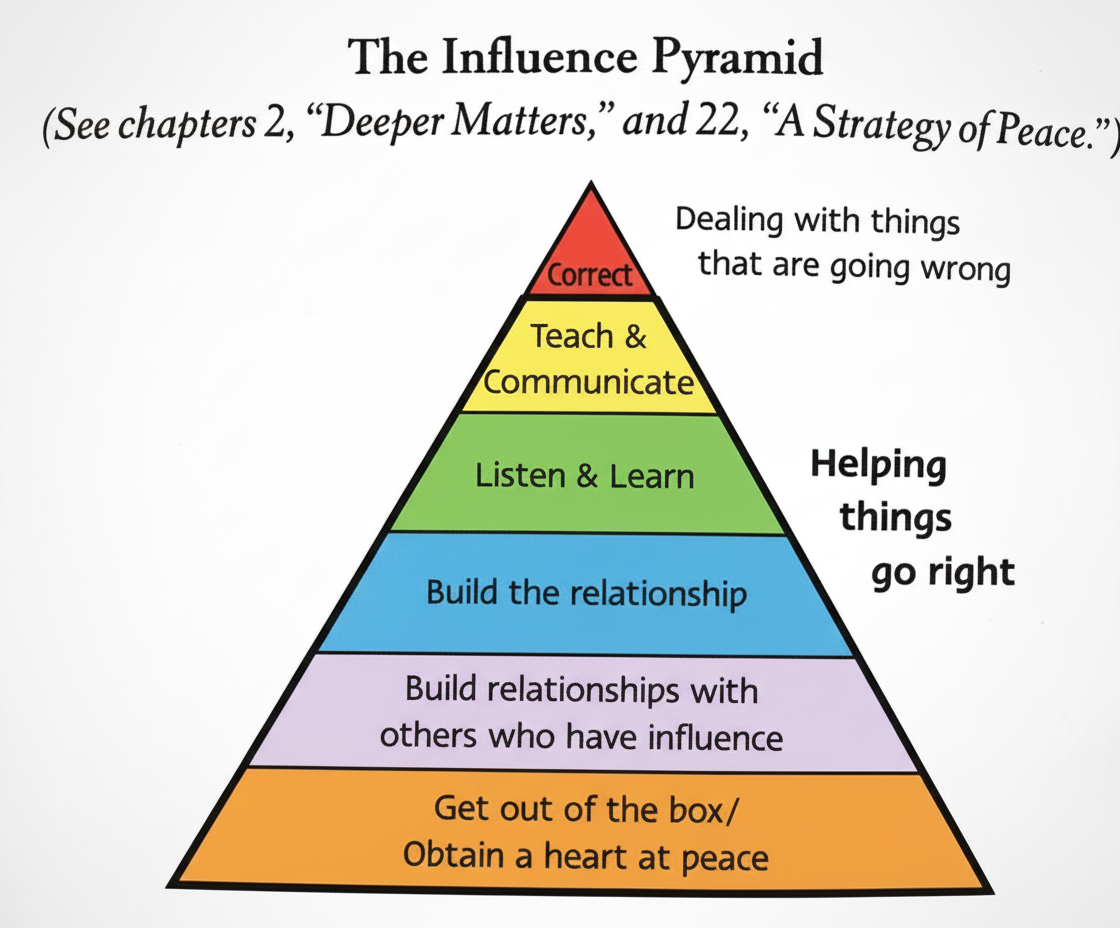
Three pertinent lessons from the pyramid:
- Most time and effort should be spent at the lower levels of the pyramid.
A solid foundation reduces the total energy required overall.
- The solution to a problem at one level of the pyramid is always found below that level.
The solution is not to persist with the same approach—it is to return to the fundamentals and invest more time there.
- Effectiveness at each level of the pyramid ultimately depends on the deepest level—one's way of being.
Operating with a heart at war—an attitude of conflict—only invites more conflict.