
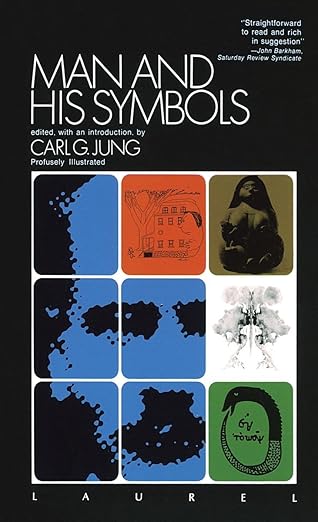
Man and His Symbols
by Carl G. Jung
Link blocked? Copy it and paste in a new browser tab.
Your Rating
All ratings are anonymous
Help others by sharing
This summary draws from several of Carl Jung's works: Man and His Symbols, along with four of his compiled volumes—Psychology and Religion: West and East, Psychology and Alchemy, The Archetypes and the Collective Unconscious, and Psychological Types—as well as The Origins and History of Consciousness by his protégé Erich Neumann. Together, these texts form a comprehensive picture of Jung's most influential ideas.
Carl Jung stands as one of the most important figures in the history of psychology. His primary area of expertise was the subconscious and symbology. He coined the terms "extrovert" and "introvert," created the foundational theory of personality that became the basis for the Myers-Briggs Type Indicator, introduced the concept of the collective unconscious, and coined the term "synchronicity." His influence extends across modern psychology, philosophy, and spirituality.
The Collective Unconscious
Jung's most famous contribution is the theory of the collective unconscious. He proposed that humans possess base instincts, but unlike animal instincts that serve survival functions, human instincts consist of innate knowledge of symbols—what he called archetypes. Archetypes are unconscious, manifesting internally through dreams, visions, and feelings, or externally through culture, art, religion, and shared symbolic imagery. These archetypes are universally recognized across all peoples throughout time and history. The ouroboros—the snake eating its own tail—appears in Greek, Roman, Hindu, Siberian, Norse, African, and South American mythologies. Rather than attributing this shared symbolism to a common cultural origin and subsequent diaspora, Jung theorized that humans are born with archetypal knowledge. Nearly all of his works explore this hypothesis, drawing from an extraordinarily vast array of mythology, alchemical traditions, and religious motifs to highlight recurring symbolic patterns. One pattern emerged as central to Jung's thesis: that archetypes are a symbol of the progression of consciousness in humanity.
In Psychology and Alchemy, Jung examined the myths surrounding alchemy—the attempted science of transmuting substances into gold through the philosopher's stone—and described the symbology embedded within the movement. He posited that the philosopher's stone was not a mythical object with Midas-like power, but instead represented the ultimate goal shared by religions across time and modern psychology alike: the achievement of internal peace and moral development. His other works carry a similar message.
Erich Neumann expanded on Jung's work by incorporating the concept of balance—a principle central to Eastern philosophy, as seen in yin and yang—along with the symbolic framework of the divine masculine and feminine. The idea that reality is fundamentally dualistic, consisting of paired opposites (also referred to as a syzygy, or divine opposites), underscores a presumption of balance. Love versus hate, hot versus cold, dark versus light, good versus evil—all are expressions of this dualism. The divine masculine and feminine represent a theory that gender carries inherent symbology, though both the masculine and feminine are present in every individual regardless of gender. The framework has nothing to do with biological sex—it is purely symbolic.
The Masculine and Feminine Symbols
The general symbolic meanings of the masculine and feminine archetypes are as follows:
Masculine
Individuation, independence, logic, creativity, structure, accountability. Fire symbol and action. Sun symbol. Consciousness.
Feminine
Collective, oneness, flow, nothingness, chaos, intuition, feelings. Water symbol and going with the current of life. Moon symbol. The unconscious.
It bears repeating: these symbols have nothing to do with actual gender. They are purely symbols of duality. Any given person may lean more masculine or feminine in any given trait or dimension, but both are always present. This will be further addressed in the discussion of personality traits below.
The Great Mother is the ultimate feminine archetype and the Great Father the ultimate masculine archetype. Both have positive and negative aspects representative of humanity's inherent duality.
The Great Mother
Positive Side
The positive aspect is nurturing and capable of seeing past the individual to the good of the collective. Like a loving mother, it views everyone equally by merit of shared humanity. It uses intuition to expand into new ideas beyond the bounds of what is known. It is calm and loving.
Negative Side
The negative aspect is characterized by a refusal to allow others to live independently, instead relishing codependency. It is chaotic and indulges in madness by allowing intuition to reign unchecked by logic.
The Great Father
Positive Side
The positive aspect is a driving force for innovation, bringing transformative change to the old order. It leads changes in consciousness, champions new paradigms, and encourages differentiation. It uses logic to test new ideas and assess their utility. It is independent and creative.
Negative Side
The negative aspect is rigid adherence to the old law or way of being. It stifles individual growth, operates from arrogant presumption, and seeks to homogenize order like a dystopian society. It preemptively rejects intuitive ideas that fall outside of the prevailing logical paradigm.
Erich Neumann used the dual nature of gender symbolism in myths to map the archetypal message of the progression of consciousness. The following outlines the key stages from his framework, described in terms of the hero's journey:
The Hero's Journey Stages
Consciousness shared with the Great Mother
From birth through early childhood, the individual's consciousness is undifferentiated from the parental unit. In myth, this is represented by a figure who is overly tied to a mother figure or to a mundane, unquestioned existence. A modern example: in the film Barbie, the protagonist's initial desire to return to the safety of Dreamland rather than embark on a personal quest.
Individuation begins
The hero initiates the first stages of independent development. This step away from the Great Mother is typically met by the archetype of the negative Great Mother, who resists the hero's budding independence. In myth, this often manifests as the Great Mother figure becoming jealous, possessive, or consumed by madness.
Individuation solidifies
The hero becomes increasingly independent from the Great Mother through accomplished tasks, feats of strength, and personality transformation. Challenges escalate in intensity and the hero is increasingly recognized as exceptional. This represents the individual becoming more differentiated. In some myths, twins with opposing traits symbolize the dual sides of the hero as the destructive aspects of self are confronted.
Individuation is accomplished
The hero completes the ultimate quest—slaying the personal dragon—symbolizing that consciousness has developed beyond the primal need to remain part of the collective, indicating full acceptance of self. The negative aspects of self have been conquered.
Crowning or conflict
In some myths, the crowning of the hero concludes the story. In others, the hero confronts the negative side of the Great Father after having overcome the Great Mother. Now fully independent from external influences, the hero challenges the establishment whose rigid beliefs prevent the further moral development of the collective.
The new Great Father
Having overcome the negative aspects of the Great Father, the hero establishes new standards of morality and consciousness that allow the collective to expand. The hero is recognized as the new Great Father. Eventually, this new Great Father will return to the pool of symbology and become the negative Great Father for the next hero's journey—the cycle continues.
Re-identification with the Great Mother
Having mastered the self, the new Great Father turns outward and reunites with the positive aspects of the Great Mother, restoring balance in duality by embracing and nurturing the collective. This final stage represents the integration of individuation with compassion—independence with connection.
This is the essential framework of archetypes as symbols of the progression of human consciousness. The pattern is deliberately simplified here for accessibility, but becomes unmistakable once recognized in mythology, literature, and film.
Jung's work on personality also incorporated the principle of inherent duality. He theorized that personality is a function of how an individual interacts between the internal and external worlds. His categories include introversion versus extroversion, intuition versus sensing, thinking versus feeling, and judging versus perceiving. No category is objectively superior—each orientation carries its own strengths and limitations.
Jung's Personality Types
Introversion vs Extroversion
The colloquial understanding of introversion and extroversion—how a person "recharges"—is not what Jung intended when he coined the terms. In Jung's framework, introversion and extroversion describe how a person engages with the world in order to learn. Extroversion is an orientation toward the physical and external world; an extroverted person learns from direct experience and external input. Introversion is an orientation toward the internal world, tapping into the archetypes of the collective unconscious. Introversion is immersion in theoretical possibility.
Intuition vs Sensing
Sensing refers to individuals who use the external world—primarily the five senses—to gather information. They tend to be more literal, focusing on facts, details, and concrete experiences. The intuitive type relies on internal instincts and insights, dwelling in the theoretical and identifying overarching patterns and possibilities as the preferred method of information gathering.
Thinking vs Feeling
Thinking is an orientation toward logic, reason, and analysis as the primary determinants of action. Feeling is an orientation that emphasizes values, empathy, and subjective experience as the primary determinants of action.
Judging vs Perceiving
Judging refers to individuals who tend to make a plan and follow it through. They value structure, order, and decisiveness. Perceiving refers to individuals who prefer to keep options open, valuing openness to new information, improvisation, and adaptability.
Each pairing is present in every individual, differing only in degree. Jung called the primary orientation the dominant function and the secondary type the auxiliary function. Just as the Great Mother and Great Father have their respective positive and negative attributes, so does each personality type. The stronger the preference for one type over its pair, the more likely a person is to exhibit the negative aspects of that orientation. Jung theorized that healthy personality development leads toward balance between each pair, even though one type will always remain more dominant than the other.
Conclusion
Jung's central thesis is that humans share an innate drive toward personal growth and development, evidenced by universally shared subconscious symbology. His analysis of personality types reinforces this framework, emphasizing that balance between opposing traits is the mechanism through which consciousness progresses. The symbols are not relics of the past—they are the living language of the psyche, and learning to read them is fundamental to understanding both the self and the human condition.