
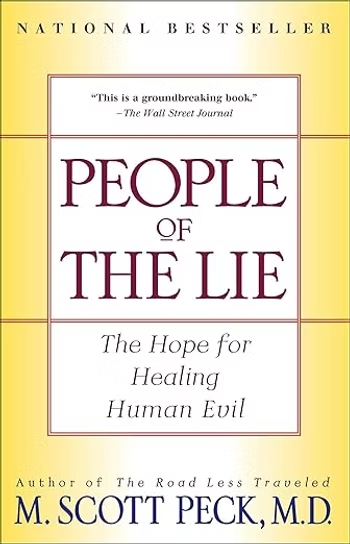
People of the Lie
by M. Scott Peck
Link blocked? Copy it and paste in a new browser tab.
Your Rating
All ratings are anonymous
Help others by sharing
In this work, psychiatrist M. Scott Peck explores what constitutes evil and what gives rise to it. Drawing on decades of clinical experience, he examines cases that reveal the subtle, often undetectable nature of human destructiveness—the kind that operates beneath the surface of ordinary life.
Among the cases presented are parents who gave their surviving son the same gun his sibling had used to commit suicide, other parents who systematically deprived their child of everything the child expressed enjoyment in while twisting a therapist's guidance to justify their actions, and a mother who used emotional manipulation to prevent her daughter from developing independence. These examples illuminate the type of evil that often goes unnoticed—not the dramatic, headline-worthy cruelty, but the quiet, insidious destruction of another person's capacity to live fully.
Clinical practice regularly reveals extremes of human cruelty: parents who attach razor blades to belts and whip their children, children forced by caregivers into sexual acts with older individuals or siblings, a mother who attempted to burn her son alive over a trivial theft. These acts, alongside humanity's broader historical record—genocide, ethnic cleansing, slavery, war crimes, and modern manifestations such as targeted economic destruction, engineered addiction through opioids and social media platforms, and the intentional poisoning of food and water supplies—demonstrate the depth of callousness that human beings are capable of perpetuating on both individual and societal scales.
With such a wide variety of manifestations, how can evil be defined? Peck notes that "evil" is "live" spelled backwards and defines evil as anything that prevents another person from living. The question then becomes: what constitutes living? If the standard is merely the absence of death—a "living wage" that restricts a person to daily survival with no capacity for growth, purpose, or self-determination—that does not meet any meaningful definition of life. Living, in its fullest sense, means having the freedom and opportunity to pursue one's own path, to follow dreams and passions uninhibitedly, so long as doing so does not impinge upon another person's right to do the same. Anything that seeks to control or prevent this is, by Peck's definition, evil. Under such a framework, the world is, unfortunately, characterized by its propensity toward evil.
What, then, creates evil? Peck identifies two defining characteristics: narcissism and laziness. Narcissism is characterized by a refusal to take accountability for oneself—a position Peck defines as scapegoating. Evil people, in his framework, are chronic scapegoaters who use projection, the subconscious misplacement of internal psychology onto the external world, to justify their own misconception of faultlessness. If they are in conflict with the world, then the world must be at fault, not themselves. As Peck writes, "The evil do not serenely bear the trial of being displeasing to themselves." Their internal absolution is, in their own minds, absolute. "Strangely enough, evil people are often destructive because they are attempting to destroy evil. The problem is that they misplace the locus of the evil. Instead of destroying others they should be destroying the sickness within themselves. As life often threatens their self-image of perfection, they are often busily engaged in hating and destroying that life—usually in the name of righteousness." Nearly all people are guilty of this to one degree or another, which is why the world remains defined by its propensity toward evil—a propensity toward maintaining one's self-image at any cost.
Laziness, the second component, is defined by the refusal to change attitudes and beliefs—clinging to old patterns for the sake of convenience and moral abdication of responsibility to adopt new truths when the flaws of old truths are made manifest. As Peck puts it, "Individuals and nations cling to obsolete and outworn ideas not simply because it takes work to change them but also because, in their narcissism, they cannot imagine that their ideas and views could be wrong. They believe themselves to be right." This insight resonates with the speech delivered by the protagonist, Cardinal Lawrence, in the film The Conclave:
Over the course of many years in the service of our mother the Church, let me tell you, there is one sin I have come to fear above all others: certainty. Certainty is the great enemy of unity. Certainty is the deadly enemy of tolerance. Even Christ was not certain at the end. "My God, My God, why have you forsaken me?" he cried out in his agony at the ninth hour on the cross. Our faith is a living thing precisely because it walks hand in hand with doubt. If there was only certainty and no doubt, there would be no mystery, and therefore no need for faith. Let us pray that God will grant us a pope who doubts.
— Cardinal Lawrence, The Conclave
Certainty, viewed through this lens, is the manifestation of laziness—and that laziness bears and upholds evil as its standard. In essence, "evil arises in the refusal to acknowledge our own sins," the primary sin of which is certainty. Defined another way, certainty is the inability to come to terms with one's own limitations: flawed perspectives, imperfect understandings, conscious or subconscious harmful actions, a pious and dogmatic self-image, and the refusal to be wrong. Evil, then, is the inability to tolerate internal suffering in any form—an unwillingness to desecrate the shrine built unto oneself, a refusal to consider anything outside of what has been deemed sacred and beyond reproach, particularly within oneself. For this reason, Peck states: "One measure—and perhaps the best measure—of a person's greatness is the capacity for suffering."
A compelling counterargument to Peck's framework is that the concept of "evil" may itself be a misnomer. People who commit what are categorized as evil acts often do so because they believe their actions are righteous. At its core, the pattern Peck describes—narcissism combined with laziness—is fundamentally an avoidance of pain. If the root cause is fear, then what is labeled "evil" may be more accurately described as cowardice: the fear of facing the suffering that comes from metaphorically undressing one's soul and confronting what is found there, the cowardice of avoiding internal suffering and abdicating moral responsibility for it. Every human being possesses areas of self-righteousness—psychological defense mechanisms designed to avoid conscious suffering—defenses that ultimately manifest as what Peck calls evil. At its deepest level, it is all fear. Fear is not evil in itself; it is something universally empathized with. Fear functions as a disease in which the manifestation of evil finds its home, but it is not something beyond understanding. It is fear—and the more extreme the fear, the more tangible evil's form becomes.
Clinical observation consistently reveals a striking paradox: even when individuals are given effective tools for healing, many resist using them independently. Clients who can demonstrably show themselves that they need not live in fear nevertheless fail to take accountability for eliminating it. Instead, time is spent scrolling social media, consuming passive entertainment, working compulsively, or otherwise abdicating the personal capacity to find internal peace. People plead for their lives to improve, yet when given the tools to do so, they wait until they are in a clinical setting to take action. Fear is an extraordinarily powerful deterrent—one that plagues humanity like a parasite—and yet even when the way out is clear, fear continues to intimidate and control. This pattern repeats across individuals, cultures, and generations.
On an individual level, each person is accountable for their own manifestations of evil—their own refusal to face uncertainty and the consequent suffering inflicted upon both themselves and those around them. But this accountability does not stop at the individual. Societies are collectively responsible for the ultimate manifestations of evil within their cultures. The Hitlers, Pol Pots, and Idi Amins of history did not emerge in a vacuum. They are products of collective refusal to take accountability on an individual level, as well as reflections of what societies subconsciously esteem when they celebrate fear as not only acceptable but laudable. Billionaires are rarely viewed as self-obsessed narcissists who grow their wealth by economically disenfranchising humanity; they are applauded. Mental health is stigmatized rather than encouraged—fear is rebranded as fixed biology, immutable psychology, or the badge of honor of self-reliance. Flexible and critical thinking is punished rather than rewarded; those who adapt and change their beliefs are labeled weak-minded, foolish, or sinful. Evil is not abhorred—it is celebrated openly. A world that views the avoidance of fear as its most esteemed value has cast its vote for a society in which fear and evil dominate without contest.
To create a world devoid of evil, the work must begin with the healing of fear within the individual. Only then can society reflect the collective choice to see fear as the disease it is—the root cause of evil.