
Play
by Stuart Brown
Link blocked? Copy it and paste in a new browser tab.
Your Rating
All ratings are anonymous
Help others by sharing
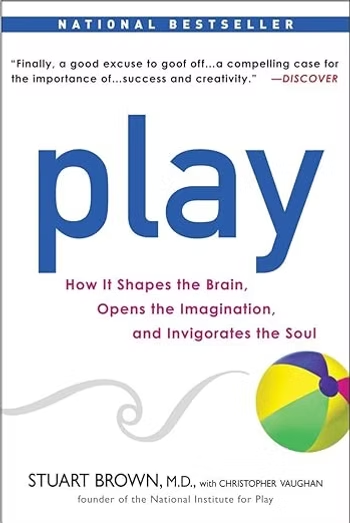
This book examines the impact of play on the brain and overall functioning, presenting a compelling argument for incorporating more play into daily life.
Among the most notable takeaways are the wide-ranging benefits that research has associated with play:
Benefits of Play
- Play Develops the Brain.
- Play is correlated to the development of the brain's frontal cortex, "which is the important brain region responsible for much of what we call cognition: discriminating relevant from irrelevant information, monitoring and organizing our own thoughts and feelings, and planning for the future."
- Play is linked to the rate and size of growth of the cerebellum which is "responsible for key cognitive functions such as attention, language processing, sensing musical rhythm, and more."
- Rats raised in "enriched" (code for play as stated by the researcher involved) environment became smarter with larger brains with more gray matter which is where the brain's data processing takes place. This difference occurred both due to play and social interaction with other rats.
- Play Impacts Physical Health.
- "Studies of early dementia suggest that physical play forestalls mental decline by stimulating neurogenesis."
- Also linked to other diseases such as heart disease.
- Lack of play possibly linked to ADHD with results showing that play helps kids with ADHD control impulsivity.
- "Studies of early dementia suggest that physical play forestalls mental decline by stimulating neurogenesis."
- Play Impacts Emotional Health.
- We can experience a play deficit just like we experience a sleep deficit. "When play is denied over the long term, our mood darkens. We lose our sense of optimism and we become anhedonic, or incapable of feeling sustained pleasure."
- The amount of play between a couple correlates to their level of happiness in a relationship.
- Play Impacts Mental Health.
- Play in business enhances creativity and problem solving.
- Play has been found to positively impact the brain much more than problem solving or other traditional ideas of maintaining brain health.
- A lack of play throughout life is linked to crime and violent behaviors.
- Play Impacts Survival.
- In a 15 year study of bears they found those that played the most, survived the best.
The impact of play on the brain is surprisingly substantial. Hinduism apparently has been saying this for a long time. Hinduism describes "all reality, including the cosmos, as the outcome of creative play by the divine absolute." So what is play? The book defines the properties of play as:
Properties of Play
- Apparently Purposeless - It's done for its own sake.
- Voluntary
- Inherent Attraction - It's fun.
- Freedom from Time - Loss of your sense of time.
- Diminished Consciousness of Self - Fully in the moment, not thinking about how you look.
- Improvisational Potential - You try new ways of doing things.
- Continuation Desire - You desire to keep doing it.
The book further categorizes play into 8 different types. Here are the 8 types of play personalities as described in the book:
8 Types of Play Personalities
- The Joker - Being foolish or joking.
- The Kinesthete - People who need to move in their play.
- The Explorer - Physical, emotional, or mental exploration.
- The Competitor - Fun is found in the fight to be #1.
- The Director - Organizing, planning, and executing is fun.
- The Collector - Collecting objects is fun.
- The Artist/ Creator - Joy is found in making things.
- The Storyteller - Using imagination is fun.
Each person engages in some combination of these eight categories—or possibly in ways not captured by the book's framework. The central message is that making time for play is essential. Modern society has placed a significant stigma on play, which may be limiting both personal development and the joy that accompanies it. The book suggests that those who are defensive about the positive role of play may be engaging in a psychological reaction to avoid confronting the absence of play in their own lives and its associated cost to their well-being.
"The master in the art of living makes little distinction between his work and his play, his labor and his leisure, his mind and his body, his information and his recreation, his love and his religion. He hardly knows which is which. He simply pursues his vision of excellence at whatever he does, leaving others to decide whether he is working or playing. To him, he's always doing both."
-James Michener