
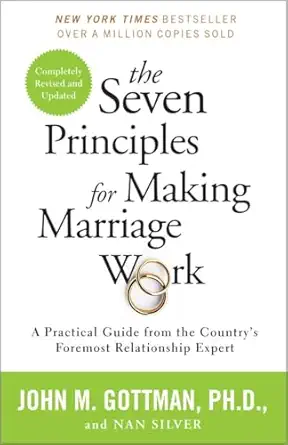
The Seven Principles for Making Marriage Work
by John M. Gottman and Nan Silver
Link blocked? Copy it and paste in a new browser tab.
Your Rating
All ratings are anonymous
Help others by sharing
John Gottman is one of the most well-known researchers on what makes relationships work and a leader in the field of couples therapy. More about the Gottman Method can be explored in depth. The book itself is highly recommended—it contains detailed examples of what these concepts look like in practice, worksheets for working on a relationship, and peripheral information not covered in this summary.
Gottman's studies led him to identify factors that predict divorce, and across his marital research, he achieved a 91% accuracy rate in predicting which couples would divorce. He also conducted a study of 640 couples using his method of couples therapy, which resulted in a 75% success rate, with only 20% of those successful couples deteriorating in later follow-ups—approximately a 50% long-term success rate, which is notable given the complexity of relationship dynamics.
A note on the definition of success: despite this book defining success as a couple remaining married, that is not always advisable. Research indicates that unhappy marriages can result in a 35% higher chance of illness and a shortened lifespan of four to eight years. Conversely, a happy marriage can add four to eight years to a lifespan. Highly conflictual relationships are also shown to be worse for children than divorce. Not all relationships need to—or even should—work out.
Before examining what works and what does not, here are several myths Gottman identified about marriages:
Marriage Myths
- Neuroses or personality problems end marriages.
Barring severe mental illness, insecurities or personality factors account for very little in determining the success of a relationship.
- Common interests keep a couple together.
Not if the couple experiences significant conflict during their shared activities.
- Relationships should be reciprocal.
While technically true, a marriage that rigidly requires tit-for-tat reciprocity is actually very negative long-term. Tallying is a sign of a struggling marriage.
- Avoiding conflict ruins marriages.
Not necessarily. There are different styles of conflict, including avoidance. What matters most is that the combined style works for both partners.
- Affairs are the primary cause of divorce.
Problems in marriages typically precede affairs. The problems build until one or both partners seek connection outside the marriage. A lack of connection makes people inclined to find it elsewhere.
- Men are not biologically built for marriages.
The research suggests this is more about opportunity than biological sex. As women have entered the workforce in larger numbers, women statistically cheat at slightly higher rates than men. (There is an argument that humans are not designed for monogamy, which this statistic may support, but that is not a part of this book.)
- Men and women are from different planets.
The quality of the couple's friendship determines 70% of satisfaction in marriage for both men and women.
What does impact the success of a relationship? Gottman identified six primary factors that lead to divorce.
The Six Factors Leading to Divorce
- Harsh Start-Up
- Four Horsemen (This alone accounts for 82% of predicting divorce)
- Flooding
- Body Language/ Physiology
- Failed Repair Attempts
- Bad Memories
Harsh Start-Up
A start-up refers to how a conversation is initiated, specifically when raising a complaint or problem. A harsh start-up involves beginning a conversation with criticism or contempt, whether overt or covert. The overall attitude with which a partner initiates a conversation sets the tone for how the conversation will likely proceed. Most communication is non-verbal—estimated between 50-90% depending on the source. The most well-known study, conducted by Albert Mehrabian, suggests that actual words account for only 7% of what is communicated. Negative sentiment override is the tendency to interpret what a partner says as negative regardless of intention. The worse a relationship is doing, the more likely negative sentiment override occurs.
The Four Horsemen
The presence of the four horsemen in a relationship allows for the prediction of divorce with 82% accuracy. These four patterns of interaction are among the most reliably destructive forces in relationships.
- Criticism: Directly attacking a partner's character rather than addressing a specific behavior.
- Defensiveness: A reaction to protect oneself from a perceived attack. This can take many forms, including counter-attacking, blaming the other person, claiming innocence, or otherwise deflecting.
- Contempt: Any behavior stemming from a partner placing themselves above, or perceiving themselves as better than, their partner. By far the strongest predictor of divorce. Happy marriages showed essentially zero contempt.
- Stonewalling: Cognitively or emotionally disengaging from the interaction entirely.
Flooding
Flooding occurs when one partner becomes overwhelmed with emotions to the point of shutting down. Flooding is problematic because it teaches a person to avoid marital conflict, which only results in increased marital distance over time. Additionally, if one partner is reaching the point of being flooded, there are communication skills that can help prevent reaching that breaking point.
Body Language/ Physiology
Body language in this context refers to individual physiological reactivity. When a person becomes emotionally activated, the body naturally enters fight-or-flight mode. While most relationship interactions are not life-threatening, the brain has not evolved to make that distinction reliably. As fight-or-flight activation increases, the brain shuts down higher cognitive functions to optimize for survival. The more intense the physiological response, the more critical thinking diminishes and base instincts take over. Notably, Gottman's research found that men are more likely to become emotionally overwhelmed than women in relationship conflict.
Failed Repair Attempts
One of Gottman's most significant findings concerns the role of repair attempts in marital success. A repair attempt is any effort by a couple to de-escalate tension during a disagreement and return to normal functioning. Couples with a strong track record of successful repair attempts can essentially neutralize the impact of the four horsemen. The ability to repair the relationship is more indicative of marital success than any other single factor. Conversely, the more repair attempts fail, the more likely the relationship will not survive. When both the four horsemen and a high rate of failed repair attempts are present, the predictability of divorce exceeds 90%.
Bad Memories
The less a person is able to recall positive memories, the more the relationship suffers—though this largely reflects the current state of the relationship rather than objective history. Mood-congruent memory bias is the tendency for people to remember events that align with their current emotional state. If a relationship is struggling, a partner may remember the groom being thirty minutes late instead of the great time the couple had for the entirety of the wedding day. The worse the normative emotional state of a relationship, the more a person will focus on the negative aspects of a memory. As many couples have experienced, trying to help a partner remember the good times rarely works when the current emotional state is negative.
These are the six factors leading to divorce (or unhappy marriages and relationships) according to Gottman's research. With the destructive patterns identified, the focus shifts to what works. Gottman's proposed solution for helping couples exit negative relationship cycles is called the Sound Marital House—a framework composed of seven principles.
The Sound Marital House
- Enhancing Love Maps
- Nurture Your Fondness and Admiration
- Turn Towards Each Other Instead of Away
- Let Your Partner Influence You
- Solve Your Solvable Problems/ Perpetual Problems
- Overcoming Gridlock
- Create Shared Meaning
Principle 1: Enhancing Love Maps
A love map is Gottman's term for how well two partners know each other—their likes, dislikes, favorite artists, favorite foods, best friends, pet peeves, and the details of their inner world. The more two partners know and remember about one another, the more the message is conveyed that they are important. Acting on this knowledge is equally important. For example, if a partner enjoys modern art, understanding why they enjoy it and who their favorite painter is deepens the love map considerably.
Step 1: Get to know your partner better.
Principle 2: Nurture Your Fondness and Admiration
This principle refers to how much partners genuinely like and admire one another. A relationship that lacks fondness and admiration stands little chance of long-term success (with the exception of arranged marriages or religions that prohibit divorce). Attention bias—the psychological tendency to notice what is consciously being looked for while ignoring what is not—is particularly relevant here. Deliberately looking for qualities to like and admire in a partner makes those qualities more visible, while failing to look for them virtually guarantees they will go unnoticed.
Step 2: Look for reasons to be grateful for your partner and express it. Look for ways to compliment your partner.
Principle 3: Turn Towards Each Other Instead of Away
A bid for connection describes any attempt by a partner to engage and build connection. Gottman found that happy partners meet their partner's bids for attention and engagement 86% of the time on average, while couples more likely to divorce meet their partner's bids only 33% of the time.
Gottman identified two primary obstacles to meeting bids for connection:
- The bid is wrapped in negative emotion.
Focusing on the negative emotion rather than the underlying bid for connection increases conflict. The ability to look beyond a perceived offense to see the expressed need is critical for successful couples. This is not permission for anyone to be intentionally rude or to become a doormat. Gottman suggests responding to a negatively wrapped bid with something like: "I want to respond to you positively, so can you tell me what you need right now from me?" Breaking out of a negative cycle of interaction may require patience from both partners.
- Distraction and mindlessness.
Technology increasingly plays a role in relationship dissatisfaction. Any time a person chooses something over their partner, it inadvertently communicates that the partner matters less than whatever else is occupying their attention. The more frequently this occurs, the more relationship problems tend to accumulate.
Active listening is the practice of being fully engaged in the process of listening, with the sole objective of understanding the other person. The simplicity of the concept rarely translates to automatic proficiency—it is a skill that must be developed like any other. The ability to actively listen to a partner translates directly into marital satisfaction.
Equally important is the ability to sit with painful emotions—whether one's own or a partner's. The inability to tolerate emotional discomfort is detrimental to relationships. A couple in an emotionally healthy relationship is characterized by the principle: "When you are in pain, the world stops, and I listen." It is common for people who are uncomfortable with emotions to seek solutions, distractions, or ways to make their partner feel better. This is statistically less helpful than simply being present with them in their emotions. Discounting or minimizing a partner's emotions with statements like "stop being dramatic" or "you are being emotional" is predictive of relationship dissatisfaction. Gottman found an 81% chance that a partner damages the relationship every time they fail to acknowledge and hear their partner's feelings.
Step 3: Don't ignore your partner.
Principle 4: Let Your Partner Influence You
This principle concerns shared power and decision-making—honoring and respecting a partner as an equal rather than an appendage. Gottman emphasizes the importance of emotional intelligence in this principle, particularly for men, as societal conditioning often discourages emotional engagement. Emotional intelligence in this context is the ability to honor and respect a partner's perspective and feelings. Gottman found that only 35% of men in his experiments met this standard. He also found that women bring up relational problems 80% of the time. Emotional intelligence here means the ability to hear and discuss these issues in order to reach a resolution rather than avoiding the conversation entirely.
Step 4: Honor and respect your partner as an equal.
Principle 5: Solve Your Solvable Problems/ Perpetual Problems
Perpetual problems are issues that cannot seem to be resolved no matter how many times they are discussed, also known as gridlock issues. Gottman found that 69% of problems in relationships are perpetual problems. How to address them is discussed further in Principle 6.
How a couple approaches conflict as a concept—before it even occurs—is integral to successfully navigating it. Gottman identifies four keys to managing conflict:
- Negative emotions are important. They should not be discounted but learned from, even when directed at oneself. Learning to remain non-reactive when negative emotions are directed inward is equally important.
- No one is right. There are only subjective realities in relationships. Internalizing this concept alone can transform a relationship. The need to be right or to determine who is right only damages the connection.
- Acceptance is crucial. Everyone wants to feel understood and accepted. When people do not feel understood or accepted, they are more likely to entrench their position than to change. Making a partner feel understood and accepted is the most effective strategy for being heard.
- Focus on fondness and admiration. The ability to remember and express love for a partner, even in the midst of conflict, is indicative of marital happiness and stability.
Gottman also provides a set of actionable steps for resolving conflict rather than merely managing it:
- Soften Start-Ups
- Complain without blaming.
- I statements — Using language to describe one's own feelings rather than attributing intentions or feelings to a partner is a common and highly effective therapy technique.
- Describe what is happening without judgment.
- Be clear about positive needs. The distinction between a positive need and a negative need matters—negative needs tend to be about control or power rather than equality.
- Be respectful.
- Learn to Make and Receive Repair Attempts
In struggling relationships, Gottman suggests making repair attempts very formal so the partner recognizes that a repair attempt is being made. In healthy relationships, repair attempts are naturally more effective and formality is typically unnecessary.
- Soothe Yourself and Each Other
Open communication about emotional states is essential, and breaks should be taken as needed for self-soothing. Negotiated time outs are pre-argument agreements on how to manage breaks during conflict. These agreements cover how to call a timeout (always for oneself, never imposed on the partner), where each individual will go, and an agreed-upon time before checking in again. During check-in, the couple assesses readiness to resume the conversation or whether more time apart is needed. The objective is to continue the conversation with a level head, not to avoid it—so dedication to resolution is vital to this agreement.
- Compromise
Meeting each other halfway is sometimes the most effective path forward.
- Process Any Grievances So They Do Not Linger
The speaker/listener technique is an effective method for ensuring grievances are addressed. One person assumes the role of listener and the other the role of speaker. The listener asks questions to deepen understanding and summarizes what the speaker has said. Once the speaker feels completely understood, the partners switch roles.
Step 5: Learn to effectively manage and resolve conflict.
Principle 6: Overcoming Gridlock
Gottman identifies gridlock in perpetual problems as stemming from a misunderstanding of a partner's underlying values and dreams. The resolution involves discussing why a partner's position on a gridlock issue is so important to them—understanding what the issue symbolizes. For example, one partner's insistence on saving aggressively may stem from a dream of early financial independence, may symbolize the financial stability that was absent in childhood, or may reflect another deeply held value. In perpetual problems, breaking through gridlock comes from genuinely understanding the partner's position at its deepest level.
Step 6: Seek understanding behind gridlock issues.
Principle 7: Create Shared Meaning
A crucial goal of any marriage, therefore, is to create an atmosphere that encourages each person to talk honestly about his or her convictions.
This principle is about building a shared narrative—aligning on values, goals, rituals, and the meaning partners want their relationship to embody.
Four Pillars of Shared Meaning:
- Rituals of Connection — Establishing routine ways to connect.
Celebrations, recreation, communication, intimacy, everyday living.
- Support for Each Other's Roles — Maintaining similar expectations for roles.
Work, spousal roles, parental roles, time spent in hobbies.
- Shared Goals
Creating goals that both partners want to achieve together. Shared goals can also include supporting each other's individual goals.
- Shared Values and Symbols
Aligning on what both partners value and what symbols they want to define their relationship.
Step 7: Actively create meaning in your relationship.
Turning a relationship around is not a small task, and it is not one that can be accomplished alone. Both partners need to be on board, committed to working as a team. Setting a dedicated time to review these principles together and creating a plan of action is a practical first step. Working with a couples therapist is also a recommended option for maximizing the likelihood of success.