
Synchronicity
by Carl Jung
Link blocked? Copy it and paste in a new browser tab.
Your Rating
All ratings are anonymous
Help others by sharing
This is a summary of the book Synchronicity by Carl Jung. Most of this book was on philosophical theory which wasn't immediately relevant to practical use and won't be discussed.
Synchronicities are seemingly non-causal meaningful occurrences and Jung thought of them through the lens of the psychically conditioned relativity of time and space. While any given event on its own is attributed to chance, the accumulation of chance occurrences collectively may indicate an unclear connection between unknown stimuli.
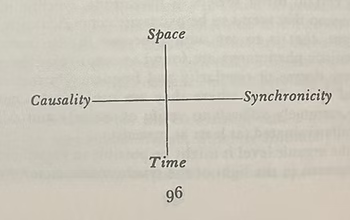
This graph shows the relationship between space and time (think Einstein's theory of relativity) on the y axis and the relationship between causality and synchronicity on the x axis. In other words, causality is a clear and reliable relationship between two stimuli while synchronicity is an unreliable and unclear relationship between two stimuli (but it still exists).
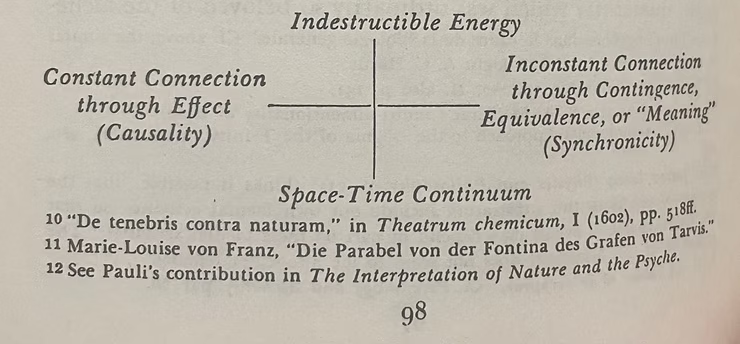
Carl Jung was a big proponent of trying to integrate exceptions into formulating a greater understanding of what is. The unexplainable should be able to be explained and should not be stuffed on the shelf of the proverbial closet for simplicity's sake. Synchronicities, made more credible by improbability, fall into this category.
Meaningful coincidences are thinkable as pure chance. But the more they multiply and greater and more exact the correspondence is, the more their probability sinks and their unthinkability increases, until they can no longer be regarded as pure chance but, for lack of a causal explanation, have to be thought of as meaningful arrangements.
Speaking of probability, Jung worked with a statistician on the probability of certain phenomena. Three findings stood out to me:
Statistical Findings
- The statistician found that assigning telepathic precognitions of death (knowing someone died before officially told by means of feelings, dreams, or otherwise) as due to chance was 4 million times less likely than explaining it as telepathic or otherwise connected.
- Jung conducted a test with a deck of cards composed of 5 cards of 5 symbols where the subject guessed what symbol was on the next card without seeing it. Two subjects were exceptional. One subject got 6.5 out of 25 correct on average after drawing 800 cards which comes to a probability of 1 in 250,000. Another participant got 10 out of 25 cards correct after 800 cards which is two times better than chance. The chances didn't change with the subject's distance from the card deck. Furthermore, the same exceptional subject once got 25 of 25 correct, a chance of 1 in 298,023,223,876,953,125. Possible? Obviously. Likely? Not remotely.
- Another experiment when the card order was scanned previous to the test impacted chance by 1 in 400,000 indicating that time may have some relationship with chance.
Synchronistic anomalies are worthy of investigation on grounds of probability and possible connection beyond what is currently known.