
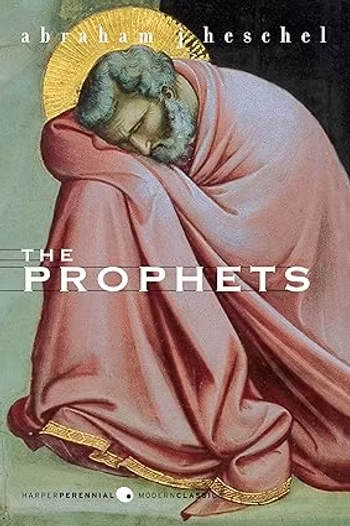
The Prophets
by Abraham Joshua Heschel
Link blocked? Copy it and paste in a new browser tab.
Your Rating
All ratings are anonymous
Help others by sharing
Heschel analyzed the prophets of the Bible and organized his analysis into what can be understood as four categories: the attributes of God as spoken of by prophets, the attributes of prophets themselves, the role of prophets, and the experience of prophecy. His analysis is notable because some of his views of God may strike many Christians as irreverent or even blasphemous. His exploration of what God seeks in a prophet is particularly insightful. He also incorporates beliefs from other religions and prominent philosophers in formulating his views, offering a broad and intellectually rich perspective.
Divine Attributes
God's nature as revealed through prophetic insight
Prophet Traits
Characteristics and attitudes of true prophets
Prophetic Role
The purpose and function of prophets in society
Prophecy Experience
The nature and process of receiving divine revelation
The Attitude and Attributes of God
Prophets expound upon God's insight into man, the attitudes of God rather than ideas about him. They see hidden meanings because they were conditioned by their experiences of inspiration. These are the attitudes of God spoken of by prophets according to Heschel:
1. God is incomprehensible
If God encompasses everything (as many religions assert), the entirety of the known universe could represent an infinitesimally small fraction of the divine totality. A complete understanding of every principle in the universe might constitute the most elementary level of knowledge—statistically negligible in comparison to what remains beyond comprehension. If God is everything, then any dogmatic proclamation about the nature of God is inherently limited.
2. God does not need anything from man
He doesn't need us to "follow his commandments," or "praise him," or anything of the sort. "Absolute distance and aloofness characterize the Supreme Being in Confucianism, in which there is a reverent recognition of heaven as the source from which man derives his nature."
3. Morality is irrelevant
If God requires nothing from humanity and created everything, then the negative aspects of existence were also divinely created and therefore serve a purpose. In this view, nothing is inherently good or bad—everything serves a function. This is the principle of divine contradiction, which Heschel considers essential to understanding God. If all beings are aspects of God, and everything imaginable was created by God for a reason, then all actions—constructive or destructive—represent God exploring different facets of the divine nature.
4. God doesn't care what we think about him
"On the contrary, he permits and takes benign delight in all the differing illusions that best the beclouded mind of Homo Sapiens." Much like a parent amused by a child's imaginative way of making sense of the world.
5. God doesn't fear
"The Greeks have always regarded the gods as immortal and happy beings as par excellence. Since the first condition for happiness is the absence of worry, which can be attained only by... living apart from the world, politics, and affairs, concern with which spoils tranquility and peace, it therefore appeared absurd, according to Epicurus, to assume that the Gods should concern themselves with the affairs of men. What holds true for man, holds true for the Gods." The absence of worry should not be mistaken for the absence of caring. Apathy is not the expression of one who truly cares about themselves or others. If there is no real death and both good and bad are part of God, then there really is nothing to be worried about. The absence of fear is a law upon which godhood is based.
6. God's laws change
"The God of Israel, in contrast, is not a Law, but the Lawgiver. The order he established is not a rigid, unchangeable structure, but a historic-dynamic reality, a drama. What the prophets proclaim is not His silence, but His pathos. To understand His ways, one must obey His will." And since his laws change over time, obeying his will means being willing to change.
7. Sin is only that which separates man from God
Sin does not exist in the way major world religions typically frame it—as rigid rules dictating what a person can and cannot do. Like a parent guiding a child, God would want humanity to grow toward the divine. Anything that distracts from that pursuit constitutes sin. "As a rule, the parent is more fully conscious of the meaning of this dependence than the child, and the parent's pain in hurting is deeper than the child's pain in being hurt." God desires that humanity remember its own godhood, and "sin" is anything that prevents that remembrance.
8. There are natural consequences for breaking God's laws
The laws are set, we just need to figure them out. For example, the natural consequence of burning fossil fuels is global warming which could lead to mass extinction.
The Attitudes and Traits of Prophets
Prophets are characterized by some degree of psychic or divine ability, ranging from the healing of illness—for which Jesus is well known—to the ability to foresee calamity. Their general disposition is a subject rarely examined, making Heschel's analysis particularly distinctive.
1. Prophets are chosen and born by intellectual curiosity
"Moses' 'prophetic career may be traced back directly to spiritual curiosity... Interest, then, is the factor which most truly portrays the nature of inspiration... It is the persistent and intense interest in God and spiritual reality that moves the prophetic nature to secure results.'" But it isn't just curiosity, it's some type of choosing. Priests and priestesses are born by intentional effort to commune with God. "The prophet, on the other hand, is not moved by a will to experience prophecy. What he achieves comes against his will. He does not pant for illumination. He does not call for it; he is called upon. God comes upon the prophet before the prophet seeks the coming of God." "Unlike mystical experience, which is attained as a result of craving for the communication with God, revelation occurs against the will of the prophet." "...Prophecy is a vocation, an act of charisma and election. It presupposes neither training nor the gradual development of a talent. It comes about as an act of grace." Although Heschel seems to contradict himself here, how I interpret this is that curiosity has to meet divine election.
2. Prophets don't identify with God, they identify as God
"In their state of ecstasy, the prophets, according to Heschel, saw themselves not as mere messengers of God, but spoke as god and identified themselves with God." God is everything and prophets are people who realized how true that is. "...the prophets' experience of God, he suggests, is characterized as a communion with the divine consciousness, a sympathy with divine pathos, a deep concern by God for humanity. The prophets do not become absorbed with God, losing their own personalities, but share the divine pathos through their sharply honed sympathy. Far from eradicating their own personalities, the prophets' own emotional experiences actively color their fellowship with the divine consciousness and their transmission of God's message." Their individuality is an expression of divinity, just as everyone else's is and the way they express their prophetic message will be in their own choice of style, unique from any other. Their passion for loving others and rectifying injustice marks them as his. "They make God audible... to reveal not only God's will, but inner life." "The prophet hears God's voice and looks at the world from God's perspective."
3. A prophet is willing to question his/her assumptions about God
The prophets had no theory or "idea" of God, they had understanding. "To the prophets, God was overwhelmingly real and shatteringly present." That understanding always involved rethinking their perceptions about God to match whatever reality is including how they identify as God.
4. A prophet has a responsibility for the moment
He/She lives in the now so that she can constantly be directed without worrying about the past or future. A prophet is a mirror of God and has to be at all times in order for God to speak through the prophet. She is in alignment with God and becomes God embodied.
5. Prophets care deeply
"The ideal state of the Stoic sage is apathy, the ideal state of the prophet is sympathy." "The Greeks... thought of God's relation to the world as one of concern and compassion." "The basic feature of pathos and the primary concern of the prophet's consciousness is a divine attentiveness and concern. Whatever message he appropriates, it reflects that awareness." "It is God's concern for man that is at the root of the prophet's work to save the people." "This sympathy served as a basis for their belief (the stoics) in the heimarmene and in the possibility of foretelling future events by divination." Love is the answer, not only to singers, but also to prophets and to God.
6. Prophets firmly stand against the inequalities and injustices of the world
Prophets' words only seem harsh to those committed to remaining indifferent to the pain of others. They refuse to consider that when they hurt another human being, they only hurt God and themselves. "The prophet... is a preacher whose purpose is not self-expression or 'the purgation of emotions,' but communication. His images must not shine, they must burn." "The prophet is intent on intensifying responsibility, is impatient of excuse, contemptuous of pretense and self-pity. His tone, rarely sweet or caressing, is frequently consoling and disburdening; his words are often slashing, even horrid - designed to shock rather than edify." Yet all of this is done to bring attention to that which separates man from a divine relationship with God, from becoming love embodied.
7. Prophets operate from a place of love, not anger
"Anger is not His disposition, but a state He waits to overcome." Anger just creates resistance and defensiveness, but love breaks all boundaries. "To love means to transfer the center of one's inner life from the ego to the object of one's love." There is no ego in unconditional love, there is only unconditional support. "The state of wrath is distasteful to God." (Isaiah 27:2-3; Hosea 11:9)
8. Prophets believe that people are naturally good
Religions that operate from a desire for control and power rather than a genuine caring for humanity require that humanity be intrinsically demonic like the concept of "the natural man" or "original sin." The idea that "...God must have nothing in common with his creation." "...We are enemies of God, and indeed for no other reason than that He is our enemy." "...but prophecy is God meeting man." "Prophecy is a reminder that what obtains between God and man is not a contract but a covenant. Anterior to the covenant is love, the love of the fathers (Deut. 4:37; 10:15), and what obtains between God and Israel must be understood, not as a legal, but as a personal relationship, as participation, involvement, tension... it is conceived as an emotional engagement." Godhood is partnership based on realizing instinctive goodness and becoming love, like God is.
9. Prophets preach equality
Anything that causes individuals to elevate themselves above others is denounced by prophets, including the making of grand sacrifices. "...The prophets did not condemn the practice of sacrifice in itself..." except "when it became a substitute for righteousness." Piety has often been equated with extreme self-sacrifice, but this is unnecessary. God desires happiness and fulfillment, which will manifest differently for each person. According to the prophets, three things merit sacrifice: wisdom, wealth, and might (power). "Let not the wise man glory in his wisdom, let not the mighty man glory in his might, let not the rich man glory in his riches; but let him who glories, glory in this, that he understands and knows Me, that I am the Lord Who practice[s] kindness, justice, and righteousness in the Earth..." (Jer. 9:23-24). The emphasis is on humility rather than self-aggrandizement. There is no need for ego when the understanding prevails that all are one, and no need for personal credit when inspiration flows from a source far greater than any individual.
10. Prophets and madness may go hand in hand
For some of the great fathers of intellectualism, Democritus, Socrates, and Plato felt that "the creative process of the poet resembles or actually is a state of madness, was expanded to the claim that the poet as a person is afflicted with madness." Aristotle said, "there is no great genius without a touch of madness" which was echoed by Cicero who said, "no man can be a good poet who is not on fire with passion, and inspired by something very like frenzy." In other words, prophets may seem mad to many. "There is a close relationship between prophecy and insanity. The kind of temperament that lends itself to psychic experience, to automations, may result in genius or it may become psychopathic and lead to melancholy and outright insanity." For this reason "...insanity was sacred to the Israelites, the insane man being believed to be possessed by a supernatural power." Apparently the line to distinguish the two is thin for many. "The tendency to treat the prophet as a candidate for hospitalization, the interpretation which seeks to dissect the prophet and find him wanting, represents a procedure which most effectively makes us inattentive to what is essential and creative in the prophetic consciousness." "Instead of subordinating oneself to the object of investigation in order to come upon the unique and singular features which constitute and characterize the personality of the prophet, this technique seeks to fit the prophet into a ready-made scheme." "Madness, however, may be the effect of genius. It seems too hard for a man of genius to live in an insane world and remain unscathed." "...The affliction is the result rather than the cause or the essence of genius." In other words, the prophet will likely seem mad to many because the culture of the time is madness. Prophets preach change to promote love and harmony, is that so insane? "...It would be hard to believe in the normalcy of our own minds if we questioned theirs. Indeed, if such is insanity, then we ought to feel ashamed of being sane."
11. Prophets live in perpetual dualism
They understand the principle of divine contradiction as well as living in the material while experiencing the spiritual. They are able to hold contrasting ideas and realities simultaneously.
12. A prophets spiritual confirmation is spiritual power
Real, powerful, tangible spiritual abilities that supersedes the rational.
The Roles of Prophets
The roles of prophets may be generally familiar, particularly to those with a Christian background. However, Heschel offers several unique insights into the prophetic role that are worth examining.
1. Prophets are essential in God's communication to man
Amos 3:7 states: "Surely the Lord God does nothing without revealing his secrets to His servants the prophets." They are the mediators. "The prophet's role is that of a mediator; neither the author nor the final addressee, he stands between God and the people." They become mediators by clearing the channels that prevent such communication to be had. "The less there is of man, the more there is of God; the less there is of the mind, the more there is of the divine." What this means is that in order to be a clear channel, a prophets can't be occupied by distractions such as fear or insecurity. Part of that communication is that prophets may speak in the third person "...because he did not know what he prophesied." "...'the prophets not only speak in the name and at the behest of God, repeating words and revelations divulged to them by God or shown in visions; they speak as God Himself and identify themselves completely with Him, while they speak in the state of ecstasy.' The outstanding feature of their attitude to God is their 'consciousness of being one with God.'"
2. Prophets seek to help expand people's knowledge of God
"The characteristic of the prophets is not foreknowledge of the future, but insight into the present pathos of God." Prophets are around to help people move beyond their current paradigm to the next level of understanding of what God is. Their role is uncovering more and more of God's dynamic being based on expanding beyond cultural norms and beliefs at the time.
3. Prophets seek to help a person understand themselves
The book ends with this paragraph: "'Know thy God' rather than 'Know Thyself' is the categorical imperative of the biblical man. There is no self-understanding without God-understanding." This suggests that all self-understanding is simultaneously God-understanding. "For different motives and in a different spirit the great mystics strive for unio mystica. In ecstasy 'we have all the vision... of a self wrought to splendor, unburdened, raised to godhood or, better, knowing its Godhood.'" Knowing one's Godhood means knowing oneself—or at least recognizing one's own inherent divinity.
4. Prophets are meant to instill hope, comfort, and console
The words of the prophets may be stinging, stern, or sharp, but they are underscored by love and compassion for humanity. A prophet begins with a message of warning but concludes with a message of hope. Prophets are fundamentally oriented toward unity. "He who does not live on others, cares for others." Divinity is defined by caring for others without seeking to control them.
5. A prophet's job is to warn
"If the watchman sees the sword coming and does not blow the trumpet, so that the people are not warned, and the sword comes, and takes any one of them, that man is taken away in his iniquity, but his blood I will require at the watchman's hand. So you, son of man, I have made a watchman for the house of Israel; whenever you hear a word from My mouth, you shall give them warning from Me" (Ezekiel 33:6-7). The prophet functions as a sentinel—one who cares deeply enough about the people to sound the alarm of imminent danger.
Prophets and Prophecy
Heschel identifies several noteworthy characteristics of prophecy itself.
1. Prophets do not have to cease to be conscious in order to obtain revelation
Revelation can be obtained by altered states of consciousness, but a prophet doesn't have to do so, that's the distinction. "Unlike mystical insight, which takes place in 'the abyss of the mind,' in 'the ground of consciousness,' prophetic illumination seems to take place in the full light of the mind, in the very center of consciousness." "...Prophetic vision is 'something terrible and fearful which the prophet feels while he is awake.'"
2. Prophets experience divine ecstasy
"There are two fundamental types of ecstasy: the wild and fervid state, which is a state of frenzy arising from overstimulation and emotional tension; and the sober or contemplative type, which is a rapture of the soul in a state of complete calmness, enabling a person to rise beyond the confines of consciousness." Prophetic ecstasy "...is a moment of speechless communion, transcending words, images, and worldly affairs." "Words cannot grasp it, categories allude it; verbal articulation is an impossibility." It is "an experience in which the individual feels himself to have become one with the divine, ecstasy is known to Christian mystics as well as to the Sufis in Islam. A partial analogy may be in the Yogi practices in India." "For it is the mind under the divine afflatus, and no longer in its own keeping,' that receives the higher knowledge." "What is important in mystical acts is that something happens; what is important in prophetic acts is that something is said. Ecstasy is the experience of a pure situation, of an inner condition." "The person becomes one with the divine... there is a fellowship, but never a fusion." "Ecstasy, mystical illumination, is a consummation, a reward." Ecstasy should not be confused with fanfare. Ecstasy happens quietly and in stillness.
3. The manner of prophecy includes the arts
"Higher inspiration (mania) in which intuitions flash forth, is the source of all poetic creation." "Prophecy, like art, is not an outburst of neurosis, but involves the ability to transcend it when present." "You are to them like on who sings love songs with a beautiful voice and plays well on an instrument, for they hear what you say, but they will not do it." (Ezekiel 33:32) This can be meant literally and figuratively. There is no one medium for prophecy. In fact, "the image of a Hebrew prophet was similar to that of a Celtic minstrel, a bard, or of an ancient Scandinavian minstrel, a scald." "The poetic enthusiast was one who moved in a supernatural world, one to whom was imparted the divine gift of poetry, one sent into the world to lead men to the beauty of the truth."
4. Prophecy isn't set in stone
"A change in man's conduct brings about a change in God's judgment. No word is God's final word." This reflects the principle of divine contradiction once again. Prophecy is a statement of what will occur if present conditions continue—much like a ship headed toward an iceberg. If the danger is recognized early enough, the course can be altered; otherwise, the outcome becomes inevitable.