
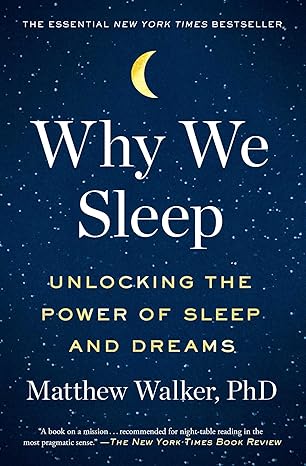
Why We Sleep
by Matthew Walker, PhD
Link blocked? Copy it and paste in a new browser tab.
Your Rating
All ratings are anonymous
Help others by sharing
The book discusses the importance of sleep and how it can impact health in all areas of life. Sleep is universally important and there is currently no known animal that doesn't sleep.
"Sleep is the single most effective thing we can do to reset our brain and body health each day - Mother Nature's best effort yet at contra-death."
Not sleeping quite literally kills us. In fact, the book describes the state of being awake as a poison that only sleep can help clear. Not sleeping can lead to a lot of health problems including a weakened immune system, Alzheimer's, pre-diabetes, coronary arteries becoming blocked and brittle, cardiovascular disease, stroke, congestive heart failure, and weight gain. Psychologically lack of sleep impacts anxiety, depression, and suicidality. It further impacts memory retention, concentration, creativity, and other desirable traits.
You can't catch up on sleep. You read that right. Any sleep lost is lost permanently. Yes, you can sleep more in an attempt to catch up on sleep and feel better but you can never replace lost sleep on a biological level. As sleep regulates the healing of the body, any lack of sleep results in what equates to permanent harm to your body. Most people need between 7-9 hours a night. 0% of people can be unimpaired by 5 hours of sleep or less although a rare group of people naturally sleep with only 6 hours of sleep.
Two main factors that determine when you want to sleep: circadian rhythm and a chemical build-up in the brain. Sleeping cycles change throughout the life span. Teenagers have later sleep cycles hence why they stay up later and sleep later. Elderly adults have the same need for sleep as other adults but often struggle sleeping as the center in the brain for deep sleep is one of the first parts of the brain to deteriorate. This lack of sleep may largely contribute to health deterioration in the elderly.
REM Sleep
REM sleep is the most active brain state besides being awake and is attributed to mental and emotional processing. REM sleep has been shown to be the most impactful sleep in many areas as deprivation of REM sleep leads to psychosis and a relatively quick death. 60-90% of REM sleep occurs during the last part of the night/ early morning. REM sleep helps with emotional intelligence, creativity, and healing trauma. Sleep studies found that sleeping regulates emotions allowing for more emotional control. The author states that REM sleep's role in social cohesion is "one of the most valuable commodities ensuring the survival and dominance of our species as a collective." Studies with sleep on PTSD found that increased REM sleep allowed for the processing of PTSD and reduction in symptomology. REM sleep's impact on creativity is well documented and Thomas Edison used to wake himself up during REM sleep and write down all of his creative ideas, which clearly worked out for him. Not getting enough REM sleep also correlates with autism.
NREM Sleep & Biphasic Patterns
NREM is also very important. NREM sleep trims unnecessary connections while REM builds them. REM sleep is high in formative years and then NREM sleep becomes more dominant as the brain focuses on trimming connections rather than on building them.
Humans naturally fall into a pattern of biphasic sleep, sleeping at night and then again during the day. Abandoning siestas led to a research experiment showing a 37% increase risk of death from heart disease and a mortality risk increase of 60% among workingmen. Naps are shown to increase creativity and productivity in the workplace and some companies are now allowing naps due to its measured impact on work performance and consequent revenue. Looks like Spain has got it right.
The Benefits of Sleep for the Brain and Body
- Enhances memory (by 20-40% according to a study) and creativity.
- Makes you look more attractive.
- Keeps you slim and lowers food cravings.
- Protects from cancer and dementia.
- Wards off cold and the flu.
- Lowers risk of heart attack, stroke, and diabetes.
- Helps depression and anxiety.
- Improved speed (20%) and accuracy (35%) of motor skills when practiced during the evening before sleep. Gained in the last two hours of sleep in the morning.
- Improves sport performance.
- Lowers risk of sport injury.
The Impact of Not Sleeping on the Brain and Body
- Linked to Alzheimer's, anxiety, depression, bipolar, suicide, stroke, and chronic pain.
- Linked to cancer, diabetes, heart attacks, infertility, weight gain, obesity, and immune deficiency.
- Greatly impacts concentration.
- Being awake for 19 hours straight impairs someone as much as being legally drunk. Getting less than 4 hours of sleep in a night increases the risk of an accident by 11.5 times. Drowsy driving has been found to be worse than drunk driving.
- Impaired learning ability.
- Impaired emotional regulation (60%).
Chemical Impact on Sleep
- Caffeine has a half life of 5-7 hours and it blocks the chemical for tiredness called adenosine. Caffeine accumulates which leads people to perpetual sleep deficits. In a study of the effect of drugs on spiders and web creation they found that caffeine led to less functional webs than LSD, marijuana, and cocaine.
- Alcohol is incredibly bad for sleep and memory retention. It lowers the ability of the body to enter deep sleep and thereby prevents deep sleep. It impacts memory retention by 50% even if used a couple days after learning the new information.
- Sleeping pills actually reduce the quality of sleep that you get and allow sleep states similar to that of alcohol. They also erase memories. People in studies of sleeping pills show that those who take sleeping pills are around 5x more likely to die than those not on sleeping pills. Even people who take sleeping pills on occasion, as little as 18 times per year, were 3.5x more likely to die than those that didn't take anything. Those on sleeping pills also had a 30-60% increased risk of cancer. CBT-I, Cognitive Behavioral Therapy for Insomnia, has been found by research to be far more effective than sleeping pills at restoring healthy sleep patterns.
What Helps Sleep
- Maintaining a strict sleep schedule has been found to be the most effective sleep management technique.
- Exercise has been shown to help some with sleep.
- A hot shower or bath can increase sleep ability by 10-15%.
- Not using blue light technology (LED screens) before sleep has been shown to make a difference in ability to sleep.
- Recommended to not be in bed unless sleeping and to not stay in bed if you can't sleep.
- Turn down the temperature at night as the body naturally cools during sleep.
- Not using chemicals that alter the ability to sleep.