- Failed to fetch
Reshaping Patterns Through Physical Form
Using the Yoga 3.0 Replication Manual with AI
The Yoga 3.0 Replication Manual
The Yoga 3.0 Replication Manual is the self-contained companion to The Plasticity of Physical Expression: Reshaping Patterns Through Physical Form, the paper that sets out how physical form may carry meaning and how deliberately changing form may help reshape the patterns held within it. The manual contains the complete anatomical chart, the geometric vocabulary, the mechanics rules, and the testing method — everything an AI needs to apply the theory without any other source material.
How To Use
- Download the manual and give it to an AI. The AI opens with its welcome and opening question, then uses the manual as the reference point for the rest of the conversation.
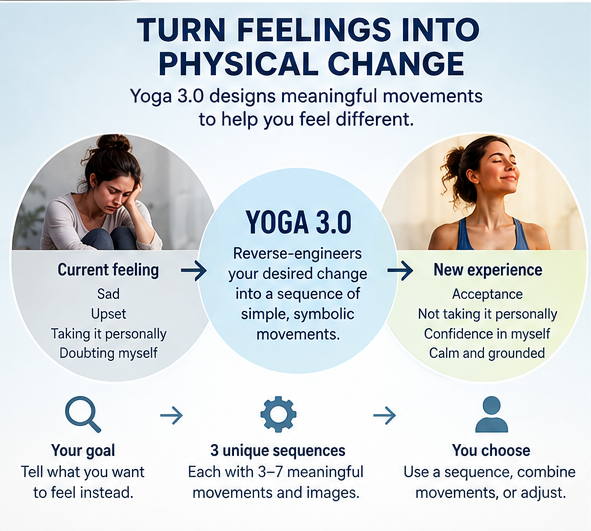
- Describe what is being struggled with, what is believed to be underneath it — the fear, hurt, disappointment, shame, or insecurity beneath the reaction, if known — and what is wanted instead. No psychological, anatomical, or yoga terminology is needed. When the deeper feeling is unknown, the AI offers possible underlying relationships without choosing one as fact. Anger is treated as a secondary response, so the experience beneath it is explored rather than the anger itself.
- Name any practical limits: a seated, standing, lying-down, hand-only, or full-body form; movements, joints, or balances to avoid; whether a chair or props are available; and any side or body region that already carries a personal meaning.
- The AI defines one central change — from the current experience toward the desired one while retaining what matters — finds the exact body regions and geometry in the manual, and offers three genuinely different movement sequences, each with a start, change, and finish chart, its symbolism, and an easier version. Every option carries the manual's full breathing instruction directly beneath its own heading and before its first movement.
- Choose, combine, alter, or reject the proposals through an intuitive understanding of the forms, then record what was actually noticed apart from the intended symbolism. Any form that causes pain, dizziness, or distress is stopped.
Movement should stay within comfortable physical limits, and this practice adds to ordinary care rather than replacing it.
Spiritual theories are speculative frameworks offered for exploration. They are not treatments, and they are not a substitute for the tested methods in the Healing Library.