
The Dunning-Kruger Effect
Psychological Concepts
The Dunning-Kruger Effect
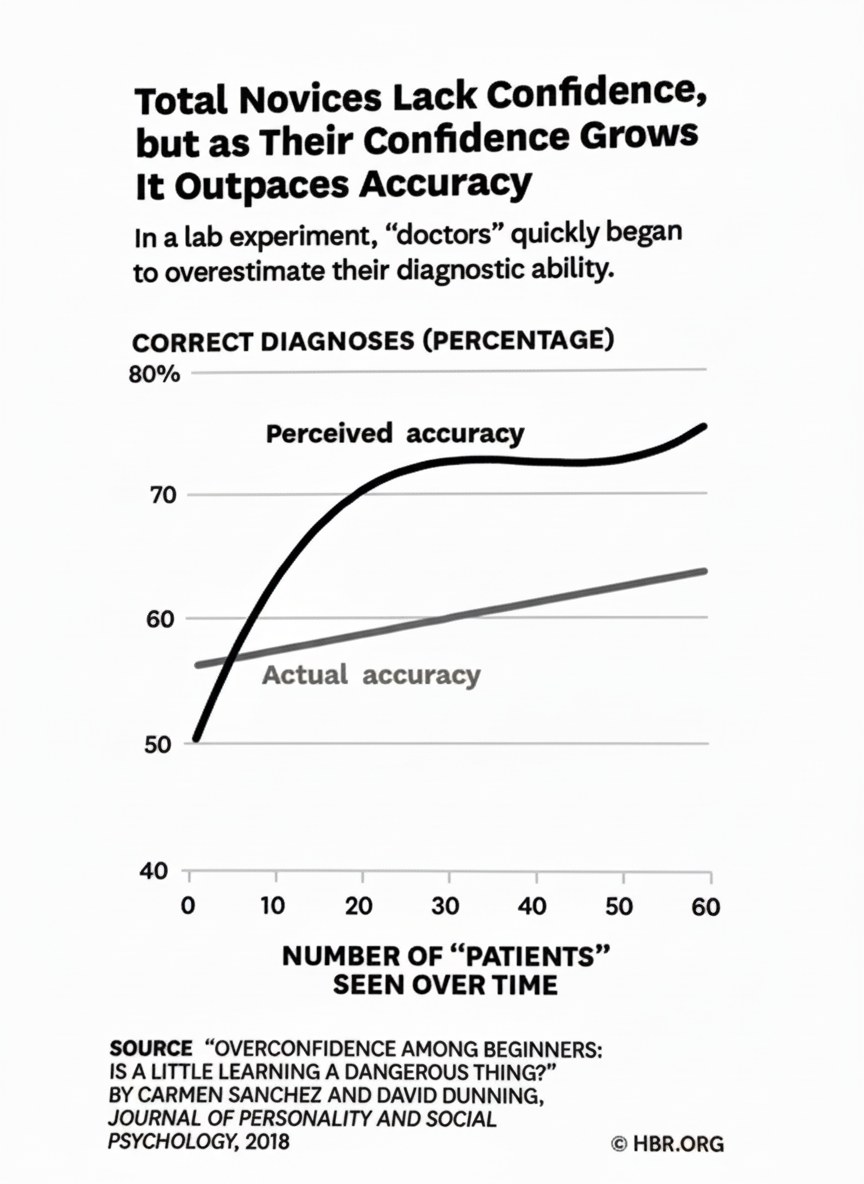
The Dunning-Kruger Effect is a cognitive bias first identified by psychologists David Dunning and Justin Kruger in 1999. Their research revealed a fascinating paradox: people with limited knowledge or competence in a given area tend to overestimate their abilities, while those with genuine expertise often underestimate theirs.
This isn't about intelligence - it's about the relationship between competence and self-awareness. When you know very little about a subject, you also lack the knowledge needed to recognize how much you don't know. As Dunning himself put it, "The first rule of the Dunning-Kruger club is you don't know you're a member of the Dunning-Kruger club."
The effect creates a characteristic pattern: beginners often feel supremely confident, then as they learn more, their confidence drops dramatically as they realize the true depth of the subject. Only after significant learning does confidence gradually rebuild on a foundation of genuine competence.
Why This Matters
Understanding the Dunning-Kruger Effect is essential for self-awareness and personal growth:
Signs & Indicators
Signs You Might Be Experiencing the Effect
- Feeling very confident about a topic you recently learned about
- Dismissing expert opinions that contradict your view
- Getting defensive when your knowledge is questioned
- Rarely saying "I don't know"
- Feeling like most people in your field are incompetent
- Not seeking feedback because you already know you're right
- Explaining complex topics as if they're simple
- Believing you've mastered something after minimal practice
Signs of Healthy Self-Assessment
- Comfortable saying "I don't know" or "I'm not sure"
- Actively seeking feedback and criticism
- Recognizing that experts know more than you in their domain
- Holding beliefs proportionally to evidence
- Changing your mind when presented with good arguments
- Appreciating the complexity and nuance in topics
- Understanding that learning is a continuous journey
- Being curious about where you might be wrong
The Confidence-Competence Gap
The core insight of this effect is that confidence and competence don't always align. When you first learn something, your brain doesn't yet have the framework to understand what mastery looks like. You might read one book on psychology and feel like an expert, unaware of the vast ocean of knowledge that exists. This is sometimes called "Mount Stupid" - the peak of confidence that comes before the valley of despair when you realize how much you don't know.
This happens because genuine expertise requires understanding not just facts, but also the nuances, exceptions, context, and interconnections between ideas. A novice sees the surface; an expert sees the depths. Without knowing those depths exist, the novice assumes the surface is all there is.
The Expert's Curse
Interestingly, the Dunning-Kruger Effect works both ways. True experts often underestimate their abilities because they assume that what comes easily to them must be easy for everyone. They're intimately aware of the gaps in their own knowledge and the complexity of their field, which can lead to imposter syndrome and unnecessary self-doubt.
This creates a troubling dynamic in society: the least qualified people often speak with the most confidence, while the most qualified hedge their statements with appropriate uncertainty. The confident voice tends to be more persuasive, even when it shouldn't be.
Metacognitive Blindness
At its heart, the Dunning-Kruger Effect is a failure of metacognition - the ability to think about your own thinking. When you lack skills in an area, you also lack the metacognitive skills to recognize your deficiency. You don't know what you don't know.
This is why the effect is so insidious: the very skills you need to recognize your incompetence are the same skills you're lacking. It creates a blind spot that's invisible from the inside. Only by actively seeking feedback, remaining humble, and committing to continuous learning can you begin to see past this blind spot.
Wisdom from Socrates
"I know that I know nothing."
— Socrates
This ancient wisdom captures the paradox perfectly: true wisdom begins with recognizing the limits of your knowledge.
Overcoming the Dunning-Kruger Effect
The good news is that the Dunning-Kruger Effect is not a permanent condition. With intentional effort, you can develop more accurate self-assessment. Here are practical strategies:
- Cultivate Intellectual Humility. Start from the assumption that you probably know less than you think, especially in areas where you feel very confident but have limited experience. Ask yourself: "How would I know if I were wrong about this?" If you can't answer that question, you might be on Mount Stupid. Intellectual humility doesn't mean doubting everything - it means holding your beliefs proportionally to the evidence and being genuinely open to updating them when new information arrives.
- Seek Feedback Actively. Because you can't see your own blind spots, you need external perspectives. Actively seek feedback from people with more experience, and more importantly, listen to it without becoming defensive. The feedback that stings is often the most valuable. Create systems for getting honest feedback. Ask specific questions rather than general ones ("What could I improve in this presentation?" rather than "Was that good?"). Thank people for critical feedback to encourage more of it.
- Study the Masters. One of the best ways to calibrate your competence is to study what true expertise looks like in your field. Read the best books, learn from the best teachers, and observe experts in action. This helps you understand how far the rabbit hole goes and where you actually stand on the journey. This often produces the "valley of despair" - that humbling moment when you realize how much you don't know. While uncomfortable, this is actually a sign of progress. You're developing the metacognitive skills to accurately assess your abilities.
- Embrace the Learning Mindset. Replace the goal of "being right" with the goal of "learning." When you prioritize learning, mistakes become data points rather than threats to your ego. You become genuinely curious about where you might be wrong because that's where the growth is. This shift transforms the Dunning-Kruger Effect from a liability into an opportunity. Every time you discover you were overconfident, you've just identified an area for growth.
- Practice Calibrated Uncertainty. Train yourself to express appropriate uncertainty in your statements. Instead of "I know this is true," try "Based on my current understanding..." or "I'm fairly confident, but I could be wrong." This isn't weakness - it's intellectual honesty. Experts in fields like medicine, forecasting, and science practice this constantly. They understand that certainty is often an illusion, and expressing calibrated uncertainty leads to better decisions and more accurate beliefs over time.
The Growth Opportunity
Recognizing the Dunning-Kruger Effect in yourself is actually cause for celebration - it means your metacognitive skills are developing. The moment you realize you might have been overconfident is the moment genuine learning becomes possible.