
Rational Emotive Behavior Therapy
In-Depth Explanation
In-Depth Explanation
Rational Emotive Behavior Therapy
Rational Emotive Behavior Therapy (REBT), created by Albert Ellis, predates and influenced CBT. While CBT focuses on changing thoughts to change emotions, REBT goes deeper: it's not just our thoughts that create emotions and behaviors—it's our underlying belief systems. By identifying and challenging irrational core beliefs, REBT helps create lasting change at the deepest level.
The ABCDE Model
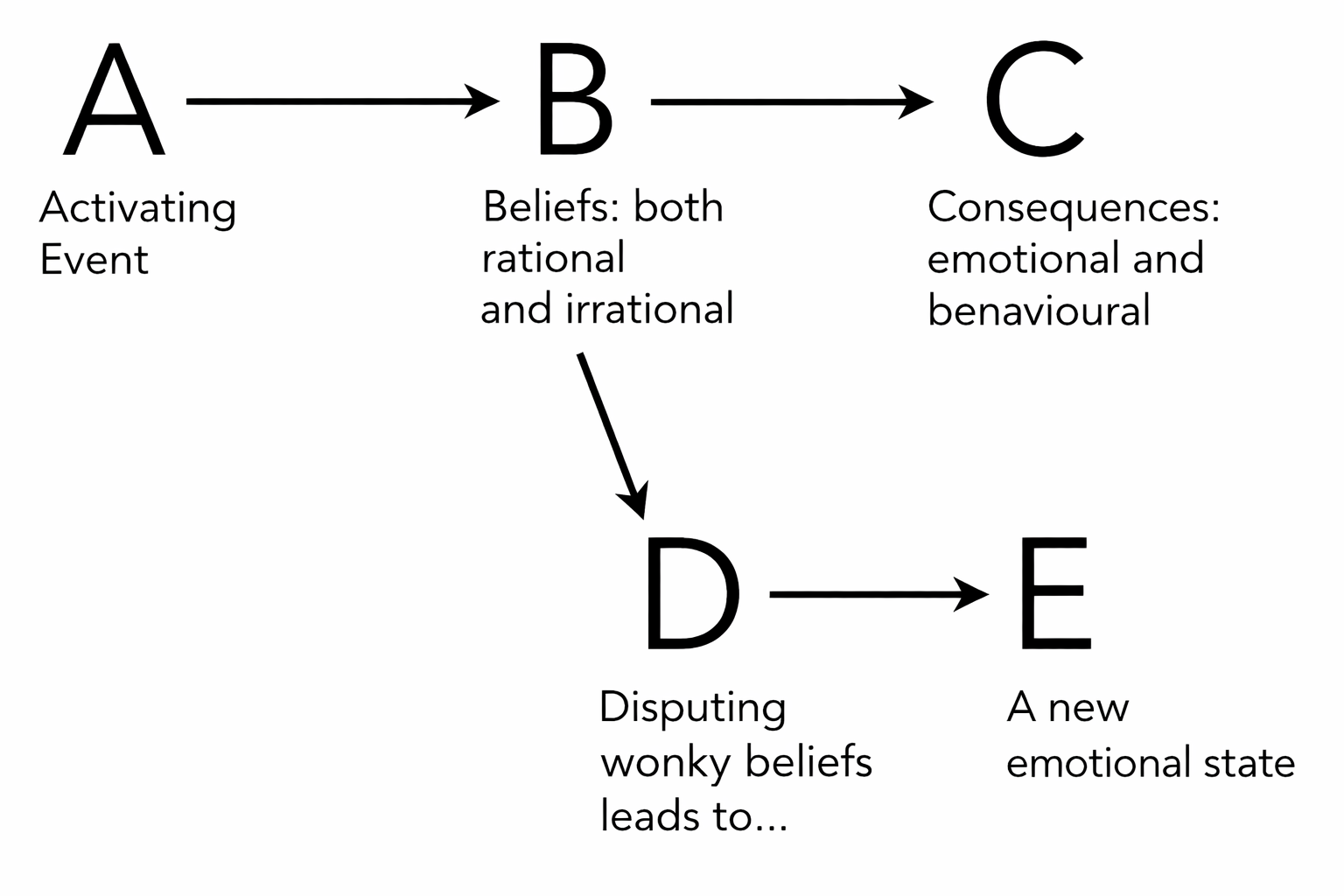
REBT is best explained through its ABCDE formula:
A - Activating Event: The event that triggers the reaction. Crucially, the event itself is always neutral—no matter what it is.
B - Belief: The belief we have about the event, which dictates how we interpret it. This is where the real action happens.
C - Consequence: Our emotional, cognitive, and behavioral reactions—which flow from our beliefs, not directly from the event.
D - Dispute: Actively challenging and trying to change the irrational belief causing the negative consequence.
E - Effecting Change: The new set of reactions that occur as a result of adopting a new, more rational belief about the same event.
How We Actually Use the Model
In practice, we usually apply the formula out of order—starting with C (the consequence we're experiencing), working back to A (what triggered it), and then uncovering B (the belief driving our reaction).
Real-Life Application:
- Notice your emotional reaction (C)
- Identify what triggered it (A)
- Ask: "What belief makes this event so upsetting?" (B)
- Challenge that belief (D)
- Develop a more rational belief (E)
Core Negative Beliefs
REBT specifically targets core negative beliefs—fundamental assumptions about yourself, others, or the world that drive emotional distress. For help identifying your beliefs, see and .
Common Irrational Beliefs:
• "I must be perfect and successful at everything"
• "Everyone must approve of me and treat me fairly"
• "Life must be easy and give me what I want"
• "My worth as a person depends on my achievements"
• "If something bad happens, it's a catastrophe"
The Key Insight: Core beliefs act as filters, causing us to interpret events in predictable (often negative) ways. The same event can devastate one person and barely affect another—the difference is in their beliefs.
Real-Life Application: When you have a strong emotional reaction, trace it back to the underlying belief. Often you'll find an absolute "must" or "should" that, upon examination, isn't actually rational or helpful.
Disputing Irrational Beliefs
The "D" in ABCDE—Dispute—is where change happens. REBT uses four specific techniques to vigorously challenge irrational beliefs:
1. Logical Disputing
Examines whether the belief follows logically. Just because you want something doesn't mean you must have it. "Does it logically follow that because I failed once, I will always fail? Does wanting approval mean I absolutely need it?"
2. Empirical Disputing
Examines the evidence. Is the belief factually true? "Where is the evidence that I must be perfect? Has anyone ever been universally approved of? What proof exists that making mistakes makes me worthless?"
3. Functional/Pragmatic Disputing
Examines the usefulness of the belief. Even if it were true, is holding this belief helping you? "Is believing I must never fail helping me succeed, or is it causing anxiety that hurts my performance? What does this belief cost me?"
4. Philosophical Disputing
Challenges the deeper meaning. Can you still find value and happiness even if the worst happens? "Even if I do fail, does that truly mean life is awful and unbearable? Can I still have a meaningful life without this thing I think I must have?"
Example in Action: Belief: "I must never make mistakes or I'm worthless."
- Logical: Does making a mistake logically equal being worthless?
- Empirical: Has anyone ever made mistakes and still been valuable?
- Functional: Is this belief helping me perform better or worse?
- Philosophical: Can I still have worth and meaning even if I make mistakes?
Putting It All Together
REBT offers a powerful framework for deep, lasting change:
• Events don't cause emotions—our beliefs about events do
• Core beliefs shape how we interpret everything
• Irrational beliefs can be identified and challenged
• New, rational beliefs lead to healthier emotional responses
• Change happens at the belief level, not just the thought level
Recommended Reading: For deeper understanding, the authors suggest "Rational Emotive Behavior Therapy: A Therapist's Guide" by Albert Ellis—a quick read that covers the theory and specific interventions in detail.
Rate This Theory
All ratings are anonymous
Help others by sharing