
Satir Model
In-Depth Explanation
In-Depth Explanation
The Satir Human Validation Process Model
Virginia Satir (1916-1988) was one of the most influential figures in family therapy, known for her warmth, humanism, and emphasis on personal growth and self-worth. Her Human Validation Process Model centers on a radical belief: every person has the internal resources to grow and become more fully themselves. Problems arise not from fundamental defects but from low self-worth and survival-based communication patterns learned in childhood. The goal of Satir's approach is "congruence"—authentic, integrated communication that honors your own needs while respecting others. This guide will help you understand your communication patterns and move toward greater congruence.
Self-Worth: The Foundation
Self-worth is the cornerstone of Satir's model. She believed that our sense of our own value determines how we communicate, relate, and cope with life's challenges.
Low Self-Worth: When we don't feel inherently valuable, we develop survival-based coping styles. We placate to avoid rejection, blame to deflect attention from our vulnerability, compute to seem invulnerable, or distract to avoid issues altogether. These patterns protect us but prevent authentic connection.
High Self-Worth: When we feel fundamentally valuable—not because of what we do but because of who we are—we can communicate honestly, take risks, admit mistakes, and remain open to others. We don't need to protect ourselves constantly because we trust our fundamental okay-ness.
Satir's Famous Quote: "I am me. In all the world, there is no one else exactly like me. I own everything about me—my body, my feelings, my mouth, my voice, all my actions—whether they be to others or myself. I own my fantasies, my dreams, my hopes, my fears. I own all my triumphs and successes, all my failures and mistakes... I am me, and I am okay."
Self-Practice: Reflect on your self-worth. Do you feel fundamentally valuable, regardless of your achievements or others' approval? Notice when your self-worth dips—what triggers it? Begin practicing self-validation: affirming your worth independent of performance.
The Four Survival Stances
Satir identified four dysfunctional communication patterns that people adopt when under stress. These are survival stances—protective strategies that helped us cope as children but limit us as adults.
1. Placating (Self-Sacrifice)
The placater ignores their own needs to keep others happy. "Whatever you want." "I don't mind." "It doesn't matter." Internally: "I'm worthless without your approval." Placaters sacrifice themselves to avoid conflict and rejection, but end up feeling resentful and invisible.
2. Blaming (Attack)
The blamer protects themselves by finding fault in others. "It's your fault." "You never..." "What's wrong with you?" Internally: "If I attack first, no one can see how afraid I am." Blamers appear strong but push others away and never get their real needs met.
3. Computing (Super-Reasonable)
The computer intellectualizes and stays in the head to avoid vulnerable feelings. "One must consider all factors." "Logically speaking..." Internally: "Feelings are dangerous—better to stay cerebral." Computers seem calm but are disconnected from themselves and others.
4. Distracting (Irrelevance)
The distracter changes the subject, jokes, or creates chaos to avoid dealing with issues. "Hey, look over there!" Random tangents and deflections. Internally: "If I keep moving, no one can corner me." Distracters avoid pain but never address underlying problems.
Self-Practice: Identify your primary stance(s). Which do you default to under stress? Notice when you shift into survival mode. What triggers it? What would you be feeling if you weren't using this stance?
Congruence: The Goal
Congruence is the alternative to survival stances. It's communication that's honest, direct, and honors yourself, the other person, and the context. All three elements are in alignment.
The Three Elements of Congruence:
• Self: You acknowledge and honor your own feelings, needs, and worth
• Other: You acknowledge and honor the other person's feelings, needs, and worth
• Context: You remain appropriate to the situation and its realities
What Congruence Sounds Like: "I feel hurt when you cancel plans at the last minute. I'd like us to find a way to communicate better about scheduling." Notice: expressing feelings (self), not blaming (other), focused on resolution (context).
Congruence Is Not: Simply assertiveness or saying whatever you feel. It includes respect for others and awareness of context. You can be congruent and still choose not to share everything if the context doesn't support it.
Self-Practice: In your next difficult conversation, pause and check: Am I honoring myself? Am I honoring the other person? Am I appropriate to this context? If any element is missing, adjust. Congruence is a practice, not a destination.
The Personal Iceberg
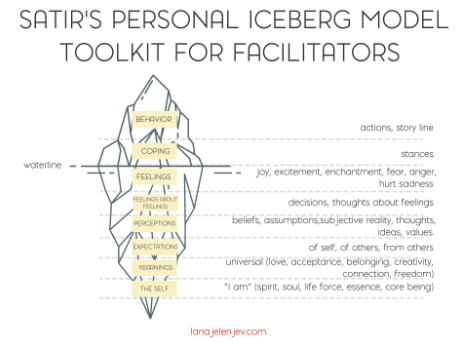
Satir's iceberg metaphor illustrates that behavior (what we can see) is just the tip. Beneath the surface lie multiple layers of internal experience that drive our actions.
The Levels (Top to Bottom):
Behavior: What others can observe—actions, words, expressions.
Coping: The stances we take (placating, blaming, computing, distracting).
Feelings: Emotions about the situation—fear, anger, sadness, joy.
Feelings About Feelings: How we judge our emotions. "I shouldn't be angry." "It's weak to be sad."
Perceptions: Our interpretations and beliefs about what's happening.
Expectations: What we expect from ourselves, others, and life.
Yearnings: Universal human longings—to be loved, to belong, to matter, to be free.
Self: Our essential nature, the "I Am" at our core.
Click image to enlarge
Self-Practice: When you're upset, work through the iceberg. What am I doing (behavior)? How am I coping? What am I feeling? How do I feel about those feelings? What am I perceiving/believing? What was I expecting? What do I really yearn for beneath all this?
The Five Freedoms
Satir articulated Five Freedoms—permissions we need to give ourselves to live authentically. Many of us learned as children that these freedoms were dangerous or wrong.
The Freedom to See and Hear: To perceive what is actually present, rather than what "should be" or what we've been told is there. Trusting your own perception.
The Freedom to Think: To think what you think, rather than what you "should" think. Having your own opinions and ideas.
The Freedom to Feel: To feel what you feel, rather than what you "should" feel. All emotions are valid information.
The Freedom to Want: To ask for what you want, rather than waiting for permission. Your needs and desires matter.
The Freedom to Imagine: To take risks and be creative on your own behalf, rather than always playing it safe. Trusting yourself to handle the consequences.
Self-Practice: Which freedoms are difficult for you? Were you taught that certain perceptions, thoughts, feelings, wants, or creative expressions were unacceptable? Practice giving yourself permission in these areas. "I am allowed to feel angry." "I am allowed to want this for myself."
Family Rules
Every family has rules—some spoken, most unspoken—about what's allowed and what isn't. These rules shape how family members communicate, express emotion, and relate to each other.
Dysfunctional Rules Often Include:
- "Don't talk about problems."
- "Don't express negative emotions."
- "Don't ask for what you need."
- "Keep the peace at all costs."
- "Loyalty to family means not talking to outsiders."
- "Some topics are off-limits."
How Rules Limit Us: Rules learned in childhood often operate unconsciously in adulthood. You may feel vaguely wrong when breaking a family rule, even if you consciously know it's unhealthy.
Self-Practice: Identify your family's unspoken rules. What couldn't you talk about? What emotions were unacceptable? Which rules do you still unconsciously follow? Begin questioning whether these rules serve you now.
The Primary Triad
Satir emphasized the primary triad—mother, father, and child—as the foundational relationship pattern that shapes our expectations and behaviors in all future relationships.
What We Learn in the Primary Triad:
- How to be intimate with others
- How relationships work (or don't)
- How conflict is handled
- Our worth and value
- What we can expect from others
Patterns Repeat: We tend to recreate familiar patterns in adult relationships. If Mom was critical, we might be drawn to critical partners—or become critical ourselves. Understanding these patterns is the first step to changing them.
Self-Practice: Reflect on your primary triad. What did you learn about relationships from your parents? What patterns do you see repeating in your adult relationships? Awareness allows choice—you can consciously create different patterns.
Applying Satir's Model to Your Life
Step 1: Recognize Your Stances
Over the next week, notice when you shift into survival stances. Are you placating? Blaming? Computing? Distracting? Don't judge—just observe. Awareness is the beginning of choice.
Step 2: Explore Your Iceberg
When you're triggered, pause and go beneath the surface. What are you feeling? What do you feel about those feelings? What are you perceiving? What did you expect? What do you really yearn for?
Step 3: Practice the Five Freedoms
Give yourself permission to perceive, think, feel, want, and imagine. Notice resistance—"I shouldn't feel this way"—and gently counter it. Your inner experience is valid.
Step 4: Work Toward Congruence
In difficult conversations, practice balancing self, other, and context. Express your truth while honoring the other person and staying appropriate. This is a practice, not perfection.
Step 5: Build Self-Worth
Practice self-validation. Affirm your worth not because of what you do but because of who you are. Treat yourself with the compassion you'd offer a good friend.
Satir's Vision: Virginia Satir believed in human potential—that everyone can grow, change, and become more fully themselves. Her model isn't about fixing what's broken but about freeing what's already whole. You have the resources within you. The work is removing the blocks that prevent you from accessing them.
Rate This Theory
All ratings are anonymous
Help others by sharing