
The Architecture of Change: Chakras, Biology, and the Reorganization of Human Function
Love's Curriculum: The Growth Of Consciousness / Paper Eleven
The Architecture of Change: Chakras, Biology, and the Reorganization of Human Function
1. The Question Left by Neural Synchrony
A person can spend years wanting dessert every night and then realize that the desire is simply gone. Someone who never cared about endurance exercise can begin wanting to run trails. A person who once responded strongly to physical attractiveness can discover that appearance alone no longer creates much interest unless emotional connection is present. Another person becomes unexpectedly more affectionate toward people or animals, more willing to speak publicly, or more attentive to subtle changes inside the body. None of these shifts has to arrive as a dramatic event. Often the conscious explanation is only, "I do not really want that anymore," or, "I just started wanting something different."
The first nine works of Love's Curriculum have already built most of the mechanism needed to understand why such changes matter. Recursive Decoding: The Conscious Acceleration of Awareness explains how a relationship learned in one form can become reusable across later experiences [1]. Decoding Reality: The Keys of Consciousness defines access as what information, relationship, state, or capacity is presently available to conscious participation and describes keys that can move that boundary [2]. Defining Consciousness: The Experiences Within Quantum Organization places those changes inside an organized living system whose conscious state depends on relations among differentiated processes [3]. The Sword of Truth: The Power of Resonant Words shows how precise language can make an implicit organizing relationship consciously recognizable [4]. The Language of Energy: How the Body Uses Symbology to Heal shows how the body can discover state-changing relationships before conscious explanation and later preserve their direction in symbolic language [5]. Causal Geometry: How Physical Form Organizes Energy establishes that form can physically instantiate relationships rather than merely symbolize them [6]. Physical Form Compendium: How The Body's Form Organizes Energy carries those relations into anatomy, support, contact, and movement [7]. The Mechanics of Becoming: Healing, State Change, and the Recursive Development of Consciousness explains how temporary experience can become durable organization [8]. Neural Synchrony: How Consciousness Connects then asks what becomes possible when differentiated capabilities begin coordinating, integrating, and producing functions unavailable to the parts alone [9].
That leaves a new question. If development occurs through changing organization among differentiated systems, where does that reorganization become visible in a human life? Which recurring domains change when a person becomes more stable, more creative, more agentic, more relationally open, more expressive, more perceptive, or more capable of integrating a larger whole?
The seven-chakra system provides an old language for exactly this kind of question. The proposal of this paper is not that seven invisible anatomical organs have already been scientifically established. It is that the chakra system can be read as a traditional classification of recurring domains of human state change. The modern biological question is then not whether one vocabulary defeats the other, but whether the domains named by the chakra system correspond to recognizable clusters of physiological, psychological, and behavioral reorganization.
The first nine theories explain relationships, access, embodiment, development, and integration. The Architecture of Change asks where those changes become visible across the whole person.
2. State and Behavior Form a Recursive Loop
A behavior is never produced by the external stimulus alone. Hunger changes the value of food. Exhaustion changes the value of rest. Fear changes the meaning of an ambiguous sound. Social context changes what feels safe to say. Internal state, prior experience, present context, and ongoing action continually alter how information is valued and which responses become likely [10]. The same object can therefore produce a different response because the organism evaluating it has changed.
Allostasis gives this process a biological language. Rather than waiting passively for every disturbance, the nervous system predicts likely needs and prepares the body in advance. It allocates resources, anticipates demands, and changes behavior according to what it expects will preserve workable regulation [11,12]. A preference can therefore be understood partly as a state-dependent valuation: this food, person, activity, environment, or action is expected to move the organism toward something useful.
When the organism changes, the valuation can change. Sweets may once have functioned as reward, stimulation, comfort, quick energy, and routine; if some of those needs change, the same food can lose its pull. Running may once have registered mainly as effort; after changes in motivation, regulation, competence, or sensory reward, the same activity can become attractive. Physical beauty may once have carried strong sexual salience; if sexuality becomes more tightly coupled to attachment or emotional significance, appearance alone may become insufficient to mobilize desire.
The direction also runs backward. Behavior changes the state that will evaluate the next event. Exercise changes physiology. Speech changes social consequences. Rest changes metabolic demand. A boundary changes a relationship. A ritual changes sensory input and prediction. The Mechanics of Becoming already describes learned patterns as feedback loops in which expectation changes physiology and action, action changes the environment, and the resulting experience can reinforce or revise the expectation [8]. State shapes behavior, and behavior reshapes state.
Persistent behavioral discontinuity is therefore informative, but it is not self-interpreting. The useful question is not merely, "Why did I stop doing that?" It is also, "What state did that behavior once help create, what does it create now, and what changed in the system that assigns value to it?"
3. From State Fluctuation to Phase-Like Reorganization
Human life contains state changes at many scales. The Architecture of Change needs a vocabulary that can distinguish them without calling every changed preference a major transformation.
A state fluctuation is momentary: a brief change in arousal, attention, desire, emotion, or bodily organization. A micro-state shift is a small change that begins to recur or persist: criticism no longer produces quite the same alarm, a craving weakens, affection becomes easier, or a once difficult conversation requires less effort. A domain reorganization occurs when several related micro-shifts change a wider functional category, such as the person's relationship with pleasure, agency, attachment, expression, or perception. A cross-domain phase-like transition occurs when changes across several domains begin reinforcing one another strongly enough that the person settles into a different overall organization.
This hierarchy extends the distinction already made in The Mechanics of Becoming. That paper separates temporary state change from deeper changes in learned associations, central organizing expectations, and the conditions of future development [8]. The present paper adds a second dimension: where those changes are distributed across the person.
Attractor dynamics offer a useful picture. An attractor is a pattern toward which a dynamical system tends to return. Neuroscience uses attractor models to explain persistent activity, memory, error correction, and integration of noisy information [13]. Imagine a marble inside a landscape of valleys. A temporary push can move the marble without changing the landscape; once the disturbance ends, the marble rolls back. Repeated learning can gradually reshape the landscape itself. Eventually another valley may become easier to occupy than the old one.
A transition can therefore look sudden even when its preparation was gradual. Critical-transition research has explored whether psychological systems can show warning dynamics before a shift, including changes in variability and recovery from perturbation [14]. Those findings do not establish that every human change is a formal physical phase transition. They justify the more limited organizational analogy already developed in Defining Consciousness and The Mechanics of Becoming: similar parts can enter different relations, and a threshold can produce a qualitatively different whole [3,8].
The important idea is not that every new habit is a phase change. It is that large reorganization may be built from many small changes that become coordinated across domains.
4. Chakras as a Translation System
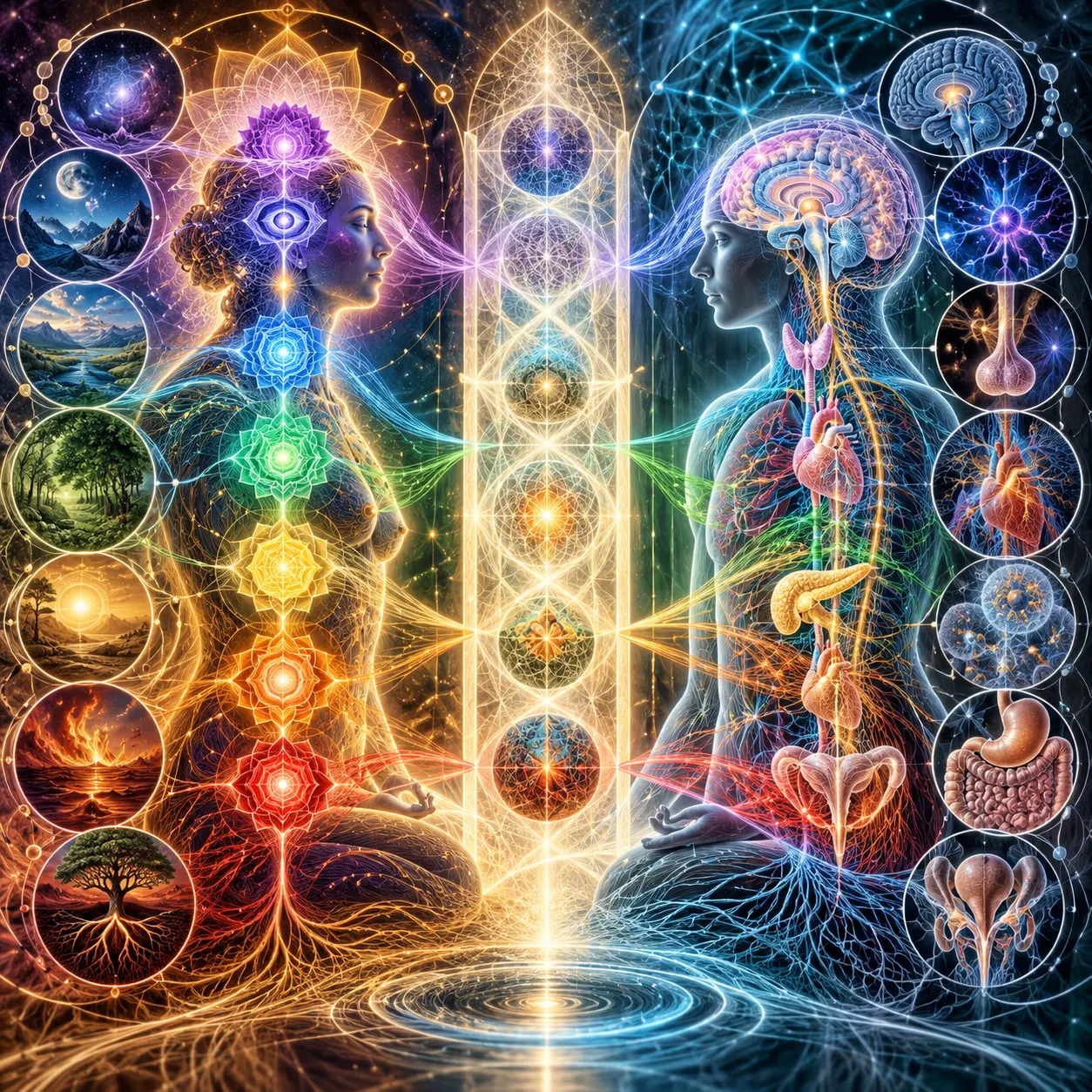
The chakra system becomes most useful when treated as a language of organization rather than as a demand that modern biology confirm an ancient anatomical diagram. A translation is not an identity. The word heart can name a cardiac organ, a region of the chest, courage, grief, affection, or the felt center of emotional life. Those meanings overlap without becoming interchangeable. Chakra language can be approached with the same discipline.
Modern authors have proposed relationships between chakra locations and endocrine glands or major nerve plexuses, and recent theoretical work has proposed neurophysiological models organized around plexus regions [15]. These correspondences are hypotheses, not settled anatomical equivalences. Historical chakra systems also vary in number, location, symbolism, and doctrine [21]. The stronger proposal does not require claiming that ancient practitioners secretly discovered the endocrine system. It asks whether recurring experiential categories were organized around bodily regions where multiple physiological processes are also integrated.
The translation can therefore move through five levels. Traditional language names a chakra. Subjective experience describes what the person feels. Behavior shows what becomes easier, harder, more attractive, less necessary, or newly possible. Physiology describes interacting neural, endocrine, autonomic, immune, metabolic, and sensory processes. Systems organization describes the relationships among those processes that generate the larger function.
The same event can be described at all five levels without collapsing them. A person may call an experience heart opening. Subjectively, they report greater affection, tenderness, compassion, or willingness to remain emotionally present. Behaviorally, they seek connection more readily, recover from relational injury faster, or show more spontaneous warmth toward people and animals. Biologically, one can investigate attachment, affiliative reward, social cognition, interoception, autonomic regulation, and co-regulation. The terms are not identical. They are translations across levels of one lived event.
This is consistent with the distinction established throughout the curriculum. The Language of Energy separates physical mechanism, experienced direction, and symbolic description [5]. Causal Geometry separates structural action from representational action [6]. Physical Form Compendium separates geometry from anatomy and personal meaning [7]. The Architecture of Change applies the same rule to chakras: the symbol, bodily region, subjective state, biological mechanism, and behavior may refer to one event without becoming the same kind of evidence.
5. Seven Functional Domains of Change
The seven commonly taught chakras can now be translated into seven broad functional domains. The categories are intentionally broad. Their purpose is to locate change, not to force one behavior into one anatomical structure.
| Chakra | Functional domain and question | Examples of micro-state shifts | Possible biological translation |
|---|---|---|---|
| 1. Muladhara - Root | Stability and survival regulation Can the system remain emotionally and physiologically stable while conditions change? | Less fear-driven behavior; less reassurance seeking; faster recovery after disruption; changed sleep or food regulation; greater tolerance for uncertainty. | Autonomic regulation; stress and threat systems; allostasis; homeostatic control; interoceptive regulation. |
| 2. Svadhisthana - Sacral | Generativity, desire, pleasure, sexuality What feels worth moving toward, enjoying, bonding with, or creating? | Changed cravings; changed sexual attraction; stronger or more selective desire; new creative output; changed novelty or sensory interests. | Reward and motivation; reproductive biology; salience; novelty; imagination; approach behavior. |
| 3. Manipura - Solar Plexus | Self-worth, agency, directed action Can internal value and intention become sustained choice and action? | Stronger boundaries; easier initiation; less permission-seeking; greater confidence; more persistence; new mastery or exercise behavior. | Executive control; action selection; inhibition; persistence; self-evaluation; metabolic mobilization. |
| 4. Anahata - Heart | Love, attachment, compassion, relational openness How much connection can be experienced without losing differentiation? | More affection; deeper attachment to people or animals; less resentment; greater compassion; easier relational recovery. | Attachment; affiliative reward; empathy; social cognition; autonomic co-regulation; interoception. |
| 5. Vishuddha - Throat | Truthful expression and externalization Can inner experience become accurate expression in the world? | Speaking more directly; saying no; writing or teaching; public expression; easier emotional disclosure; greater congruence between belief and speech. | Language; vocalization; motor expression; self-disclosure; social inhibition; respiratory-vocal coordination. |
| 6. Ajna - Third Eye | Relational perception, pattern recognition, metacognition What can I detect, relate, and understand that was previously unavailable? | Noticing subtle bodily signals; earlier pattern detection; stronger metacognition; recognizing invariant relationships across situations or disciplines. | Attention; interoception; abstraction; relational reasoning; predictive processing; metacognition. |
| 7. Sahasrara - Crown | Meta-integration and whole-system synthesis Can differentiated domains be understood as one larger organization without erasing their differences? | Worldview reorganization; formerly separate subjects becoming coherent; priorities changing around a larger model; greater integration across domains. | Large-scale integration; synthesis across representations; network-level coordination; correspondence remains especially theoretical. |
Several corrections follow from this translation. Root is not maximum stillness; useful stability must permit change. Solar Plexus is not merely action; it includes the internal authority and self-worth that allow action to be chosen rather than compulsively performed. Third Eye is not any unusual sensation; bodily sensitivity becomes relevant when signals can be noticed, related, interpreted, and placed into a wider pattern. Crown is not integration in general, because integration already occurs throughout the nervous system and throughout the curriculum. Crown is better treated here as meta-integration: increasing recognition of how differentiated domains belong to a larger whole.
6. A Chakra Is a Domain, Not a Level
The numbered sequence can easily suggest that a person completes one chakra and moves upward to the next. The present model rejects that interpretation. A person occupies a changing configuration across all seven domains at once. Stability can improve while expression remains constrained. Creative generativity can be intense while agency is weak. Perception can become unusually sensitive while integration remains poor. Greater activity in one domain does not establish greater development of the whole.
The ordered sequence still has meaning. It can describe increasing functional complexity. Regulation influences what can be safely desired. Desire creates movement toward action. Action enters relationship. Relationship creates the need for truthful expression. Expression and experience provide material for increasingly explicit perception. Perception can eventually make the relationships among domains themselves recognizable. But once several domains are operating, information moves both upward and downward. The sequence describes one developmental grammar; recursion describes the functioning organism.
This resolves the apparent conflict between sequential and simultaneous change. A lower-domain shift can create conditions for an upper-domain change, but an upper-domain insight can also reorganize a lower-domain response. Greater relational understanding can reduce Root threat. Greater Heart connection can change Sacral attraction. Third Eye recognition can change Solar Plexus choice. Crown-level synthesis can change the meaning assigned to every other domain. Development is not a staircase. It is a network whose nodes have a traditional order but whose influence is reciprocal.
7. Two Axes of Change: Energetic Direction and Functional Domain
The Language of Energy and The Architecture of Change answer different questions about the same event. The Language of Energy asks what direction a transition takes: grounding, expansion, containment, release, flow, rhythm, elevation, descent, connection, or another recurring transformation [5]. The Architecture of Change asks where in human function that transition becomes consequential: stability, generativity, agency, connection, expression, perception, or meta-integration.
Those are two different axes. Grounding can primarily affect Root in one situation and Heart in another. Expansion can be Sacral when it appears as increased creative possibility, Throat when it appears as broader expression, or Crown when it allows previously separate concepts to enter one model. Connection can occur within Heart attachment, Third Eye pattern recognition, Neural Synchrony between differentiated brain systems, or social coordination between people. The energetic direction describes the transformation; the chakra domain describes the functional territory in which that transformation matters.
Physical Form Compendium adds still another axis: the concrete bodily configuration through which the change is enacted [7]. The Mechanics of Becoming adds depth and durability: whether the change is merely visited or becomes an ordinary capacity [8]. Neural Synchrony adds organization among differentiated functions: whether domains merely coexist, coordinate in time, integrate, or create synergistic capability [9].
One event can therefore be described by its physical form, energetic direction, functional domain, developmental depth, and degree of integration without treating those descriptions as competitors.
8. The Behavior Is Not the Chakra
Once the model has more than one axis, fixed symbolic dictionaries become less useful. The same behavior can serve different functions, and different behaviors can serve the same function. Trail running gives a simple example. One person may use it mainly for Root regulation because rhythmic movement, exertion, and environmental contact help the system settle. Another may experience it as Sacral pleasure and sensory aliveness. Another may seek Solar Plexus mastery and challenge. Another may experience Heart connection with nature. Another may use movement to make bodily and cognitive patterns easier to notice, giving the same run a Third Eye function.
Biology contains a related principle called degeneracy: structurally different components can support similar functions, while the same components can participate in different functions depending on context [16]. Degeneracy gives living systems robustness, flexibility, and multiple routes toward useful outcomes.
This is exactly why Reverse State Mapping in The Language of Energy cannot become a universal chart in which walking means one thing and water means another [5]. The practical question is relational. What was the person's state before the behavior? What changed afterward? Which other actions create a similar transition? Which features of the activity appear necessary? Which domain changed most clearly? The same action can be classified differently when its function changes.
A useful mapping therefore looks more like this: behavior -> physical operations -> energetic direction -> functional domain -> biological mechanisms -> resulting state. Then the recursion continues: the changed state alters future valuation, which changes future behavior. The dictionary is not a list of symbols. It is a map of relationships.
9. Connectivity, Synchrony, Integration, and Synergy Across Domains
Neural Synchrony: How Consciousness Connects distinguishes four relationships that now become useful for the chakra model [9]. Connectivity means that two domains can influence one another. Synchrony means that features of their activity become coordinated in time. Integration means that differentiated contributions participate in one functioning whole. Synergy means that their joint organization makes a capability available that cannot be recovered from either contribution separately.
Root and Heart can be connected because relational safety influences regulation and regulation influences relational openness. They become synchronized when changes in stability and connection begin moving together. They become integrated when the person's capacity for deep feeling depends on remaining regulated and that regulated openness changes how relationships are handled. A synergistic capability could then appear: the person can remain emotionally open during an intensity that previously required either withdrawal or flooding.
Heart and Sacral can be connected when attachment changes sexual valuation. If emotional resonance increasingly determines what becomes sexually salient, a new attraction profile emerges from the relationship between two domains rather than from either one alone. Sacral and Throat can integrate when creativity creates pressure for expression and expression, in turn, clarifies and generates further creativity. Solar Plexus and Throat can integrate when internal authority reduces the cost of public expression while successful expression reinforces agency. Root and Third Eye can integrate when subtle internal signals become easier to notice without becoming threatening, allowing more information to be perceived precisely because regulation has improved.
This is the biological principle developed in Neural Synchrony applied to person-level domains: capability may reside in the relationships among differentiated functions. The novelty is often in the edges, not the nodes. A person can possess sexuality, attachment, language, interoception, agency, and creativity separately while lacking the coordination that would allow them to operate as one more capable system.
Interdisciplinary intelligence gives an intuitive cognitive example. A person can know psychology, biology, physics, music, and systems theory as separate subjects while generating relatively little novelty. Relational reasoning allows structures learned in one domain to reorganize understanding in another [17]. The new insight need not come from possessing more facts. It can come from increasing the number of useful relationships among facts. Cross-domain development may work similarly: the parts already exist, but their new organization changes what the whole can do.
10. Access, Transition Cost, and Latent Capacity
Access already has a precise meaning in Love's Curriculum: the information, relationship, state, or capacity presently available to conscious participation [2,3]. The Architecture of Change should therefore not redefine access. It adds one possible constraint on access: transition cost.
A capacity can belong to the organism's possible repertoire while remaining poorly accessible because entering the required organization is difficult, unstable, metabolically demanding, dependent on narrow conditions, or easily disrupted. Network control theory provides a mathematical analogue by asking how network structure influences the input required to move a brain from one activity configuration toward another [18]. A control-energy estimate is not a direct measure of the subjective effort required to love, create, speak, or meditate. The structural point is that the same network can contain multiple possible states while some transitions are much easier than others.
Everyday development often looks exactly like a change in transition cost. At first, meditation may require twenty minutes before quiet becomes available; later a similar organization can appear within seconds. Vulnerable speech may initially require rehearsal and intense effort; after repeated successful expression, honesty may become easier than concealment. Exercise can move from something deliberately forced into something the body spontaneously seeks. Creative work can shift from laboriously generating ideas into trying to capture ideas quickly enough.
The Mechanics of Becoming already explains why repeated access can become more stable through prediction updating, plasticity, generalization, recovery, and metaplasticity [8]. Neural Synchrony adds that new functional partnerships can create capacities unavailable to isolated systems [9]. The Architecture of Change now supplies a way to observe where the reduced access cost appears. A change may first become visible as less Root alarm, more Sacral generativity, easier Solar Plexus action, more Heart openness, freer Throat expression, earlier Third Eye recognition, or broader Crown synthesis.
Latent capacity therefore does not have to mean a dormant organ or an unused brain region. It can mean a configuration the organism can technically produce but rarely reaches, cannot sustain, or reaches only under special conditions. Development can increase access by changing routing, coupling, prediction, transition cost, and integration among systems already present.
11. Development Is Flexible Integration, Not Maximum Activation
If chakras are functional domains, then more activity cannot automatically mean more development. Constant speech is not advanced Throat functioning. Intense sexual pursuit is not advanced Sacral functioning. Hypervigilance is not advanced Third Eye perception merely because the person notices many details. Emotional flooding is not advanced Heart functioning merely because feeling is intense.
The Mechanics of Becoming already distinguishes intensity from durable development and evaluates change through what becomes possible afterward [8]. Defining Consciousness likewise argues that greater consciousness cannot be reduced to one dimension; integration, access, awareness, differentiation, self-reference, and stability can change independently [3]. The present paper applies that logic to the seven domains.
A better marker is flexible access with integration. Sexual energy can become strong without becoming compulsory. Emotional openness can increase without erasing boundaries. Agency can become decisive without becoming domination. Expression can become honest without becoming indiscriminate. Perception can become more sensitive without losing the ability to filter noise. Meta-integration can become wider without collapsing genuine differences into one vague explanation.
Metastability provides a useful analogue. Metastable brain dynamics allow temporary coordination without requiring every part to remain permanently synchronized [19]. Too much segregation prevents useful exchange. Too much uniformity destroys differentiation. Flexible systems can assemble, disassemble, and reorganize according to present demands.
This reframes Root especially clearly. Stability is not immobility. A system that never changes may simply be rigid. Functional stability means being organized enough to tolerate change without disintegrating. Greater stability can permit greater exploration; exploration creates new states; new states require integration; successful integration creates a more capable form of stability. The developmental image is therefore recursive: stability permits change, change creates complexity, complexity demands integration, and integration creates a new foundation for further change.
12. Measuring Development Across Domains
The Mechanics of Becoming proposes four dimensions for comparing change: depth, reach, generalization, and stability [8]. Depth concerns how organizationally central the affected pattern is. Reach concerns how many other responses depend on it. Generalization concerns how widely the new learning transfers across situations. Stability concerns whether the response can be reproduced and sustained without the original conditions.
The Architecture of Change adds two dimensions that belong specifically to a domain map. Domain breadth asks how many functional domains are changing during the same period. Domain synchrony asks whether those changes are beginning to move together and reinforce one another.
A person who starts running has experienced a behavioral change. If running becomes one route toward improved regulation, that may represent a Root micro-state shift. If sleep, food regulation, reactivity, and tolerance for uncertainty also change, the evidence for a broader Root reorganization becomes stronger. If during the same period creativity increases, attraction becomes more emotionally selective, agency strengthens, affection expands, expression becomes easier, and subtle patterns become more noticeable, the scientific question changes again. The issue is no longer one behavior. It is coordinated reorganization across several domains.
The dimensions can also separate spectacular states from deep change. A dramatic altered state can have enormous intensity but little generalization or stability. A quiet reduction in a central survival expectation can change thousands of later decisions. A sudden burst of creativity can be transient, while a modest increase in agency can make creative work consistently executable. Developmental importance therefore depends on the organization created and sustained, not on how extraordinary the moment feels.
13. Transition, Hysteresis, and the Difference Between Reorganization and Development
A major transition and the integration of that transition are not the same event. Crossing a threshold can happen quickly. Making the resulting organization reliable may take much longer.
Hysteresis describes systems in which the path into a state and the path out of it are not identical. Human brain networks during anesthesia and recovery provide one example: loss and recovery of consciousness can follow different network trajectories, demonstrating that present state depends partly on the history of the system [20]. The broader lesson is structural. The conditions required to create a transition do not have to be the same conditions required to maintain the resulting organization.
Years of healing, practice, relationship, meditation, repeated action, or accumulated insight can prepare a threshold. After the threshold is crossed, the person may no longer require the original intensity of those inputs. A difficult response can become ordinary. The new organization begins generating itself.
But transition is neutral. Trauma can reorganize a person. Addiction can reorganize reward. Chronic stress can reorganize sleep, appetite, attention, and social behavior. Illness can reorganize priorities and physiology. Falling in love can reorganize valuation. Healing can reorganize them again. A transition becomes developmental only when the resulting organization increases coherent capacity rather than merely producing difference.
This is why the chakra model should not treat every unusual activation as advancement. A person can experience intense perceptual, emotional, sexual, or spiritual states without having the regulatory capacity to integrate them. The later theory Spiritual Psychosis: Psychosis and the Reorganization of Consciousness will require exactly this distinction. Reorganization can outrun integration. The developmental question is whether the new state becomes more accurate, more flexible, more generalizable, more stable, and more compatible with functioning across the rest of the system.
14. What The Architecture of Change Adds to Love's Curriculum
The first nine works can now be restated as a continuous argument. Recursive Decoding: The Conscious Acceleration of Awareness establishes that awareness accelerates when it recognizes relationships that survive changes in surface form [1]. Decoding Reality: The Keys of Consciousness explains how patterns, states, symbols, relationships, environments, and other keys can change conscious access [2]. Defining Consciousness: The Experiences Within Quantum Organization identifies consciousness as an experiential whole whose capacities depend on physical organization [3]. The Sword of Truth: The Power of Resonant Words shows how precise symbolic structure can expose a deeply organizing learned relationship [4]. The Language of Energy: How the Body Uses Symbology to Heal shows how bodily state-changing knowledge can precede explanation and later be translated into reusable symbolic direction [5]. Causal Geometry: How Physical Form Organizes Energy shows that relationships can be physically instantiated through form [6]. Physical Form Compendium: How The Body's Form Organizes Energy shows how geometry becomes differentiated when embodied through anatomy, support, contact, and sequence [7]. The Mechanics of Becoming: Healing, State Change, and the Recursive Development of Consciousness explains how an experienced alternative can become a durable capacity that changes what can happen next [8]. Neural Synchrony: How Consciousness Connects explains how differentiated capabilities can coordinate, integrate, and create synergistic functions unavailable to the parts alone [9].
The Architecture of Change adds the map. It proposes that many of the resulting transformations become visible across seven recurring functional domains: stability, generativity, agency, connection, truthful expression, relational perception, and meta-integration. A changed behavior can now be located not only by what it looks like but by the state transition it creates, the domain in which it matters, the depth and durability of the change, and the relationships it forms with other domains.
This turns the chakra system into a translation framework inside the curriculum rather than a separate spiritual doctrine sitting beside it. The biological layer describes mechanisms. The experiential layer describes what the reorganization feels like from within. Behavior shows what the new organization does. Energetic language compresses the direction of the transition. Chakra language groups where the transition becomes meaningful across the person. Neural integration explains how those domains can influence one another and create new capability.
The deepest recurring principle remains unchanged: new capacity can emerge when existing parts enter new relationships. A violin does not need to become a different instrument when it joins an orchestra. Its possibilities change because of what it can now coordinate with. The same may be true of biological systems, knowledge domains, and the person as a whole. The organism does not always need more pieces. Sometimes it needs a new arrangement.
15. From The Architecture of Change to Third Eye Theory
Once development can be mapped across domains, one domain creates the next question. Ajna, the Third Eye, has been translated here as relational perception: the increasing ability to detect, compare, and consciously recognize relationships that were previously inaccessible or unnoticed. But that description is still too broad. Interoception, intuition, pattern recognition, metacognition, analogy, prediction, and subtle perceptual sensitivity are not identical processes. The next theory must ask what they share and where they separate.
That question follows directly from Recursive Decoding. Awareness accelerates when a relationship learned in one experience becomes reusable in another [1]. The Architecture of Change now adds a person-level map of the domains being related. Third Eye Theory can examine the perceptual function that increasingly recognizes those relations in real time: a bodily change before conscious explanation, the same emotional rule beneath different situations, the same structure across distant disciplines, or the larger pattern emerging from several simultaneous state shifts.
The handoff is therefore precise. The Architecture of Change asks where transformation is occurring. Third Eye Theory asks how consciousness becomes increasingly capable of seeing the relationships among those transformations.
The chakra system becomes a map of changing domains. The Third Eye becomes the question of how the map itself becomes increasingly readable to consciousness.
16. Conclusion: The Architecture Is in the Relationships
A craving disappears. Attraction changes. A person suddenly wants movement. Affection expands. A difficult boundary becomes ordinary. Private ideas become public expression. A subtle body signal becomes consciously noticeable. Two fields of knowledge that had seemed unrelated suddenly reveal the same structure. Each event can be small. The significance appears in the relationships among them.
The chakra system offers one historical language for grouping those relationships into recurring domains. Modern biology offers another language for the neural, endocrine, autonomic, metabolic, sensory, and social processes through which the changes occur. Love's Curriculum supplies a third layer by asking how relationships become recognizable, accessible, embodied, integrated, and reusable. The languages should not be collapsed into one another. Their value lies in translation.
The resulting model is neither a seven-step ladder nor a claim that every preference is spiritually important. Human functioning occupies a changing configuration across multiple domains. Small shifts can remain local. Related shifts can reorganize a domain. Several domain changes can become synchronized and integrated. New functions can emerge from the relationships among them. When enough of those changes become mutually reinforcing, the whole person can settle into a different organization.
This is why the architecture of change is not located in one gland, one brain region, one belief, one behavior, or one chakra. It is located in the changing relationships through which the organism becomes able to regulate, desire, act, connect, express, perceive, and integrate differently. The parts matter. The state of each part matters. But the deepest developmental variable may be what the parts can become together.
Rate This Theory
All ratings are anonymous
Help others by sharing
Comments
(0)AnonymousNo comments yet. Be the first to share your thoughts!
Spiritual theories are speculative frameworks offered for exploration. They are not treatments, and they are not a substitute for the tested methods in the Healing Library.