
Biological Ascension Theory
Spiritual Exploration
Spiritual Exploration
Biological Ascension Theory
How biological challenge may prepare the body for higher states of consciousness
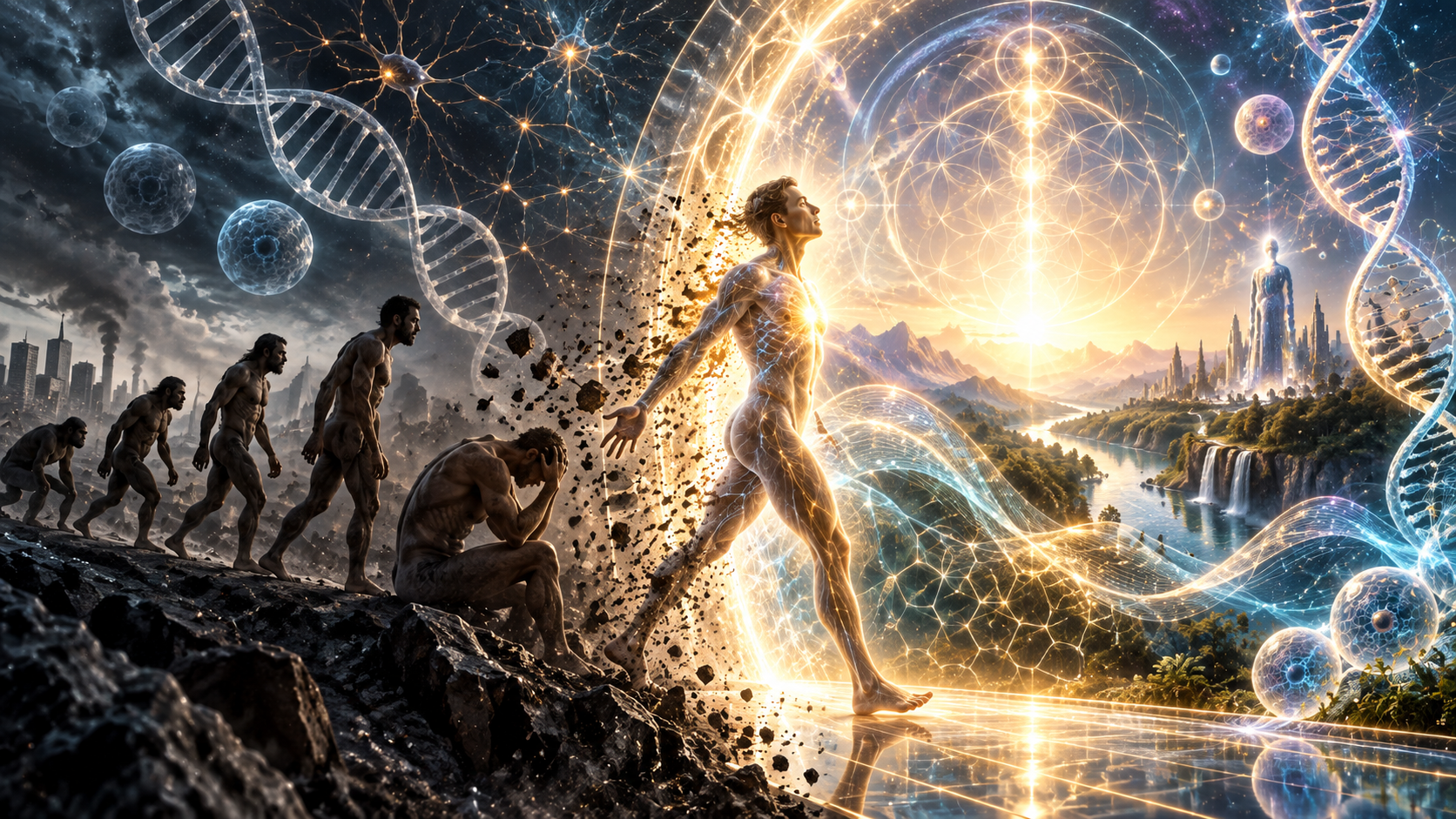
The body is always adjusting to what life asks of it. If one spot on the foot is rubbed again and again, the skin can grow thicker there and form a callus. A callus is simply extra outer skin built where the body expects more friction. If muscles are repeatedly asked to lift something that is difficult but manageable, they can grow stronger. If bones regularly carry greater force, they can slowly rebuild themselves so that they are better suited to that force. None of these changes requires the body to understand what is happening. The body meets a demand, notices that its present way of working is not quite enough, and changes itself. (Freeman, 2002; Currier et al., 2026; Hughes et al., 2020)
The same pattern can involve the whole body. Someone who spends time in very hot conditions can gradually become better at handling heat because sweating, blood flow near the skin, and other cooling responses change. Someone who spends enough time high in the mountains, where less oxygen is available in each breath, can also adapt. Breathing changes, the blood changes, and the body becomes better at delivering the oxygen that is available. Scientists call these changes acclimation or acclimatization, which simply means that the body adjusts to a new environment. (Deshayes et al., 2024; von Grunigen et al., 2025)
Experience can change the nervous system in the same basic way. The nervous system is the network made of the brain, spinal cord, and nerves that carries information through the body. When we practice something, connections between nerve cells can strengthen, weaken, or reorganize until a task that once required great effort becomes easier. Scientists call this neural plasticity. Plasticity means the nervous system is changeable rather than fixed. Biology can even prepare itself through one smaller challenge for a later, larger challenge. In a process called preconditioning, a brief and controlled stress can sometimes switch on protective responses that make tissue more resistant to a stronger stress afterward. (Caroni et al., 2012; Eisen et al., 2004)
Across skin, muscle, bone, temperature control, oxygen use, and the nervous system, the details are different but the pattern is easy to recognize. A challenge places more demand on the body than usual. If that challenge is not overwhelming and the body has enough time and resources to recover, the response can leave the body able to handle something it could not handle as well before. This does not mean that all stress is good. Too much friction causes a wound instead of a callus, and too much force can tear a muscle instead of strengthening it. The important part is not the stress itself. The important part is what the body becomes capable of after successfully adapting to it.
A Different Story: What Viruses Have Given Life
There is another fact about biology that seems unrelated at first. Viruses are usually introduced as enemies because many of them make living things sick. A virus is a tiny package of genetic instructions that cannot reproduce on its own. It has to enter a living cell and use that cell's machinery to make more copies of itself. That can damage the cell and can trigger the immune response that makes a person feel sick.
Yet the relationship between viruses and life has not always ended with damage. Some viruses have left pieces of themselves inside the DNA of the organisms they infected. DNA is the long chemical instruction set inside cells, and the genome is the complete collection of those instructions. One family of viruses, called retroviruses, can copy their own instructions into DNA and insert that DNA into a host cell. Very rarely, long ago, this happened in cells that later helped produce offspring. The viral DNA was then passed from parent to child and eventually became a permanent part of the species. These inherited remains are called endogenous retroviruses. 'Endogenous' simply means that they are now inside the organism's inherited DNA rather than arriving as a new infection. Ancient retroviral material makes up about eight percent of the human genome. (Kyriakou & Magiorkinis, 2023)
Most of this old viral material no longer behaves like an active virus, but some of it has been reused by evolution. One of the clearest examples helps build the placenta, the temporary organ that connects a developing baby with its mother during pregnancy. A retrovirus normally needs to fuse its outer surface with a cell so it can enter. Long ago, mammals acquired viral genes with that fusion ability. One of the proteins produced from such a gene is called syncytin. Instead of helping a virus enter a cell, syncytin helps placental cells join together. A tool that once served a virus became useful to mammalian reproduction. (Mi et al., 2000)
This kind of relationship is not limited to ancient human DNA. Scientists have found viruses that help plants tolerate drought, a virus inside a fungus that helps a plant survive extreme heat, and virus-derived systems that became important to the reproduction of certain wasps. These are examples of mutualism, which means that two living systems interact in a way that benefits at least the host rather than simply harming it. Viruses can clearly be dangerous, but the history of life shows that danger is not the only kind of relationship they can have with living organisms. (Roossinck, 2011)
Taken on its own, this tells us something important. A virus can be a source of damage, but over long stretches of evolution viral material has also become raw material for new biological abilities. Life has sometimes taken something that arrived as an intrusion and found a new use for it.
When the Two Patterns Meet
Now return to the first pattern. The body can change when it successfully adapts to a challenge. Skin can thicken, muscle can strengthen, bone can rebuild, the nervous system can learn, and whole systems can adjust to new environments. The second pattern adds something different: viruses have sometimes contributed material that living systems later used in new ways. Once both ideas are visible, a smaller question appears naturally. What happens during the much shorter encounter between a virus and one individual body?
When a person catches a respiratory virus, the body changes the way it operates. Immune cells become active, blood flow changes in infected tissues, mucus increases, appetite and sleep may change, and energy is redirected toward defense and repair. The immune system is the collection of cells, tissues, and chemical signals that protects the body from threats. When the infection is over, most of these temporary changes settle down, but the body does not always return to exactly the same biological starting point.
The easiest example is immune memory. During an infection, some immune cells learn to recognize specific features of the virus. A portion of those cells can remain after recovery. If the same virus appears again, the body may respond sooner because it has already built cells that recognize it. The body has not simply removed the problem; it has kept information from the encounter.
Researchers have also found a broader kind of immune learning. The immune system has a fast, general defense called the innate immune system. 'Innate' means it is available from the start rather than being built specifically for one particular virus. Scientists once thought this part of immunity had little lasting memory, but research now shows that some innate immune cells can be changed by an earlier challenge so that they respond differently later. This is called trained immunity. One way to picture it is that the cell keeps the same instruction book, but places bookmarks on certain pages so that some instructions can be found and used more quickly. The scientific word for changes in how easily genes are used, without changing the DNA letters themselves, is epigenetics. Trained immunity also involves changes in metabolism, which simply means how cells obtain, store, and spend energy. (Netea et al., 2020)
Even some of the early cells in bone marrow that later produce immune cells can be changed by previous immune challenges. Bone marrow is the soft tissue inside many bones where blood and immune cells are made. This means an encounter can sometimes affect not only the cells that were present during the challenge, but also cells that are produced later. The infection ends, yet part of the body's response to it remains built into the way future cells behave. (Netea et al., 2020)
Another idea from biology points in the same direction. Hormesis is the name for a pattern in which a manageable stress activates protective changes that help a cell or organism deal with later stress. The idea is similar to exercise: a challenge that is small enough to recover from can sometimes increase future capacity, while a challenge that is too large can cause harm. In 2024, researchers reviewed evidence that infections can sometimes produce hormesis-like responses in experimental models. They paid particular attention to mitochondria, small structures inside cells that help turn food into usable energy. The researchers proposed that changes in how mitochondria handle stress may be one way an infection can leave a cell better prepared for a later challenge. This is still a developing area of research, but the important point is that scientists are already asking whether infection can sometimes produce adaptation rather than only damage and repair. (Bauer et al., 2024)
State A -> challenge -> adaptation -> recovery -> State B
State B does not have to look dramatically different from State A. The person may simply feel healthy again. The difference may be hidden inside immune cells, energy systems, or other parts of the body. Yet if some useful change remains, recovery has not been a perfect return to the beginning. The body has solved a problem and carried part of the solution forward.
Staying Stable by Changing
This way of thinking matches another basic rule of physiology, the science of how living bodies function. The body has to keep many things within workable ranges: temperature cannot become too high or too low, blood sugar cannot swing without limit, and cells need the right balance of water, salts, oxygen, and energy. Keeping these internal conditions within safe ranges is called homeostasis.
Homeostasis does not mean the body keeps everything perfectly still. Imagine keeping a room at a comfortable temperature. The heater may turn on, turn off, or work harder depending on how cold it is outside. The room stays comfortable because the system changes what it is doing. The body works in a similar way. Scientists use the word allostasis for the idea that stability can be maintained by changing how the body operates. Heart rate, hormones, immune activity, sleep, appetite, and energy use can all shift so that the organism can meet a new demand and later settle again. (McEwen, 1998)
This matters because it gives us a different picture of biological development. The body may not spend a lifetime defending one unchanging baseline. It may repeatedly meet new demands, adjust, recover, and establish slightly different working states. Most of those changes may be small, and some may be temporary, but the body is clearly capable of building new ways of functioning from what it encounters.
What Does the Body Have to Do With Consciousness?
At this point, the argument has stayed within ordinary biology. The next question requires us to look at consciousness. In this paper, consciousness simply means the fact that we are having an experience at all: seeing, feeling, thinking, noticing, remembering, and being aware of ourselves and the world around us.
Whatever consciousness ultimately turns out to be, human experience clearly changes when the body changes. Someone who has been awake all night can think, feel, and react differently from the same person after good sleep. Fever can make thinking foggy. Anesthesia can make ordinary awareness disappear. Hormones, pain, hunger, medication, meditation, and sensory changes can all alter experience. This does not prove that the brain creates consciousness, but it does show that the condition of the body affects the kind of consciousness a human being can express and sustain.
The immune system is also not separate from the brain in the simple way people once imagined. Nerve cells and immune cells constantly send signals that affect one another. This two-way system is called the neuroimmune system: 'neuro' refers to nerves and the brain, while 'immune' refers to the body's defenses. Immune signals can influence sleep, motivation, learning, and memory, while activity in the nervous system can influence immune behavior. Modern research increasingly treats cognition, or thinking and learning, as something that happens inside a body whose nervous and immune systems are in constant conversation. (Klein, 2026)
That makes a new possibility easier to picture. A state of consciousness may not depend only on whether it can appear for a moment. It may also depend on whether the body can carry it without becoming unstable. Think of pouring water through a narrow funnel. A large amount of water may be available, but the funnel can only move so much at once. If the opening becomes wider, more water can pass through without overflowing. In the same way, a more intense or complex state of consciousness might require enough capacity in attention, emotional regulation, sensory processing, energy use, and nervous-system coordination to remain stable.
This is the central proposal of Biological Ascension Theory. The body and consciousness may develop together. Biological challenges can sometimes increase or change physical capacity. If certain forms of consciousness require certain biological capacities, then countless small adaptations across a lifetime might gradually prepare the organism to sustain states that once exceeded what it could comfortably carry.
Why a New State Could Appear Suddenly
If the body changes little by little, it may seem that consciousness should also change little by little. Nature often gives us another pattern. Water can cool one degree at a time while remaining liquid, and then at the right temperature it begins to freeze. The change from liquid to solid is called a phase transition. A phase is simply one stable form of a material, and a phase transition is the point where the material reorganizes into another form. The temperature changed gradually, but the visible state changed much more suddenly.
A simple way to picture this is to imagine that a new state requires one hundred small pieces to be in place. The number is only a metaphor, but it makes the pattern easy to see. At 40, the person may still feel like the same person; at 70, the new state may still be unavailable; even at 99, the system may still look almost unchanged. Then the count reaches 100, and the final change matters not because it is more powerful than the ninety-nine that came before it, but because it completes the conditions needed for the system to reorganize. The visible change can therefore appear sudden even when almost all of the preparation happened gradually.
Scientists see similar behavior in complex systems, which are systems made of many interacting parts, such as an ecosystem, a brain, or a living body. A complex system can absorb many small changes while looking mostly the same until it reaches a threshold, meaning a point beyond which the old arrangement can no longer remain stable. At that point the system can move into a new state, and scientists describe changes like these as critical transitions. (Scheffer et al., 2009)
Human growth offers an easy biological example. In one detailed study of infants, body length did not appear to increase by the same tiny amount every day; growth often appeared in spurts separated by periods in which no measurable increase occurred. The researchers called this saltatory growth, meaning growth that happens in jumps. The study does not mean every kind of development works exactly this way, but it shows that real growth can remain difficult to see for a while and then become visible in a burst. (Lampl et al., 1992)
Artificial intelligence provides another useful comparison. A learning computer system can be given example after example while its ability to use the underlying rule on new examples improves very little, and then, after much more training, its performance can suddenly jump. Researchers have called one version of this pattern grokking, meaning that a system appears to move from memorizing examples to grasping a rule well enough to use it more broadly. The new ability seems to appear quickly even though the training that prepared the system happened over a much longer period. (Power et al., 2022)
If consciousness develops through thresholds, a person could therefore change biologically and psychologically for years without entering a clearly different state. The underlying capacity could keep growing while ordinary experience remained mostly familiar, until one more change completed the conditions needed for something new to become stable. What feels like a sudden leap would then be the visible moment when a long period of preparation finally reaches 100.
Nature Also Contains Barriers Between Stable States
Physics gives two useful pictures of this idea. An atom is one of the tiny building blocks of matter, and electrons are very small particles associated with atoms. Electrons in atoms can exist in certain allowed energy states. When the right amount of energy is gained or lost, the atom can move from one allowed state to another. The point is not that consciousness is an electron. The useful part of the comparison is that nature can contain distinct stable states rather than every possible halfway condition being equally stable.
Quantum tunneling offers a different picture. Imagine a ball sitting in one valley with a hill between it and another valley. In everyday physics, the ball must have enough energy to climb over the hill. At the quantum scale, where very small particles follow rules that do not match ordinary everyday motion, a system can sometimes appear on the other side of a barrier even when the ordinary classical description says it should not be able to cross that barrier. This is called quantum tunneling. The theory does not claim that consciousness literally tunnels like a particle. The comparison is useful because it shows that a barrier that looks impassable from inside one state is not always the final limit of the larger system.
Living cells show an even closer version of this pattern. Most cells in the body contain nearly the same DNA, yet a skin cell and a nerve cell behave very differently because they use different parts of that DNA. Scientists have learned that, under the right conditions, mature cells can sometimes be reprogrammed into very different cell states by changing the signals that control which genes are active. Reprogramming means changing the cell's working identity rather than changing the basic DNA instruction set. A living system can therefore move from one stable organization into another without becoming a completely different collection of raw material. (Ladewig et al., 2013)
The Brain Already Moves Between Different Modes
The brain itself does not operate in one unchanging pattern. Sleep, waking, anesthesia, seizures, meditation, and psychedelic states are associated with different patterns of brain activity. Researchers studying a concept called criticality ask whether the brain sometimes works near a boundary between activity that is too rigid and activity that is too chaotic. A system near such a boundary can be especially sensitive, allowing activity in one area to influence other areas without the whole system becoming either frozen or uncontrolled.
A 2023 review looked at studies of brain criticality during sleep, anesthesia, epilepsy, meditation, psychedelic states, delirium, and disorders in which consciousness is impaired. The research is still young and the methods are not yet consistent, but the review found repeated evidence that different states of consciousness are associated with different positions relative to this critical zone. That does not prove that one state is spiritually higher than another. It does show that different kinds of conscious experience can be associated with different large-scale ways in which the brain organizes its activity. (Gervais et al., 2023)
Rest May Be Part of the Change
A transition is only useful if the new ability can be kept. Learning gives a familiar example. Someone can study something difficult during the day, understand part of it, and then find the idea clearer after sleeping. During sleep, the brain does not simply turn off. It replays and reorganizes parts of what was learned, strengthening some memories, connecting information, and helping new knowledge become easier to use. Scientists call this consolidation, which means making a new memory or skill more stable. (Diekelmann & Born, 2010)
This suggests that long quiet periods may not be empty periods. A person could have an intense burst of development and then spend days, weeks, or months without another dramatic change because the new organization is being made easier to maintain. What once took great effort can gradually become normal. Biological Ascension Theory therefore does not picture development as constant upward motion. It looks more like challenge, change, integration, stability, and then another period of challenge and change.
Why the Body Could Carry Symbolic Meaning
There is one more part of the theory that begins with something ordinary. Human beings constantly use the body to understand things that are not literally physical. A responsibility can feel heavy. We can see someone's point. We can move forward in life, stand our ground, lose our voice, or be unable to stomach an idea. These phrases make sense because physical experience gives the mind a familiar structure for understanding less visible experiences.
Researchers call this general idea embodied cognition. 'Embodied' means connected to the body, and 'cognition' means thinking, understanding, remembering, and making sense of things. Embodied cognition does not mean every thought comes directly from a body movement. It means that the brain often uses systems involved in sensation and action as part of the way concepts are understood. Evidence is strongest for concrete ideas and actions, while scientists still debate how much very abstract thought depends on bodily systems. (Galetzka, 2017)
The brain also constantly receives information from inside the body: heartbeat, breathing, hunger, tension, warmth, pain, and many other signals. Sensing the body's internal condition is called interoception. 'Intero' means inside, and 'ception' refers to sensing. These internal signals help shape how we feel. In one series of studies involving 701 people, different emotions were linked with different patterns of bodily sensation. Anger, fear, sadness, happiness, and love did not all feel as though they happened in exactly the same places. (Craig, 2002; Nummenmaa et al., 2014)
This does not prove that every symptom carries a hidden message. It does show that the body is already part of the language through which the mind experiences and describes meaning. If physical symptoms sometimes have symbolic importance, the clearest place to begin would be with what the body part actually does. Eyes see, ears hear, hands act and create, feet support movement, the throat turns an internal thought into an outward voice, and the lungs keep life going through the repeated exchange of air.
When the Body Has to Catch Up
Crossing into a new state would not necessarily mean that every part of the organism was instantly ready for it. Consciousness could change first, bringing a sudden increase in insight, awareness, perception, or creative activity while the body was still organized around the demands of the state that came before. Because conscious experience is carried through biological systems that have to process information, regulate emotion, coordinate attention, use energy, and keep the whole organism stable, a sharp increase in what a person is experiencing could create new physical demands before those systems have had time to adjust. If illness appeared during the same period, Biological Ascension Theory would not have to treat the illness as the cause of the new state; it could instead represent the body trying to catch up with a change that has already begun.
If the body also carries symbolic meaning, the location of the symptoms could help describe what kind of capacity is under the greatest strain. The brain gathers information from many different places and organizes it into patterns, thoughts, and understanding, so symptoms centered in the head during a period of unusually rapid insight could symbolically correspond with the greater demand to process and integrate what is arriving. The throat performs a different job because it is one of the main places where something that exists internally becomes something expressed outwardly through the voice, which makes throat symptoms a natural symbolic match when new understanding is being turned into words, writing, teaching, or explanation. The lungs carry the process one step further because breathing is a continuous exchange between the organism and the world: air enters, something useful is taken from it, something is returned, and the exchange has to continue for life to be sustained. In that sense, the lungs provide a natural symbol for the point where an idea moves beyond being understood or spoken and begins to live through action, exchange, and continued interaction with the world.
A theory can exist privately in someone's mind and can later be given a voice through writing or speech, but when that theory becomes a project, a business, a method, or something other people begin interacting with, it enters a different stage because it now has to respond, exchange, adapt, and keep moving beyond the moment in which it was first conceived. The throat gives the idea a voice, while the lungs, symbolically, give it breath. If a person's development moved from intense insight, to expressing those insights, to bringing them into active use in the world while physical symptoms moved through the head, throat, and lungs in a similar sequence, the meaning would not depend on claiming that every headache, sore throat, or cough always represents the same thing. It would come from the way the physical and psychological patterns mirror one another in that particular period of change.
Seen this way, the illness could show where the body is working hardest to adapt. A sudden increase in understanding could demand greater capacity for integration, a flood of ideas could demand greater capacity for expression, and moving those ideas from theory into something active in the world could demand greater capacity for sustained exchange. The symbolism would describe the direction of the adaptation, while the illness itself would represent the body's effort to make the new level of functioning physically sustainable.
This gives Biological Ascension Theory two related pathways without requiring them to happen in a fixed order. Sometimes biological adaptation may come first and gradually make a new state of consciousness possible; at other times consciousness may move first and place the body under pressure to reorganize around what has already begun to emerge. In both cases, the larger process is the same: biology and consciousness are not developing separately, but becoming increasingly capable of sustaining more together.
Conclusion
The body does not pass through life unchanged. Friction can change skin, weight can change muscle and bone, heat and altitude can change whole-body regulation, practice can change neural connections, and infection can change how the immune system behaves in the future. Even viruses, usually thought of only as invaders, have contributed material that life has sometimes turned into useful biological functions. Again and again, living systems meet a demand, reorganize around it, and can emerge able to do something differently than before.
Biological Ascension Theory proposes that the same pattern may apply to the relationship between the body and consciousness. If some states of consciousness place demands on the organism that earlier states did not, then the body may have to develop the capacity to carry them. Most of that development could be almost invisible, like counting from 1 to 99. The person keeps living, learning, healing, adapting, and recovering while the conditions for something new quietly accumulate. Then the count reaches 100, the threshold is crossed, and what looked impossible from the previous state becomes the new state.
Within this theory, illness can fit into that transition in a more direct way than simply adding one more adaptation to the count. If consciousness begins entering a state that the body is not yet fully able to sustain, becoming sick at the same time could represent the organism being forced to adjust to the new demand. The body parts affected may then provide clues about what is changing. Symptoms involving the head could correspond with processing and integration, the throat with turning insight into expression, and the lungs with giving that expression breath so it can become a living exchange with the world. The illness would not be the ascension. It would be part of the body's attempt to become capable of carrying it.
Seen this way, ascension is not consciousness escaping the body. It is consciousness and the body changing together. Each successfully integrated challenge may move the system one step closer to a threshold, while periods of illness or instability may sometimes mark the moments when the body has to catch up with what consciousness is becoming. What appears to be a sudden leap may therefore be the visible moment when a long period of hidden preparation finally reaches 100. The body may not merely be where consciousness experiences life. It may be the living structure that is gradually being rebuilt so consciousness can sustain what comes next.
Rate This Theory
All ratings are anonymous
Help others by sharing
Comments
(0)AnonymousNo comments yet. Be the first to share your thoughts!
Spiritual theories are speculative frameworks offered for exploration. They are not treatments, and they are not a substitute for the tested methods in the Healing Library.