
Biological Awakening Theory
Spiritual Exploration
Spiritual Exploration
Biological Awakening Theory
The Untapped Potential of the Human Body
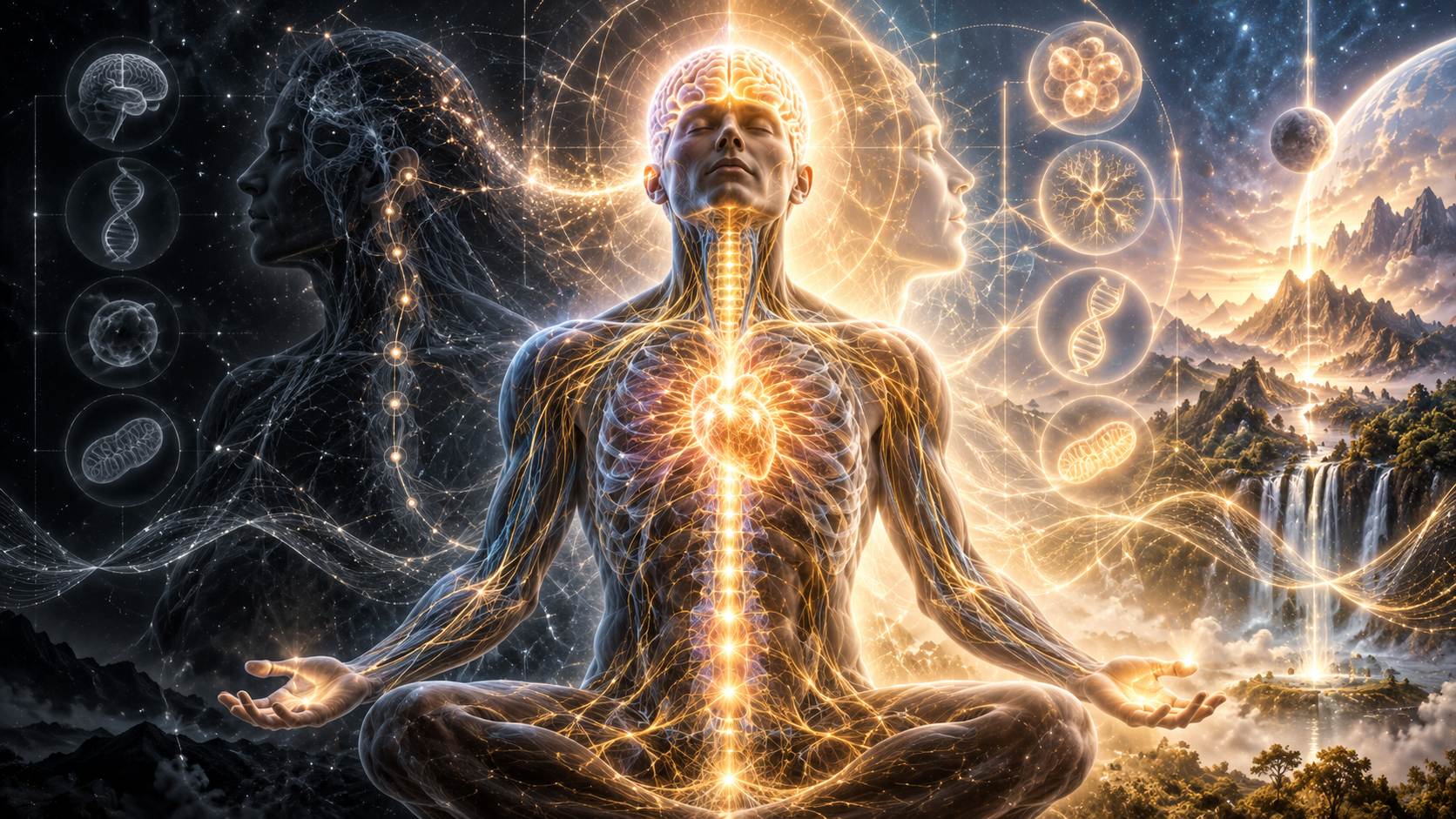
Imagine trying to explain something you know well while someone is watching and waiting for your answer. You begin speaking, lose your place, and suddenly cannot find words you have used hundreds of times before. Later, when the pressure is gone, those same words come easily. You did not have to learn them again, and your brain did not grow new parts in the meantime. The information was there in both moments, but it was not equally available to you.
A similar difference can appear when you are trying to solve a problem. In one state, you keep returning to the same idea even though it does not work. In another, you notice an alternative that was in front of you all along. There are many reasons a solution might become easier to find, but one of them is the condition of the person doing the thinking. Fear, pressure, ease, curiosity, and enjoyment do not merely color an experience after it happens; they can change what we notice and how we use what we already know.
Researchers have watched this happen under controlled conditions. In a series of experiments, people who had been put in a pleasant mood, sometimes by watching a short comedy or receiving a small gift, were more likely to solve problems that required an unusual connection between familiar things (Isen, Daubman, & Nowicki, 1987). Other researchers found that positive emotion could broaden attention, helping people take in more of what was around them and imagine a wider range of possible actions (Fredrickson & Branigan, 2005). Under strong stress, by contrast, chemical changes in the brain can interfere with the prefrontal cortex, a region important for holding information in mind, considering alternatives, and choosing how to respond (Arnsten, 2009).
The person has not received new intelligence or lost the knowledge they once had. Their existing abilities are working under different conditions. A tense state can make thinking narrow and repetitive, while another state can make the same mind more flexible. It is not that feeling good guarantees a clever answer, or that stress is always harmful. The important observation is that an ability can be present in the organism without being equally accessible in every state.
The effect becomes easier to recognize when it is no longer limited to thoughts and emotions. Every breath changes the movement of the chest, the pressure inside the body, and the timing of signals traveling between the lungs, heart, and brain. When breathing slows into a regular rhythm, the heart often begins to speed up and slow down in a related rhythm. The change in time between heartbeats is called heart rate variability, and the relationship among breathing, heartbeat timing, blood-pressure regulation, and the nervous system can be strengthened through paced breathing and feedback (Lehrer & Gevirtz, 2014).
People sometimes call this kind of coordination heart–brain coherence. Here coherence means that bodily rhythms are interacting in an organized way, not that the heart and brain have become one signal or that every rhythm must beat at the same speed. Studies have found a modest relationship between heart rate variability and mental flexibility, while reviews of training that gives people live information about their heart rhythms have found improvements in some, though not all, tasks involving attention and self-control (Magnon et al., 2022; Tinello et al., 2022). The body’s state can help set the conditions in which thinking takes place.
This is the same person, with the same eyes, hands, memories, and brain, yet a change in emotional and bodily organization can make familiar capacities more or less available. The differences need not be dramatic. Clearer attention, an easier connection between ideas, a steadier response to a difficult moment, or a solution that finally becomes visible may be ordinary examples of what changes when the organism works in a different state.
An Ability Can Be Present Before We Notice It
The difference between having a capacity and being able to use it becomes clearer when we look at the senses. We usually think of seeing as whatever appears before our eyes, hearing as whatever sounds we notice, and feeling the body as whatever sensations demand our attention. But a sense organ does not send us a complete, unedited account of everything it receives. The nervous system sorts, combines, and filters signals long before they become a conscious experience.
For example, researchers exposed people to carefully controlled rotations of magnetic fields about as strong as Earth’s. Certain rotations produced changes in the electrical activity of their brains even though the participants did not report feeling the field turn (Wang et al., 2019). This does not establish that people can consciously navigate by magnetism, but it shows why the question of what a body detects is different from the question of what a person notices. The nervous system can respond to information that does not appear as a recognizable sensation.
Smell provides an example closer to everyday experience. We normally experience a smell as simply being somewhere in the air, yet the brain can compare the amount of odor reaching the left and right nostrils. In experiments, people used these small differences to find a direction without necessarily knowing which nostril was receiving the stronger signal (Wu et al., 2020). Information about the world was available to the organism before it was available as a conscious explanation of how that organism knew where to go.
The more closely researchers examine human sensory systems, the longer the list of such capacities becomes. Some are part of ordinary functioning but are so precise that we almost never think about them. Others require training, unusual anatomy, or laboratory conditions to reveal themselves. They are not all abilities that any person can learn at will, but they show why familiar experience alone cannot provide a complete inventory of the body’s biological equipment.
Hearing and vibration
- Echolocation: People can learn to use echoes from audible clicks to judge the location and shape of objects; trained listeners can recruit brain regions normally associated with vision while doing so (Norman, Hartley, & Thaler, 2024).
- Very low sound: Infrasound is sound below the usual lower limit of hearing. At sufficient intensity, some low-frequency sound can still be heard or felt through bodily vibration (Lubner et al., 2020).
- Absolute pitch: Some adults learn to name musical notes without hearing a reference note first, an ability once thought to depend much more strictly on early childhood training (Wong et al., 2025).
- Sound direction: The brain can compare the arrival time of a sound at the two ears across differences measured in millionths of a second (Brughera, Dunai, & Hartmann, 2013).
- Fine vibration: Specialized touch receptors detect extremely small movements of the skin, sometimes at scales measured in micrometers, or thousandths of a millimeter.
Touch, vision, and body position
- Temperature differences: Skin receptors can detect small changes relative to the temperature the skin has become used to (Lithfous et al., 2020).
- Electric fields: Strong enough electric fields can move fine body hairs, letting touch receptors detect the movement without a separate electrical sense organ (Chapman et al., 2005).
- Magnetic-field response: Certain Earth-strength field changes can produce a measurable brain response without a consciously recognized magnetic sensation (Wang et al., 2019).
- Body position: Proprioception is the sense of where our body parts are without looking at them, using signals from muscles, joints, and other tissues along with information from the inner ear.
- Single photons: A photon is a single packet of light. Under tightly controlled conditions, people can sometimes report the arrival of one photon more often than chance alone would predict (Tinsley et al., 2016).
- Near-ultraviolet light: Ultraviolet light lies beyond the violet end of ordinary vision. The retina can respond to some of it, but the eye’s natural lens normally filters it out (Griswold & Stark, 1992).
- Unusual infrared perception: Infrared light lies beyond visible red. Under special laboratory conditions, intense infrared light can trigger a visible response through a two-photon process; this is not ordinary infrared vision (Palczewska et al., 2014).
- Polarized light: Polarization describes the orientation of a light wave. People can learn to see a faint pattern called Haidinger’s brush that reveals a property of light usually overlooked (Temple et al., 2015).
- Very fine visual detail: Visual hyperacuity is the ability to judge tiny differences in alignment more precisely than the spacing between individual light receptors might suggest. Training can improve it (Poggio, Fahle, & Edelman, 1992).
- Additional color distinctions: A small number of people inherit an additional functioning type of color receptor and may distinguish colors that look identical to others. This anatomical difference is not a capacity that everyone can turn on through practice (Jordan et al., 2010).
Smell, internal sensation, and biological timing
- Fine smell discrimination: The nose and brain can distinguish an enormous variety of odors, with sensitivity differing from person to person (Bushdid et al., 2014; Doty, 2006).
- Odor tracking: Humans can follow a scent trail across the ground and improve with practice (Porter et al., 2007).
- Direction from two nostrils: The brain can use left-right differences in smell to guide movement without making that comparison consciously obvious (Wu et al., 2020).
- Social chemical information: Body odors can carry cues about another person’s emotional state and influence the recipient without a conscious account of what the odor means (de Groot & Smeets, 2017; Calvi et al., 2020).
- Internal sensing: Interoception is the nervous system’s ongoing awareness of conditions inside the body, including signals from the heart, lungs, digestive tract, and blood vessels. Much of this activity never becomes a clear conscious sensation (Craig, 2002).
- Biological timekeeping: Special light-sensitive cells in the eye help regulate the daily sleep-and-wake cycle without having to form the images we normally think of as vision.
The interesting discovery is not that the body possesses a collection of supernatural senses. It is that the same familiar anatomy can carry information at a level of detail and through channels we would never infer from ordinary experience alone. Some signals already influence behavior without our knowing how, while others become noticeable only when the conditions are right.
The Same Hardware Can Do More Than Its Usual Job
Receiving information is one part of the story. The brain can also find unexpected uses for the information it receives. Consider someone who cannot rely on sight but learns to listen to the echoes of a click. At first, the click may sound like a click and nothing more. With training, the listener can begin to hear whether there is a wall ahead, how far away an object is, or where an opening may be. In studies of echolocation training, both blind and sighted adults showed changes in visual-cortex activity while processing echoes (Norman, Hartley, & Thaler, 2024).
We usually call this part of the brain the visual cortex because it helps us make sense of what enters through our eyes. It would be easy to assume that, without sight, the tissue could no longer perform its usual work. Yet a person learning echolocation can use that same region while working out where objects are from sound. The information has arrived through the ears rather than the eyes, but the brain is still helping the person understand the space around them (Norman, Hartley, & Thaler, 2024).
Researchers have explored this flexibility even more directly through sensory substitution. A device can turn a picture into a pattern of sounds, giving a person information about the picture through hearing instead of sight. At first those sounds may mean nothing. With practice, the listener learns which sound patterns represent particular shapes or letters, much as an unfamiliar word eventually becomes meaningful after it has been learned. In studies involving blind readers, a region usually involved in recognizing written words became active while they read words delivered as sound, without receiving those words through their eyes (Maidenbaum, Abboud, & Amedi, 2014; Reich, Maidenbaum, & Amedi, 2012).
The eye normally supplies the information, but it is not the only possible doorway into the brain’s existing ability to make sense of a word or a surrounding space. No new visual cortex had to grow before the person could use it this way. A familiar piece of anatomy was able to take on work that its ordinary function had concealed. This raises a different possibility from merely making an existing sense more sensitive: some parts of the body may be capable of doing things that ordinary experience has never required them to do.
The Body’s Automatic Work Is Not Always Beyond Influence
Other biological capacities are familiar because we see their results every day but rarely think about controlling them. The pupils change size, the heart speeds up, goosebumps rise, blood vessels adjust, and the immune system responds to threats. These changes are coordinated partly by the autonomic nervous system, the network that manages many functions without requiring a separate conscious instruction for each one.
That does not make every function permanently inaccessible. When people receive live feedback about the size of their pupils, for example, they can learn to influence pupil diameter, a response normally treated as automatic (Meissner et al., 2024). Some people report being able to produce goosebumps voluntarily, and researchers have documented the response under controlled observation (Heathers et al., 2018). In another experiment, training that combined breathing, meditation, and cold exposure allowed participants to produce unusually strong sympathetic activation and alter their response to a controlled inflammatory challenge (Kox et al., 2014). Here sympathetic activation means the body’s increased readiness for action, while inflammation is part of the immune response to injury or threat.
The examples extend across the organism:
- Pupil size can become more influenceable through feedback (Meissner et al., 2024).
- Goosebumps, usually an automatic skin response, can be voluntarily produced by some individuals (Heathers et al., 2018).
- Breathing can be consciously changed, with resulting changes in heart rhythm and blood-pressure regulation (Lehrer & Gevirtz, 2014).
- Sympathetic activity and epinephrine, a chemical that helps prepare the body for action, can be influenced through specific training (Kox et al., 2014).
- Inflammatory responses can be influenced indirectly through changes in autonomic activity, rather than by consciously commanding individual immune cells (Kox et al., 2014).
- Experienced g-Tummo meditators have produced measurable rises in peripheral body temperature using breathing and focused attention (Kozhevnikov et al., 2013).
- Attention and training can change the experience of pain and the ability to recognize some internal bodily signals.
The heart, glands, nerves, and immune cells were present before the training began. What changed was how the person could influence processes that had previously seemed to run entirely on their own. This is a different kind of access from sharpening a familiar sense, but the underlying lesson is similar: the list of things we can consciously do with our biology is not always the same as the list of things that biology is capable of doing.
Some of the Machinery Is Literally Kept Behind Biological Locks
So far, the body has revealed signals we seldom notice, brain tissue that can take on unexpected work, and automatic processes that can become more influenceable. Neuroscience offers an even more literal version of the same pattern. The brain contains physical connections that are present without being fully functional under ordinary conditions.
Nerve cells, called neurons, communicate at meeting points called synapses. Some synapses are described as silent because the connection exists but does not respond to ordinary signaling in the same way as an active one. Under certain conditions, activity can recruit these connections into working circuits. Research in the adult brain describes them as a reserve for plasticity, the ability of nervous tissue to change through experience (Vardalaki, Yaeger, & Harnett, 2025).
Other connections may be capable of working but prevented from expressing what they contain. The brain uses inhibition, meaning signals that reduce other nerve cells’ activity, to regulate communication and prevent everything from being active at once. In human experiments, learned associations that had ceased to appear in ordinary responses could become detectable again after researchers altered the balance of excitation and inhibition (Barron et al., 2016). The information had not needed to be learned again. A change in the conditions surrounding it made it accessible.
There are also locks that develop as we grow. Childhood includes critical periods, windows during which particular forms of learning and neural change happen with unusual ease. As the brain matures, structures surrounding some nerve cells, including perineuronal nets, help stabilize their connections and make further rearrangement harder. These structures are often described as brakes on plasticity. Animal experiments have shown that altering some of these brakes can reopen forms of learning that had become restricted in adulthood (Carulli & Verhaagen, 2021; Nardou et al., 2023).
A silent connection, an inhibited memory, and a closed learning window are not the same mechanism. Their shared feature is that the biological possibility can be present while the conditions required to express it are not. In one state of the system, the capacity remains hidden; in another, it becomes available.
Practice Can Change What the System Makes Available
Breathing is ordinarily present long before anyone decides to meditate. Someone practicing attention to the breath may first notice only air moving in and out, then gradually distinguish its pace, the movement of the chest and abdomen, and the small changes in bodily sensation that accompany it. The signals were not necessarily absent before practice. What has changed is the detail that enters conscious experience and the ability to remain with it.
Meditation research has examined changes in the brain’s sensory gating, the process through which some incoming signals are given priority while others are filtered. Studies of mindfulness have found changes in the regulation of alpha rhythms, patterns of electrical activity that help organize sensory attention (Kerr et al., 2013). In an experiment on idea generation, open-monitoring meditation, which involves noticing ongoing experience without settling on one narrow target, improved performance on a task requiring many different possible answers (Colzato, Ozturk, & Hommel, 2012). Another study found improvement on problems that required insight, when an answer becomes recognizable after an unproductive way of thinking is set aside (Ostafin & Kassman, 2012).
There is a further reason to look at meditation here. Noticing more of the breath or generating more ideas shows a familiar ability becoming more accessible, but the earlier examples of echolocation and silent synapses suggest a larger possibility: existing biological systems may also begin working together in ways they do not ordinarily use. To explore that possibility, researchers have studied what happens inside the same body as a meditator moves between different states.
In an intensive study of jhāna, a form of deep meditation in which attention becomes deeply absorbed, researchers observed changes in communication among brain networks as one experienced practitioner entered different states (Chowdhury et al., 2025). The brain did not acquire new regions between those states; existing regions participated in different patterns of activity. Research with experienced meditators has also found short-term changes in gene expression in blood cells. Gene expression describes how actively a cell uses the instructions already present in its DNA, the material that carries its genetic information (Kaliman et al., 2014).
These findings concern different levels of biology, but each gives another example of the same organism changing how its existing machinery operates.
The progression is becoming clearer. A change in mood can alter how easily a person finds a solution. Attention can bring a faint bodily signal into awareness. Practice can recruit a brain region for an unfamiliar task or bring an automatic process under greater influence. And during different states of meditation, existing networks can communicate in different ways. Ordinary consciousness does not reveal all of these possibilities at once.
When a Hidden Change Becomes Visible
Even when the conditions for a new capacity develop slowly, the moment that capacity appears need not feel gradual. The distinction is familiar from learning: a problem may resist every attempt until the needed connection becomes clear, when the solution seems to arrive all at once. Other fields contain their own examples of change accumulating beneath the surface before a distinct new state appears:
- Water can cool gradually and then reorganize into ice at the conditions required for freezing.
- Electrons in atoms move between permitted energy states rather than occupying every possible intermediate state.
- Quantum tunneling allows certain microscopic systems to cross barriers that ordinary classical motion would not cross (Hensinger et al., 2001).
- Ecosystems and other complex systems can accumulate changes and then pass a tipping point into a different pattern (Scheffer et al., 2009).
- Artificial neural networks can train for a long time before showing a sudden improvement in applying what they learned to unfamiliar examples, a pattern called grokking (Power et al., 2022).
- Measurements of infant growth have found spurts separated by periods with little detectable increase in length (Lampl, Veldhuis, & Johnson, 1992).
- Cellular reprogramming can move a mature cell into a different stable identity when the use of its existing genetic instructions changes (Ladewig, Koch, & Brüstle, 2013).
- Cell-fate decisions can follow gradual internal changes before a cell commits to a developmental path.
- Silent synapses can become functionally active when the required conditions are met (Vardalaki, Yaeger, & Harnett, 2025).
- Dormant learned associations can become expressible again when inhibition changes (Barron et al., 2016).
- Some closed developmental learning windows can be reopened experimentally by altering biological restrictions (Carulli & Verhaagen, 2021; Nardou et al., 2023).
- Waking, sleep, anesthesia, and other conscious states correspond to different patterns of organized brain activity, and transitions between them can be rapid (Gervais et al., 2023).
These examples operate through different mechanisms and on different timescales. What they share is that the visible arrival of a new state need not reveal how much preparation made it possible.
Biological Awakening Theory
Think again of a familiar ability that becomes easier to use when the pressure lifts. The person did not need a different brain to remember the right words, and a change in mood can make the same mind more flexible and creative. We already live with this basic pattern: our emotional and bodily state affects how much of what we can do is available to us in a given moment.
The examples that follow extend that pattern beyond what we normally recognize. The body can respond to information that never becomes a conscious sensation. Existing brain tissue can learn to perform an unfamiliar task, bodily functions once considered automatic can become more influenceable, and neural connections can remain silent or restricted until conditions change. The difference is no longer simply doing a familiar thing better. It is gaining access to something the body was capable of all along but that ordinary experience did not reveal.
Biological Awakening Theory proposes that enlightenment may be a further expression of this process. Greater awareness may first make ordinary capacities more accessible, then extend to sensations, bodily functions, and forms of neural coordination that are usually outside conscious experience. Some access might appear briefly before the body can sustain it, and gradual changes could eventually bring the organism across a threshold into a lasting new state. The change would not require a new human organ; it could involve a different range of access to the biology already present throughout the body.
We experience the beginning of this possibility every day when the same mind becomes more capable in a different internal state. Enlightenment may be what happens when that opening continues beyond the familiar abilities we already know, allowing consciousness to access more and more of the human body’s untapped potential.
Rate This Theory
All ratings are anonymous
Help others by sharing
Comments
(0)AnonymousNo comments yet. Be the first to share your thoughts!
Spiritual theories are speculative frameworks offered for exploration. They are not treatments, and they are not a substitute for the tested methods in the Healing Library.