
The Body Language of the Subconscious
Spiritual Exploration
Spiritual Exploration
The Body Language of the Subconscious
Decoding the Language of the Body
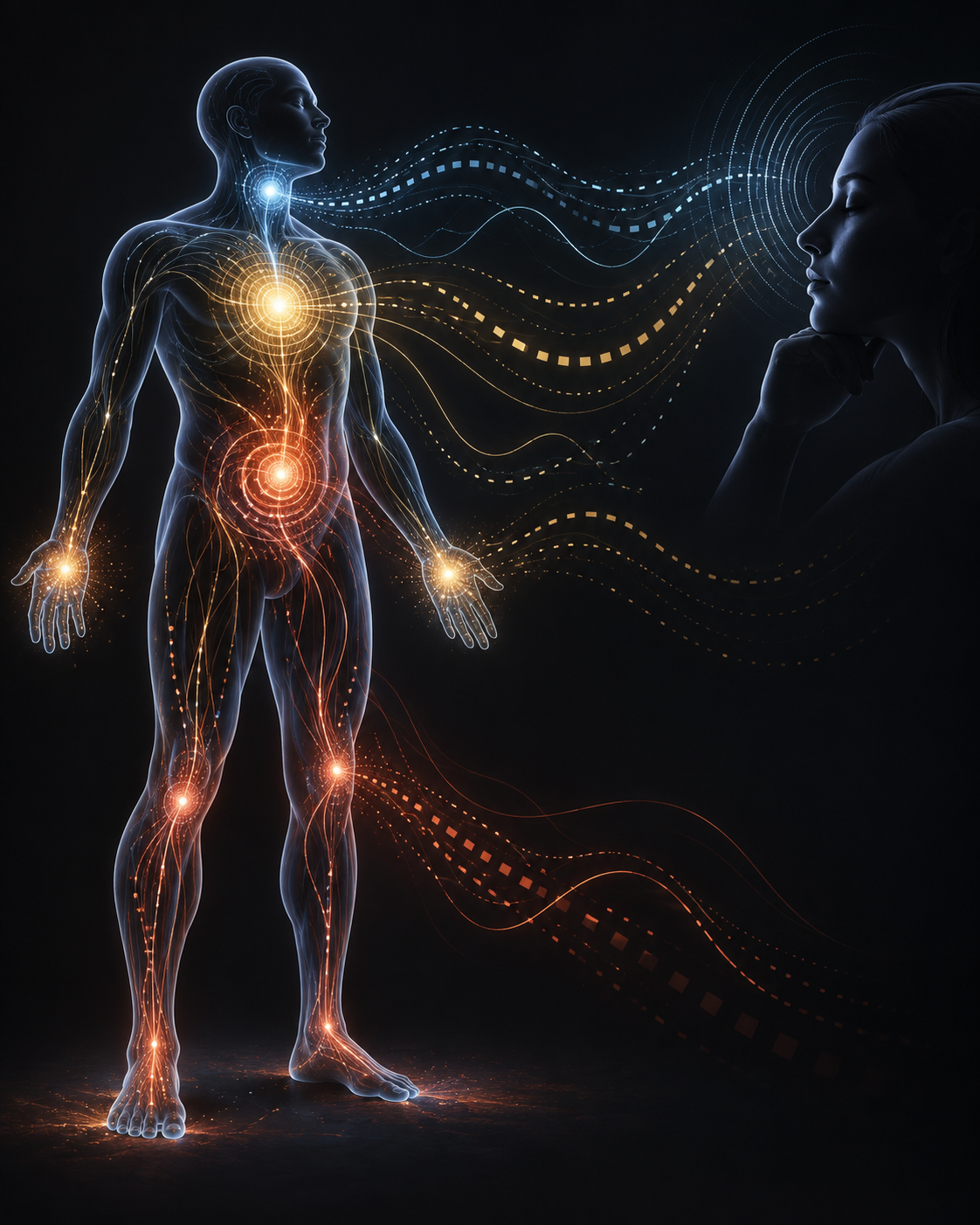
Think about a time you were sure you had lost something important. Before you could finish searching for it, your stomach may have dropped, your hands moved more quickly, or your breath changed. Then you found it, perhaps exactly where you had left it, and your shoulders loosened as you breathed out. Nothing about the object had changed. What changed was what you understood about the moment, and your body moved with that understanding.
Small changes like these accompany us throughout the day. We lean closer when we want to hear something, press our lips together when we are deciding what to say, or shift in our seats when remaining still becomes difficult. We may notice a feeling and then change how we move, but sometimes the movement comes first and only afterward do we realize what was happening inside us. These reactions are so ordinary that we seldom wonder why they happen in a particular part of the body, or why one experience makes us hold ourselves tightly while another allows us to relax.
To understand what these everyday reactions might tell us, we can begin with something familiar: the moment when our body responds before we have found the words to explain why.
1. What the Body Does Before We Find the Words
Think of a moment when you wanted to say something but could not quite get the words out. You may have known exactly what you meant, yet your throat felt tight, your jaw pressed together, or your shoulders rose toward your ears. Perhaps you crossed your arms and started bouncing one foot while you waited for the right moment. None of these movements required a conscious plan. The body began responding while the words were still forming.
We notice this in smaller moments too. A hand moves to the chest when something touches us emotionally. We rub our forehead while trying to make sense of a problem, hold our stomach when something feels difficult to take in, and shift our feet when we are ready to move. Sometimes the movement is practical: the room is cold, the chair is uncomfortable, or we are tired. At other times, it seems to arrive with a feeling that has not yet become clear enough to describe.
Why would an experience we have not fully understood already be changing the way we breathe, where we feel tension, and what we do with our hands? To answer that, we need to look at what happens in the body before a thought becomes a sentence.
2. The Work Happening Outside Our Awareness
Your nervous system is the body’s network of nerves, together with the brain and spinal cord, that carries information and helps coordinate what happens next. It keeps working when you are not paying attention to it. You do not have to remember to beat your heart, decide how fast to breathe every second, or tell your muscles to steady you when you nearly lose your balance. Your body responds first, and you may only notice the response afterward.
The word subconscious is used here for the parts of our mental life that influence us without needing our deliberate attention, including habits, learned associations, automatic emotional reactions, and memories that affect us before we recall them clearly. It does not mean a second person hidden inside the mind. It means that a great deal of what guides us is already happening before we can explain it in words.
The brain also receives a constant stream of information from inside the body. The name for noticing and making sense of these internal signals is interoception. Hunger, a racing heart, a tight stomach, or a change in breathing are ordinary examples. A part of the brain called the insula, a small region folded beneath the brain’s outer surface, helps bring information about the body together with feelings and awareness [1]. In everyday terms, the brain does not simply send instructions to the body; it is also listening to the body all the time.
Imagine hearing a knock on a door before you know who is outside. The sound tells you that something needs attention, but not yet what it is. A sudden change in the body can work much the same way. It may be the first thing we notice about an emotional experience whose meaning we have not worked out. The body’s response is real even when our explanation of it is still incomplete.
3. How an Earlier Experience Can Return as a Physical Reaction
A child who is repeatedly mocked for speaking up may eventually learn that expressing disagreement feels unsafe. Much later, that person might know that a new friend is kind and still notice their jaw tighten when they need to say no. Their body can react to what a moment reminds them of, even when they understand that the present situation is different.
That is one useful meaning of the phrase “the body stores trauma.” Trauma means an experience that is deeply distressing or overwhelming and may continue to affect a person afterward. The past is not literally sitting inside a shoulder or a stomach as though an organ were a box holding a memory. Instead, the brain and nervous system can learn patterns of expectation and protection that remain available long after an event ends. A reminder may bring back a rapid heartbeat, braced muscles, or a change in breathing before the person has consciously connected the present moment to the earlier one. Research on trauma reminders describes these kinds of physical and emotional reactions [2].
This connection has also been studied in people with ongoing physical symptoms. A meta-analysis is a study that brings together results from many earlier studies to look for a larger pattern. One such analysis of 71 studies found that people reporting psychological trauma had greater odds of certain long-lasting symptom conditions, including irritable bowel syndrome and fibromyalgia, than people who did not report trauma [3]. That finding does not mean every stomachache or muscle pain comes from an emotional wound. It does show why bodily experience and psychological history belong in the same conversation.
A person who notices the same throat reaction whenever they must express a need, or the same shoulder tension whenever they feel responsible for everyone around them, has found a pattern worth understanding. The body may be revealing that an earlier way of responding has become active again. To discover whether its location adds any meaning, however, we need to ask whether emotions are felt randomly throughout the body or whether different feelings already have recognizable physical patterns.
4. Emotions Already Have Shapes in the Body
If you ask someone where they feel sadness, fear, or joy, they may point to different parts of their body. That familiar observation led researchers to ask a simple question: if many people described the same emotion, would they mark the same places?
In 2014, Lauri Nummenmaa and colleagues asked 701 participants across five experiments to color human outlines showing where they felt more or less bodily activity during different emotions. The researchers combined those drawings into maps. Different emotions produced distinguishable patterns, and the maps were broadly similar across the groups studied [4]. A later study with 3,954 adults from 101 countries found substantial similarities in reported bodily maps across those populations [5].
The participants reported where their bodies felt more or less active; the researchers did not place sensors inside each marked region to measure every physical change there. Still, the result matters. The outlines did not become a meaningless blur when everyone’s responses were brought together. Different emotions had different bodily shapes.
Now consider two people who both say they are nervous. One is about to tell someone a difficult truth, while the other is afraid of losing someone they love. The word “nervous” is the same, but what each person is going through is different. If emotions have recognizable bodily patterns, might those differences in meaning also help shape the particular sensations each person notices? We cannot answer that from the emotion-map studies alone, but the question takes us one step closer to understanding why a feeling might arise in one place rather than another.
5. Why a Body Part Might Carry a Meaning
Long before anyone studies the nervous system, a child learns what hands, feet, shoulders, mouths, and stomachs do. Hands hold and let go. Feet support us and move us forward. Shoulders carry things. A mouth takes things in and sends words out. We learn the meanings of these actions through using our bodies every day, so it is natural for them to become ways of understanding less visible experiences.
We speak of carrying a burden, swallowing a hurtful remark, being unable to stomach an experience, getting back on our feet, or holding on to a relationship. We do not usually stop to picture a real object on our shoulders when someone tells us that they are carrying too much. We immediately understand that something in their life feels heavy. Our bodies give us a familiar way of describing something we cannot touch.
Researchers use the term embodied cognition for the idea that thinking is shaped partly by the body’s experiences of sensing and moving, rather than being separate from them. A metaphor expresses one experience through another: describing responsibility as a weight is a metaphor because duties do not literally have pounds or kilograms. Research on metaphor comprehension suggests that the brain’s systems for sensation and movement can contribute to how we understand some of these abstract ideas [6]. In one experiment, participants carrying weight on their shoulders responded differently on a task involving responsibility [7]. It is a narrow result, not proof that sore shoulders mean too much responsibility, but it reveals how closely physical and psychological meanings can meet.
The connection becomes even easier to see with the throat. Speaking requires the mouth, tongue, jaw, and throat to work together. When someone wants to speak but holds back, the experience of expression and the physical machinery of expression already occupy the same moment. The arms can similarly hold someone close or push them away, while the legs can move toward something or keep a person in place. Physical function gives each region a possible role in a larger language of experience.
6. What Different Traditions Have Seen in the Body
Across time and cultures, people have made maps that connect particular parts of the body with feelings, actions, and spiritual experiences. They do not all describe the body in the same way, and one tradition’s symbolic picture is not the same kind of evidence as an experiment. Yet the places where their ideas resemble one another are useful to examine, especially when we can see how the proposed meaning relates to what that body part actually does.
Chakras and the body as a series of centers
In several Indian yoga and tantric traditions, a chakra is a center described within a spiritual map of the body. The commonly taught seven-chakra arrangement links the base of the body with grounding and safety, the lower abdomen with sexuality and creativity, the upper abdomen with personal power, the heart with love, the throat with expression, the area between the brows with insight, and the crown with spiritual connection. Different traditions have described different chakra systems, so this seven-center arrangement should not be mistaken for every historical version. Even so, it gives us a clear example of a body map arranged by different areas of human experience.
Traditional Chinese Medicine and the feelings of the organs
Traditional Chinese Medicine is a historical healing system that describes health through relationships among bodily functions, environmental influences, and the flow of qi, a traditional concept often translated as vital energy. One of its sets of correspondences links the heart with joy, the liver with anger, the spleen with worry or overthinking, the lungs with grief, and the kidneys with fear [8]. These traditional organ systems do not exactly match the organs described in modern anatomy, nor do the associations prove that a particular emotion is physically stored in an organ. They show another longstanding attempt to understand feelings through the body.
Muscular holding and somatic psychotherapy
The psychiatrist Wilhelm Reich described habitual muscular tension as armoring: the idea that people may hold parts of themselves tight while holding back feelings or actions. His framework grouped the body into seven broad regions, including the eyes, mouth, neck, chest, diaphragm, abdomen, and pelvis [9]. The diaphragm is the broad muscle beneath the lungs that helps us breathe. Whether or not Reich’s wider explanations are accepted, it is easy to recognize that we can tighten our jaw, hold our breath, or draw our shoulders up when trying to control a difficult response.
Somatic psychotherapy is an approach to psychological work that pays attention to the body as well as to thoughts and words; somatic simply means “relating to the body.” It may explore breathing, posture, movement, and changing sensations as part of an emotional experience.
Not every somatic approach assigns fixed meanings to body parts, but these practices draw attention to the very movements people often overlook.
Reflexology and symbolic body maps
Reflexology is a practice that assigns points on the hands or feet to other parts of the body. Its proposed organ-specific healing effects have not been proven [10], and its map is not the same as the symbolic map developed here. Meanwhile, metaphysical symptom dictionaries assign meanings such as burdens to shoulders or expression to the throat. Such dictionaries are collections of proposed symbolic interpretations, not medical diagnoses. A repeated idea in several books can result from shared metaphors or the books borrowing from one another; it is not automatically several independent discoveries.
What emerges from this comparison is not one perfect ancient chart repeated everywhere. The traditions disagree on many details, and their finer assignments often lack direct research. The most understandable overlaps tend to involve the body’s familiar functions: mouths and throats with expression, chests with emotional connection, shoulders with carrying, stomachs with taking in and processing, hands with doing and exchanging, and legs and feet with support and movement. Those broad connections offer a place to begin before considering the smaller and more personal meanings on the full map.
7. The Body Begins to Look Like a Language
A spoken sentence is more useful than a single isolated word because its parts work together. “Hold” could mean many things on its own, but “hold my hand” points toward contact, while “hold back” points toward restraint. A bodily sensation might work in a similar way. Knowing where something happens gives us one part of the experience; knowing what it feels like gives us another.
Imagine that pressure appears in the throat just as a person is thinking about saying something important. If the throat belongs to the broad area of expression, and pressure feels like something pressing for attention, the combination may point toward expression that feels urgent or difficult. Tightness in the same place might suggest a different part of the experience: holding back, bracing, or control. Warmth might accompany growing ease with expression. The body region remains the same while the felt quality changes what the experience could be saying.
The same pattern can be explored elsewhere. Heaviness in the chest may accompany something emotionally difficult to carry, while warmth in the chest may accompany closeness or comfort. Pressure in the shoulders may appear around a demand to take on more, while tightness in the calves may accompany a sense of wanting to move but holding back. None of these translations comes from the sensation alone. They are possible meanings that become interesting when they repeatedly match what is happening in the person’s life.
At this point, the idea we have been approaching can be stated plainly: the body may be the language through which the subconscious communicates. A location may suggest the subject, a sensation may express what is happening within that subject, and the circumstances of the person’s life help us understand what the message concerns. The body is not simply displaying emotion; it may be offering a way to recognize what has not yet been fully put into words.
The supplied symbolic map adds a further possibility involving the two sides of the body: the left is read as relatively inward, personal, or receptive, while the right is read as relatively outward, active, or giving. The center represents the main theme. This is a working symbolic convention rather than a rule of brain anatomy, and a person’s own patterns may not follow it. The complete reference at the end of this paper preserves the map’s individual locations and the different meanings it proposes for sensations in those locations.
8. When the Body Answers With a Movement
A sensation may be only the beginning of what the body does. A person can feel something and then, without choosing it deliberately, move a hand toward that place, cover it, grip something, lean away, or shift their feet. The movement adds a new part to the picture: not only what is being experienced, but how the person may be responding to it.
Folded arms: protection or holding ourselves
When we fold our arms across the chest, our arms make a barrier over a region that many people connect with vulnerable feelings. At the same time, the arms can act like an embrace, holding the body rather than pushing anyone away. If the person has just heard something painful or feels exposed, the movement could express protection or self-support. If they are cold, tired, or simply comfortable that way, it may say nothing about the conversation. The shape of the movement offers possible meanings; the circumstances help us recognize which one, if any, belongs.
A bouncing leg: movement while staying in place
Now picture a foot tapping beneath a chair while the rest of the body remains still. The legs are made for walking, and the calves and feet help us keep moving and change direction, but this movement repeats without taking us anywhere. When it appears as someone waits to act or leave, it could express anticipation, restrained momentum, or restlessness. The same movement can help a person concentrate or relieve ordinary discomfort, and an uncomfortable urge to move the legs can also have medical causes. Its possible symbolic meaning comes from its relationship to a particular moment, not from the tapping by itself.
The hands move toward what needs attention
A person who places a palm over the chest brings contact to a region associated in the map with emotional connection; the action might offer comfort, recognition, or support for what they feel. Holding the stomach may provide relief to an uneasy part of the body, and rubbing the forehead may help when thinking has become tiring. These movements are especially interesting because the hands, which act and make contact, are directed toward another region. The action may express an attempt to soothe, steady, or attend to what is happening there.
Covering the mouth places a physical boundary in front of speech. Pressing the lips together or tightening the jaw may accompany an effort to keep a response inside. Gripping the opposite wrist may steady the hand before an action, and a clenched fist brings the fingers together into a shape ready to exert force. Such movements can involve restraint, readiness, determination, or simple habit; their possible meaning becomes more specific when we consider the body part, its action, and the person’s situation together.
How posture changes the space around us
Drawing the knees toward the chest encloses the body, while leaning forward brings us nearer to what is in front of us. Leaning back creates more space; pacing puts the body in motion without necessarily moving toward a destination. These actions may sometimes express shelter, approach, withdrawal, or uncertainty about direction. They can also reflect the chair, the temperature, a sore muscle, or the way someone naturally sits. No single posture can reliably tell us another person’s private feelings.
This adds a useful distinction to the language: sensations may express what is active, while movements may express what the body is doing in response. The throat may tighten around expression while a hand covers the mouth; the chest may feel heavy while the arms fold around it; the legs may become restless while the person remains seated. Together, the parts can suggest more than any one of them could alone.
9. Familiar Behaviors, Seen Through the Map
The following guide extends the proposed anatomical meanings into ordinary actions. It is a way to begin noticing patterns in ourselves, not a method for reading someone else’s mind from a gesture. Different explanations may fit the same movement, so a person’s experience matters more than a quick interpretation from the outside.
| Everyday movement | One possible symbolic reading |
|---|---|
| Arms folded over chest | Protecting vulnerable feeling or giving oneself support. |
| One leg bouncing | Movement, anticipation, or energy held in place. |
| Jaw clenched | Holding back words, emotion, or a response. |
| Fists clenched | Gathering force, asserting control, or containing an impulse. |
| Hand on chest | Contact or support directed toward emotional experience. |
| Hand on stomach | Contact or comfort directed toward visceral unease or taking in an experience. |
| Hand covering mouth | A boundary around speech, expression, or an immediate reaction. |
| Touching throat | Contact with a region associated with vulnerable expression. |
| Rubbing back of neck | Soothing bracing or guarded readiness. |
| Rubbing forehead | Trying to ease effortful attention or understanding. |
| Covering eyes | Limiting what comes in, withdrawing attention, or seeking relief. |
| Holding opposite wrist | Steadying, containing, or supporting action. |
| Fingers tapping | Small repeated movements of readiness or detailed action. |
| Shoulders rising | Bracing, protecting, or preparing to carry a load. |
| Crossing legs | Creating a contained or supported position while seated. |
| Feet tucked under chair | Drawing the base of the body inward or seeking support. |
| Pacing | Putting an urge for movement into action without a settled direction. |
| Shifting weight between feet | Adjusting stance, balance, or readiness to move. |
| Leaning toward someone | Moving closer to contact, hearing, or attention. |
| Leaning away | Creating distance or space from what is in front of us. |
A folded arm does not always mean the same thing even for one person. It might provide comfort during sadness and simply feel pleasant while listening to a story. A bouncing foot might accompany impatience one day and help with concentration the next. The purpose of the table is to give ordinary movements a place in the wider body map, so that patterns can be noticed rather than meanings assigned automatically.
10. When Several Parts of the Body Speak Together
Return to the person who wants to say something difficult. Their throat tightens, their arms fold across the chest, and a foot starts bouncing. Each reaction could have a simple explanation of its own. Yet imagine that the person notices the same combination whenever they want to reveal something emotionally important but are afraid of the response. The throat may concern expression, the arms may be providing protection around the chest, and the foot may be repeating a movement that cannot yet go forward. In that person’s life, the pattern could begin to make sense as one experience with several parts.
Another person may place a hand over the chest while gripping the opposite wrist. The first movement offers contact to an emotionally important region, while the second physically steadies or contains the hand that might otherwise act. If that person recognizes a recurring connection between strong feeling and deliberate restraint, the movements may help them notice what is happening before they can describe it clearly.
What matters is not finding an impressive interpretation for every gesture. It is discovering whether a particular bodily pattern belongs to a particular kind of experience for the person who feels it. A sensation may bring one concern to awareness while another body part expresses the response to that concern. That is how a vocabulary of locations and sensations could become a richer language of the subconscious.
11. Learning to Listen Without Putting Words in the Body’s Mouth
When a familiar reaction appears, begin with what is actually there. Notice where the sensation is, whether it feels tight, heavy, warm, restless, or something else, and what your body is doing at the same moment. Then look at the circumstances. What were you thinking about just before it began? Did a particular conversation, memory, person, or decision bring it on? Does the same pattern appear at other times when a similar issue is active?
An interpretation becomes more useful when it helps you recognize an experience that was not initially obvious and continues to fit as you learn more. If you always decide what a sensation meant only after you know the outcome, almost anything can be turned into a convincing story. Leaving room for a mistaken interpretation keeps the language grounded in what you actually observe. It also makes space for personal meanings that differ from the general map.
The body can communicate about your experience without proving what another person thinks or what will happen next. A sudden pain, new weakness, ongoing numbness, unexplained difficulty breathing, or other concerning symptom may have a physical cause that needs medical attention regardless of any symbolic association. Listening to the body includes taking its ordinary physical needs seriously.
Conclusion: Learning the Language We Have Been Living In
Before we can explain an emotion, we may already be breathing differently, holding our jaw, reaching for our chest, or moving a foot beneath a chair. Our bodies carry the effects of what we have learned, give recognizable shapes to many feelings, and provide the everyday actions through which we understand responsibility, closeness, expression, support, and movement. The traditions that assign meaning to body regions offer one vocabulary for these connections; personal experience may give that vocabulary a form of its own.
If a sensation can draw our attention to what is happening within us, and a movement can show how we are responding to it, then the body is doing more than reacting. It may be helping our subconscious experience become something we can recognize. We need not force every ache or gesture into a message to see the larger possibility: the body may be the language through which the subconscious has been speaking to us all along.
The appendix that follows the references is meant to turn this idea into something a person can begin noticing in everyday life. It includes the complete working body map along with a guide for combining location, sensation, side, movement, and context so that readers can begin learning the recurring patterns of their own body rather than simply memorizing a list of meanings.
Rate This Theory
All ratings are anonymous
Help others by sharing
Comments
(0)AnonymousNo comments yet. Be the first to share your thoughts!
Spiritual theories are speculative frameworks offered for exploration. They are not treatments, and they are not a substitute for the tested methods in the Healing Library.