
Decoding Reality: The Keys of Consciousness
Love's Curriculum: The Growth Of Consciousness / Paper Three
Decoding Reality: The Keys of Consciousness
1. What Expanded Awareness Is Accessing
The foundational paper begins with a problem that no finite learner can escape. Reality presents more possible experience than any one person can examine separately, so awareness becomes more capable when it recognizes relationships that survive changes in surface form. In that paper, awareness means the conscious recognition of how experiences relate. A person accelerates when a relationship learned yesterday becomes part of how today's experience is perceived, compared, and understood [1]. The result is not simply a larger store of memories. The range of what can be recognized changes.
The same paper also introduces a second idea that becomes the starting point here: consciousness may have a moving boundary of access. A person can process information before they can explain it, can gain deliberate influence over processes that once felt completely automatic, and can enter states in which relationships that were previously difficult to notice become easier to recognize [1]. Access, as the term is used here, means what information, relationship, state, or capacity is presently available to conscious participation. If access can change, then the next question is not only how awareness learns faster. It is what awareness is gaining access to.
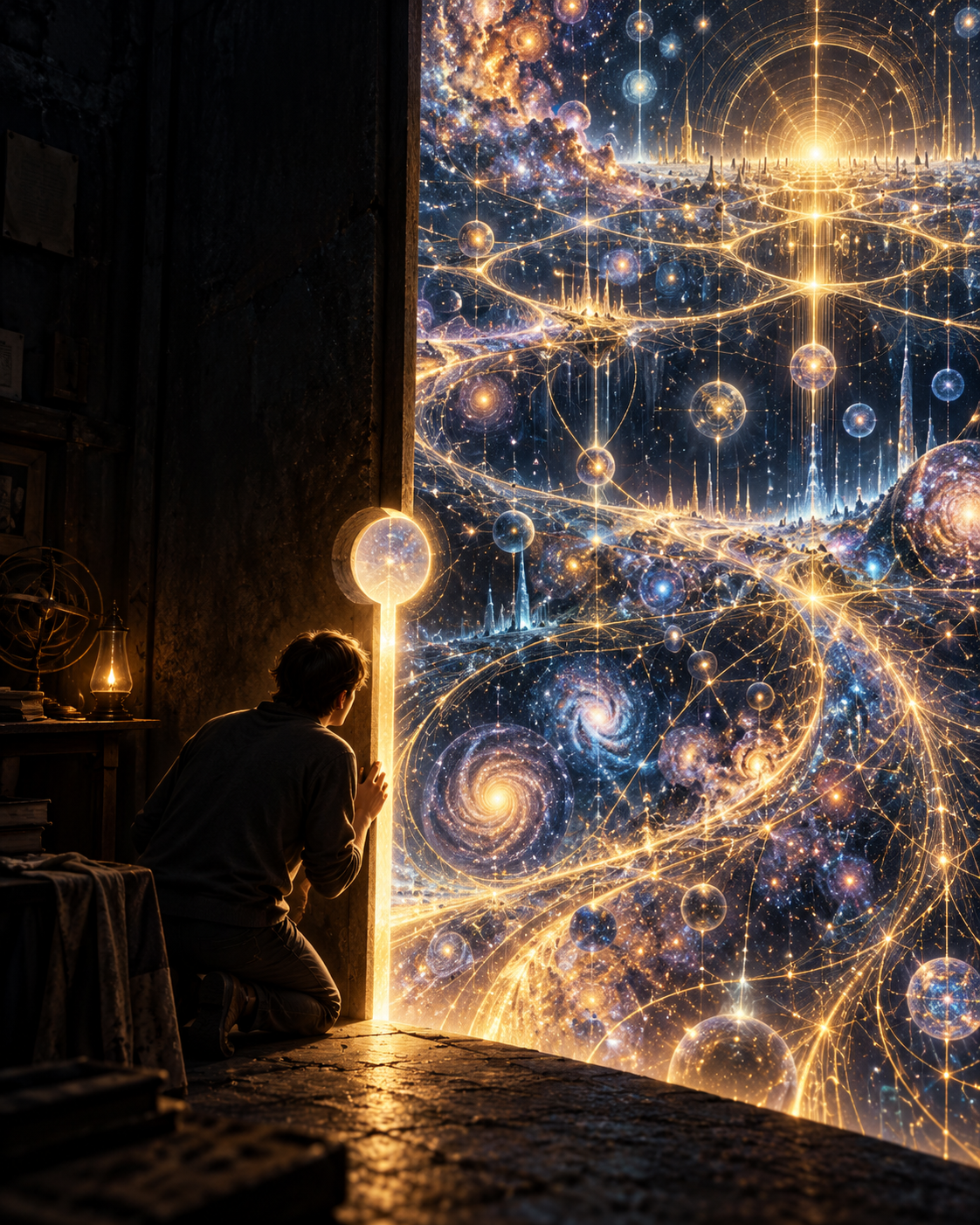
Imagine standing in a large library with only one shelf illuminated. Everything on that shelf is genuinely available to you, but the darkness around it does not prove that the rest of the library is empty. If another light turns on, nothing new has to be added to the building. More of what was already there becomes usable from your position. Decoding Reality develops the possibility that ordinary consciousness works in a similar way: local awareness may occupy a narrow region of a larger relational structure, while development changes how much of that structure can become consciously available.
This is where the phrase keys of consciousness becomes useful. A key of consciousness is any pattern, experience, relationship, symbol, state, or arrangement that changes what consciousness can recognize, access, integrate, or sustain. Some keys may work by directing attention. Some may reorganize bodily state. Some may compress a relationship into a form that can be reconstructed later. Some may allow another person's perspective to become available. The stronger proposal explored in this paper is that certain keys may also help a local consciousness access relationships belonging to a reality larger than what ordinary awareness can presently hold.
The paper therefore asks two linked questions. What is the larger structure being decoded, and what kinds of keys could change a consciousness enough for more of that structure to become accessible?
2. What Reality Is Being Decoded?
A map is useful because it preserves relationships while changing the form in which those relationships appear.
A street becomes a line, a city becomes a mark, and many miles can be reduced to a few inches of paper. The paper is not the landscape, but someone who understands the representation can recover enough of the landscape's organization to navigate it. The first paper called the relationship that survives this change an invariant relationship, meaning an organization that remains recognizable when the material or representation changes [1].
Structural realism provides a philosophical parallel. Structural realism is the view that some of the relationships described by successful science may remain reliable even when scientific theories change their descriptions of the individual things involved [2]. A later theory can replace an earlier picture of what the world is made of while preserving mathematical relationships that continued to predict observations. The important suggestion is that understanding can sometimes become more dependable when it reaches beneath the surface description and identifies the organization that persists.
Decoding Reality extends that idea into a metaphysical proposal. Metaphysics is the study of what reality ultimately is. The theory proposes that reality is one complete relational structure expressed through many differentiated forms and perspectives. Differentiated means distinguishable without necessarily being independent. A finger is distinguishable from a hand and a hand from an arm, but the distinction does not make each one a separate organism. Their identities include the relationships through which they belong to something larger.
A tree gives the same idea a simpler shape. One twig occupies a position no other twig occupies. It can grow in a different direction, receive different light, and be damaged while another twig remains intact. Yet its individuality does not make it a separate tree. Its history, nourishment, support, and future possibilities depend on the branch, trunk, roots, soil, water, and larger organism in which it participates. Decoding Reality treats an individual perspective in a similar way: local experience can be genuine and distinct without being a complete description of the whole to which it belongs.
This is why the theory repeatedly uses images such as the tree, the web, and the tapestry. Each preserves a different relationship. A tree makes branching easy to see, a web emphasizes mutual connection, and a tapestry shows how one thread can remain distinct while helping form a design larger than itself. None is offered as a literal scientific diagram of the universe. Their value is that they make the same possibility understandable from different directions: a local part can be real while the structure that gives it meaning extends beyond what that part can immediately access.
3. From Code to a Key of Consciousness
The word code can suggest a secret alphabet hidden somewhere behind matter, but Decoding Reality uses it in the broader sense established by the foundational paper. A code is a generative relationship, meaning a relationship that can produce or organize more than one expression. A recipe gives an ordinary example. The written instructions are not the finished meal. They specify relationships among ingredients, amounts, order, temperature, and time that allow recognizable meals to be produced in different kitchens. The finished meals can vary while the organization that generated them remains identifiable.
Several layers become important once this distinction is made. The code is the generative relationship itself. An expression is one particular form produced within that relationship. A pattern becomes visible when several expressions reveal recurring organization. A symbol is a compact representation that preserves enough of that organization for it to be recognized again. A key of consciousness goes one step farther: it is a form, experience, or condition that changes what the decoder can consciously reach, recognize, or organize.
That distinction matters because not every useful symbol changes consciousness in the same way. A road sign can communicate information without deeply changing the person who reads it. A sentence that accurately names a relationship a person has struggled to understand for years can do something different. It can reorganize old memories, change the meaning of present experience, and make future examples easier to recognize. The first paper describes this as the decoder being altered by what it decodes [1]. The present paper calls the representation a key of consciousness when its effect reaches far enough to move the boundary of access itself.
The movement can therefore operate in both directions. Generative structure produces expressions, repeated expressions reveal patterns, and recognized patterns can be compressed into symbols. Consciousness can then work backward from a compact form toward the relationship it preserves. If the encounter also changes attention, bodily state, expectation, integration, or the range of information available to awareness, the symbol is no longer only a representation of the code. It has become part of the mechanism through which the decoder gains access to it.
This is why numbers, geometry, language, imagery, bodily states, relationships, environments, rituals, and altered states can all belong in one theory without being treated as physically identical. Their surfaces differ.
What makes them members of the same family is the possibility that each can change which relationships become consciously available.
4. Fibonacci as Code, Signature, and Key
The Fibonacci sequence gives the theory a clear example because its visible terms keep changing while the relationship producing them remains stable. Beginning with 1 and 1, each later number is formed by adding the two immediately before it: 1, 1, 2, 3, 5, 8, 13, 21, and so on. Someone who memorizes those numbers knows several outputs. Someone who understands the recurrence can continue the sequence without having seen the later terms. The reusable information lies in the relationship rather than in any single number.
As the sequence continues, the ratio between neighboring terms approaches approximately 1.618, commonly called the golden ratio. Related numerical arrangements appear in some examples of phyllotaxis, the pattern by which leaves, seeds, or new plant structures are arranged during growth [3]. The important point for this theory is that a relatively simple recursive relationship can continue producing new forms while a deeper organization remains recognizable across them.
Fibonacci can therefore be separated into several levels. The recurrence is the generative code. The sequence is a numerical expression of that code. The approach toward the golden ratio reveals another stable relationship generated through the recurrence. A spiral constructed from Fibonacci-sized squares is a geometric signature, a visible representation that makes part of the numerical organization easier to see. When that number sequence or geometry is encountered by consciousness, it can also become a potential key if the representation helps the decoder recognize, enter, or stabilize the relationship it preserves.
This is the difference between saying that a symbol is sacred and asking what the symbol does. A geometric form could matter because it resembles something culturally important, because it has been repeatedly associated with a spiritual meaning, because its proportions interact with ordinary perceptual systems, or because its structure corresponds to a deeper organization that the larger system can recognize before conscious language explains it. Those mechanisms are not identical, but they all turn the same question toward access: what becomes available to consciousness when the form is encountered?
Fibonacci is especially useful because the same organization can be translated through number, ratio, recursion, geometry, and physical growth without becoming one identical object. It gives the theory a concrete picture of how reality can express a relationship through several surfaces and how one of those surfaces can later help consciousness work backward toward the relationship itself.
5. One Reality and Many Accessible Paths
Imagine a printed story in which the reader is repeatedly asked to choose what happens next. Every available page already belongs to the complete book, but one reading follows only one sequence through it. The route matters because choosing one page changes which later pages can be reached from that point. At the same time, an unread page does not disappear from the book merely because a different path was followed.
Decoding Reality uses this image to describe its larger possibility structure. The theory proposes that total reality contains a complete field of realizable configurations and pathways, while an individual consciousness experiences one local trajectory through that field. A trajectory is the sequence of states and events encountered from one position through the structure. The unaccessed branches are not treated as discarded possibilities that ceased to belong to reality when another path became lived. They remain parts of the larger whole that are not presently available from that local point of access.
This proposal is not identical to the popular image of many separate universes floating beside one another. It is closer to one tree containing many branches. A person standing on one branch has a real position and can move only through routes connected to it, but the unseen branches still belong to the same tree. In the theory, what is usually called one person's reality is therefore the portion of the total structure that becomes available along that person's path rather than the full extent of what reality contains.
Quantum mechanics provides one comparison, although the metaphysical proposal goes beyond what the physics establishes. The many-worlds interpretation describes the universal quantum state as developing branches associated with different outcomes without requiring a literal collapse that destroys every alternative except the one observed. Decoherence is the process through which interactions with the environment make those alternatives lose observable interference with one another [4]. Decoding Reality adds a further claim: the branches are interpreted as unaccessed portions of one larger reality through which local consciousness experiences a particular path. That addition is part of this theory rather than a conclusion supplied by quantum mechanics itself.
The distinction matters because it changes what choice means. A decision does not have to create a possible path from nothing. It can determine which neighboring region of an already larger structure becomes part of lived experience. Choosing one road changes what can be reached next, what information becomes available, what relationships are encountered, and which later choices can arise from that position. Agency remains meaningful because the local trajectory depends on the sequence of choices even if the wider field contains possibilities that are not presently being experienced.
6. Time as Sequential Access
The same model changes the way time can be pictured. Ordinary experience arrives in sequence. A person reads one sentence before the next, wakes into one morning before another, and often learns the meaning of an earlier event only after later information changes its context. Yet a structure can be complete while still being encountered one part at a time. A book exists as a whole even though the reader experiences its pages sequentially.
Eternalism is a philosophical view of time in which past, present, and future events are treated as parts of one spacetime structure rather than reality containing only a uniquely existing present moment [5]. It is often illustrated with the idea of a block universe. Decoding Reality combines a related intuition with the branching model developed above: the larger structure can be complete at a level wider than local awareness while an embodied perspective encounters only the sequence available from its current position.
Sequential access makes discovery possible. If every clue, consequence, interpretation, and possible outcome were equally available to ordinary awareness at once, there would be no meaningful progression from confusion to recognition. The person would possess the whole relationship instead of learning it. When access is local and sequential, however, an event can be misunderstood at one stage and become newly intelligible later because another part of the structure has finally been encountered.
This gives the familiar experience of looking back on one's life a larger theoretical importance. The past event has not changed, yet a new relationship can change what that event means within the person's understanding. A later friendship can reveal what was missing in an earlier one. Becoming a parent can reorganize the meaning of one's own childhood. A scientific discovery can make observations recorded decades earlier suddenly fit into a coherent model. In each case, later access changes the structure available to interpretation.
Time, under this theory, is therefore not only the order in which events occur. For local consciousness, it is also the order in which parts of a larger relationship become available to be decoded.
7. Why Access Is Limited
The foundational paper describes consciousness as having a moving boundary of access: information can be processed outside ordinary awareness, and training or state change can alter what becomes available to conscious participation [1]. Decoding Reality asks why a larger reality would be experienced through a boundary at all.
A person looking through a small opening into a room can see only what the opening allows. Moving the opening changes the view, but it does not create the furniture that becomes visible or destroy what falls outside the frame. The limitation belongs to the person's access rather than to the room itself. In the same way, local consciousness could be limited without the larger structure itself becoming incomplete.
This restriction gives discovery a function. Someone who is handed the completed answer to a puzzle can understand the answer, but they cannot have the same experience as the person who searches through the clues and recognizes the solution. Discovery requires a period during which the relationship is not yet explicit. If total reality already contains its complete structure, local limitation can create experiences that complete access alone cannot contain in the same form: uncertainty, search, surprise, choice, recognition, remembrance, and the felt transition from separation toward connection.
Several religious traditions preserve images that become relevant at exactly this point. In Lurianic Kabbalah, tzimtzum refers to divine contraction or withdrawal in relation to creation, with some later Hasidic interpretations describing the contraction as epistemic concealment rather than a literal absence of God [6].
Hindu discussions of lila, usually translated as divine play, ask why a complete divine reality would create if it lacks nothing that creation could supply [7]. Christian discussions of kenosis, meaning self-emptying, center on Philippians 2:7 and the self-emptying of Christ in taking human form [8]. These traditions remain theologically different, but each preserves a version of the same structural problem: what becomes possible when fullness is experienced through limitation?
Decoding Reality answers by treating restricted access as a condition of local experience rather than a defect in the whole. The whole does not need to lose its structure in order for one of its perspectives to experience uncertainty. Locality creates the difference between possessing a relationship and discovering it. Under the theory, creation can therefore be understood not only as the production of differentiated forms, but also as the production of perspectives from which the relationships among those forms can become lived discoveries.
8. The Subconscious Beyond the Boundary
Ordinary experience already shows that conscious awareness is narrower than the processing that contributes to it. A name can return after someone stops deliberately searching for it. A person can know that a sentence sounds wrong before they can state the grammatical rule. An experienced worker can notice that something is unusual before they can identify the exact cue that produced the judgment. The foundational paper uses examples like these to separate processing, access, and explanation: the organism can respond to information before the person can consciously describe what was noticed [1].
The subconscious, as the term is used here, refers to processes and representations operating outside ordinary conscious awareness. It is not treated as one hidden organ. The important distinction is between what the larger system can organize and what the person can presently hold in explicit awareness. Research on incubation in problem solving, for example, has found that setting a problem aside can improve later performance under some conditions, suggesting that useful reorganization does not depend entirely on continuous deliberate thought [9].
Decoding Reality proposes that the subconscious functions as a wider interface than ordinary awareness. It can compare more of the person's history, bodily state, expectations, associations, sensory information, and learned relationships than can be held in conscious attention at one moment. A dream, image, bodily sensation, intuition, or sudden association may therefore appear before the person has a complete verbal explanation because the larger system has organized a relationship that consciousness has not yet translated.
Carl Jung's concept of the collective unconscious adds a further possibility. Jung described archetypes as preexistent organizing forms within the collective unconscious and likened them to instinctual patterns; they can become visible through dreams, myths, religious beliefs, and other symbolic imagery [10]. This does not require a finished picture of every ancient symbol to be inherited. The inherited component can instead be understood as an organizing tendency that gives recurring experience a recognizable form. Decoding Reality extends that possibility by asking whether tendencies involving relationships such as one and many, inside and outside, center and boundary, parent and child, danger and safety, repetition and change could make some structures easier to recognize before culture gives them particular names and images.
The stronger extension of Decoding Reality is that subconscious organization may reach beyond the information an individual has consciously acquired. If reality is one relational structure and the individual is a local expression within it, the subconscious may function as an interface through which more of that structure becomes available than ordinary awareness can immediately explain. Dreams, intuitions, bodily signals, and symbolic experiences would then matter because they are possible forms through which a wider organization can approach the moving boundary of conscious access.
9. Symbols as Compressed Interfaces
A wedding ring can occupy less space than a coin while calling up years of shared experience for the person wearing it. A few notes of music can make an old period of life feel immediately present. A map can fold an entire city into a page. In each case, the physical cue is much smaller than the network of relationships it allows someone to reconstruct.
The first paper described symbols as knowledge seeds because a compact form can preserve enough structure for a larger understanding to be rebuilt [1]. Decoding Reality adds another role. If conscious access is limited, compression may be one of the ways information crosses that limit. A symbol can gather a complex relationship into a form small enough to be remembered, imagined, repeated, drawn, spoken, or carried across generations.
This makes the visual form of sacred writing and religious symbols relevant without reducing their significance to decoration. Pythagorean traditions treated whole-number ratios as central to musical intervals and extended mathematical harmony into a larger picture of cosmic order [24]. The Sefer Yetzirah, or Book of Creation, describes creation through twenty-two Hebrew letters and ten sefirot; in this early text, the sefirot function more like fundamental dimensions or primordial structures than the later Kabbalistic attributes of God [11]. Jewish gematria developed methods of reading numerical relationships through Hebrew letters themselves [25]. The Greek word logos can mean word or account, and in Heraclitus it names a common intelligible order that people can fail to understand; the Gospel of John later places the Logos, usually translated as the Word, at the beginning of creation [12]. The Shabaka Stone preserves an Egyptian Memphite account in which Ptah gives life through heart and tongue: the heart devises and the tongue commands, linking conceived order with expressed form [13]. These traditions do not make one identical historical claim, but each treats number, symbol, language, or expression as more than a label placed on a finished world.
The structural possibility is that a symbol can function as an interface between levels of organization. A finite mark can direct attention toward a relationship much larger than itself. The infinity symbol is a small drawing that gives the mind access to the idea of continuation without a final bound. An equation can fit on one line while preserving relationships that apply across enormous physical systems. A sacred name can combine sound, visual form, learned meaning, history, and expectation in one compact representation.
Under the theory, the most important symbols would be those that preserve relationships deeply enough that they can be decoded again rather than merely memorized. Their form can become a key because it reduces a larger organization to something local consciousness can hold while still retaining a path back toward the structure from which the symbol was derived.
10. The Families of Consciousness Keys
A key of consciousness is defined by function rather than by appearance. The useful question is not whether something looks spiritual. It is whether the encounter changes what consciousness can recognize, access, integrate, or sustain. The same key can also work through more than one mechanism. A ritual may combine language, geometry, movement, environment, relationship, expectation, memory, and altered state at the same time.
Numerical keys organize relationship through quantity, sequence, ratio, and repetition. A number can strip away the surface of the objects being counted and preserve only their relation. Repeating forms such as 11:11 make repetition and visual symmetry immediately obvious, while learned cultural associations can add personal meaning to the pattern. Numerology is the broader attempt to interpret numerical relationships as meaningful patterns. Within this theory, the strongest question is not whether every repeated number has a fixed message, but whether some numerical arrangements preserve relationships that alter recognition or state.
Geometric keys organize relationship in space. Geometry means the study and arrangement of shape, distance, angle, proportion, orientation, symmetry, boundary, and position. A circle, crossing, spiral, enclosure, or repeated proportion can therefore carry relationships in visible form before any words are added. The foundational paper already establishes that geometric form can interact with perception and state [1]. Here the additional possibility is that some geometry functions as a key because the spatial relationship it preserves corresponds to a deeper organization consciousness can recognize or enact.
Linguistic keys use words, letters, names, and verbal structure. Language can make an implicit relationship explicit when the right phrase suddenly organizes years of experience. Sacred language adds another layer because a word can be heard, seen, repeated, imagined, written, and associated with generations of meaning.
The name of God in a religious tradition can therefore function simultaneously as sound, visual form, concept, memory, and ritual object. A linguistic key changes access when naming the relationship makes it consciously available in a way that vaguer language did not.
Imaginal keys operate through internally generated perception. Imagery means forming a sensory-like experience in the mind when the object is not physically present. Visual imagery recruits a network that extends from frontal regions into sensory areas and can function in some respects like a weaker form of perception [27].
Emotional imagery can also evoke measurable emotional and physiological responses [28]. A visual key therefore does not always need to remain outside the person. Once the form has been learned, consciousness can recreate it internally and use imagination as part of the access process.
Embodied keys work through the living system itself. Breath, posture, movement, touch, rhythm, sensation, temperature, and other bodily conditions can change state before the person possesses a complete explanation of why. The foundational paper makes this especially important because it shows that form can change state and that state changes what becomes understandable [1]. The body is therefore not merely a container for decoding. It is one of the surfaces through which access can be changed.
Relational keys arise through another perspective. A person can recognize something in themselves because another person names it, mirrors it, contradicts it, loves them differently, or reveals a possibility that was not visible from one position alone. Relationship expands access because two local perspectives can make different portions of the same larger structure available to one another. Later papers develop resonance and relational integration in detail; here the key point is that another consciousness can itself become an access condition.
Environmental keys organize the conditions surrounding the decoder. Light, sound, architecture, nature, temperature, social setting, and repeated ritual space can alter attention, expectation, physiology, and behavior together. A temple, forest, quiet room, or crowded street does not merely provide a background for consciousness. The environment changes the state from which consciousness is interpreting what happens.
Altered-state keys change the organization of consciousness more directly. Meditation, trance, sleep transitions, intense emotion, contemplative absorption, and other altered states can change which memories, sensations, associations, and patterns become available [1]. An altered state is not automatically a more accurate state, but it can widen or reorganize the field from which decoding occurs. In the strongest version of the theory, such states become especially important because changing the decoder may also change which portion of the larger relational structure can be accessed.
These families are not eight separate theories. They are eight common surfaces through which the boundary of access can move. The later curriculum examines several of them independently so that language, body, geometry, relationship, and state change can be understood in their own mechanisms before being recombined.
11. Portals as Changes in Access
The word portal often suggests a doorway between separate places, but the earlier sections allow a more precise meaning. A portal can be understood as a change in access. The larger structure does not have to appear from nowhere. What changes is which part of that structure can be reached, noticed, or integrated from the current state of the decoder.
Ordinary psychology already contains small versions of this effect. A smell can suddenly make a forgotten memory available. A sentence can name an emotional relationship so precisely that years of experience reorganize around it. A song can alter attention and bodily state within seconds. Mental imagery recruits some of the same neural systems involved in perception [27], and emotional imagery can produce measurable emotional and physiological responses even when the imagined event is not physically present [28]. These examples show that relatively small cues can produce large changes in what information or state becomes accessible.
Decoding Reality proposes that some symbols, numbers, geometries, rituals, or states may function in the same general way at deeper levels. Their importance would not come from being magical objects that create an otherwise nonexistent reality. It would come from their ability to organize the decoder so that a relationship already present within the larger structure becomes easier to access.
This is where repeating numbers such as 11:11 become theoretically interesting without requiring a fixed angel- number dictionary. Four identical numerical forms make repetition and visual symmetry immediately obvious.
Cultural associations can add learned meaning, making the pattern more personally salient. Those ordinary mechanisms are enough to explain why 11:11 can capture attention more readily than an irregular time. The stronger possibility explored by this theory is that some repeated numerical or geometric arrangements preserve relationships that the subconscious recognizes more deeply than conscious language can immediately explain.
A portal, in this sense, is not defined by the strangeness of the experience. It is defined by a transition in accessibility. A key is whatever reliably helps produce that transition. The families above give that definition practical form. A portal is the transition in accessibility, while the key is the pattern, state, relationship, or arrangement that helps produce the transition. Decoding Reality therefore treats access itself as one of the central variables of consciousness: what a person can consciously use depends not only on what exists, but on the organization of the decoder at the moment the information is encountered.
12. Remembering Instead of Receiving
Some learning feels like acquiring a fact that was previously absent. Other learning feels like recognition. The pieces were already present, but they had not yet been organized in the way that makes their relationship obvious. When the relationship becomes visible, the result can feel less like receiving new material and more like finally seeing what had been there all along.
Plato gave this experience a philosophical form through anamnesis, a Greek term meaning recollection or remembering. In the Meno, Socrates uses a geometric problem to explore whether understanding can be drawn out through questioning rather than simply placed into the learner from outside [14]. The dialogue is not modern evidence that every truth was literally known before birth, but it creates an important connection among geometry, relationship, inquiry, and recollection.
Sufi traditions place remembrance near the center of spiritual practice through dhikr, a term meaning remembrance or recollection of God. Dhikr can involve repeated divine names or Qur'anic phrases and is used to direct attention away from ordinary forgetfulness and toward divine presence [15]. Again, the theology is distinct from Plato and from the present theory. The important structural similarity is that spiritual movement is described as recovering recognition rather than acquiring a completely foreign reality.
Decoding Reality uses remembrance in the same structural sense. The individual does not need to recover a forgotten biography in which they consciously knew every law of the universe. The proposal is that the relationship being discovered already belongs to the reality of which the person is part. From the local perspective the understanding is new, while from the level of the whole the structure being recognized was already present.
This distinction becomes central to the theory's account of enlightenment. Development does not require a finite mind to collect every possible fact. It requires increasingly accurate access to the relationships through which many facts belong together. What appears as spiritual remembrance is the movement by which a local perspective recognizes more of the organization it has always existed within.
13. Collective Access: Many Views of One Whole
Stand close to a large building and it is impossible to see every side at once. A person on the opposite side can describe windows that are invisible from your position, while someone on a hill may see the roof that neither of you can see from the ground. The descriptions can differ without requiring three different buildings. Each observer has access to a different portion of the same object.
Decoding Reality treats individual consciousnesses in a similar way. A local perspective gains experiences and relationships unavailable from another position, which means difference is not simply a problem that unity must erase. Difference increases the range of the whole that can be experienced. If every perspective were identical, every perspective would encounter the same limitations.
Research on cumulative culture shows how knowledge can be distributed across people and preserved across generations, reducing how much each learner must discover independently [16]. In two studies involving 699 people, Woolley and colleagues reported a group-level collective-intelligence factor that was not strongly explained by the average or maximum intelligence of individual members and was associated with social sensitivity and more equal conversational turn-taking [17]. The foundational paper uses findings like these to establish that human learning can compound across minds [1]. Paper 2 changes the emphasis from transmission to access. When one person communicates a relationship another person could not see from their own position, the second person's accessible world becomes larger. A creation can therefore function as a key of consciousness for someone who never lived the experiences that produced it.
Religious traditions preserve comparable images. In 1 Corinthians 12, Paul describes one body made of different members and asks what would happen if the whole body were only an eye: there would be no hearing [18]. Huayan Buddhism uses the image of Indra's Net, an immense network of jewels in which each jewel reflects every other jewel, to express a reality in which individual things are intelligible through their relationships with the whole [19]. The traditions are different, but both make differentiation part of the capacity of the larger system rather than an obstacle to it.
Collective access is therefore more than several people knowing the same fact. Different perspectives make different relationships available, and communication allows those relationships to become shared without requiring the perspectives themselves to disappear. Humanity becomes a distributed decoder because the accessible knowledge of the network can exceed what any one person can personally discover or hold.
Pierre Teilhard de Chardin developed a related Christian evolutionary picture through the noosphere, his term for the reflective or thinking layer formed by human consciousness on Earth, and the Omega Point, the transcendent goal toward which he envisioned the noosphere converging [26]. Decoding Reality gives this kind of convergence an access-based mechanism: different perspectives contribute different portions of the larger structure, and integration allows locally discovered relationships to become available across a wider field of consciousness.
14. Shared Memory Beyond Communication
Ordinary collective learning depends on a path of transmission. Someone speaks, writes, demonstrates, builds, records, or leaves behind a symbol, and another person encounters what was transmitted. The relationship between the two learners can be traced through an observable channel.
Rupert Sheldrake's hypothesis of morphic resonance proposes an additional possibility. Morphic resonance is the idea that similar systems may draw upon and contribute to a pooled memory of previous similar systems, allowing repeated forms or learned patterns to become easier to establish even without conventional communication. In a 1987 paper, Sheldrake explicitly connected this proposal with Jung's collective unconscious [20].
Within Decoding Reality, morphic resonance would provide a transpersonal mechanism for collective access.
Transpersonal means extending beyond the ordinary boundaries of one individual person. If a consciousness successfully accesses and stabilizes a relationship, a morphic-resonance model would suggest that the same organization could become more accessible to other similar systems even when no book, conversation, or demonstration passes between them.
The larger theory does not require this mechanism in order for collective learning to occur. Culture already provides powerful routes through which knowledge compounds. Morphic resonance matters because it offers a specific model for the stronger possibility that access itself can be influenced across individuals without ordinary transmission. A 2026 series of Wordle studies reported inconsistent results across three experiments rather than a stable replicated effect, so the proposal remains an unsettled hypothesis rather than an established mechanism [21].
Sheldrake also applied the idea to religious ritual, including Passover and Christian Communion, proposing that repeated performance could resonate with previous performance of the same form [22]. This creates an especially relevant bridge to sacred symbolism. A ritual can already carry inherited cultural meaning through teaching and repetition. If morphic resonance were also operating, the same repeated form could function as an access point shaped not only by what the participant consciously learned but also by the accumulated history of the pattern itself.
This is where Jung's archetypes, collective memory, ritual repetition, and the larger Sea of Consciousness hypothesis begin to approach one another. The common question is whether repeated organization can become easier to access because it has already been established elsewhere in the larger system.
15. Religions as Preserved Access Systems
Human beings preserve difficult discoveries because rediscovering them from the beginning is expensive. A relationship that took years to understand may be compressed into a story, image, proverb, ritual, building, number, or symbol that survives long after the original discoverer is gone. The representation can change across generations while still carrying enough organization for someone later to reconstruct part of the original insight.
Decoding Reality therefore treats religions partly as long-running systems for preserving discoveries about consciousness, creation, limitation, suffering, relationship, remembrance, return, and unity. This does not require every religion to be secretly identical. Their differences are useful because they help separate the relationships that recur from the interpretations that belong to one culture, language, or historical setting.
The Dao De Jing describes the Dao giving rise to one, one to two, two to three, and three to the multitude of things [23]. Heraclitus describes an intelligible Logos that people can fail to understand even while living within its order [12]. The Sefer Yetzirah joins number and letter within an account of creation [11]. Kabbalistic tzimtzum describes fullness becoming concealed so that finite experience can appear [6]. Platonic anamnesis frames learning as recollection [14]. Sufi dhikr makes remembrance a spiritual practice [15]. Huayan uses interdependence to explain how the part belongs to the whole [19]. Egyptian Memphite theology describes conceived order becoming manifest through expression [13]. The Christian sources used earlier add creation through the Logos and the self-emptying of Christ in kenosis [8,12].
The doctrines should not be collapsed into one claim, but a smaller family of structural movements appears often enough to deserve attention. Unity differentiates. A local perspective emerges. Something becomes concealed, forgotten, or unavailable. Experience unfolds inside that limitation. A relationship is rediscovered.
The local perspective then moves toward a more integrated recognition of the source or whole from which it never became completely independent.
If these recurring relationships preserve genuine observations about consciousness or reality, religions can be understood as historical systems for preserving and reopening access to relationships. Their stories and symbols may carry compressed maps of relationships even when later interpretation has changed, accumulated, or partially lost the original key. Comparative decoding then becomes a process of testing what each preserved form appears to reopen rather than forcing the traditions into agreement. The aim is to identify the invariant precisely enough that the shared relationship, the cultural packaging, and the possible distortion can each be seen more clearly.
16. God and the Complete Structure
The code metaphor also changes how omniscience can be imagined. Omniscience means all-knowing. It is often pictured as perfect prediction by a mind standing somewhere inside time, but prediction is only necessary from a position that does not already have access to the complete structure. An author who has written a branching story does not predict which pages exist. The pages belong to the work as a whole, while the reader encounters them one at a time.
Within the divine version of Decoding Reality, God corresponds to the complete structure, the source of that structure, or complete awareness of it. Omnipotence means all-powerful and can be related to the generative source or authorship of the relationships through which possible forms arise. Omniscience can be related to complete access to the resulting structure. The distinction allows creation and knowledge to be understood as different aspects of the same larger organization.
This makes the religious language of Word and Logos especially relevant. If reality is generated through reusable relationships that function like a grammar, creation through Word can be read as an image of intelligible order becoming expression. The metaphor does not require God to issue an independent command for every leaf, star, thought, and possible decision. A comparatively small set of sufficiently deep generative relationships can produce enormous complexity, just as grammar can generate sentences that were never individually memorized.
The same idea also explains why local consciousness can remain limited without implying that the whole is incomplete. The complete code can contain the possible forms while the individual encounters those forms sequentially from one position. What develops through a life is not the completeness of reality itself but the accessibility and embodiment of its relationships within one differentiated perspective.
Creation can then be understood as the expression of one structure through many local points of experience.
The whole does not need new facts supplied by the individual. What the individual contributes is a way for those relationships to become lived, discovered, interpreted, expressed, and shared from a position that complete access would not reproduce in the same form.
17. Why Decoding Leads Toward Love
Suppose two neighbors initially think of their lives as almost completely separate. Later they discover that their homes share a water supply, their children depend on the same school, and each person's choices change conditions the other must live with. The relationship did not begin on the day it was recognized. What changed was the amount of the system that each person understood.
If reality is fundamentally relational, deeper decoding should repeatedly have this character. Things that looked independent become intelligible through connections that were present before the observer noticed them.
Recognition then changes what participation means. A decision that once appeared to affect only the self can look different when the larger network of consequences becomes visible.
Huayan Buddhism explicitly connects recognition of interdependence with compassion [19]. Decoding Reality gives love a similar structural role without reducing love to an abstract principle. Love is the lived response that becomes possible when another perspective is no longer treated as though it exists outside the system that also contains oneself. Decoding reveals the relationship, while love is one way that recognition becomes embodied in behavior.
This is why intellectual statements about unity are not enough to complete the process. Someone can repeat that everything is connected while behaving as though every other person's experience is disposable. The words have been learned, but the relationship has not reorganized participation. A decoded relationship becomes developmentally important when it changes what the person notices, values, chooses, and can sustain.
The later papers in the curriculum examine healing, language, embodiment, resonance, and relationship in greater detail. At this stage, the important point is that increasing recognition of relationship should have consequences beyond explanation. If the whole is genuinely relational, understanding it more deeply should gradually make absolute separation harder to maintain as the organizing assumption of a life.
18. Reality Becoming Explicit to Itself
The theory can now return to the question that opened the paper. If awareness can accelerate and the boundary of access can move, what is happening when a key of consciousness works? The answer cannot be described completely as one mind collecting information about an external world, because the mind doing the learning is itself part of the reality being learned.
Reality produces differentiated physical systems. Some of those systems become living organisms capable of perception, memory, anticipation, imagination, language, and reflection. Those organisms encounter patterns in the world that produced them, compress the patterns into symbols and theories, alter their own states, compare discoveries with other organisms, and gradually make more of the relationships through which they exist available to conscious recognition. The decoder is therefore not standing outside the structure. It is one of the structure's own expressions.
A key of consciousness matters because it changes the local conditions of that recognition. A number can direct attention toward a relationship. A geometric form can organize spatial perception. A sentence can make an implicit pattern explicit. A posture or rhythm can change bodily state. Another person can reveal a perspective unavailable from one position. An altered state can reorganize which memories, associations, or sensations enter awareness. In each case, something that already belonged to the larger system becomes newly usable from a particular point within it.
This creates a recursive loop at the largest scale of the theory. Generative relationships become expressed as forms. Some forms become capable of recognizing relationships. Recognition becomes conscious understanding. Understanding can then be externalized through language, science, art, ritual, movement, or other forms that become keys for additional consciousnesses. Each new decoder begins from a different position and can contribute relationships that were not accessible from another point of view.
Under the strongest version of Decoding Reality, differentiation serves this function. A complete structure and the experience of discovering that structure are not the same thing. Complete access contains the relationship, but local access allows uncertainty, choice, search, error, correction, surprise, insight, remembrance, creation, and love to exist as lived transitions. The whole does not become more complete when a person understands something. A relationship that was implicit in the structure becomes explicit within one of its local expressions.
Forgetting then gains a place in the process. Restricted access makes rediscovery possible. Difference creates positions from which relationship can be experienced. Keys move the boundary around those positions.
Creation expands generative relationships into multiplicity, while decoding moves through that multiplicity toward the relationships that make it intelligible. The movement does not require the many to disappear. It requires the many to become increasingly conscious of the organization through which they belong together.
In this sense, reality is not being explained to something outside reality. Through conscious beings and the keys that expand their access, parts of reality become capable of making the relationships of reality explicit from within.
19. The Movement of the Whole
The larger theory can now be stated as a continuous movement rather than a collection of separate claims. A unified structure differentiates into distinct forms and perspectives. Difference makes new relationships possible, while locality limits what any one perspective can access. Restricted access allows uncertainty, choice, experience, and discovery to occur. Experience provides material from which recurring patterns can be recognized. The subconscious can organize relationships before ordinary awareness can explain them, and symbols can compress those relationships into forms that survive memory, communication, and cultural change.
A key of consciousness is the point where that larger movement becomes locally actionable. The key may be a number, geometric form, word, image, bodily condition, relationship, environment, ritual, or altered state. What makes it a key is not its category but its effect: it changes what the decoder can recognize, access, integrate, or sustain. A portal is the corresponding transition, the moment when the boundary of accessibility changes and a relationship that was previously outside conscious reach becomes available from the current position.
Decoding then makes the relationship explicit, and the newly understood relationship changes the awareness that will interpret what comes next. Different decoders share, compare, and integrate what they have learned, allowing collective access to exceed the experience of any one individual. If transpersonal forms of shared memory such as morphic resonance also occur, repeated organization may become accessible through routes that extend beyond ordinary communication. At every level, the repeated movement is from difference toward relationship and from relationship toward larger integration.
This movement does not make individuality a mistake. A branch can remain a branch while being understood as part of a tree. A person can retain a distinct history, body, perspective, and path while recognizing that those distinctions do not exhaust what the person belongs to. Convergence does not require sameness because difference is part of what allows the larger whole to encounter itself from more than one position.
The foundational paper asks how awareness can use each genuine discovery to increase its ability to make the next one [1]. Decoding Reality answers what that accelerating awareness may be doing: moving the boundary between what belongs to the larger structure and what a local consciousness can consciously access. The keys of consciousness are the interfaces through which that boundary can change.
Enlightenment, in this framework, is not the accumulation of an infinite catalogue of facts. It is the increasingly stable recognition and embodiment of the relationships through which apparent multiplicity belongs to a larger whole. The world does not become connected when the relationship is recognized. What changes is that the connection becomes available to consciousness and begins to reorganize how the local perspective participates in the reality it was already part of.
Rate This Theory
All ratings are anonymous
Help others by sharing
Comments
(0)AnonymousNo comments yet. Be the first to share your thoughts!
Spiritual theories are speculative frameworks offered for exploration. They are not treatments, and they are not a substitute for the tested methods in the Healing Library.