
The Divine Model: The Depths of Divinity
Love's Curriculum: The Growth Of Consciousness / Paper Fourteen
The Divine Model: The Depths of Divinity
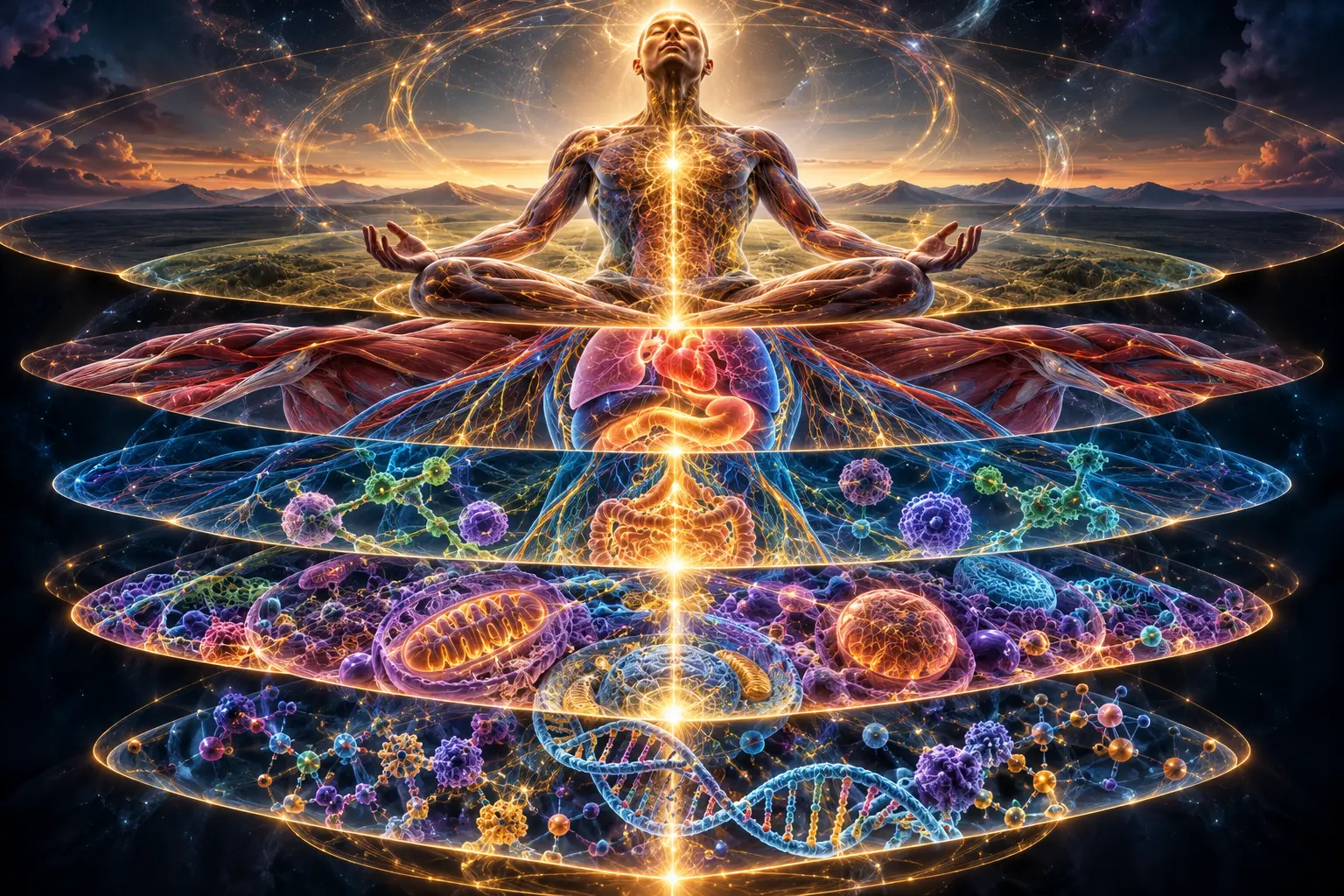
1. The Boundary We Assume Is Fixed
A person can decide to lift a hand. They can decide to stand, speak, hold their breath, walk into sunlight, or leave a room. They cannot ordinarily decide to release a particular amount of epinephrine, lower one inflammatory cytokine, change the voltage across a group of cell membranes, or instruct an immune cell what to do next. The first set of actions feels voluntary. The second set feels like something the body does on its own.
That boundary is so familiar that it is easy to mistake it for a permanent division inside the human organism. Conscious choice seems to operate at the surface, while the deeper work of physiology proceeds automatically underneath it. Yet even ordinary behavior already crosses that line. Choosing to breathe differently changes carbon dioxide, blood chemistry, heart rhythm, and autonomic activity. Choosing to exercise changes temperature, metabolism, hormones, circulation, and later sleep. A simple action can reach much farther into the body than the action itself appears to reach.
The previous papers in Love's Curriculum have approached this same problem from several directions. Decoding Reality: The Keys of Consciousness defines access as the information, relationship, state, or capacity presently available to conscious participation [2]. Defining Consciousness separates that access from consciousness itself and from agency, the capacity of a system to act in relation to its state [3]. The Mechanics of Becoming then distinguishes a state that can be visited from a capacity that has become reliably available across future situations [8]. Spiritual Psychosis adds the necessary warning: large changes in access can occur without becoming stable, accurate, or well integrated [12].
The question left by those papers is therefore more specific than whether consciousness can expand. It is how far conscious participation can reach into the normally automatic organization of the person, and what would have to change for that influence to become precise, reliable, and ordinary rather than rare or unstable.
2. The Voluntary Boundary Can Move
The strongest starting point is not a spiritual report but an experiment in which researchers deliberately challenged the supposed border between voluntary and involuntary biology. In 2014, Matthijs Kox and colleagues randomly assigned 24 healthy men to a trained group or an untrained control group. Twelve participants received ten days of training involving breathing techniques, meditation, and cold exposure. All 24 were then given a small intravenous dose of bacterial endotoxin, a standard research procedure that temporarily activates the innate immune system and produces flu-like symptoms [14].
During the endotoxin challenge, the trained participants practiced the learned techniques. Their epinephrine rose sharply. The anti-inflammatory cytokine IL-10 rose faster and reached higher levels, while the pro-inflammatory cytokines TNF-alpha, IL-6, and IL-8 were lower than in the control group. They also reported fewer flu-like symptoms. The important point is not that they consciously commanded those cytokines. They intentionally entered a learned physiological state, that state changed sympathetic activity and epinephrine, and the change propagated into an immune response [14].
A different practice reaches another normally automatic function. Kozhevnikov and colleagues studied ten experienced Tibetan g-tummo practitioners while measuring axillary temperature and EEG activity. Six of them performed the forceful-breath form of the practice. During the version that combined the breathing technique with meditative visualization, average axillary temperature among those six rose to 37.6 degrees Celsius, and one participant reached 38.3 degrees. The study also found that the breathing and muscular components produced much of the heat, while the meditative component appeared to help sustain temperature increases for longer periods [15]. The finding is useful precisely because it is not magical: a learned state coordinated breathing, muscular action, attention, and thermoregulation in a way most people cannot reproduce on command.
Learning can reach immune and endocrine responses without the person directly controlling either system. A 2017 systematic review examined 16 human studies in which a neutral cue was repeatedly paired with a drug or physiological intervention. Across the literature, conditioned immunosuppression, allergic responses, and insulin or glycemic responses could be produced under some conditions, while evidence for several other endocrine and immune responses remained preliminary [17]. The cue did not contain the drug. The organism had learned the relationship and later began producing part of the biological response when the cue returned.
The same downward path can reach molecular regulation. Buric and colleagues reviewed 18 studies of meditation, yoga, Tai Chi, Qigong, breath regulation, and related mind-body practices that measured gene expression. The studies differed substantially in design, but 81 percent of those that measured inflammatory genes or NF-kappaB activity reported significant downregulation of those pathways [18]. This does not mean that a person can choose an individual gene and switch it off. It means that repeated states of the whole organism can alter the molecular environment in which genes are expressed.
Taken together, these findings establish a modest but important fact. The voluntary-involuntary boundary is not fixed. Training, expectation, conditioning, and learned state changes can sometimes extend deliberate influence into autonomic, immune, endocrine, thermal, pain-regulatory, and molecular processes [14-18]. The remaining question is not whether conscious action can ever reach deeper biology. It is how far that access can develop and what makes deeper access useful rather than disruptive.
3. Depth of Access
Depth of access is the simplest name for that difference. It describes how far conscious influence can reach into processes that normally operate automatically. The term does not mean that consciousness becomes larger or that a person understands every mechanism involved. It describes what the person can reliably influence from the level of conscious participation.
Walking across a room makes the distinction clear. The conscious instruction may be no more complicated than go to the kitchen. The person does not calculate which motor neurons should fire, how blood flow should change, which muscles should stabilize the pelvis, or how much ATP each contracting fiber will use. The nervous system translates a simple intention into thousands of coordinated lower-level events. Conscious access therefore does not require conscious micromanagement.
The same principle can apply to emotional and physiological development. Someone who repeatedly forces themselves not to speak during conflict is controlling an output. Someone whose learned expectation that disagreement destroys connection has changed no longer needs to suppress the same alarm every time. The change has occurred closer to a process generating many later reactions. The Sword of Truth and The Mechanics of Becoming already establish why a change in a highly connected organizing belief can alter many apparently separate behaviors at once [4,8]. Depth of access extends that logic from psychological organization into biological regulation.
This also separates knowledge from access. A person may know the physiology of panic and still be unable to stop it. Another person may regulate panic effectively without knowing the names of the systems involved. Development does not necessarily mean learning more facts about the machinery. It can mean gaining a more dependable route into the controls the organism already uses.
4. When a State Becomes an Ability
A single extraordinary experience is not enough to establish development. The Mechanics of Becoming makes this distinction throughout the curriculum: a state is the organization present now; a capacity is a changed ability to produce and sustain useful organizations later [8]. The Architecture of Change adds another piece. A capacity can exist in the organism's repertoire while remaining difficult to reach, dependent on special conditions, or easy to lose. It calls the effort required to reach the state its transition cost [10].
The idea is easier to understand than the term. A beginning meditator may need twenty quiet minutes, closed eyes, a particular room, and deliberate breathing before calm becomes available. Months or years later, a similar organization may appear within seconds while standing in a crowded place. A person learning to set boundaries may initially need rehearsal, reassurance, and intense effort; later the honest response can become easier than the old suppression. The important change is not only that the person can reach the state. They need less help getting there and can keep it under a wider range of conditions.
This provides a useful distinction between awakening and enlightenment. An awakening can be understood as access: the person enters an organization that was previously unavailable or only dimly available. That state may involve unusual clarity, unity, perception, bodily regulation, or a different relationship with fear and identity. Enlightenment is the stronger claim. The new organization has become stable enough to travel with the person. It generalizes beyond the original ritual, teacher, substance, crisis, environment, or moment that first revealed it.
Several qualities therefore matter at once. Access can become deeper by reaching more automatic processes. It can become broader by involving more parts of the person's functioning. It can become more precise, so that the useful process changes without unnecessary disruption elsewhere. It can become more stable, so the organization survives changing circumstances. And it can become easier, so less preparation and force are required to enter it. None of these qualities is identical to the others.
5. Why More Control Is Not Enlightenment
A person can gain an unusual capacity without becoming more integrated. That distinction is essential because the preceding papers already show what happens when intensity outruns organization. The All Seeing Eye argues that noticing more patterns is not Third Eye development if discernment collapses; the proposed development requires earlier perception together with accuracy and the ability to correct mistakes [11]. Spiritual Psychosis examines the more extreme case, where salience, certainty, perception, self-experience, and bodily state can change dramatically while reality testing and coherent interpretation become less reliable [12].
The same rule applies to biological control. Producing a massive sympathetic response is not automatically a higher state. Feeling everything intensely is not automatically deeper integration. Keeping every process under constant conscious supervision would not be mastery either. Breathing, digestion, balance, tissue repair, immune surveillance, and thousands of other functions work precisely because most of their detail is handled automatically.
Neural Synchrony supplies the larger principle. Better functioning does not come from making every part of a system do the same thing. Specialized processes must remain different enough to contribute different information while coordinating when their relationship becomes useful [9]. The Architecture of Change makes the same point across the functional domains of the person: more activity is not the same as more development [10].
The Divine Model therefore treats advanced self-regulation as flexible access rather than continuous control. The person becomes better able to enter, influence, and leave useful organizations while allowing the organism to manage the lower-level details. The deeper the access becomes, the less conscious force may be required at the surface.
6. Healing From the Level That Generates the Pattern
This model changes the way healing can be understood. Imagine someone who repeatedly becomes silent whenever an important relationship feels threatened. They could practice speaking up in one conversation after another, correcting the behavior each time it appears. Or the deeper expectation organizing the silence could change. If the nervous system no longer predicts that disagreement will destroy connection, speech, muscle tension, attention, emotional alarm, and later relationship choices can all change together. The intervention is small compared with the number of consequences because it reaches a process from which many consequences were being generated [4,8].
Biological systems can also change nonlinearly. Research on critical transitions examines systems that absorb gradual changes while appearing relatively stable and then shift rapidly after a threshold is crossed. A review of complex disease dynamics describes how such transitions can separate one stable regime from another and why a small final perturbation may have a large visible effect when the underlying system is already near a tipping point [19]. The Architecture of Change uses the same limited analogy for human development: many small shifts can accumulate until a different whole becomes easier to occupy [10].
That makes sudden healing less mysterious without making every sudden recovery psychological. Spontaneous cancer regression is rare but documented. A 2021 review describes cases in which tumours regressed without the expected targeted treatment and emphasizes mechanisms involving immune activation, infection, biopsy-related disruption, changes in the tumour microenvironment, and induced cell death [20]. The cases show that the organism sometimes contains pathways capable of producing unexpectedly large biological change. They do not show that conscious intention caused those remissions.
The earlier studies establish a separate fact: learned and intentional states can influence some autonomic, immune, endocrine, inflammatory, pain-regulatory, and molecular processes [14-18]. The new proposal is the connection between those facts. A profound psychological or mystical event could, in principle, matter biologically if it changes an upstream state strongly enough to recruit processes that the organism already possesses. The event would not need to manually repair each cell. It would need to change conditions from which many cellular actions follow.
This gives spontaneous or mystical healing a coherent place in the theory. A large outcome does not require an equally large visible trigger when the system is already prepared to reorganize. What looks like the moment of the healing may be the moment a much longer hidden process finally crosses its threshold.
7. What Energy Work Could Mean Physically
The phrase energy work becomes difficult only when every meaning of energy is collapsed into one invisible substance. The Language of Energy avoids that problem by treating words such as flow, grounding, release, containment, and connection as descriptions of the direction of a state change. Causal Geometry then separates symbolic meaning from physical action and uses energy in its ordinary scientific senses: mechanical, thermal, electromagnetic, fluid, metabolic, and other measurable processes [5,6].
Living tissue is genuinely electrical. Cells maintain voltage differences across their membranes through ion channels and pumps. Reviews of developmental and regenerative bioelectricity describe spatial and temporal voltage patterns that participate in cell proliferation, migration, differentiation, anatomical patterning, and regeneration [21]. Injury also disrupts normal electrical gradients. A systematic review of wound healing describes endogenous injury currents and evidence that applied electrical stimulation can influence repair under some conditions [22]. Biology therefore does not use electricity only for nerve impulses. Electrical organization is one of the ways tissues coordinate what happens next.
That makes one version of energy work physically intelligible. A person who becomes unusually skilled at changing breathing, muscular recruitment, autonomic balance, attention, vascular tone, endocrine conditions, and neural activity is already reorganizing an electrochemical body. Greater development might mean learning to produce those patterns with more precision: not simply more activation, but the right timing, location, sequence, and combination of changes. The important variable may be organization rather than raw strength.
When another person is involved, the strongest evidence points first to ordinary biological communication. Goldstein and colleagues studied 22 romantic couples while one partner received experimentally induced pain. They recorded respiration and ECG under touch and no-touch conditions. Touch increased interpersonal coupling in respiration and, during pain, in cardiac dynamics; stronger coupling was associated with greater analgesia [23]. One person's organized state can therefore become information for another nervous system through touch, breathing, timing, facial expression, voice, movement, expectation, and other sensory channels. The second person's body then produces its own physiological response.
This gives entrainment a concrete meaning. A healer does not have to transmit a completed healing response into another body. They may change the conditions under which the other organism regulates itself. The defibrillator analogy is useful only at this structural level. A defibrillator does not manufacture a healthy heartbeat beat by beat; it perturbs an electrical system strongly enough for organized cardiac activity to re-emerge. Interpersonal state change could work through far smaller sensory and autonomic signals while preserving the same general relationship: an organized input changes what state a self-organizing system can enter.
Direct electromagnetic influence between ordinary human bodies is a different and much stronger claim. The body's magnetic fields are real but extremely weak. The magnetic field measured above the chest from the heart is roughly tens of picotesla, and brain fields are around a picotesla or less [24]. By comparison, transcranial magnetic stimulation uses rapidly changing magnetic fields of roughly 1 to 4 tesla to induce electrical currents capable of directly stimulating cortex [25]. Current measurements therefore do not support treating an ordinary human biomagnetic field as a small TMS coil or defibrillator.
The open possibility is narrower. If development can alter the patterning of the body's electrochemical activity, it is reasonable to ask whether some of those changes could eventually be measured outside the body or whether biological systems can respond to structured signals that have not yet been characterized. That possibility remains unestablished. The theory does not depend on it. The established pathway already allows one person's trained biological state to help reorganize another person's state through coupling and entrainment.
8. The Other Direction of Technology
Technology is usually recognized by the object it leaves behind. A forge leaves slag. A road remains in the landscape. A machine leaves parts. A computer leaves circuitry. That makes technological history easier to read when the tool exists outside the body.
John Barrow proposed a useful reversal of the familiar Kardashev idea of civilizational advancement. Instead of ranking civilizations only by the amount of energy they command, Barrow described increasing technological power as the ability to manipulate progressively smaller layers of reality: human-scale objects, genes, molecules, atoms, nuclei, elementary particles, and eventually the structure of space-time [26]. The value of the comparison is not that human development literally follows Barrow's technological scale. Decoding Reality: The Art of Pattern Recognition already warns that two systems can share a real relationship without sharing the same physical mechanism [13]. The transferable relationship is simpler: greater capability can come from reaching closer to the processes that generate surface outcomes.
Modern civilization has pursued that direction mostly outward. It has learned to manipulate matter, chemistry, genes, electricity, computation, and increasingly small physical structures. Human development raises the possibility of the same directional principle turned inward. Breath, posture, attention, imagery, fasting, sound, touch, movement, darkness, sensory restriction, ritual, contemplation, and social synchrony can all be used to alter the conditions under which the organism operates. The Language of Energy already describes ritual as preserved state-transition technology: several mechanisms can be stacked until a particular state becomes easier to enter and easier to reproduce [5].
This creates two possible axes of technology. External technology increases control over processes outside the organism. Internal technology increases access to processes inside the organism. A civilization can become extraordinary along one axis without advancing equally along the other.
That possibility changes how ancient cultures should be interpreted. External technology leaves durable hardware. Internal technology may be carried primarily by trained bodies and living traditions. When those practitioners disappear, what survives may be a posture, chant, breathing sequence, initiation, image, building, ritual object, rule of fasting, or story whose original function is no longer obvious. Even architecture can participate in state. Ancient Greek and Roman theatres show that changes in design and material altered sound level, reverberation, and speech transmission [27]. A built environment can therefore be part of a repeatable sensory technology without containing anything that resembles a modern machine.
The point is not that ancient civilizations secretly possessed superior industrial science. It is that the word advanced may be narrower than we think. If a culture invested heavily in the disciplined production of attention, altered state, pain regulation, autonomic control, interpersonal synchrony, and other forms of internal access, an archaeological survey designed mainly to find machines would systematically underestimate that dimension of its technology.
9. When Development Looks Divine
If internal technology can develop, the next question follows naturally. What would an unusually advanced practitioner look like to someone who could not reproduce the same state?
A person who remains regulated under conditions that overwhelm others, controls pain unusually well, enters altered states deliberately, changes body temperature, recognizes relationships rapidly without losing discernment, or consistently changes the state of people around them would not merely hold different beliefs. They would display capacities that appear unavailable to the observer. The difference could be developmental and still look supernatural from the outside.
This does not require changing the meaning of God established earlier in Love's Curriculum. Decoding Reality uses God for the complete structure, its generative source, or complete awareness of the whole [2]. The Divine Model uses divinity in a second, relational sense: the degree to which a local conscious being gains access to and expresses deeper layers of the system in which it participates. A person can become more divine in this developmental sense without becoming the totality itself.
Ancient traditions show that the boundary between human and divine was sometimes more permeable than modern categories suggest. Andrew Collins notes that Egyptian pharaohs could be described as divine beings and as manifestations of Horus within Egyptian kingship [28]. Tyson Putthoff's study of Egyptian embodiment argues more broadly that ordinary humans were understood as sharing in divine nature, while the pharaoh possessed a substantially greater share [29]. In Greek religion, James Bernard Murphy describes heroic deification, including traditions in which exceptional humans such as Heracles crossed from human to divine status [30].
Those sources establish the historical permeability of the categories; they do not establish why the categories were permeable. The Divine Model offers one possible explanation. If some cultures cultivated advanced internal states more systematically, people occupying those states may have been encountered more often. Later generations could preserve descriptions of what those people appeared able to do even after the practices that produced the capacities weakened or disappeared.
That creates a simple path by which development can become mythology. While a method is alive, a culture can say, this is what a trained person can become. After the method is lost, the same description becomes, our ancestors said certain people could do impossible things. With enough time, biography, symbol, ritual, politics, and cosmology can accumulate around the remembered figure. The original capacity may become impossible to separate from the deity that carries its story.
This is not a claim that ancient gods were simply enlightened humans. Mythology contains far more than preserved biography. The narrower insight is that a culture with stronger traditions of internal development could also produce more stories in which the distance between ordinary human functioning and exceptional human functioning was described as divine.
10. Why Deeper Access Can Look Miraculous
A defibrillator would look impossible to someone who understood the heart only as a piece of flesh. Gene editing would look impossible to someone who did not know that inherited biological instructions can be altered at the molecular level. The event seems miraculous when the result is visible but the layer producing the result is not.
That relationship does not depend on magic. A surgeon operates at a layer the patient's ordinary voluntary control cannot reach. A genetic engineer changes instructions that ordinary behavior cannot directly alter. A person looking only from the surface sees an effect that appears far too large for the visible action that produced it.
The same logic can apply inwardly. If a person acquired reliable access to processes that most people experience as automatic, the observable difference would be real even if every step remained natural. The more developed person would not need to violate physical law to appear divine. They would need to operate through a level of biological organization that the observer could not yet access, understand, or reproduce.
This is also why the smallest visible action can sometimes have the largest apparent effect. A deep control point has leverage because many surface events depend upon it. Pressing one switch can darken an entire building not because the finger supplied the building's energy, but because the switch changed a relationship inside the system that controlled what happened everywhere else. Healing, regulation, and advanced state change may sometimes follow the same logic.
11. The Divine Model
The preceding evidence makes a different model of enlightenment possible. Higher consciousness does not have to mean consciousness floating farther away from the body. It may mean conscious participation reaching more deeply into the organization that produces bodily state, perception, behavior, and later experience.
The development can be described without inventing a mystical substance. First, a state that was unavailable becomes accessible. Repetition makes the route easier. Learning changes the expectations and conditions that previously blocked the state. Different systems learn to coordinate without losing their specialized functions. The person becomes able to reach deeper processes with greater precision and across more areas of life. Eventually what once required an extraordinary condition can become part of ordinary functioning [8-12].
Enlightenment, in this model, is not the highest state someone has ever experienced. It is the stable development of deeper access. The access must be usable rather than merely intense, precise rather than indiscriminate, broad enough to reorganize the person rather than one isolated trick, and stable enough to remain available outside the conditions that first revealed it. An extraordinary autonomic ability alone would not establish enlightenment. Neither would a mystical experience, unusual perception, emotional intensity, or a temporary sense of unity. The model also allows enlightenment to occur in degrees. There may be no single point at which every possible layer becomes accessible. One developmental threshold can make emotional regulation easier. Another can change perception. Another can deepen autonomic influence. Another can integrate capacities that once appeared only separately. Each transition changes what the person can do from within the same organism.
Divinity then becomes the larger relationship described by the title of this paper. Absolute divinity belongs to the complete reality described earlier in the curriculum. Human divinity is the progressive ability of a local consciousness to participate in deeper layers of that reality through the system it inhabits. The farther that participation develops beyond ordinary access, the more divine it can appear to an observer who has not made the same transition.
12. The Inward Direction of Advancement
A civilization can become more powerful by building a larger machine, but it can also become more powerful by learning to act closer to the level from which the machine's behavior is generated. That is why manipulating genes changes possibilities that cannot be reached by rearranging organs with the hands, and why manipulating atoms changes possibilities that cannot be reached by reshaping the finished material. Depth creates leverage.
The human organism may contain an inward version of the same principle. We already know that learned states can reach farther into physiology than ordinary intuition suggests. The evidence does not show unlimited biological command, and it does not establish the extraordinary claims attached to every spiritual tradition. It shows something more useful: the line between deliberate action and automatic biology is movable, and development can change what becomes accessible from the conscious level.
Once that is recognized, several ideas that appear unrelated begin to occupy the same map. Healing can reduce the deeper expectations that repeatedly generate surface reactions. Meditation and training can make previously difficult states easier to enter. Interpersonal coupling can allow one organized nervous system to influence the conditions of another. Bioelectricity shows that living tissues themselves are organized partly through electrical relationships. Sudden change can occur when a system crosses a threshold. Ancient ritual can be reconsidered as a possible technology of state as well as a carrier of belief. Divinity can describe the developmental distance between what one person can access and what another person can only witness.
The larger implication is not that the human body is secretly omnipotent. It is that human advancement may have an inward direction that modern civilization has barely learned to measure. What spiritual traditions called mastery, awakening, healing, or divinity may sometimes describe different depths of access to a system that has always been doing far more than ordinary awareness could consciously reach.
Seen this way, the ascent associated with enlightenment is also a descent: consciousness becomes more capable by reaching closer to the processes from which its ordinary life is produced. The divine is not added from outside. It becomes visible as more of the system becomes available from within.
Rate This Theory
All ratings are anonymous
Help others by sharing
Comments
(0)AnonymousNo comments yet. Be the first to share your thoughts!
Spiritual theories are speculative frameworks offered for exploration. They are not treatments, and they are not a substitute for the tested methods in the Healing Library.