
The Living Earth: Nature, Healing, and Planetary Consciousness
Love's Curriculum: The Growth Of Consciousness / Paper Sixteen
The Living Earth: Nature, Healing, and Planetary Consciousness
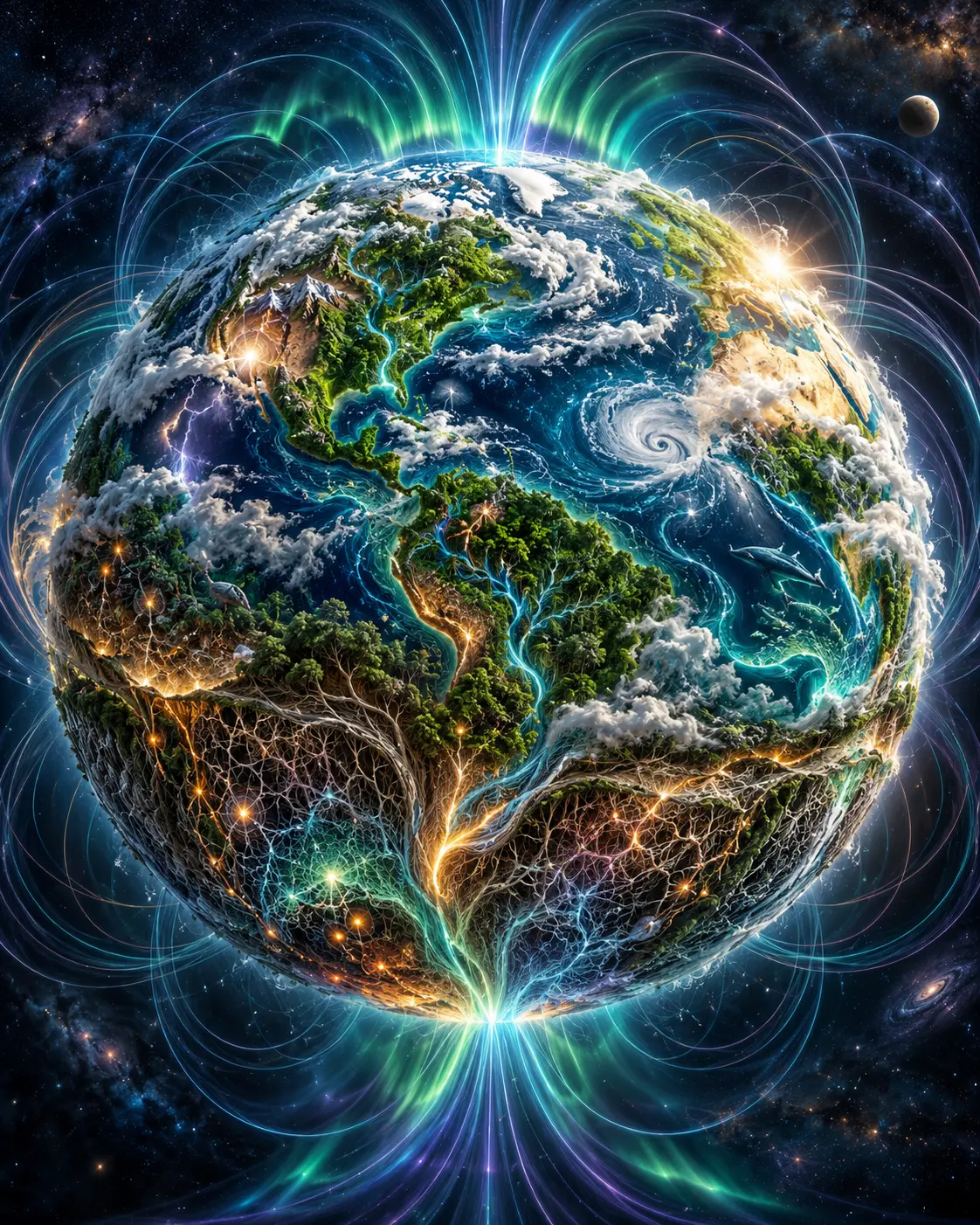
1. The Body Changes When the World Changes
A person can feel tense at a computer, step outside, and notice the body reorganize before there is time to explain why, because leaving the room changes several conditions at once: the eyes move from a near, fixed visual field into greater depth, sunlight or open daylight reaches the retina, air moves across the skin, temperature shifts, distant sounds replace the repetitive acoustics of an enclosed space, and the body begins orienting to a different setting. What feels like a simple preference for being outside can therefore begin as a physical transition before any conscious interpretation is added, with breathing, attention, muscle tone, and arousal changing as the organism responds to a wider set of environmental signals.
Research on nature exposure repeatedly finds changes in the same systems people describe subjectively. A 2020 systematic review found lower physiological stress across all seven included studies that measured it, while a larger meta-analysis of greenspace exposure found associations with lower salivary cortisol, heart rate, and diastolic blood pressure among other outcomes [11,12]. Bratman and colleagues randomly assigned healthy adults to a ninety-minute walk in either a natural or urban setting and found that the nature group reported less rumination while also showing reduced activity in the subgenual prefrontal cortex, a region associated with repetitive negative self-focused thought [13]. Forest research adds another layer because Song, Ikei, and Miyazaki found that people beginning with relatively elevated physiological values often shifted downward in forests while those beginning lower sometimes shifted upward, a pattern they described as physiological adjustment rather than simple sedation [14].
The Language of Energy already established the immediate mechanism from the human side by showing that an environment can function as a key when it changes the physical conditions maintaining a state, including light, temperature, visual flow, sound, movement, microbial exposure, air chemistry, bodily contact, and electrical boundary conditions [4]. That paper explained how an environment can change state; The Living Earth asks the deeper question created by that finding, which is why the larger natural environment contains so many conditions that can participate in regulation in the first place.
Adaptation supplies part of the answer because human beings evolved within outdoor conditions and our bodies became fitted to them, but that explanation changes once the environment is no longer treated as a neutral stage that existed first while organisms merely learned to survive upon it. The natural world in which human regulation developed was itself partly made by life, altered over immense spans of time by organisms that changed atmosphere, soil, water, chemistry, habitat, and one another. Nature's effect on the body therefore begins to look less like contact between a self-contained organism and an external background and more like a smaller living system re-entering the larger living conditions that helped produce it.
2. Regulation Was Never Inside the Body Alone
Defining Consciousness established that a conscious organism is physically open: the skull is an anatomical boundary, but the processes organizing conscious state continually depend on relationships that cross it, including hormones, immune signals, breathing, circulation, posture, light, temperature, microorganisms, touch, social interaction, architecture, and natural environments [3]. The Language of Energy then showed how those relationships can operate as state-changing inputs rather than as scenery around an otherwise self-contained nervous system [4], which means that what we call self-regulation has always depended partly on conditions supplied from beyond the skin.
Circadian timing makes that dependence especially clear because human cells contain biological clocks whose timing is repeatedly synchronized by environmental light to the day-night cycle created by Earth's rotation. A planetary movement is therefore carried inside the timing architecture of the human body, while similar forms of entrainment appear throughout biology as organisms coordinate behavior with seasons, tides, lunar illumination, temperature, food availability, and other recurring environmental changes. The organism performs its own regulation, but many of the signals that make accurate regulation possible are generated by larger systems in which the organism is embedded.
Earthing belongs within the same logic. The Language of Energy already separated the basic electrical relationship from broader health claims by establishing that the body is conductive, Earth functions as an electrical reference, and direct contact changes the body's electrical relation to surrounding fields [4]. Ground contact is therefore one physical change among many that can occur when a person goes outside, alongside altered light, airflow, temperature, sound, movement, microbial exposure, plant chemistry, visual depth, and social demand; nature is not one stimulus but a simultaneous recoupling to a much larger field of conditions.
Once regulation is understood this way, the organism no longer resembles a sealed machine carrying all of its necessary controls inside itself. It is a process whose normal functioning depends on continuous exchange with a larger world, so when nature changes a person's state the environment is participating in the organization of that person rather than merely surrounding it. The remaining question is whether this relationship exists only because organisms adapted to Earth or whether Earth and life have been recursively adapting to one another, with each changing the conditions under which the other develops.
3. Nature Is Not Neutral Because Life Helped Build It
Earth's living environment was not delivered to life in its present form because life helped construct the conditions that later life inherited. Microbial metabolisms altered oceans and atmosphere, photosynthesis introduced oxygen into a world that had contained very little free oxygen, and organisms transformed carbon, nitrogen, sulfur, phosphorus, soils, sediments, and eventually the structure of entire landscapes. Lyons and colleagues describe early Earth and microbial life as a history of reciprocal influence in which changing environments altered biological possibilities while biological innovations changed the planet those organisms inherited [15].
The Great Oxidation Event makes that recursion visible because oxygenic photosynthesis existed before oxygen accumulated substantially in the atmosphere, while geological and chemical sinks consumed much of what organisms produced until the balance between biological production and planetary chemistry entered a different regime. Dynamical-systems work now models atmospheric oxygenation as a history containing multiple stable states and threshold-like transitions rather than one smooth increase [16]. Activity beginning inside living cells therefore helped transform the atmosphere, and the transformed atmosphere then changed which forms of metabolism and later biological organization could exist.
Over geological time, the environment becomes partly the retained consequence of previous life, which is why a forest, reef, soil system, or microbial mat is not simply a location in which organisms happen to reside. Forests modify humidity, shade, soil, airflow, chemistry, sound, and microbial exposure; reefs construct physical habitat; and microorganisms can build three-dimensional structures that provide food, refuge, colonization surfaces, and new ecological relationships [31]. Organisms change the environment, the altered environment changes later organisms, and those organisms continue changing the conditions that will shape what comes next.
Nature can injure, poison, infect, nourish, regulate, or sustain because its non-neutrality is deeper than whether any single encounter is beneficial to a particular organism. Human beings evolved inside a biosphere that had already spent billions of years reorganizing the planet, and what now reaches the nervous system as sunlight through leaves, soil microbes, plant volatiles, natural sound, open visual distance, water, temperature, or ground contact comes from a world carrying that accumulated biological history. Nature's healing effect can therefore be understood as one expression of a larger reciprocal principle in which the state of the whole changes the state of its parts while the activity of those parts continually changes the whole.
4. The Scale of the Individual Keeps Moving
The curriculum has already established that a larger whole can acquire capacities unavailable to its isolated components, while Neural Synchrony makes the developmental rule more precise by showing that higher organization is not maximum connection but useful coordination among differentiated parts [7]. Distinct components must preserve information worth contributing, gain pathways through which influence can travel, coordinate when their relationship matters, and integrate strongly enough that the whole can perform functions no isolated part could produce. Evolution repeatedly changes the scale at which that organization becomes meaningful.
Mitochondria descend from bacteria whose ancestors once lived more independently, yet their descendants now function as integrated components of eukaryotic cells, while multicellular organisms represent a further transition in which once more independent cells became specialized parts of bodies organized through communication, division of labor, developmental constraint, and suppression of lower-level conflict. Social insects provide another version, with some colonies analyzed as superorganisms because selection and function become meaningful at the level of the collective. Evolutionary biology groups such changes under major transitions in individuality [17], and the repeating relationship is that differentiated parts can become organized strongly enough for a new functional individual to appear.
Once such a whole exists, influence runs downward as well as upward. Human cells do not reproduce whenever local conditions permit it because organism-level signals constrain growth, direct differentiation, regulate repair, and initiate programmed cell death, meaning that a cell remains alive and specialized while its viable behavior is partly defined by a larger organization it cannot individually comprehend. Cancer reveals the cost when that relation fails, since multicellularity depends on mechanisms that limit lower-level competition and cancer can exploit failures in those controls, allowing locally successful cell lineages to proliferate at the expense of the organism whose existence sustains them [29].
That distinction becomes important at the planetary scale because local biological success does not automatically mean developmental alignment with the larger conscious system proposed by this theory. A poisonous plant, pathogen, predator, or competing organism must be interpreted according to the role its activity plays within life as a whole rather than according to whether it is pleasant to one species, because destruction can also serve defense, regulation, adaptation, population balance, or later biological opportunity. The cancer analogy applies when a locally successful strategy harms living or conscious parts without becoming integrated into a wider life-supporting function, even if the surrounding physical environment remains perfectly stable.
The point is therefore not that a developing Earth becomes harmless, but that conflict becomes increasingly incorporated into larger organizations capable of sustaining more coherent life. A white blood cell can destroy another cell while serving the body, just as ecological competition or toxicity can participate in a larger living structure, so the relevant developmental question is whether local action remains isolated in its own advantage or becomes part of a whole whose growing capacity supports the life and consciousness contained within it.
5. Development Means Differentiation Becoming More Coherent
The Living Earth therefore inherits the same rule that Neural Synchrony and The Architecture of Change established at the human scale: development increases coherent differentiation rather than erasing difference. Ecology supplies a clean example through the insurance effect, in which biodiversity can stabilize ecosystem functioning because species do not all respond to disturbance in the same way; one declines under conditions another can tolerate or exploit, and those asynchronous responses allow the whole to preserve functions more reliably than any single species could [18]. Difference becomes useful when it is organized.
The same relationship appears in a brain, where perfect synchrony across every neural system would destroy specialization, and in collective reasoning, where rapid agreement can remove the independent perspectives needed to detect error or contribute missing information [7,10]. Integration therefore gains power from the distinctions it preserves, which means that planetary development should not be imagined as everything becoming more alike or more tightly synchronized. A more capable planetary whole would preserve biological, behavioral, and experiential diversity while coordinating those differences strongly enough that they contribute to the viability and development of the whole.
Biodiversity takes on a deeper meaning within that framework because it is not merely a count of species but a reservoir of differentiated metabolisms, sensory worlds, behaviors, ecological strategies, and forms of life. If consciousness is expressed through living organization, a planet capable of sustaining more forms of life is also capable of sustaining more ways reality can be encountered from within. Free Choice and Fatalism supplies the philosophical direction by proposing that developing consciousness moves toward increasingly accurate recognition of reality and that fuller recognition includes the reality of other conscious perspectives rather than treating them as disposable obstacles to one's own [10].
At planetary scale, those ideas converge into a developmental principle: advancement increases the capacity of the whole to sustain differentiated conscious life while coordinating conflict strongly enough that those differences can continue participating in a shared reality. Love, in the language of Free Choice and Fatalism, is not the disappearance of distinction but the lived recognition that another center of experience is real; planetary coherence extends that same relation across the living system.
6. Crisis, Phase Change, and Planetary Memory
Nature develops through long periods of accumulation as well as through abrupt reorganizations in which an existing state becomes unstable and another organization becomes possible. The Architecture of Change already established the crucial distinction at the human scale: trauma, addiction, illness, love, healing, and spiritual experience can all reorganize a person, yet reorganization becomes development only when the resulting state increases coherent capacity by becoming more accurate, flexible, stable, generalizable, and compatible with the functioning of the larger system [8]. The Mechanics of Becoming adds that a temporary state matters developmentally when it changes what the organism can later access and sustain [6].
Earth displays the same relational grammar in systems that can absorb gradual pressure while remaining in one regime and then reorganize rapidly after a threshold is crossed, a pattern studied through critical-transition research in ecosystems, climate components, and other complex systems [20]. The materials may remain largely familiar while their relationships change enough that the whole begins behaving differently, which makes planetary disruption comparable to illness not because Earth is a human body but because both can be pushed out of a previous organization and forced into responses that state did not previously require. The disruption creates the transition; what becomes possible afterward determines whether the transition becomes developmental.
The end-Permian crisis shows the scale of such reorganization because Siberian Traps volcanism altered atmospheric and oceanic conditions through warming, acidification, oxygen loss, and related stresses, contributing to the largest known mass extinction [23]. The biosphere that followed was not simply the former world restored after an interruption, since ecological relationships, dominant groups, and evolutionary opportunities had been reorganized. The Great Oxidation Event shows the same principle from another direction: oxygen was destructive to many organisms adapted to an anoxic world, yet the changed chemistry later supported far more energy-intensive aerobic metabolism and contributed to conditions under which complex life could develop [15,16].
Other Earth systems reveal state change without needing to be interpreted as biological progress. The geodynamo generated by Earth's core can occupy different global magnetic orientations, as paleomagnetic records of repeated polarity reversals demonstrate, while seismology also shows that the solid inner core changes its differential rotation relative to the surface and has recently backtracked in that motion [24,25]. These changes establish that Earth is a dynamical system composed of nested processes capable of reorganizing across very different timescales, so planetary development need not be imagined as one smooth ascent.
What allows disruption to become development is the retention of successful response. Ecologists use ecological memory to describe surviving organisms, seed banks, physical structures, nutrient distributions, and other legacies through which the past changes how an ecosystem responds to the next disturbance [19], while planetary history is likewise retained in genomes, symbioses, atmospheric chemistry, soils, reefs, ecological relationships, learned behavior, culture, and technology. A crisis alters the system, adaptation reorganizes what can survive, integration turns the successful response into part of the new whole, and memory carries that organization forward so the next state begins with capacities the earlier one did not possess.
7. What Planetary Development Would Look Like
Once that developmental grammar is carried outward, planetary evolution can be described without requiring every evolutionary change to count as progress. The relevant measure is not whether every lineage becomes more complex or whether older forms disappear, but whether Earth expands the range of living and conscious organization it can generate and sustain. Microbes remain extraordinarily successful while new levels of organization appear above and alongside them, allowing the planet to preserve earlier solutions while adding capacities that did not previously exist.
Earth once contained no known life, then cellular life appeared, eukaryotic cells integrated lineages that had once been more independent, multicellularity arose repeatedly, nervous systems developed, and animals acquired increasingly elaborate forms of perception, memory, learning, and social behavior. Symbolic human consciousness eventually became capable of reflecting on itself, transmitting knowledge across generations, treating disease, preserving species, restoring habitats, and modeling the planet as a whole. Read across deep time, the important trend is therefore an expansion in the range of possible conscious organization rather than a simple replacement of the simple by the complex.
The pattern becomes even more significant when living things begin creating conditions that support other living things. Trees build forests, corals build reefs, microbes create habitats, animals move nutrients and seeds, social organisms construct nests and colonies, and humans build medical systems, sanctuaries, conservation programs, and institutions that preserve knowledge across generations [31]. Cooperation is central to many transitions that create higher levels of organization because genomes, cells, organisms, societies, and mutualisms repeatedly require mechanisms that limit lower-level behaviors capable of undermining the larger association [30].
Within The Living Earth, that history defines a developmental gradient in which self-maintenance becomes cooperation, cooperation expands into support of larger groups, and conscious beings eventually become capable of supporting unrelated life, deliberately reducing suffering, and intentionally advancing the conditions under which other consciousness can develop. The cancer analogy belongs here because local success can remain misaligned with this larger direction when a life-form harms other living or conscious parts without that harm becoming integrated into a wider life-supporting function. A toxic organism does not need to damage soil, air, climate, or habitat to matter at this level, because the proposed planetary purpose concerns the development of consciousness itself rather than environmental stability alone.
Planetary development therefore appears as the increasing capacity of Earth to generate life, sustain differentiated experience, integrate conflict, preserve successful adaptation, recover from disruption, and eventually produce beings capable of consciously helping other beings develop. What begins as survival within the planet becomes participation in the development of the living whole.
8. Planetary Intelligence and the Growth of Self-Access
A scientific precedent already exists for treating intelligence as a process that can become meaningful at planetary scale. In 2022, Adam Frank, David Grinspoon, and Sara Walker described a progression from an immature biosphere, through a mature biosphere with stronger planetary feedback, to an immature technosphere in which technological civilization possesses planetary power without planetary coordination, and finally to a mature technosphere capable of responding intelligently to the condition of the whole [21]. Their proposal concerns intelligence and feedback; The Living Earth places that developmental sequence inside the consciousness framework already established by the curriculum.
The Divine Model describes development partly as increasing depth of access, meaning that processes once automatic, inaccessible, or difficult to influence can become increasingly available to conscious participation [9]. At the scale of a person, this can mean recognizing a survival pattern earlier, regulating a state with less effort, or gaining more reliable influence over processes that previously unfolded outside deliberate participation. Humanity creates a planetary analogue because conscious parts of Earth have begun gaining access to information about the planetary system itself.
For billions of years, the biosphere altered atmosphere, oceans, climate, and chemistry without any known organism constructing a global representation of those changes, whereas Earth now contains satellites that observe the planet from orbit, seismology that infers the structure and movement of its interior, climate models that represent coupled atmospheric and oceanic processes, and sensor networks that track magnetic fields, ice, forests, carbon, ocean temperature, atmospheric chemistry, and biodiversity. Human institutions can compare those observations, preserve them across generations, and change collective behavior in response. If humans are components of Earth rather than observers standing outside it, the planetary system now contains parts capable of representing the condition of the planetary system.
That recursion closely resembles the developmental movement described throughout the curriculum: a process first operates, awareness makes the process recognizable, recognition changes access, and increased access allows intentional participation in something that previously unfolded automatically. The difference between planetary power and planetary maturity therefore becomes more than a question of sustainability, because an immature technosphere can alter the whole without adequately representing the consequences while a mature one would increasingly coordinate local action with information about the larger system [21]. Under The Living Earth, that change marks a movement from unconscious planetary participation toward increasingly conscious participation in planetary organization.
9. Rhythms Above Us, Rhythms Within Us
Earth participates in systems larger than itself, and life repeatedly carries those larger rhythms into biological organization. Earth's rotation creates the light-dark cycle encoded in circadian timing, its orbit and axial geometry create seasonal changes that organisms anticipate and use, and lunar motion contributes illumination and tidal cycles around which many species organize reproduction and behavior. Orbital variation can reach even deeper into evolutionary history, as Beaufort and colleagues found that coccolithophore morphology across 2.8 million years contained cyclic variation associated with tropical seasonality driven by orbital eccentricity [22], allowing a relationship originating in celestial mechanics to become visible in evolving biological form.
Recursive Decoding gives that chain a useful language because the surface form changes radically as the relationship moves from orbit to climate, ecology, selection, and organism, while the causal sequence remains recognizable across scales. What appears as astronomy at one level becomes biology after passing through the environmental conditions that translate one scale into another. Earth also generates its own nested rhythms through atmospheric circulation, ocean currents, hydrological cycles, geomagnetic variation, seismic oscillations, biological productivity, and countless other processes whose periods overlap without collapsing into one planetary beat.
Defining Consciousness already established how fields and frequency should be understood within this curriculum: frequency by itself is simply the rate of an oscillation, while frequency, phase, amplitude, coupling, spatial distribution, and field configuration can become dimensions of the exterior measurement of an organized conscious state [3]. When the organized process is conscious, frequency is therefore one measurable feature of the physical depiction of consciousness rather than a separate mystical substance or a single number that stands for the whole.
A planetary consciousness would accordingly be expressed through the changing relation among many processes rather than through one frequency such as 7.83 Hz. A human brain remains conscious through the coordinated activity of many rhythms whose relationships shift from moment to moment, and a conscious Earth would likewise be expressed through the organization of electromagnetic fields, atmospheric and oceanic cycles, geological dynamics, biological activity, and the information flows connecting them. Physics would record the exterior organization of those processes, while the experiential side would belong to what it is like to exist as the organized whole itself.
10. Monuments as Interfaces Between Scales
Human cultures have repeatedly oriented collective life around celestial transitions such as solstices, equinoxes, lunar cycles, eclipses, and other recurring changes in the sky because these events mark real changes in the relationships among Earth, Sun, and Moon while also organizing calendars, agriculture, navigation, ritual, and social coordination. Causal Geometry gives ancient monuments a particularly useful place in this argument because it distinguishes representational action from structural action: a form can symbolize a relationship, but geometry can also physically create one by controlling pathways, boundaries, direction, convergence, and exposure [5].
Newgrange in Ireland makes that distinction tangible because its passage and roof-box are aligned so that winter-solstice sunlight penetrates deep into the monument's interior chamber [26]. The structure does not merely depict the solstice or remind observers that it exists; its geometry selects a particular astronomical configuration, channels the resulting light through a designed path, and turns a celestial relation into a sensory event inside a human-built space. Celestial geometry, Earth's orientation, architecture, light, human perception, and collective ritual therefore participate in one continuous operation.
Biology had already been entraining to celestial cycles long before humans built monuments, so monumental architecture can be understood as a cultural extension of a relationship living systems had always carried physically. A group could gather within a structure whose geometry synchronized human attention to a transition in a larger system, making the change collectively perceivable and repeatable across generations. Sacred time then acquires a physical foundation without losing its cultural meaning because solstices, equinoxes, lunar standstills, and eclipses are genuine extrema, crossings, alignments, and reorganizations before any symbolic interpretation is added.
Ancient cultures were therefore doing consciously and culturally what organisms had long done biologically: orienting behavior to larger rhythms and transition points. Their symbols and cosmologies remain culturally distinct, yet the shared structural fact is that human consciousness learned to recognize changes in systems larger than the human body and to organize collective experience around those changes.
11. From Planetary Organization to Planetary Experience
By the time the consciousness question appears, the physical and developmental structure has already been established: organisms are open systems, life and environment recursively construct one another, individuality can move upward in scale, differentiated parts can form higher-capacity wholes, planetary systems undergo state changes, and conscious organisms can now represent the condition of the planet that contains them. Defining Consciousness supplies the next step by proposing that consciousness may be the intrinsic experiential dimension of physical reality when that reality becomes organized into a unified subject, while also insisting on the harder distinction that connection, collective intelligence, and collective subjecthood are not the same thing [3]. The Living Earth therefore asks whether planetary organization can become integrated deeply enough for Earth itself to constitute a higher-order subject.
Biology makes that question intelligible because individuality has repeatedly moved upward in scale [17], Neural Synchrony makes it more precise because higher capacity emerges through differentiated integration rather than sheer connectivity [7], and Earth-system science supplies a candidate substrate in which atmosphere, oceans, rock, climate, electromagnetic processes, organisms, and technological systems continually alter one another. Planetary-intelligence theory adds a developmental trajectory in which global feedback can become increasingly coordinated [21]. Panpsychism and Russellian monism then change the ontological background by placing experiential potential within the intrinsic nature of physical reality, so the central problem becomes organizational: what relations allow a collection of processes to become one subject?
Within this theory, planetary subjecthood develops as differentiation, reciprocal influence, integration, memory, and self-access become increasingly organized together. Differentiation supplies distinct contributions, reciprocal influence allows local states to change the whole while the whole changes local states, integration allows those contributions to participate in coherent planetary processes, memory allows previous transitions to remain active in present organization, and self-access grows as components of the system construct representations of the system and use those representations to alter later behavior. Earth already expresses each of these properties, while the question of consciousness turns on how completely they participate in one experiential organization.
A planetary consciousness would therefore express itself according to planetary organization rather than human anatomy or human timescale. Processes spanning oceans, biospheric networks, electromagnetic fields, climate systems, and geological time would appear to outside measurement as weather, chemistry, fields, life, cycles, feedback, adaptation, and changing organization, just as the physical activity of a human brain appears as electrical potentials, blood flow, chemistry, and network dynamics rather than as the experience those measurements accompany. From our position inside Earth, we can measure increasingly detailed features of the planet's exterior organization while remaining unable to occupy whatever interior perspective that organization may possess.
The significance of this proposal is that planetary consciousness no longer depends on imagining Earth as a giant human mind. It follows from the same principle used throughout the curriculum: if experience belongs to organized physical reality and if individuality can move when differentiated processes become sufficiently integrated, then the relevant boundary of a conscious subject must be discovered from organization rather than assumed from familiar anatomy.
12. Mother Earth and the Recognition of Relationship
Indigenous traditions enter the argument most meaningfully at this point because many of them begin from a relational understanding that modern industrial thought often separates into different categories. Indigenous peoples hold distinct cosmologies, languages, histories, and relationships to land, yet a 2026 scoping review of wellbeing frameworks from Turtle Island and Moananuiakea identified recurring themes in which wellbeing is inseparable from relationships among people, community, land, culture, spirituality, and responsibility [27]. A 2024 systematic umbrella review likewise found that climate change and biodiversity loss affect Indigenous health through pathways tied to place, culture, livelihood, food systems, identity, and social relationships [28].
The systems argument developed here makes that relational orientation physically intelligible because human health depends on planetary conditions, human activity changes those conditions, and planetary changes return through food, water, climate, microbial exposure, stress, displacement, culture, and bodily regulation. Care for Earth is therefore not generosity toward an object outside the self but participation in the health of a larger system within which the self develops. The phrase Mother Earth compresses origin, nourishment, dependency, belonging, and reciprocal care into one image, while The Living Earth adds that the relation may also be conscious at the planetary scale.
That addition gives reciprocity a developmental meaning consistent with the rest of the curriculum. A cell becomes a more coherent part of an organism when its behavior responds to information beyond its own immediate reproduction, and a person develops relationally when another person's reality can remain real even when it conflicts with immediate desire. Humanity becomes a more coherent planetary component as it recognizes that the wellbeing of other life and future consciousness belongs to the same reality it is trying to understand, so development at the planetary scale requires distinct parts to act with increasing awareness of the whole without surrendering their own differentiation.
Mother Earth therefore becomes more than a poetic substitute for ecology within this theory. It names a relationship in which life arises from Earth, remains regulated through Earth, changes Earth in return, and gradually becomes capable of consciously recognizing and caring for the larger system from which it emerged.
13. The Living Earth
The ordinary experience that opened the paper - feeling the body change when a person steps outside - now sits inside a much larger structure. Human regulation already carries planetary rhythms, bodily state depends on environmental signals that cross the apparent boundary of the organism, and the natural environment itself is partly the accumulated product of life modifying Earth over geological time. Evolution repeatedly forms larger individuals from differentiated parts, higher levels feed conditions back to lower levels, biodiversity can stabilize wholes through difference, crises can reorganize systems, and successful adaptations can remain as memory that changes what later states are capable of becoming.
Following that same developmental grammar outward changes what planetary evolution can mean. Earth does not advance because every disturbance is beneficial or because every organism becomes more complex; it advances as the whole becomes capable of generating, sustaining, integrating, and preserving a wider range of living and conscious organization. A developing Earth would therefore express consciousness through the organization already present as living systems become more differentiated and more capable of cooperation, planetary feedback becomes more integrated, crises leave increasingly useful retained structure, conscious organisms gain greater access to the state of the whole, and life becomes increasingly capable of supporting the existence, healing, and development of other life.
Planetary misalignment can then be understood without reducing it to environmental damage. A locally successful life-form acts against the developmental direction of the whole when its activity harms living or conscious parts without becoming integrated into a larger life-supporting organization, which is why the cancer analogy concerns local success divorced from the advancement of the larger conscious system rather than simple ecological disruption. Planetary healing describes the opposite relation, in which conflict, disturbance, difference, and even destructive processes are increasingly incorporated into organizations capable of sustaining a wider field of life and consciousness.
Free Choice and Fatalism proposed that developing consciousness moves toward fuller recognition of reality and that love is one lived consequence of recognizing other centers of experience as genuinely real [10]. The Living Earth carries that principle to planetary scale by treating the consciousnesses of Earth as differentiated expressions within a larger conscious system, so the development of the whole cannot be separated from the development of the lives through which Earth increasingly recognizes, represents, and responds to itself. Human beings become especially important at this stage because planetary processes that once unfolded without reflective representation can now be observed, modeled, remembered, and intentionally acted upon from within the planet itself.
Nature's healing effect on human beings is therefore the most immediate place this larger relation becomes personally visible. Forests alter nervous-system state, daylight changes cellular timing, soil and microbes alter biological conditions, horizons change vision and attention, ground contact changes physical coupling, and these ordinary mechanisms reveal that the larger system continually participates in the organization of the part because the part was never separate from it. Earth gives rise to life, life changes Earth, Earth changes life, life becomes conscious, consciousness becomes capable of recognizing the planet, and that recognition changes how conscious life can participate in what happens next; the world heals as its parts become increasingly capable of living in conscious relation to the whole.
Rate This Theory
All ratings are anonymous
Help others by sharing
Comments
(0)AnonymousNo comments yet. Be the first to share your thoughts!
Spiritual theories are speculative frameworks offered for exploration. They are not treatments, and they are not a substitute for the tested methods in the Healing Library.