
The Ouroboros: The Divine Curriculum of Consciousness
Spiritual Exploration
Spiritual Exploration
The Ouroboros: The Divine Curriculum of Consciousness
What Happens After Enlightenment?
The earlier papers followed consciousness toward a threshold. Healing brought unconscious experience into awareness, inner division became increasingly integrated, and the learner gradually developed the capacity to live from truths that had once existed only as glimpses. The Atemporal Language of Consciousness described enlightenment as the point at which the student becomes capable of embodying the state from which it had been learning. Yet that paper also left an important clue: the teacher does not stop developing when the student reaches it. Teaching changes the teacher, and the developmental relationship continues at a higher level.
The Tree of Life and the Sea of Consciousness widened the same idea. Individual lives were pictured as distinct expressions of a greater consciousness whose branches gather experiences unavailable from any single point of view. When enough of those experiences can belong to one coherent understanding, a more inclusive state becomes possible, and rather than ending development, that new state becomes the seed of another tree.
Put those two ideas together and a new question appears. If enlightenment is not the end of learning, what does an enlightened person learn next? If a more integrated consciousness becomes the seed of a larger one, how could one person begin contributing to a body that does not yet exist in that form?
The answer may begin much closer to ordinary life than descriptions of collective consciousness usually suggest. One person heals, and the next person who meets them encounters a different human being whose changed way of responding is already enough to alter the relationship.
In this paper, a healer does not mean a profession. A healer is anyone who chooses to heal themselves. The person who learns to remain present with fear rather than organize life around avoiding it, who can experience shame without collapsing into self-hatred, who can love without abandoning their own inner truth, and who can meet another person's pain without making it an enemy has become capable of offering something different to every relationship they enter. Professional therapy gives us a concentrated place to observe that process, but the process itself belongs to human connection.
The path of the healer therefore begins long before enlightenment because the first thing being healed is the individual. Each time a person becomes conscious of a divided or rejected part of themselves and learns to remain present with it, they become more internally integrated and more capable of remaining present when those same emotions appear in another person. Healing the self is therefore also preparation for healing in relationship.
Enlightenment marks a change in scale rather than a change in process. Before that threshold, consciousness is primarily learning how to bring the divided parts of the individual into a more coherent whole. As that integration becomes sufficiently stable, the same capacity can increasingly operate between people. The person who has learned not to abandon their own fear, grief, anger, vulnerability, or uncertainty becomes better able to remain present when another person brings those experiences into the relationship. What was first an inward process of integration becomes a relational one, and as those relationships begin influencing still larger networks of people, the same process can extend again into the collective. Healing has not ended at enlightenment. The unit being healed has become larger.
When One Person Changes the Room
Imagine someone describing grief so overwhelming that they are convinced nobody could truly feel it with them without becoming overwhelmed too. A therapist can say, "Your grief is safe to feel," but the client is receiving information from more than the sentence. Does the therapist tense, rush to reassure, retreat into analysis, change the subject, or emotionally disappear, or can the therapist actually feel the weight of the grief while remaining warm, clear, and present? The words may be identical, but the pattern the client encounters is not.
Psychology already has names for parts of what is happening here. Imagine that the client has repeatedly learned that intense emotion drives people away. They may enter therapy expecting the therapist to become overwhelmed, reject them, or eventually leave, even when the therapist has done nothing to suggest that will happen. Psychology calls this transference: an earlier relational pattern has become active in a new relationship, shaping what the client expects from the person in front of them.
The therapist's own emotional response then becomes part of what the client encounters. Countertransference describes reactions that arise in the therapist through contact with the client, such as feeling unusually protective, helpless, irritated, frightened, drawn in, or desperate to make the feeling stop. Empathy is different because it allows the therapist to understand and emotionally connect with what the client is experiencing without requiring the therapist to reproduce the client's reaction. The same grief can therefore be met by someone who withdraws from it, someone who becomes lost inside it, or someone who can feel its weight while remaining present. The client is not encountering a technique alone; they are encountering what the person using that technique is capable of doing with the emotion between them.
The research makes that difference difficult to dismiss. To make the size of the findings easier to understand, the studies below sometimes report an effect size called d. An effect size shows how far apart outcomes are without depending on the particular test being used; as a rough guide, about 0.2 is small, 0.5 moderate, and 0.8 large. A meta-analysis combining 82 independent samples and 6,138 clients found that greater therapist empathy predicted better psychotherapy outcomes with an effect equivalent to d = 0.58, a moderate difference [1].
A separate meta-analysis found that unmanaged countertransference reactions had a small negative relationship with outcome, equivalent to d = -0.33, while successful management of those reactions had a much larger positive relationship with outcome, equivalent to d = 0.84, a large effect [2]. The pattern is important: the therapist does not help by remaining untouched. Empathy predicts better outcomes, while being emotionally activated without being able to manage that activation predicts worse ones. What matters is the ability to be genuinely affected while retaining enough internal organization to remain present.
Co-regulation gives us a way to understand how that presence can affect another person. When two people are emotionally engaged with each other, their nervous systems do not respond in isolation. One person's distress changes their voice, breathing, facial expression, attention, and behavior; the other person responds to those changes, and that response becomes new information for the distressed person. Someone who is becoming overwhelmed may begin to settle when the person beside them remains attentive, emotionally available, and able to stay connected without becoming overwhelmed themselves.
This kind of stability should not be confused with detachment. A person can appear calm because they have emotionally withdrawn, shut down, or stopped allowing the other person's experience to affect them. That may reduce visible reactivity, but it does not create the kind of connection being described here. Healing requires regulated presence: enough openness to genuinely feel and respond to the other person, combined with enough internal coherence to remain oneself while doing so.
One psychotherapy study made this process visible by analyzing 227 recorded sessions and 16,355 moment-to-moment observations [3]. The researchers tracked changes in vocal pitch, a physical sign of how emotionally activated each person's voice became. This was not an empathy questionnaire, but it captured a basic part of empathic attunement: whether the therapist's voice actually changed with the emotional intensity of the interaction rather than remaining flat and unaffected. When therapists showed greater emotional responsiveness, clients returned toward their own usual level more quickly and were less likely to keep escalating across the session. In practical terms, the therapist's emotional engagement was followed by greater regulation in the client, not greater dysregulation. The effect also ran in reverse: changes in the client's emotional state altered the therapist's regulation as well. That reverse influence becomes important in the next section.
Suppose a client has learned that their pain is too much for other people. If the person sitting with them becomes frightened by the pain, needs it to stop, or withdraws from it, the relationship can reproduce the lesson the client already expects. A therapist may verbally say the emotion is acceptable while behaviorally communicating that it is dangerous.
Now imagine the therapist feels the emotional weight and remains connected both to the client and to themselves. They do not become cold or detached, but neither do they disappear into the client's distress. The same emotion is now occurring inside a relationship capable of holding it, so the client is not merely being told what regulation looks like; they are encountering it directly. The lesson becomes less "do what I say" and more "experience what I am while I am with you" - or, more simply, "do as I am."
This relational effect becomes even more important when it is compared with the treatment model itself. Psychotherapies are usually organized into named approaches such as cognitive behavioral therapy, psychodynamic therapy, interpersonal therapy, acceptance and commitment therapy, and many others. These models can look very different on paper, yet when researchers directly compare credible treatments designed to help the same kinds of problems, their average outcomes are usually very similar. A 2026 umbrella review brought together 46 meta-analytic comparisons from 19 previous meta-analyses, representing about 22,000 participants, and found average differences of only 0.17 standard deviations for primary outcomes and 0.16 for secondary outcomes [4].
Those are small effects - roughly one third the size of the moderate effects found for empathy and therapeutic alliance. Some approaches perform somewhat better for particular problems, so the model is not irrelevant, but switching between credible therapy schools usually changes average outcome only slightly.
The quality of the relationship shows a much more consistent connection with outcome. Researchers call the working relationship between therapist and client the therapeutic alliance. It includes whether the client feels understood and connected to the therapist, whether the two agree on what they are trying to accomplish, and whether they can work together on how to get there. A major meta-analysis combining 295 studies and more than 30,000 clients found that stronger therapeutic alliances predicted better treatment outcomes with an effect equivalent to d = 0.58, a moderate effect [5]. The finding held across different therapeutic approaches, client populations, countries, and ways of measuring the relationship. In other words, the quality of the working relationship had a meaningful connection with whether people improved even when the named treatment model changed.
The quality of that relationship also depends on more than simply being pleasant or calm. Researchers have studied a therapist quality called congruence, or genuineness, which means that the therapist is aware of their own internal experience and remains authentically present with the person in front of them rather than hiding behind a professional role. A meta-analysis of 21 studies involving 1,192 clients found an effect equivalent to d = 0.46 between therapist genuineness and improvement [6]. That is close to a moderate effect and only modestly smaller than the effects found for empathy or therapeutic alliance. Being genuinely present in the relationship therefore makes a measurable difference in outcome.
Good therapy also does not require the relationship to remain perfect. Therapists misunderstand clients, clients become angry or withdraw, disagreements occur, and emotional reactions can disrupt the connection. Researchers call these moments alliance ruptures. A meta-analysis of 11 studies involving 1,314 clients found that successful repair of these breaks was associated with better outcomes at d = 0.62, a moderate effect slightly larger than the effects reported for empathy, alliance, or genuineness [7]. A healing relationship therefore does not depend on never becoming unsettled. It depends on being able to stay connected enough to notice when the relationship has been disrupted, tolerate what the disruption brings up, and find a way back into genuine contact.
The differences between therapists become even harder to dismiss when outcomes are examined directly. One study followed 6,960 patients treated by 696 therapists and classified therapists separately across different symptom and functioning domains according to whether their average clients reliably improved, worsened, or did neither [8]. Depending on the domain, 33% to 65% of therapists fell into the combined categories of unclassifiable, ineffective, or harmful. The size of the difference was enormous: therapists classified as effective produced large positive treatment effects ranging from d = 1.00 to 1.52, while therapists classified as harmful produced large negative effects ranging from d = -0.91 to -1.49. In practical terms, the average clients of effective therapists improved substantially, while the average clients of harmful therapists became substantially worse.
Effectiveness also transferred poorly from one problem area to another, suggesting that being highly effective with one kind of difficulty did not guarantee the same effectiveness with another. Learning a therapeutic model and becoming an effective therapist are therefore not the same thing.
A healer can hardly provide regulated presence around an experience that repeatedly overwhelms their own capacity to remain connected. Knowledge can teach someone what acceptance looks like, but knowledge cannot substitute for having learned to stay open, responsive, and anchored in oneself when the relevant emotion is actually present. The person's own healing therefore becomes part of what they offer.
The same principle extends far beyond therapy. A parent who has learned to remain present during conflict gives a child a different nervous system to develop beside; a partner who can hear disappointment without treating it as abandonment changes what disagreement can become; and a friend who can sit beside grief without demanding that it disappear changes the conditions in which grief is being experienced. Research calls this broader effect social buffering. In an experiment with 81 children and adolescents, support from a parent completely eliminated the cortisol stress response to a laboratory stressor in 9- to 10-year-old children compared with support from a stranger, although the same effect was not found in adolescents; developmental reviews find that friends and romantic partners can take on similar stress-buffering roles later in life [9]. Every healed pattern therefore changes the environment encountered by another person, making capacities developed within one person available inside the relationships around them.
The Relationship That Changes Both People
Everything described so far could make healing sound as though it moves in one direction: a more integrated person provides regulation, safety, or presence to someone who has less capacity in that particular moment. But the same research that shows people regulating one another also makes something else clear. Relationships are reciprocal. The person receiving support is affecting the person providing it at the same time.
What happens between them can be understood as a form of resonance. Here resonance does not mean that both people must feel the same emotion, or that their bodies have been shown to vibrate at one identical measurable frequency. It means that the pattern expressed by one person activates something responsive in the other. Grief may awaken grief, but it might also awaken tenderness, fear, protectiveness, helplessness, an urge to rescue, an impulse to withdraw, or the capacity to remain closely present. One person's experience does not remain contained within them; it reaches the other person and finds something there that responds.
A client may therefore bring fear into the room that awakens the healer's urge to rescue them, anger that produces defensiveness, longing that activates attachment, or shame that touches a part of the healer they believed was already resolved. Countertransference gives psychology a clinical name for some of this activation, but the developmental question is what happens to whatever has been awakened.
If the reaction remains outside awareness, the healer may begin acting from it. They may become overly protective, withdraw, try to make the other person's emotion disappear, seek reassurance from the client, or react defensively without understanding why. The relationship can then reproduce the same pattern it might otherwise have helped heal.
If the healer recognizes what has been activated and works through it instead, the relationship changes both people. The client encounters someone capable of staying present with an experience that may previously have overwhelmed relationships, while the healer discovers another place where their own integration still has an edge. Once that edge is healed, the next person who brings similar material encounters someone different. What once produced fear, urgency, defensiveness, or instability can now be held with less effort and less need for the other person to change first.
Healing therefore becomes cumulative. One person offers the capacity they have already developed while the other person reveals where that capacity ends. Working through what is revealed expands what the healer can hold, and that expanded capacity becomes available in the next relationship. The next relationship then exposes another edge. Over time, the distinction between teacher and student becomes less fixed because each person can be more developed in one part of the interaction while still having something to learn from the other.
This is the interpersonal version of the learning relationship developed in The Atemporal Language of Consciousness. In that theory, a more-developed state helps an earlier state learn something it has already integrated, yet the act of teaching deepens the understanding of the state above as well. Eventually the learner reaches the level of the teacher while the teacher becomes capable of moving farther. Development therefore does not pass in one direction from a completed being to an unfinished one. Teaching and learning continually feed each other.
Relationships can follow the same structure. A healer may have already integrated the particular experience another person is struggling with, allowing the healer to provide a pattern the other person does not yet possess. At the same time, the relationship can reveal something the healer has not yet integrated. What one person has already learned becomes part of the other's development, while what the other person awakens becomes part of the healer's next lesson. Both leave the relationship with possibilities they did not have before entering it.
Enlightenment does not end this reciprocal process. It changes its scale. Before enlightenment, much of the curriculum concerns becoming integrated enough to remain connected to oneself without continually abandoning, suppressing, or dividing against parts of inner experience. As that integration becomes more stable, relationship creates a new challenge: remaining whole while becoming deeply connected to another person. The question gradually changes from "Can I remain whole inside myself?" to "Can I remain whole while becoming part of something larger with you?"
The relationship itself then becomes part of the curriculum. Healing one person changes what they are capable of bringing into the next relationship, that relationship changes another person, and the changed person carries a different pattern into the relationships that follow. The process no longer belongs to one isolated individual. Healing begins moving through the connections between people, preparing the way for the larger question this theory is building toward: what happens when increasingly integrated individuals begin functioning as parts of a more integrated whole?
How the Next Lesson Is Found
Reciprocal relationships create endless opportunities to learn, but they also create another problem. Life contains more people, symbols, ideas, emotions, choices, and experiences than any consciousness could investigate equally, so what determines which encounter belongs to the curriculum now? The answer developed across the preceding papers is inner truth.
A person can see the same image a hundred times and feel almost nothing, then encounter another symbol and stop. A sentence organizes years of experience in a moment. A person feels important before the reason is clear. A bodily sensation repeatedly appears around one conflict. A piece of music seems to express something that has never reached language. The outer event varies, but the structure is the same: something outside conscious awareness corresponds closely enough with something already present within the person that recognition begins before explanation.
A tuning fork offers a simple image of this process: strike one fork near another tuned to the same note and the second can begin vibrating because it is especially responsive to that pattern. The first fork does not manufacture the second fork's capacity; it activates a capacity that was already there.
The same relationship gives spiritual resonance its developmental meaning because inner truth comes first. An image, person, idea, experience, or bodily response resonates because it corresponds with something already organized within consciousness. The outer form does not have to implant the lesson; it makes an existing truth easier to recognize.
Within the frequency language developed across these theories, the same relationship can be pictured as a meeting between patterns. A more integrated person behaves like a more stable oscillator: not someone who never changes, but someone whose organization returns more reliably to coherence after being disturbed. Another person may resonate strongly with that pattern while also activating emotional organizations that remain unstable within it.
Physics may therefore provide more than an analogy for spiritual resonance; it may describe the physical mechanics through which such a reality operates. In wave mechanics, constructive interference occurs when compatible waves meet in phase and reinforce one another, increasing the resulting amplitude, while destructive interference occurs when waves meet out of phase and reduce one another [16]. These are established physical processes.
The unresolved question is whether the energetic or biofield patterns described in spiritual traditions are physically oscillatory systems. If they are, then these mechanics would apply to the spiritual interaction rather than merely resemble it. Increasing psychological integration could correspond with a more stable or coherent energetic pattern, while contact between people could allow those patterns to reinforce, disrupt, or reorganize one another according to the same basic mechanics already observed in other oscillating systems. Physics would then be describing the mechanism of a spiritual reality rather than merely supplying a metaphor for it.
The psychological level is already observable through empathy, co-regulation, alliance, and the effects of one person's regulation on another, while the literal biofield mechanism remains the proposed extension. In either case, the developmental logic is the same: an encounter becomes especially important when something in one pattern activates a responsive possibility in the other. Resonance can therefore do more than connect people; it can help reveal which part of the curriculum is ready to become conscious next.
This is why resonance can be both the curriculum and the map. It is the curriculum because moments of resonance are where learning becomes alive: a hidden truth becomes felt, examined, lived, and eventually integrated. It is also the map because, among thousands of possible experiences, resonance tells consciousness where to look by marking a point of correspondence with the learner's own developmental structure. Inner truth creates the possibility of resonance, resonance provides direction back toward that truth, recognition makes integration possible, and greater integration changes what can resonate next. The sequence is therefore inner truth, resonance, direction, recognition, integration, and greater capacity.
For the individual, this curriculum has two primary paths. Self-resonance is the path of inner truth and self-love, through which consciousness learns what it actually feels, values, fears, needs, desires, and recognizes as true beneath the identities built to survive other people's expectations. The more of the inner life that can be encountered without condemnation, the less energy must be spent keeping the self divided against itself. Self-love is therefore not positive thinking added on top of the person but the increasing ability to allow the real person to exist.
As self-resonance reduces the need to condemn or suppress parts of the inner life, it also changes how other people are treated. A person who no longer needs to condemn their own vulnerability has less need to condemn vulnerability elsewhere, and someone who can tolerate their own uncertainty has less need to control everyone around them. Loving the self therefore frees space to love others because the standards once used to attack the self are no longer as available for attacking the world.
Other-resonance approaches the curriculum from the opposite direction by teaching the depth of love for another human being even when that love is not reciprocated. The resonance is not primarily that the other person mirrors the self correctly; it is the discovery that love can continue to exist without being guaranteed a reward, possession, validation, or equal response in return.
That experience then turns back toward the self, because discovering that one is capable of loving another person with extraordinary depth is also discovering something extraordinary about one's own nature. The love itself becomes evidence of the person one is, allowing love for another to become another path toward self-understanding and self-love.
The two paths therefore continually become one another: self-love increases the capacity for other-love, while other-love reveals the loving nature of the self. For an increasingly enlightened consciousness, their convergence becomes even more important because if the individual is a differentiated expression of a greater Self, resonance with another person is not only an encounter with something outside the self but the greater Self encountering another expression of itself from a different position. Self-resonance and other-resonance remain different learning experiences while the distinction is useful, yet at a larger scale both become resonance within one body. The enlightened person's curriculum therefore shifts from discovering inner truth in relative isolation toward increasing the precision, depth, and regulated presence with which truth can remain resonant across relationship.
When Connection Becomes a Body
This is where enlightenment becomes both an entry and a beginning. The Sea of Consciousness described individual consciousness as a drop or wave within a larger reality, so from that perspective enlightenment is an expansion of participation in a greater conscious body that already exists. The person does not create the Sea by recognizing it any more than one cell creates the human body by becoming aware of the organism around it, yet the same enlightened person can also become the seed of a new body at another scale.
A body is not created merely by placing many parts beside one another. Living organization requires differentiated parts that can communicate, coordinate, and remain stable enough for the larger structure to persist, which human development illustrates as cells with common ancestry progressively differentiate into nerve, muscle, blood, and many other forms whose differences make a more capable organism possible [12].
Biology gives a particularly clear example of how separate living beings can become parts of a larger living system. Some microscopic organisms called social amoebae spend much of their lives as independent single cells, each moving and feeding on its own. They do not normally exist as one animal.
When food becomes scarce, however, thousands of these individual cells begin signaling to one another and moving together. One species, Dictyostelium discoideum, can gather into a coordinated mass that behaves as a multicellular body. The cells move together, and later different cells take on different roles, with some helping form a stalk while others become reproductive spores [13]. What began as thousands of separate living units becomes an organized whole in which individual cells participate in something none of them could create alone.
That transition makes the larger possibility easier to see. Becoming part of a greater organism does not require the original living units to disappear. It can occur when previously independent units become sufficiently coordinated that a new level of organization emerges from their relationship.
A caterpillar becoming a butterfly shows a related principle from another direction. Development can reorganize an existing living system so thoroughly that capacities unavailable to the earlier form become possible in the next one [15]. The lesson across these examples is not that human groups are amoebae or insects. It is that living development can cross thresholds at which the form of the learner changes.
Religion has long described enlightenment in similarly enlarged terms. Christianity's body metaphor describes many differentiated members participating in one body [10]. The Bhagavad Gita describes the person established in yoga as seeing the Self in all beings and all beings in the Self [11]. These are different traditions with different doctrines, but both describe spiritual development through a more inclusive relationship between individual and whole rather than through perfect isolation.
Seen at the scale of one enlightened person, this means that although one individual cannot constitute a collective body alone, they can provide a first stable node around which greater coherence becomes possible. Their healing has reduced the amount of internal conflict they bring into relationship, their self-resonance helps them remain connected to inner truth, and their capacity for other-resonance allows profound connection without requiring another person to regulate their sense of worth. Their relationships can therefore sustain greater intensity without automatically collapsing into control, rejection, fusion, or avoidance.
The first new structure is not a mystical group mind but a relationship that can hold more conscious complexity than either participant could hold in isolation. Because that relationship changes both people, each carries the change into the next relationship, and a network begins to form in which increasing numbers of people can maintain connection without losing themselves. What one person learns becomes part of the conditions in which another person learns, allowing the increasingly regulated pattern to propagate.
Within the proposed frequency model, this is where stabilized wavelengths become developmentally important. A more coherent consciousness would not need to persuade another person before influencing the interaction. Its organization is already present in posture, timing, attention, emotional response, physiological regulation, and, if the biofield extension is correct, in the stability of the energetic pattern itself. The next person encounters that baseline before any lesson is explained.
As more people become capable of sustaining similar coherence, constructive interaction becomes easier to establish and harder to disrupt. The system gains memory because each participant carries the integrations produced by earlier relationships. A person stabilized in one relationship can become a stabilizing influence in another. The network therefore learns through the accumulated development of its members.
This is how one enlightened individual can begin contributing to the creation of a new body while simultaneously participating in a greater body that already exists. Enlightenment opens awareness upward into the Sea while extending outward as a seed from which a new coherent collective can grow. These are not separate movements: the individual becomes more capable of belonging to the greater whole precisely because they have become more capable of remaining themselves within connection.
As that network becomes more integrated, the question gradually changes from how separate people can help one another heal to what a sufficiently coherent larger organization might eventually be able to perceive and do.
What a Larger Connection Could Make Possible
A single neuron cannot see, yet a sufficiently organized nervous system can produce vision; one heart cell cannot circulate blood through a body, yet a coordinated heart can. These examples show how new capacities can appear when living parts enter relationships capable of sustaining a larger organization.
If enlightenment is increased participation in a greater conscious body, then the unusual abilities associated with advanced spiritual states take on a different place in the theory. They no longer need to be treated as prizes awarded after enlightenment. They can be understood as possible capacities of a consciousness operating through a larger field of relationship.
The Cosmic Game Theory of Consciousness began with the observation that cultures repeatedly give names to people believed to possess forms of consciousness beyond the ordinary: prophets, yogis, shamans, mystics, mediums, healers, and others. The specific claims differ dramatically across traditions, but recurring themes include unusual discernment, healing, prophecy, heightened intuition, direct spiritual knowing, and forms of communication that appear to exceed ordinary channels.
Christian scripture, for example, places discernment among spiritual gifts and contains stories in which information is known without ordinary disclosure [10,14]. Other traditions describe different capacities through their own religious languages. The point here is not that every traditional claim has therefore been scientifically demonstrated. The developmental question is what such reports would mean if consciousness really does expand its participation in a larger body.
The biological analogy suggests one way to picture this possibility. A neuron embedded in a larger nervous system participates in information it could not generate by itself because the additional capacity belongs to the organization rather than to the isolated cell. In the same way, an enlightened consciousness participating more fully in a larger conscious system could gain access to information, sensitivities, or forms of coordination unavailable from a more isolated state.
This possibility also gives the reported abilities a purpose. Greater sensitivity would create more opportunities for resonance, greater discernment could allow subtler differences between inner truth and distortion to be recognized, more direct communication could increase coordination between parts of the larger body, and healing ability could allow coherence to propagate more efficiently through the network. In this framework, new capacities serve the next curriculum rather than proving that the curriculum has ended.
This is another place where the earlier theory of reciprocal learning returns. The enlightened person may be more capable than the person they are helping, but the relationship still contains information the enlightened person does not yet possess. Greater abilities do not remove the need to learn; they increase the amount of reality that can enter the learning process. As consciousness perceives more, it can resonate more precisely; as resonance becomes more precise, integration can deepen; and as integration deepens, the person becomes capable of helping sustain a larger body.
Eventually, that larger body becomes a learner in its own right. The question that once appeared inside an individual as "What is true in me?" can appear at the collective level as "What is true in us?" The individual once learned to love the parts of themselves they had rejected; a larger consciousness would face the corresponding task of learning to include differentiated members whose experiences, needs, and roles can appear incompatible from inside any one perspective. The curriculum has not changed, but the capacity of the student has.
Why Would Consciousness Separate Again?
A problem appears once this movement toward greater unity is followed to its conclusion: if healing, enlightenment, resonance, and collective integration all move consciousness toward greater unity, why would consciousness ever move away from unity in the first place? That question returns directly to The Cosmic Game Theory of Consciousness, which began with four ideas: everything is one, consciousness or soul is eternal, divinity develops in stages, and existence gives consciousness the opportunity to forget divinity so that it can rediscover and experience it anew. The original image was a game in which consciousness enters limitation, forgets what it is, moves through contrast, and eventually remembers. The papers since then have supplied a possible mechanism the first paper did not yet have.
A play offers a familiar way to understand those learning conditions. A story becomes possible because the actors agree to occupy different positions, perhaps with one playing a protector and another an opponent. From inside the story their conflict is real, and the person playing the villain does not behave like the person playing the hero merely because both actors belong to the same production. The distinction is what allows the story to happen, and the same structure gives the Cosmic Game its learning conditions.
If every expression of consciousness continuously experienced itself as the entire divine whole, self-love and other-love would not be distinguishable experiences. There would be no apparent other whose love could be given freely, no inner truth that could be hidden and rediscovered, no rejection through which self-love could become a choice, and no reunion because separation would never have been experienced. Love would exist, but there would be no genuine opposite against which love could be chosen, learned, protected, or embodied.
That opposite reaches its fullest expression in what human beings call evil. Within this theory, evil is not a separate eternal power standing outside consciousness. It is the deepest possible movement into separation: the point at which another expression of the same larger being can be experienced as so completely 'not me' that the other's pain, freedom, or existence no longer restrains what one is willing to do. Domination, cruelty, exploitation, dehumanization, and destruction become possible when the shared reality of the other has been forgotten deeply enough.
This makes the possibility of evil foundational to the curriculum rather than incidental to it. If consciousness could never move far enough into separation to genuinely reject love, then love would have no true opposite and the return toward love would have nothing real to transform. Forgetting makes cruelty possible, and because cruelty is possible, compassion, protection, courage, forgiveness, sacrifice, boundaries, and love can become real choices made in the presence of their opposite. Evil is the fullest expression of separation, and that furthest point creates the duality through which growth toward reunion can exist at all.
The structural role of evil does not turn evil into good. Inside the lived reality of the curriculum, harm remains harm, suffering remains suffering, and responsibility remains real precisely because the choice between separation and love is real. The point is not that cruelty becomes desirable because growth can follow it, but that a universe containing genuine freedom must contain the possibility of refusing relationship as completely as it contains the possibility of choosing it.
Differentiation therefore makes perspective possible, forgetting makes discovery possible, freedom makes opposition possible, and opposition creates contrast. Consciousness can occupy roles that move in very different directions inside the play: some remember divinity more readily, others move more deeply into separation, some relationships become places of safety, and others become conditions through which boundaries, self-love, forgiveness, courage, grief, or nonreciprocal love have to be discovered. The opposing role is not outside the game but one of the positions through which the game produces experience.
This does not require every actor to understand the larger role while playing it. The power of the game depends on limited perspective. A person inside one life sees the immediate relationship, the harm, the longing, the rejection, the choice, and the consequence. The larger coordination may be invisible from that position.
What makes a path through the game possible is resonance. Inner truth remains capable of answering what corresponds with it, so a symbol, relationship, emotion, creative impulse, bodily response, or moment of unexpected recognition can act like a marker within the play. The person may not know why it matters yet, but the resonance gives direction because ordinary experience is the medium through which inner truth can be encountered. The game therefore does not need a voice outside the player announcing every next move; the map is built into the player.
The Shape That Was There All Along
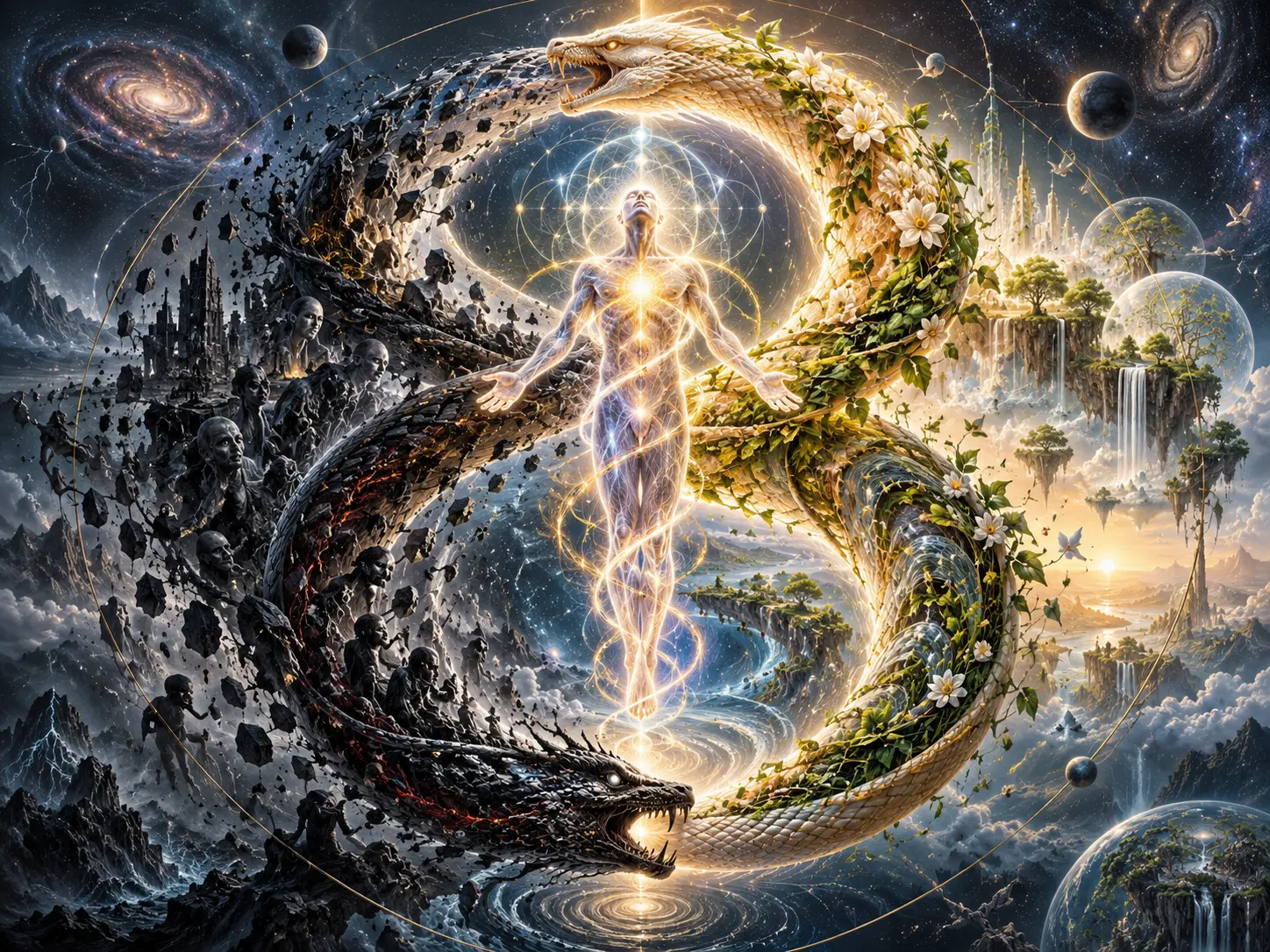
Once the game is understood this way, the familiar Ouroboros changes shape.
Seen in two dimensions, the Ouroboros appears as a circle: the serpent curves back upon itself until its ending meets its beginning. The circle shows return, but it hides development because the path appears to come back to the same level. Within this theory, that familiar image is the flattened two-dimensional view of a three-dimensional structure.
Give the Ouroboros depth and the path becomes a double spiral. One spiral moves downward into differentiation, forgetting, and increasing separation, reaching its fullest expression in evil. The returning spiral moves upward through resonance, healing, integration, remembrance, and increasingly inclusive love. This returning path is the growth spiral: the movement through which the duality created by separation becomes material for development. These are not two separate realities. They are opposite movements within one continuous Ouroboros.
The downward movement creates distinct perspectives and a genuine opposite against which the upward movement can become experiential. The upward spiral does not erase the journey through difference as though separation had never happened; it gathers what those differences made possible and carries that learning into a more integrated form. The end reconnects with the beginning, but the consciousness returning has greater capacity because it has lived the full distance between separation and reunion.
This three-dimensional Ouroboros explains why familiar lessons can return without producing mere repetition. A relationship activates an old fear, but the person confronting it is no longer the person who first learned the fear. A later state of the self embodies what an earlier state could not. A healer meets another person's pain with capacities created by every previous encounter. A collective revisits the problem of difference at a scale no individual could contain alone. The subject can repeat while the learner has changed.
The Atemporal Language of Consciousness used the Ouroboros to describe this reciprocal relationship within one self: the more-developed state helps the earlier state reach an understanding it already embodies, the earlier state's struggle deepens the teacher's understanding, the student becomes capable of teaching, and the teacher becomes ready for what comes next. This paper gives that symbol its fuller geometry. The student and teacher relationship is one local turn of the larger double spiral, where separation creates a difference in developmental position and integration returns the lesson at greater capacity.
The same architecture can then extend beyond one individual. The healer and the person being healed teach one another, the enlightened person and the people around them continue changing one another, increasingly coherent relationships form a network capable of functioning as a larger learner, and that larger learner begins its own cycle of differentiation, resonance, integration, and transformation. What is a whole at one level becomes a part at the next. The Ouroboros is therefore not simply a symbol of repetition but the threedimensional structure by which the completion of one curriculum creates the consciousness capable of entering another.
What the Cosmic Game Was Trying to Explain
That brings the paper back to the theory that began the series. The Cosmic Game Theory began by placing ideas from religion beside findings from psychology, biology, neuroscience, and physics and asking whether they might be describing different levels of the same process. At the time, many of the spiritual ideas could be recognized more easily than they could be explained. Traditions across the world spoke of awakening, hidden knowledge, divine connection, energy, purification, rebirth, oneness, duality, balance, love, and transformation, yet those words often remained separated from any clear account of how such things could actually occur. The theories that followed have gradually changed that problem. They have not made spirituality less strange by dismissing it; they have made parts of it less mysterious by asking what physical, biological, psychological, and relational processes could produce the experiences that spiritual traditions were trying to describe.
Consider enlightenment. In spiritual language, enlightenment can sound like an undefined leap into a higher state of being. The scientific picture developed across these papers gives that idea a possible mechanism. The brain already moves between distinct organized states, training can change access to processes that initially appear automatic, neural connections can remain present but functionally silent until conditions allow them to become active, developmental windows can close and later reopen, and cells can be reprogrammed into different stable identities without changing the DNA they contain. Complex systems can absorb gradual change for long periods and then reorganize once a threshold is crossed. The Cosmic Game originally suggested that spiritual development might culminate in a genuinely different state of consciousness; the later theories give that proposal a biological and systems-level form. Enlightenment becomes less like a magical event and more like a phase transition in a living system, where enough change accumulates that the previous organization is no longer the only one the person can sustain.
The same thing happens to the spiritual language of hidden knowledge. Traditions have long described intuition, inner knowing, revelation, symbols, bodily messages, prophecy, and information arriving before conscious reasoning. Modern psychology already shows that conscious thought receives only a small portion of the information being processed by the nervous system. The body can register changes before the conscious mind understands what produced them, interoception can bring hidden processing into awareness as sensation, and attention can exclude information the nervous system has nevertheless received. The Body Language of the Subconscious, The Architecture of Connection, and the atemporal theories extend that foundation in different directions, so what once had to be called simply intuition can now be separated into different possibilities: ordinary subconscious pattern recognition, bodily signaling, learned association, anticipatory processing, and, in the harder cases, information whose route is not yet explained.
Symbols become less mysterious in the same way. A spiritual symbol does not have to be treated as a supernatural object containing a secret message placed there from outside humanity. A symbol can function as compressed information, preserving many related meanings in one image while different levels of understanding become available at different stages of development. Psychology gives us archetypes, associative learning, priming, and inherited patterns of response; cultural transmission explains how symbols can survive for thousands of years; the atemporal theories ask whether some patterns may also be accessible through forms of consciousness that are not limited to ordinary linear learning. The spiritual use of symbols therefore moves from unexplained mystery toward a set of mechanisms that can be separated, studied, and compared rather than collapsed into one vague category.
The language of energy and vibration follows the same path. Spiritual traditions have used those words so broadly that they can easily become meaningless, yet the body is literally electrical, magnetic, mechanical, chemical, and rhythmic. Tissues have resonant frequencies, sound can reorganize matter, electrical activity in the brain and heart produces measurable fields, and human interaction can produce measurable physiological synchrony. Wave mechanics already describes resonance, constructive interference, destructive interference, entrainment, and changes in amplitude when oscillating systems interact. None of this by itself proves every spiritual claim about energy, but it removes the need to treat vibration and resonance as purely mystical language. If some proposed human energetic or biofield interaction is real, physics already contains candidate mechanics by which oscillating systems can influence one another; the unresolved question becomes whether the proposed human field exists and behaves that way, not whether interaction between oscillating systems is physically possible.
Healing also becomes more concrete. Religious traditions have described purification, release, confession, surrender, forgiveness, truth, and liberation for thousands of years, while psychology describes affect labeling, exposure, prediction error, memory reconsolidation, regulation, integration, and reduced internal conflict. The Healing Nature of Consciousness joined these processes around a simpler principle: experience that remains divided from awareness continues influencing the person without being fully integrated. Healing occurs as what was previously avoided, suppressed, or unconscious becomes something the person can consciously experience without having to remain at war with it. Purification no longer has to mean that something spiritually impure is being removed; it can describe the reduction of internal division as previously rejected experience becomes part of a coherent self.
That shift also changes what non-attachment means. In religious language, non-attachment can sound like withdrawal from ordinary life or the elimination of desire. Across the psychological theories, it becomes easier to see as freedom from being automatically governed by fear, craving, identity, expectation, or avoidance. A person can still care deeply, want something, grieve its loss, protect themselves, or pursue change without requiring reality to obey that desire before they can remain psychologically whole. What spiritual traditions called detachment or surrender begins to resemble increasing freedom from compulsive regulation of experience.
Love receives one of the largest changes in meaning. In the Cosmic Game, love appeared again and again across religious traditions as though spirituality simply kept insisting that people should be loving. The later theories show why love might occupy that position. Attachment, empathy, co-regulation, physiological synchrony, social buffering, therapeutic alliance, touch, emotional responsiveness, and relational learning all show that one person's internal organization becomes part of another person's developmental environment. Love is therefore not merely a moral instruction or pleasant emotion. At its deepest level in these theories, it is an integrative capacity: the ability to remain in relationship with something without needing to reject, dominate, absorb, or destroy it. Self-love integrates parts within the person, while love of others allows increasingly different people to remain connected without their differences requiring separation. The same process is operating at two scales.
This makes the repeated religious emphasis on balance more understandable as well. Biology depends on regulation rather than maximum activation of any one process, while psychological health requires capacities that can appear opposite: openness without loss of boundaries, strength without domination, vulnerability without collapse, autonomy without isolation, and connection without self-abandonment. The Kabbalistic Tree of Life made this especially visible through the relationship between Chesed, associated with lovingkindness and openness, Gevurah, associated with strength and restraint, and Tiferet, the harmony that allows those capacities to exist together. Balance is not spiritual moderation for its own sake; it is the organization required for apparently opposing capacities to remain present in the same stable system.
Duality then becomes more than another ancient symbol. A developmental system needs differences before integration can mean anything. There is no courage without fear, forgiveness without injury, reunion without separation, or meaningful love where rejection is impossible. The Ouroboros now gives that structure its fullest form. The descending spiral moves toward increasing differentiation, separation, opposition, and forgetting, with evil as the extreme expression of that direction because it represents separation becoming complete enough that another expression of the same larger reality can be treated as disposable, exploitable, or worthy of destruction. The growth spiral moves in the opposite direction, not by pretending those differences never existed, but by learning how to hold them within progressively larger forms of relationship. What religion called the struggle between good and evil, darkness and light, separation and unity becomes a developmental structure in which genuine opposition creates the conditions through which integration can become an achievement rather than an automatic state.
Even the spiritual claim that all beings are ultimately one becomes easier to picture without requiring the reader to begin with mysticism. Biology repeatedly creates larger living organizations from smaller living units. Cells coordinate into tissues, tissues into organs, organs into organisms, and organisms into social systems with properties no individual member possesses alone. Social amoebae such as Dictyostelium make the transition unusually visible because organisms that normally live as independent cells can gather, coordinate, specialize, and form a larger multicellular body. The smaller unit does not have to disappear for a larger unit to emerge.
The Tree of Life and the Sea of Consciousness extends that known organizational principle into a hypothesis about consciousness. Individual minds may remain distinct while participating in a larger conscious system, just as smaller biological units can retain their own organization while becoming parts of something greater. The familiar biological Tree of Life gives the image another dimension because every living branch appears separate at its tip while remaining connected through a shared history and a common structure beneath it. The theory extends that relationship from biological ancestry into consciousness itself, proposing that apparently separate lives may be branches through which a greater consciousness encounters different possibilities.
The same demystification applies even to ideas that remain much less settled. Reincarnation is no longer only a religious doctrine when researchers can investigate children who report specific memories of previous lives and compare those reports with records of deceased people. Telepathy becomes a question about information transfer under conditions where ordinary sensory routes are controlled, precognition becomes a question about whether measurable physiological differences can occur before an unpredictable event, biofields become a question about whether biological activity outside the body contains organized information capable of affecting another system, and atemporal consciousness becomes a question about whether information and development are as strictly confined to the ordinary sequence of time as conscious experience makes them appear. These questions remain open, but they have moved from mythology into forms that can at least be observed, measured, challenged, and tested.
This is the larger circle that began with the Cosmic Game. The original theory gathered spiritual traditions because they repeatedly seemed to be describing the same basic journey: a larger reality becomes experienced through limited perspectives, those perspectives encounter opposition and uncertainty, experience changes them, development increases their capacities, and some form of awakening allows a return toward greater unity. At the beginning, much of that structure could only be described in the vocabulary humanity had inherited from religion. The theories that followed have spent their time translating that vocabulary without assuming that the spiritual reality behind it must disappear in the translation.
Awakening becomes state change, purification becomes integration, inner knowing becomes subconscious processing and, in harder cases, a testable problem of unexplained information access. Energy becomes measurable activity and a possible problem of resonance, sacred geometry becomes the effect of form and pattern on biological and psychological systems, healing becomes conscious integration, spiritual relationship becomes co-regulation, synchrony, attachment, resonance, and reciprocal development, balance becomes the stable integration of opposing capacities, duality becomes the developmental distance between separation and reunion, enlightenment becomes a change in organization and capacity, and oneness becomes a problem of emergence: how distinct living units can participate in a larger whole without ceasing to be themselves.
Not every spiritual claim has therefore been proven, and some of the largest questions remain exactly where science should leave them: open. But they no longer all occupy the same undifferentiated category of mystery. Some now have established mechanisms, some have partial evidence, some have physical models that make them possible to investigate, and others remain theoretical extensions waiting for better methods. That distinction is itself part of the purpose of the series because spirituality does not become more meaningful by keeping everything mysterious; it becomes more useful when experiences once described only through sacred language can be separated into processes, compared with evidence, and investigated without requiring either automatic belief or automatic dismissal.
The Cosmic Game began by asking whether science and spirituality might be looking at the same reality from different directions. The theories that followed do not finish that question by simply declaring that they are. They finish it by showing how they could be, while the three-dimensional Ouroboros gives the entire developmental movement a single form: consciousness enters differentiation and forgetting, encounters the full range of separation, and returns through resonance, healing, love, remembrance, and increasing integration with greater capacity than it had before. What the first theory could describe as a spiritual pattern can now be followed through increasingly concrete mechanisms across the entire series.
The World Heals When We Do
The preceding sections have shown that many ideas once expressed almost entirely through spiritual language can be approached through observable mechanisms without losing their larger meaning. At the same time, the evidence considered throughout the series keeps pushing in the opposite direction from a purely material explanation of consciousness. Ordinary awareness accesses only part of what the nervous system processes, consciousness can occupy radically different states, some evidence suggests information and aspects of consciousness may cross boundaries that ordinary models do not fully explain, and research into survival after death raises the possibility that consciousness does not simply end with the body. Physics independently describes a reality in which the separate objects of everyday experience arise from deeper underlying structures rather than existing as completely isolated things.
Taken together, those findings point toward consciousness not as something temporarily produced inside reality, but as the enduring reality from which individual experience emerges. If that is correct, then the progression explored throughout these papers is not limited to human psychology. Individual lives become different perspectives through which consciousness encounters experiences that could not occur in the same way from complete awareness, while healing allows what those experiences produce to become consciously integrated rather than remaining divided or lost.
This gives healing a much larger role than repairing damage. Experience changes consciousness, but experience alone does not necessarily produce progression. What has been encountered must become integrated into a form capable of carrying it forward. Healing is that movement. What was unconscious becomes conscious, what was divided becomes capable of belonging together, and the resulting state can hold more experience, greater difference, and capacities that were unavailable before. That more capable state does not mark an end, because it can enter possibilities that the previous state could not reach, creating new experience and continuing the same process again.
The Ouroboros therefore brings the original Cosmic Game into sharper focus. Consciousness enters limitation so that experience becomes possible, experience creates the conditions for change, and healing integrates what has been learned into a greater capacity for what comes next. At enlightenment the process does not stop; what had developed as an individual can participate in something larger, allowing progression to continue at another scale. The apparent ending becomes another beginning because each integrated state creates possibilities that could not exist before it.
Seen this way, personal healing, relational healing, collective development, spiritual awakening, and the emergence of larger forms of consciousness are not separate processes that merely resemble one another. They are the same movement appearing at different scales. The cumulative evidence across these papers points toward a reality in which consciousness persists, differentiates into experience, and progresses by integrating what those experiences make possible.
This is the scale at which “The World Heals When We Do” belongs. If reality is consciousness, then every act of healing participates in the same movement by which experience becomes integrated and consciousness becomes capable of more. The phrase is therefore not merely about the effect one healed person has on another; it names the continuity between healing within one life and the larger progression occurring across the whole.
Conclusion
Across these papers, the question has steadily widened. Healing first appeared as a way for an individual to become less divided, but that quickly raised a larger question about what greater integration actually changes. If a person can become capable of perceiving, regulating, creating, relating, and participating in life in ways that were previously unavailable, then healing is doing more than reducing suffering. It is changing the capacity of consciousness itself.
The evidence gathered throughout this series pushes that idea beyond the boundaries of one lifetime and one brain. Ordinary awareness captures only part of what the larger system processes, altered states can reorganize what becomes accessible to experience, and research into survival and anomalous information transfer challenges the assumption that consciousness begins and ends with the biological organism. At the same time, the physical world increasingly appears less like a collection of truly isolated things and more like differentiated expressions of deeper underlying structures. Together, these lines of evidence point toward consciousness as something fundamental and enduring rather than temporary and self-contained.
Once that possibility is taken seriously, the role of experience becomes clearer. Consciousness cannot develop through repetition alone. Experience can remain unresolved, fragmented, or unconscious and continue producing the same pattern indefinitely. What changes consciousness is the integration of that experience. Healing is the process through which what has been lived is no longer merely endured but incorporated, changing what consciousness can hold, understand, and become. Greater capacity then makes new forms of experience possible, and those experiences create the conditions for further transformation.
This turns progression into something much larger than self-improvement. If individual consciousnesses are differentiated expressions of a deeper conscious reality, then every genuine increase in integration is one instance of that reality becoming capable of more. The scale can change from person to relationship, from relationship to collective, and beyond, but the underlying movement remains the same: experience creates new possibilities, healing integrates them, and integration expands capacity.
The cumulative argument of these papers therefore leads beyond a theory of healing or even a theory of enlightenment. It points toward a description of existence itself. Reality is consciousness, and consciousness progresses through what it experiences. Healing is the mechanism that converts experience into greater capacity, allowing consciousness to enter possibilities that could not exist from the state that came before. Existence is not merely where this progression happens. Existence is that progression.
Rate This Theory
All ratings are anonymous
Help others by sharing
Comments
(0)AnonymousNo comments yet. Be the first to share your thoughts!
Spiritual theories are speculative frameworks offered for exploration. They are not treatments, and they are not a substitute for the tested methods in the Healing Library.