
The Plasticity of Physical Expression: Reshaping Patterns Through Physical Form
Spiritual Exploration
Spiritual Exploration
The Plasticity of Physical Expression: Reshaping Patterns Through Physical Form
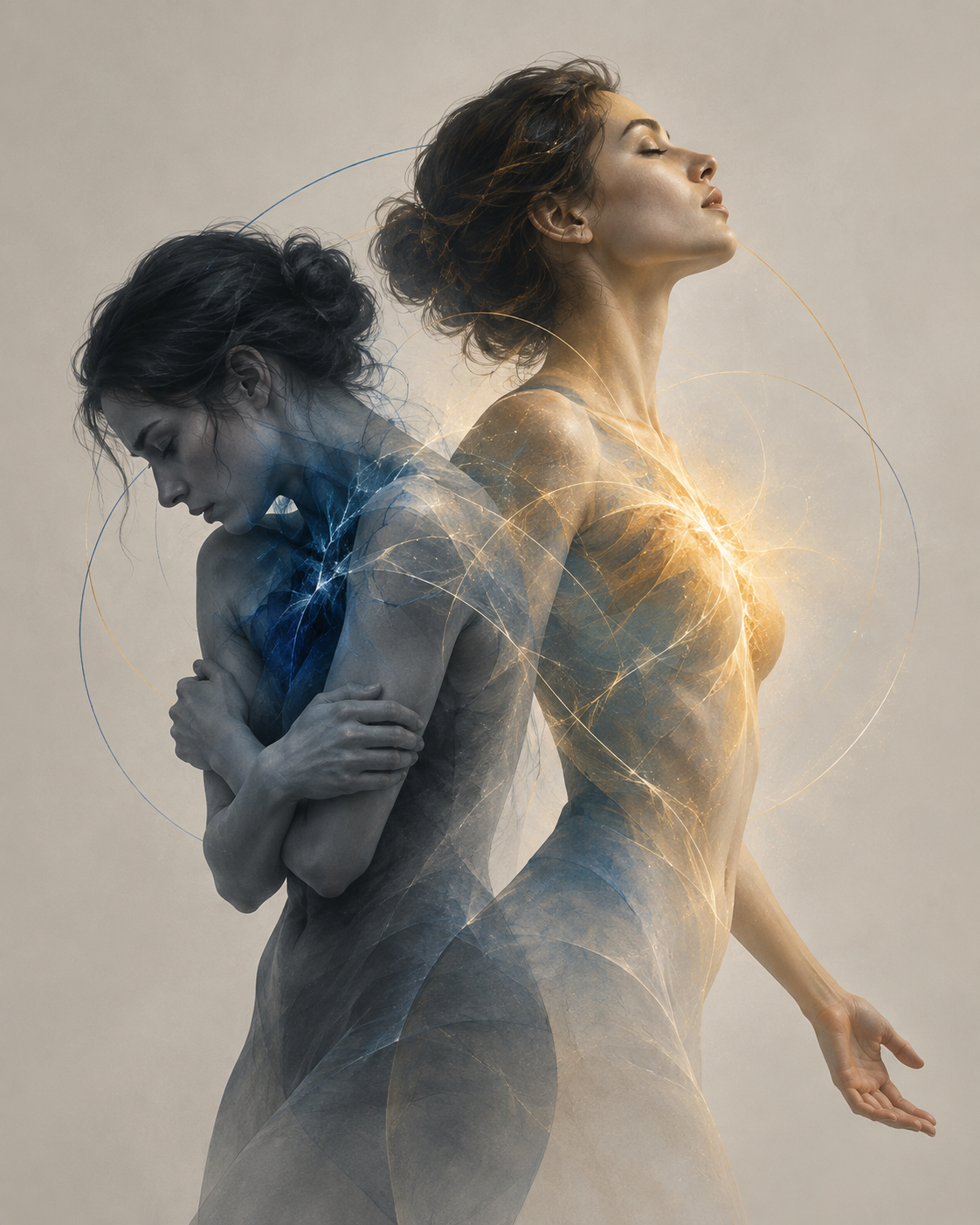
1. From Expression to Influence
The previous paper in this series, When the Body Speaks: Decoding the Language of the Subconscious, followed the body in one direction. A psychological process begins, the body changes, and that change can become part of what reaches awareness. The throat tightens before a person admits they are holding something back. The chest closes before they have named the need to protect themselves. The feet begin moving before a decision has become a sentence. In that direction, physical expression is part of the message.
The relationship does not have to stop there. A person can also deliberately change the position of the body before the inner pattern has changed. They can plant their feet before saying something difficult, straighten after collapsing inward, uncross the arms, open the chest, kneel, reach, bow, twist, stand taller, or move from one position into another. The external situation may be exactly the same, yet the nervous system is now receiving a different set of signals from muscles, joints, balance, breathing, pressure, orientation, and movement.
That reversal creates the central idea of this paper. If psychological and emotional patterns repeatedly shape physical expression, physical expression may also become one of the ways those patterns are reshaped. The claim is larger than the idea that posture can make someone feel better for a few minutes. It is that deliberately taking another form may give the person repeated practice in another organization of feeling, attention, action, and response. If that organization is practiced often enough, it may become easier to access when the old pattern would normally take over.
2. Physical Form Is Part of a State
A clenched fist makes the two directions easy to see. Anger can tighten the hand without a deliberate decision, showing an inner state changing physical form. Deliberately making a fist also changes the body immediately: muscles contract, pressure increases, joints take another position, and the brain receives different sensory information from the hand and arm. The form is not merely an image of anger. Once it exists, it becomes part of the physical condition in which the next moment is experienced.
Researchers have tested this broader principle by changing posture first. In a randomized study, 74 adults were assigned to sit either upright or slumped while completing a stressful speaking task. The upright group reported better mood, less fear, and higher self-esteem than the slumped group. [1] In another experiment involving people being treated for depression, those placed in a slumped posture later showed a stronger bias toward remembering negative material, while those sitting upright did not show the same negative imbalance. [2]
Movement shows the same relationship. Researchers altered the way people walked so their gait became more upbeat or more downcast while keeping walking speed comparable. Those guided toward the more upbeat pattern later remembered a greater proportion of positive self-referential words. [3] A systematic review and meta-analysis identified 73 relevant studies of expansive and contractive postures and movements and found robust differences in affective and overt behavioral responses. The clearest comparison with neutral conditions suggested that the overall effect was driven more by disadvantages associated with contractive forms than by large benefits from expansive forms. [4] These findings do not show that one posture creates one fixed emotion. They show something more useful here: changing physical form can participate in changing what the person feels, remembers, or does next.
The earlier paper in this series, Borrowed States: From Chemical Regulation to Natural Embodiment, used the word state for the overall condition in which body and mind are operating at a particular moment. Guardedness and openness are different states. Scattered activation and focused readiness are different states. A state is not produced by one variable alone. It includes the way attention is organized, what the person expects, how the body is activated, what sensations are reaching awareness, and what actions feel available. Physical form belongs inside that larger organization.
Interoception is the nervous system's sensing of conditions inside the body, including heartbeat, breathing, pressure, tension, temperature, pain, and signals from internal organs. [5, 6] Changing posture or movement changes some of the information entering that system. It can alter muscle tension, breathing mechanics, balance, pressure, exposure or protection, and readiness for action. The person is therefore not trying to persuade the mind with a pose. They are changing part of the physical situation from which the mind is experiencing the moment.
3. Psychological Patterns Are Also Physical Patterns
A recurring psychological pattern is rarely made of thought alone. Imagine someone who learned that disagreement is dangerous. Years later, the pattern may include an expectation of rejection, a surge of fear, held breath, a tightened throat, shoulders drawing inward, reduced eye contact, softer speech, and an urge to end the conversation. Those pieces can happen so quickly that they feel like one reaction, but the reaction is an organization of many processes occurring together.
The physical parts of that organization matter because they help determine what the person can do while the pattern is active. A collapsed posture changes breathing and movement. A tightened jaw makes speech physically different. Turning away changes what is seen. Bracing the abdomen changes the felt condition of the body. None of these physical changes has to be the original cause of the fear in order to help maintain the form the fear takes once it appears.
This is the opening physical expression provides. If a pattern partly lives through repeated bodily organization, then changing that organization can interrupt more than appearance. The person can practice standing while the old impulse is to shrink, breathing while the old impulse is to brace, remaining open while the old impulse is to protect, or holding a stable position while the old impulse is to retreat. The psychological history has not vanished, but the body is no longer completing the old pattern in exactly the same way.
4. Repetition Turns Form Into Rehearsal
Doing something once and becoming capable of doing it naturally are different events. A person can force themselves to speak clearly one time while terrified, just as someone can play a difficult chord once without yet being able to play it fluently. Repetition matters because repeated action gives the system more experience organizing itself around the same demand.
In this paper, plasticity means the ability of a recurring pattern to change through repeated experience or use. The term does not require every change to come from one neural mechanism. The relevant question is functional: after repeatedly practicing another way of organizing the same kind of moment, does that alternative become easier, faster, and less effortful to access?
The earlier paper in this series, The Biology of Becoming: The Advancement of Structural Capability, developed the broader principle that repeated demand can lead to adaptation and that integration is what allows a useful change to remain available rather than having to be recreated from the beginning each time. Physical expression fits naturally into that logic. Deliberately taking a form can create the immediate demand; repeating the form in psychologically relevant situations can create repeated practice; integration would be visible when the person begins entering the new response with less deliberate effort.
This makes physical form a possible rehearsal rather than a command. A grounded stance does not order the nervous system to become confident. It gives the person repeated experience of meeting a moment while physically organized in a way that supports staying, speaking, balancing, reaching, opening, resisting, yielding, or another relevant action. The important change would occur if the new organization gradually becomes part of what the person does before they have to think about it.
5. Meaning Changes What a Form Rehearses
Physical form does not operate only through mechanics. Human beings also experience bodies through meaning. The previous paper in this series, When the Body Speaks: Decoding the Language of the Subconscious, showed why some bodily meanings arise naturally from function. Feet and legs carry us through space, so they readily become associated with support, direction, and movement. Hands reach, hold, release, give, receive, and create. The throat is physically involved in voice. The chest is exposed when the body opens and protected when the body folds inward.
Whole-body forms can combine several of those functions at once. Standing with the feet planted, torso upright, chest exposed, head lifted, and arms reaching outward is physically different from curling inward with the head lowered and arms wrapped around the torso. The first form involves support, exposure, extension, and outward action. The second involves containment, protection, reduced exposure, and contraction. A person does not need a symbolic dictionary to feel that these forms place the body in different relationships with the world.
Meaning is still personal. One person may experience kneeling as surrender, another as devotion, another as humiliation, and another as relief from having to remain strong. Opening the chest may feel like freedom to one person and danger to someone whose history made exposure unsafe. The same form can therefore rehearse different psychological material in different people. What matters is not assigning a universal meaning to a posture but noticing what relationship the form repeatedly has to the person's own emotional life.
This is why personally meaningful physical expression may matter more than mechanically copying a pose. The form changes the body, but the person also knows what the form means to them. A posture can therefore combine sensory input, action, attention, memory, expectation, and symbolism in the same event. The body is physically doing something while the person is psychologically experiencing what that doing represents.
6. A Sequence Can Rehearse Transformation
A single form represents one organization. A sequence can represent movement between organizations. That difference matters because many psychological changes are not destinations that appear all at once. A person may first need to feel protected enough to remain present, then grounded enough to stop retreating, then open enough to experience what was being avoided, and only then ready to speak or act.
Physical forms can give that progression a body. Someone might move from a contained posture into a grounded stance, then into an opening form, then into a position that emphasizes reaching or expression. Another person might move from effort into support and finally into surrender. The sequence does not prove that these symbolic meanings are biologically encoded. Its value is that the person is no longer only imagining a transition. They are performing one.
That makes sequence potentially different from holding one so-called positive posture. The important event may be the transition itself: contraction becoming extension, withdrawal becoming approach, instability becoming balance, restraint becoming expression. Repetition then rehearses not merely a state but a pathway from one state to another. If the pathway becomes familiar, the system may gain another route to use when the original pattern appears.
7. Yoga as an Existing Vocabulary of Deliberate Form
Nothing in this theory requires yoga, but yoga provides an unusually developed example of people deliberately organizing the body because they expect inner conditions to change with it. The word yoga is much broader than the posture-centered exercise commonly called yoga in the modern West. In Hindu traditions, yoga can refer to multiple disciplined paths toward liberation, including paths centered on action, devotion, and knowledge. [7, 8] Hatha traditions developed a distinct emphasis on physical practices, including asana and breath control. [8, 9] Modern posture-based yoga developed from those traditions while also being shaped by modern physical culture. [10]
Hatha yoga is especially relevant because physical form was used as a means of changing energy. Posture, breath regulation, muscular locks, and seals were practiced to alter the movement and organization of prana, the vital energy described in yogic traditions. Those energetic changes were not treated as ends in themselves. Continued practice was directed toward increasingly transformed states associated with kundalini awakening, samadhi, and ultimately liberation. Physical form therefore connected directly to spiritual development through an intermediate step: change the body to change energy, and repeatedly change energy to change what the person can become. [9]
A similar structure appears in Dao Yin and qigong. Dao Yin combines physical movement, breathing, and mental focus to guide qi, the vital energy described in Chinese traditions. The terminology differs from yoga, but the practical structure is similar: bodily practice is used deliberately to influence vital energy within broader systems of health preservation and Taoist cultivation. [11]
The importance of these traditions here is not that their energetic models prove the mechanism proposed in this paper. It is that the relationship being explored is old and unusually specific. Physical forms were repeatedly practiced not simply because they represented a desired state, but because they were believed to help produce the internal energetic conditions through which deeper transformation became possible.
8. Repeated Body-Based Practice Can Reach Beyond the Moment
The strongest version of this theory requires more than evidence that posture can change a feeling for several minutes. It requires a reason to think repeated body-based practice can participate in changes that last beyond the practice itself. Research on trauma-sensitive yoga provides one relevant precedent because post-traumatic stress disorder, or PTSD, often includes persistent bodily readiness for danger together with intrusive memories, avoidance, emotional numbing, and hyperarousal.
A 2014 randomized trial studied women with chronic PTSD who participated in trauma-informed yoga. The yoga group showed substantial improvement, and a larger proportion no longer met diagnostic criteria for PTSD after treatment than in the comparison condition. [12] A 2023 randomized clinical trial in women veterans with military sexual trauma-related PTSD compared Trauma Center Trauma-Sensitive Yoga with Cognitive Processing Therapy. Both groups improved; post hoc equivalence analyses found comparable reductions in clinician-rated PTSD symptoms, and yoga had higher treatment completion. [13]
A 2024 meta-analysis of 20 randomized controlled trials found significant improvements in self-reported PTSD and depressive symptoms, while pooled clinician-rated PTSD outcomes did not show a significant benefit; the authors also noted that individual intervention studies tended to have high risk of bias. [14] These studies do not show that a particular pose carries a fixed symbolic meaning, nor do they isolate posture from breathing, attention, safety, repetition, or the therapeutic context. Their importance here is narrower and more useful: repeated practice organized through the body can contribute to psychological change that is not confined to the few minutes in which a posture is being held.
9. The Plasticity Hypothesis
The pieces can now be placed together without making the experiment the theory. First, physical form is part of the state a person is in, and changing posture or movement can alter emotional and cognitive outcomes. Second, recurring psychological patterns often include recurring bodily organization. Third, repeated action can become easier and more automatic as the organism gains experience with it. Fourth, physical forms can carry personal meaning because they physically enact relationships such as protecting, reaching, grounding, opening, yielding, standing, carrying, and moving.
The plasticity hypothesis is that deliberately repeating a psychologically relevant physical organization can help reshape the larger pattern in which that organization participates. The first effect may be temporary: the person enters another state only while taking the form. With repetition, the transition may become easier. With further integration, the person may begin producing part of the new organization in ordinary life before deliberately choosing the posture at all.
The earlier paper in this series, Borrowed States: From Chemical Regulation to Natural Embodiment, distinguished temporary access to a state from natural embodiment of that state. The same distinction clarifies physical expression. A posture can initially function as external support for a way of being that is not yet easy to access. Pattern reshaping would mean that the support gradually becomes less necessary because the person has learned the organization the form was helping them enter.
That progression creates three different levels of change. A state shift occurs when the person feels or functions differently while using the form. Rehearsed access occurs when the same change becomes easier to produce through repetition. Pattern reshaping occurs when the alternative response begins appearing outside the practice, in the situations where the old pattern once organized the body automatically. Only the third level would justify saying that the underlying pattern itself has meaningfully changed.
Seen this way, the purpose of physical expression is not to replace psychological understanding with posture. It is to give psychological development another route. A person can understand that they have a right to speak and still collapse when conflict begins. Physical practice lets them repeatedly inhabit the act of staying upright, breathing, remaining present, and speaking while the old pattern is active. The body becomes one of the places where the new response is learned rather than merely one of the places where the old response is displayed.
10. Beyond Yoga
Once the mechanism is separated from yoga, it becomes easy to recognize in ordinary life. A musician changes posture before performing. An athlete takes a stance before competition. A speaker plants their feet before addressing a room. Someone preparing to set a boundary sits upright rather than folding inward. A grieving person curls around themselves for protection and later finds themselves able to uncurl. People pace while thinking, kneel while praying, bow during ritual, dance during celebration, and reach for another person when words are insufficient.
These actions may sometimes be consequences of an inner state, sometimes ways of regulating it, and often both. The theory developed here suggests that their repeated use can also become developmental. A form that once had to be chosen deliberately may eventually become the body's ordinary expression of a different psychological organization.
Physical expression therefore deserves to be considered alongside thought, emotion, language, relationship, and behavior as part of how human patterns are formed and changed. The body is not merely where a psychological pattern becomes visible after the important work has already happened elsewhere. It is one of the systems through which the pattern is being enacted in real time, which means it may also be one of the systems through which another pattern can be practiced.
Conclusion: Reshaping Patterns Through Physical Form
The previous paper in this series, When the Body Speaks: Decoding the Language of the Subconscious, asked what physical sensation, posture, and movement may reveal about processes that have not yet become conscious language. This paper follows the relationship in the opposite direction. Once the body takes a form, that form becomes part of the conditions in which the next moment is experienced.
Research already shows that posture and movement can influence mood, memory, fear, and behavior. Psychological patterns also repeatedly organize breathing, tension, orientation, movement, and action. The larger proposal is that these facts can meet through repetition: a person may deliberately inhabit another physical organization often enough that what first had to be practiced becomes progressively easier to access.
The plasticity of physical expression is therefore not the claim that a pose contains a hidden emotion or that posture alone can erase a psychological history. It is the possibility that repeated physical form can become repeated psychological rehearsal. When the new organization begins appearing naturally in the situations that once produced the old one, the body has done more than change how the person looked. It has participated in reshaping the pattern itself.
Practical Add-On | A Way to Test the Idea
The theory above does not depend on the following method. This section is an optional way for readers to examine the idea in their own experience. Yoga is used only because it provides many recognizable, repeatable physical forms; the same approach could be adapted to ordinary posture, gesture, walking, dance, martial arts, or other movement systems.
1. Describe the starting pattern
Before choosing a form, describe what is happening in ordinary language: the emotion, bodily sensations and locations, urges, posture, breathing, and the quality of activation. The useful question is not simply how bad the state feels, but how it is organized.
2. Choose forms before reading meanings
Use the visual sheet in Appendix A or another catalog and select the forms that feel relevant before reading any suggested symbolism. Attraction, resistance, curiosity, discomfort, or a strong bodily desire to enter a position can all be recorded. The purpose is to preserve the person's original response before an interpretation is supplied.
3. Compare the symbolism with the person's own meaning
After the first choices are recorded, read the possible meanings in Appendix B. Accept, reject, or revise them based on personal experience. The catalog is a prompt rather than a dictionary. A form that repeatedly means something different to the person should be understood through that recurring personal meaning.
4. Arrange a transition
Place the chosen forms in the order that feels right. Only afterward ask whether the sequence appears to move through a psychological process such as protection to grounding, contraction to opening, uncertainty to direction, effort to support, or withholding to expression.
5. Perform and observe
Move through the sequence within safe physical limits while noticing changes in emotion, bodily sensation, breathing, muscular softening or bracing, activation, spontaneous long breaths, the urge to remain in or leave a form, and any change in the intended sequence.
6. Compare what changed into what
Describe the ending state using the same language used at the beginning. Do not reduce the result to whether the person feels calmer or better. Fear may become anger, scattered activation may become determination, heaviness may become grief, guardedness may become vulnerability, or nothing meaningful may change. The direction of the change is the information.
Illustrative First Self-Test
The author's first self-test began after an energy drink produced a jittery, restless physical state. Poses were selected intuitively from a visual grounding category rather than from a routine designed in advance. The sequence was Mountain Pose, Reverse Warrior, High Crescent Lunge, Revolved Crescent Lunge, and Standing Backbend, performed for roughly five minutes.
During the sequence, a large breath released spontaneously and the body naturally settled into a more relaxed position within one of the forms. Afterward, the jitteriness was gone but readiness remained. The resulting state was described as 'calm but ready' and 'not jittery, just determination almost.' The observation is useful because the activation did not simply disappear; its quality appeared to change from scattered and restless to more organized and purposeful.
One self-test cannot determine why the change occurred. The sequence involved movement, attention, expectation, breathing, stretching, time, and several specific forms. Its role here is only illustrative: it shows the kind of transformation the theory is interested in tracking.
What Would Count as Pattern Reshaping?
A temporary effect should continue to depend on the posture or sequence. A developmental effect should gradually require less assistance. Repeated observations can therefore ask whether the same starting pattern attracts similar forms, whether a transition becomes easier to produce, whether fewer forms are needed over time, whether attraction toward a once-important form fades, and whether the new response eventually appears in daily life when the old trigger returns.
Comparisons can also separate parts of the method. A personally chosen sequence can be compared with an instructor-selected routine matched for time and physical difficulty. Symbolic meanings can be hidden or shown before selection. The same forms can be performed in different safe orders. These comparisons help distinguish the effect of movement itself from the effects of personal meaning, sequence, expectation, and repetition.
Anonymous Comments
(0)What clicked for you in this paper could be what makes it click for the next reader.
No comments yet. Be the first to share your thoughts!
Spiritual theories are speculative frameworks offered for exploration. They are not treatments, and they are not a substitute for the tested methods in the Healing Library.