
Physical Form and the Transformation of Consciousness
Spiritual Exploration
Spiritual Exploration
Physical Form and the Transformation of Consciousness
How physical position may reveal, influence, and transform inner experience
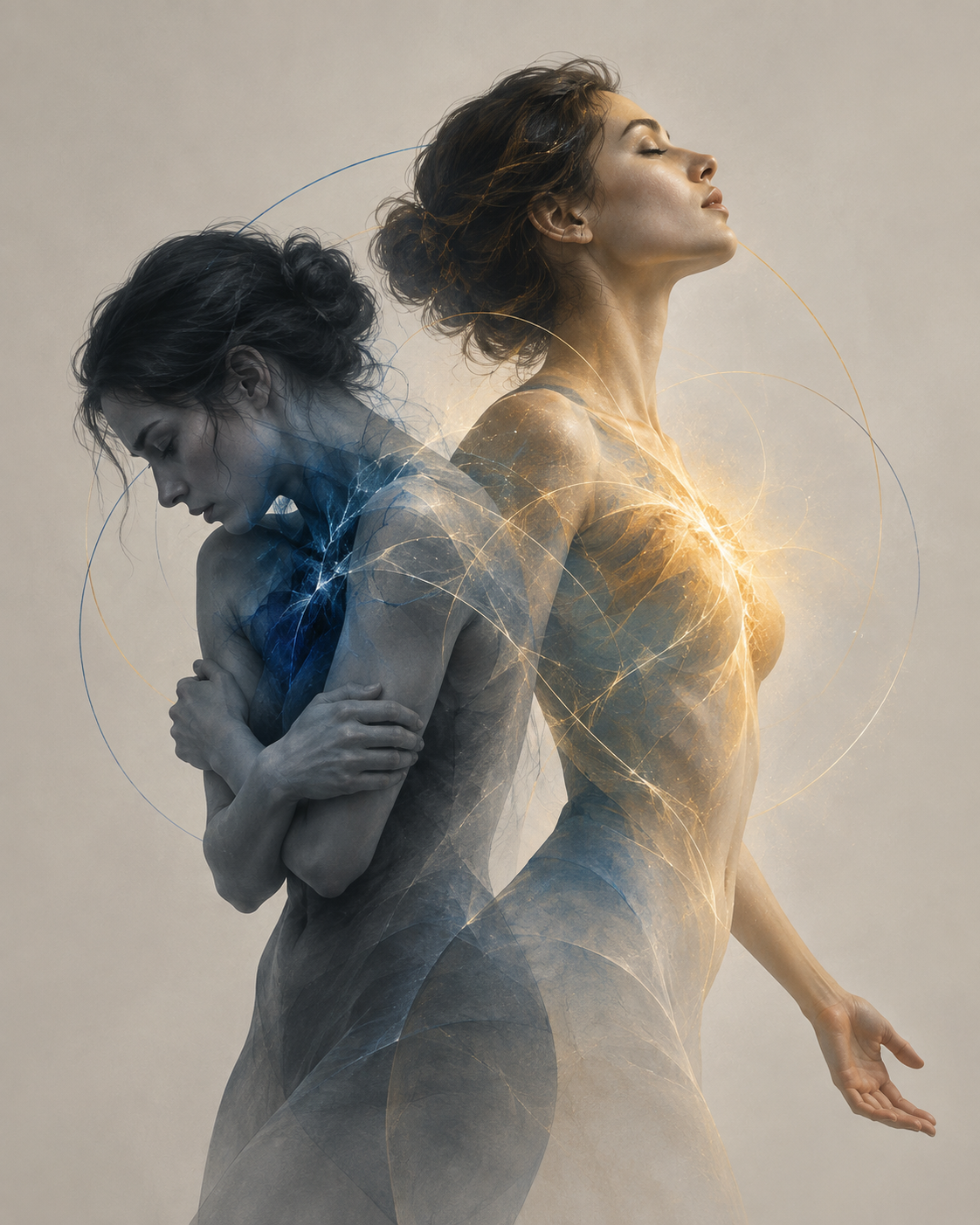
1. The Body Speaks Before We Do
Imagine two people sitting across from you. One has their arms wrapped tightly around their body, their shoulders pulled forward, and their head lowered. The other sits upright with their shoulders relaxed and their arms resting loosely at their sides. Neither person has spoken, yet the two bodies do not look as though they are having the same experience. You might not know exactly what either person feels, but you would probably expect the first person to be more guarded or uncomfortable and the second to be more at ease.
We read positions like these every day without stopping to name what we are doing. A child who is frightened may hide behind a parent. Someone who does not want to be approached may turn away or pull their arms inward. A person who has finally decided to say no may straighten, plant their feet, and stop shrinking. The same position never means exactly the same thing in every person or every situation, but the larger pattern is easy to recognize: what happens inside us often changes the way we arrange the body on the outside.
That observation is ordinary enough that it can be easy to overlook. We usually think of an emotion as something hidden inside a person and body language as something added afterward, yet the body is often part of the emotion from the beginning. Fear can arrive with a lowered head and a body drawn inward. Confidence can arrive with a steadier stance. Relief can appear as muscles that finally let go. Before asking whether a physical position can change anything, it is worth establishing just how much information a position can carry by itself.
2. How Much Can a Body Position Say Without Words?
Researchers can test this by stripping away the other parts of communication. Instead of letting people hear a voice or read a sentence, they can show only the body and ask observers to identify the emotion being expressed. In one experiment, participants viewed bodies expressing anger, fear, or happiness while the faces were hidden. From physical form alone, they identified the emotion correctly 86.5 percent of the time on average: 94.4 percent for anger, 89.6 percent for fear, and 75.7 percent for happiness. This does not mean that 86.5 percent of all communication comes from posture. It means that when physical position was isolated from words, tone, and facial expression, the body still carried enough information for people to recognize the emotional state with substantial accuracy. [1]
The information is not limited to the outline of the entire body. Other research has found that people can recognize emotional information at better-than-chance levels from isolated hands, arms, heads, and torsos, although the full body is generally easier to read. [2] Even the way one part of the body is positioned can therefore carry information about what a person is experiencing.
For this theory, that body-only recognition rate is more useful than a broad statistic about nonverbal communication because it isolates the thing being examined: physical position itself. The point is simple: a body can communicate emotion through its shape even when the observer has no words or tone of voice to rely on.
So far the direction is familiar. Something happens inside a person, their body takes a shape, and another person can often read part of what that shape expresses. The next question turns that relationship around. If a feeling can change the body, what happens when the body is changed first?
3. What Happens When the Form Changes First?
A simple way to understand the question is to think about a clenched fist. Anger can make a hand clench without any deliberate decision, showing how emotion can change physical form. If someone deliberately makes the same fist, however, the position also changes what they feel in the hand and arm: pressure, muscle tension, and resistance. That raises the question this section needs to answer: can changing physical form first sometimes change the emotional experience that follows?
Researchers have tested that question directly with body posture. In a randomized study, 74 adults were assigned to sit either upright or slumped while completing a stressful speaking task. The upright group reported better mood, less fear, and higher self-esteem than the slumped group. [3] In another experiment involving people being treated for depression, those placed in a slumped posture later showed a stronger bias toward remembering negative material, while those sitting upright did not show the same negative imbalance. [4] These studies do not show that posture can simply switch an emotion on or off, but they do show that changing position can alter parts of emotional and cognitive experience.
The pattern also appears in movement. Researchers changed the way people walked so that their gait became more upbeat or more downcast while keeping walking speed comparable. Those guided toward the more upbeat pattern later remembered a greater proportion of positive words about themselves. [5] A systematic review and meta-analysis of 73 experiments likewise found reliable differences in emotional and behavioral responses between expansive and contracted postures and movements, with the clearest effects often coming from the disadvantages of contracted positions rather than from any dramatic benefit of so-called power poses. [6]
Taken together, the evidence supports a modest but important conclusion: physical form does not control emotion like a switch, yet deliberately changing posture or movement can sometimes change how a person feels, remembers, or responds. That is enough to justify asking what happens when the forms are chosen intentionally for the state a person wants to change.
4. What Has Actually Changed When a Feeling Changes?
Imagine someone waiting to give a speech. Their heart is beating quickly, their body feels charged, and they cannot sit still. At first they experience that activation as fear and want to leave. A few minutes later, nothing about the room has changed and their heart may still be beating quickly, but the same person now feels ready to speak. The physical activation has not necessarily disappeared. What changed is the experience of it: fear became readiness.
That difference gives the title of this paper its meaning. Consciousness is the experience of being aware - what a moment feels like from the inside, including thoughts, emotions, sensations, attention, and perception. The word does not have to refer to an extraordinary mystical state. If a person moves from panic to calm, shame to acceptance, guardedness to openness, or restless activation to determination, their conscious experience has changed because the lived quality of the moment is different.
The body is part of that experience. Emotions are often accompanied by sensations that can be felt directly: pressure in the chest, trembling in the hands, heat in the face, heaviness in the limbs, tightness in the throat, or a sudden release through a long breath. Scientists use the word interoception for the ability to sense signals arising from inside the body. These internal signals contribute to emotional experience because the brain is not only interpreting what is happening around us; it is also continuously receiving information about what is happening within us. [7, 8]
People often describe the overall felt quality of those sensations as energy. In this paper, an energetic experience means the subjective feeling of activation in the body - for example jitteriness, heaviness, warmth, pulsing, lightness, pressure, movement, or a sense of charge. Using the word energy in this way does not prove that a particular spiritual energy has been measured. It simply gives a name to something the person can directly feel. If the energetic quality of the body changes from scattered restlessness to calm readiness, that change is part of the transformation in conscious experience.
5. From Body Language to an Inner Language
Up to this point, the body has been doing two things. It can reveal something about a person’s emotional state through the position it takes, and changing that position can sometimes influence what the person feels. Put those two findings together and another possibility begins to appear.
Imagine noticing that every time a certain subject comes up, your arms pull toward your body and your chest tightens. You may not have consciously decided to protect yourself, but your body has changed before you have fully put the feeling into words. Once you notice the pattern, the position itself becomes information. It gives you another way to recognize what is happening inside you.
The same thing can happen in the other direction. Perhaps there are moments when you naturally straighten before saying something difficult, plant your feet before holding a boundary, or loosen your body when you finally feel safe. You do not need a chart telling you what those positions mean. Their meaning becomes clearer because you can compare the form of your body with what was happening inside you when the form appeared.
This does not mean that every position has one hidden meaning. Folding the arms might mean protection in one moment, comfort in another, or simply that someone is cold. What matters is the relationship between the position and the experience of the person whose body is making it. Over time, repeated patterns may become recognizable in the same way that repeated words in an unfamiliar language eventually begin to make sense.
Body language is usually discussed as communication between people: one body expresses something and another person reads it. The possibility being explored here is that the same process may also work inwardly. A person may learn to notice the forms their own body takes and use those forms as clues to feelings, needs, or changes that have not yet become completely conscious.
Once physical form can carry meaning in this way, a new question follows naturally. If a body position can come to represent an inner state, could a person also deliberately choose a physical form that represents a state they want to experience? That is where physical form begins to become symbolic.
6. Physical Form as Symbol
A symbol is something visible that carries a meaning larger than its literal shape. A closed door is still a door, but it can also represent being shut out. An open hand is still a hand, but it can represent giving, receiving, releasing, or asking someone to stop. People understand symbols because the mind connects a physical form with an idea or experience.
A body position can function in the same way. A wide stance may represent steadiness or the right to occupy space. Curling inward may represent protection. Reaching upward may represent striving, freedom, or opening. Exposing the throat may represent speaking freely to one person and vulnerability to another. The theory does not claim that any of these meanings are universal. The important question is whether a form carries meaning for the person who is drawn to it.
Once a form has a personal meaning, deliberately entering it creates something different from merely thinking about the desired state. Someone who wants to feel more grounded can think the word grounded, but a physical form can let them stand, balance, breathe, and feel what groundedness means in their own body. Someone who wants to become more comfortable being seen can understand that idea intellectually, yet an open physical position can turn the idea into an experience. The form becomes a way of giving an inner change a physical shape.
7. A Sequence Can Become a Path
One position can represent a state, while several positions can represent a movement between states. Think of the difference between looking at one photograph and watching several photographs in order. The first can show where someone is; the sequence can show how they got there.
A person who wants to speak honestly might not feel ready to begin with complete openness. They may first choose a protected form, then a posture that gradually opens the chest, then one that exposes the throat, and finally an upright position that feels stable. Another person may need the opposite movement, beginning with strength and finishing in surrender. The sequence does not have to follow a universal emotional map. The point is that the order itself can become meaningful when the person chooses it.
This is where intuition enters the experiment. Intuition here means a felt sense that one option seems right before the person can fully explain why. The participant looks at several physical forms, notices which ones attract them, and then arranges those forms in the order that feels right. Only afterward do they examine whether the sequence appears to represent a recognizable process. This order matters because it gives the person a chance to respond before an explanation tells them what they are supposed to see.
8. Why Yoga Becomes a Useful Way to Test the Idea
Nothing in the theory up to this point requires yoga. The idea is about physical form and the possibility that deliberately chosen forms can influence inner experience. Yoga becomes useful because it offers something an experiment needs: a large library of recognizable, repeatable body positions. Instead of asking someone to invent a posture from nothing, a catalog can show many different ways of standing, folding, twisting, balancing, opening, resting, reaching, or turning, allowing the person to notice which shapes draw their attention.
Before using those forms, however, it is important to understand that the word yoga means much more in Hindu traditions than the posture-based exercise commonly called yoga in the modern West. In many Hindu traditions, yoga is a disciplined path toward liberation. Liberation, often called moksha, refers to freedom from the ignorance, attachment, or cycle of suffering that keeps a person from realizing the deepest nature of self and reality. In that larger sense, yoga is not one exercise system but a family of methods for transforming the person. [9, 10]
Different branches emphasize different ways of doing that work. Karma Yoga uses action and service while practicing freedom from attachment to the reward. Bhakti Yoga develops devotion and relationship with the divine. Jnana Yoga emphasizes knowledge, discernment, and inquiry into what is ultimately real. Raja Yoga, especially as described through the eight limbs associated with Patanjali, includes ethics, personal disciplines, physical posture, regulation of breath, withdrawal from distracting sensory input, concentration, meditation, and samadhi, a state of deep absorption. Hatha traditions develop bodily practices such as posture, breath regulation, locks, and seals, while mantra-centered and Kundalini-oriented traditions use sound, attention, subtle-energy models, and other practices. These paths overlap, but together they make the distinction clear: physical postures are one part of yoga, not the whole of yoga. [13-15]
Modern Western yoga often places far more attention on asana, the Sanskrit word for physical posture, and may be practiced primarily for flexibility, strength, stress reduction, or health. That form of practice can still be useful, but it should not be confused with the wider religious and philosophical systems from which the word yoga comes. [12] For the present experiment, Western yoga poses are being used as a practical vocabulary of physical forms. Yoga provides the shapes; the theory being tested is larger than yoga itself.
9. Hatha Yoga and the Older Idea That Form Can Change Energy
Hatha yoga is particularly relevant because it already treats the arrangement of the body as something that can influence inner experience. Traditional Hatha texts describe asana, breath practices called pranayama, bodily locks called bandhas, and gestures or seals called mudras as methods for preparing and transforming the practitioner. They also use the word prana for a vital energy that is understood to move through the living body. The Hatha Yoga Pradipika, an influential text in this tradition, links the regulation of breath with the steadiness of the mind and describes practices intended to influence prana. [11]
Traditional prana and modern physiological measurements are not the same explanation, so the experiment should not pretend that they are. A backbend can be described physiologically as a change in joint position, muscle tension, breathing mechanics, balance, and sensory input. A Hatha practitioner may also understand the same position through an energetic framework. The useful point for this theory is that both perspectives treat bodily form as capable of changing the person’s internal condition rather than as decoration added to an otherwise separate mind.
That gives the proposed experiment an older precedent and a new question. Hatha yoga already provides practices in which form is used intentionally. Modern research already shows that changing form can sometimes influence emotion. The new part is asking what happens when the person chooses the form through intuition and symbolism rather than simply following a sequence selected by someone else.
10. A Healing Precedent: Yoga and Trauma
There is another reason yoga is useful as a first testing method: posture-based yoga has already been studied in people whose bodies remain strongly involved in emotional distress. Trauma provides a clear example. A person can know that danger has ended and still feel their body tense, brace, freeze, or become highly alert. The conscious understanding “I am safe now” does not always immediately change what the body is doing.
A 2014 randomized trial studied women with chronic post-traumatic stress disorder, or PTSD, a condition in which trauma-related symptoms continue after the danger has passed. Participants who completed a trauma-informed yoga program showed substantial improvement, and a larger proportion no longer met the diagnostic criteria for PTSD at the end of treatment than in the comparison group. [13] A 2023 randomized clinical trial with women veterans who had PTSD related to military sexual trauma compared Trauma Center Trauma-Sensitive Yoga with cognitive processing therapy, an established trauma-focused treatment. Both groups improved, and the yoga treatment fell within the study’s prespecified range for being no worse than the comparison treatment, while treatment completion was higher in the yoga group. [14]
A 2024 meta-analysis of randomized trials also found improvements in self-reported PTSD and depressive symptoms, while clinician-rated PTSD outcomes were less clear and the authors noted limitations in the quality of the existing evidence. [15] These studies do not test symbolic pose selection, and they do not prove that yoga should replace appropriate trauma treatment. What they provide is a precedent for the larger idea that working through the body can contribute to meaningful emotional change.
11. The Proposed Experiment: Let the Person Choose the Forms
The experiment begins with a visual catalog rather than a routine. The catalog contains common positions used in Western yoga and groups them by broad physical characteristics such as grounding, balancing, folding, opening, twisting, reclining, and inversion. Each position also has suggested symbolic meanings, but those meanings are hidden at first. The reason is simple: if the symbolism is shown before the person chooses, it becomes difficult to know whether they were originally drawn to the shape or merely to the description beside it.
Step 1: Describe the starting state
Before looking at the images, the participant describes what they are feeling emotionally and physically in ordinary language. They record noticeable sensations such as pressure, warmth, cold, trembling, tightness, heaviness, lightness, restlessness, or a sense of movement, including where those sensations are located. If useful, important qualities such as calmness, jitteriness, openness, determination, safety, or readiness can also be rated from zero to ten so the same qualities can be measured afterward.
Step 2: Choose by intuition
The participant looks through the pose images without seeing the suggested meanings and selects whichever forms feel right. They are not required to explain the choice. A pose may look physically satisfying, emotionally meaningful, strangely attractive, uncomfortable but important, or simply correct in a way that is difficult to put into words. Attraction, comfort, discomfort, and resistance are recorded separately because they may not point in the same direction.
Step 3: Reveal the possible symbolism
Only after the first choices are recorded does the participant read possible symbolic meanings. They can note that an original choice now makes more sense, reject the suggested meaning, supply a completely different personal meaning, or add another pose because its symbolism represents something they consciously want to experience. This creates two kinds of selection that can later be compared: the forms chosen before explanation and the forms chosen after symbolic reflection.
Step 4: Put the forms in the order that feels right
The selected images are arranged into a sequence before the person begins moving. The participant is not told that protection must come before openness or that strength must come before surrender. They simply choose the order that feels correct. After the sequence is fixed, they can consider whether it appears to tell a symbolic story, but that interpretation comes after the intuitive order rather than creating it.
Step 5: Perform the sequence and watch what changes
The participant performs the sequence within safe physical limits while paying attention to the experience inside each form. They record changes in emotion, bodily sensations, perceived energy, breathing, muscular softening, spontaneous long breaths, urges to remain in a pose, urges to leave it, and any point at which the planned next position stops feeling right. If the sequence changes during practice, both the original plan and the actual path are kept because the change itself may contain useful information.
Step 6: Compare the state before and after
Immediately afterward, the participant describes the new state using the same language used at the beginning. The main question is not “Did you relax?” but “What changed into what?” A person could move from agitation to determination, withdrawal to openness, confusion to steadiness, or vulnerability to safety without becoming less energetic overall. Follow-up observations can then examine whether the change lasts and whether a symbolically related shift appears in ordinary life, such as speaking more freely, setting a clearer boundary, or allowing oneself to rest.
12. The First Test: Could Physical Form Change an Energetic State?
The author’s first self-test began with a very specific question. After drinking an energy drink, he felt physically jittery and restless and wanted to see whether the proposed method could change the energy he was feeling in his body. Rather than choosing a general yoga routine, he opened the grounding category of the paper’s catalog and used intuition to select the forms that felt right for that state.
He chose Mountain Pose, Reverse Warrior, High Crescent Lunge, Revolved Crescent Lunge, and Standing Backbend, then arranged them in that order because the sequence felt right. The entire practice took approximately five minutes. During the sequence, he released a large breath and noticed that his body naturally settled into a more relaxed position within the form he was holding.
After the sequence, the jitteriness was gone. What replaced it was not tiredness or a loss of readiness. He described the new state as “calm but ready,” with a feeling closer to determination. The distinction matters because the experiment had been designed specifically to see whether his energetic experience would change, and the reported result was not simply less energy. The quality of the activation changed from restless and scattered to calmer and more purposeful.
The forms he selected were largely upright, active, directional, and expansive, so the resulting sense of determination is an interesting match with some of the qualities those shapes can symbolize. That match does not show which part of the method caused the change. Movement, breathing, expectation, the passage of time, the effects of caffeine changing naturally, intuitive selection, symbolic meaning, or a combination of them could all have contributed. What the test demonstrates is the kind of transformation the larger experiment needs to measure: not only whether a person feels better, but whether one emotional and energetic state becomes a meaningfully different one.
13. How to Tell Whether the Method Is Doing Anything Special
A single five-minute experience cannot separate intuitive form selection from the ordinary effects of moving the body. A stronger experiment therefore needs comparisons. One session could use an instructor-selected routine of similar length and difficulty. Another could use poses chosen intuitively while the symbolic descriptions remain hidden. A third could allow the participant to choose after reading the symbolic possibilities. A fourth could use the same personally selected poses but place them in a different safe order. An adaptive version could ask the person to choose only one pose at a time, returning to the catalog after each pose to see whether the next preferred form changes with the new internal state.
The measurements should preserve the direction of change rather than collapsing everything into a single “better or worse” score. Calmness, physical activation, restlessness, readiness, determination, openness, safety, confidence, and any personally important quality can be rated separately. Bodily sensations should also be recorded because the energetic part of the theory concerns the felt body itself. Someone may remain highly activated while moving from fear to excitement, or remain physically tired while moving from heaviness to peacefulness. Those are different transformations and should not be treated as the same result.
Over repeated sessions, several patterns would be especially interesting. Does the same starting state repeatedly attract similar forms? Do different starting states lead the same person toward different categories? Does attraction to a particular form fade after the quality it represented becomes easier to experience? Do changes occur more strongly when poses are intuitively chosen than when the same amount of movement is prescribed? These questions turn the theory from an interpretation of one experience into something that can actually be tested.
14. The Larger Idea Beyond Yoga
Once the method is clear, yoga can return to its proper place in the theory: it is the first experimental tool, not the subject. The larger proposal concerns physical form wherever it appears. Someone may notice that they fold inward during a difficult conversation and experiment with sitting in a more supported position before speaking. A person preparing to set a boundary may deliberately plant their feet and feel what changes. Someone who needs safety may discover that the useful form is not expansion at all but a contained position that lets the body stop bracing.
The same idea could eventually be tested through ordinary posture, walking, dance, gesture, martial arts, ritual movement, or any practice in which a person deliberately changes the shape of the body and observes what follows. Yoga is especially convenient because it already contains a large visual vocabulary of forms and comes from traditions that have long treated bodily practice as part of transformation. But if the central hypothesis is correct, the important mechanism would not belong exclusively to yoga. It would belong to the relationship between physical form and the person experiencing it.
Conclusion: Giving Inner Change a Physical Form
The argument begins with something almost everyone already recognizes: people do not keep every feeling hidden inside. Fear, confidence, protection, hesitation, readiness, and relief can become visible in the way a body is arranged, and other people can often read those positions even without words. Research then adds the less obvious half of the relationship by showing that changing facial or whole-body form can sometimes influence emotion, memory, and response in return.
Once those two directions are placed together, a new possibility appears. Physical form may be useful not only as an expression of what a person already feels, but as a way of exploring what they are seeking to feel. A personally meaningful form can become a symbol, a sequence of forms can become a path from one state toward another, and the emotional or energetic change that occurs while moving through that path is a change in conscious experience because the lived experience itself has changed.
Physical Form and the Transformation of Consciousness proposes a simple way to test that possibility: show a person many forms, let intuition identify what attracts them before explanations interfere, reveal possible symbolism afterward, let the person arrange the forms into the order that feels right, then observe what changes when the sequence is physically experienced. The first test produced a shift from jittery restlessness to calm determination in about five minutes. That experience does not establish the mechanism, but it demonstrates the question at the center of the theory.
If inner experience can shape physical form, and physical form can sometimes shape inner experience in return, then deliberately chosen forms may become one way of participating in the transformation of consciousness.
Rate This Theory
All ratings are anonymous
Help others by sharing
Comments
(0)AnonymousNo comments yet. Be the first to share your thoughts!
Spiritual theories are speculative frameworks offered for exploration. They are not treatments, and they are not a substitute for the tested methods in the Healing Library.