
The Purpose of Creation
Spiritual Exploration
Spiritual Exploration
The Purpose of Creation
Healing, Creativity, and the Purpose of Consciousness
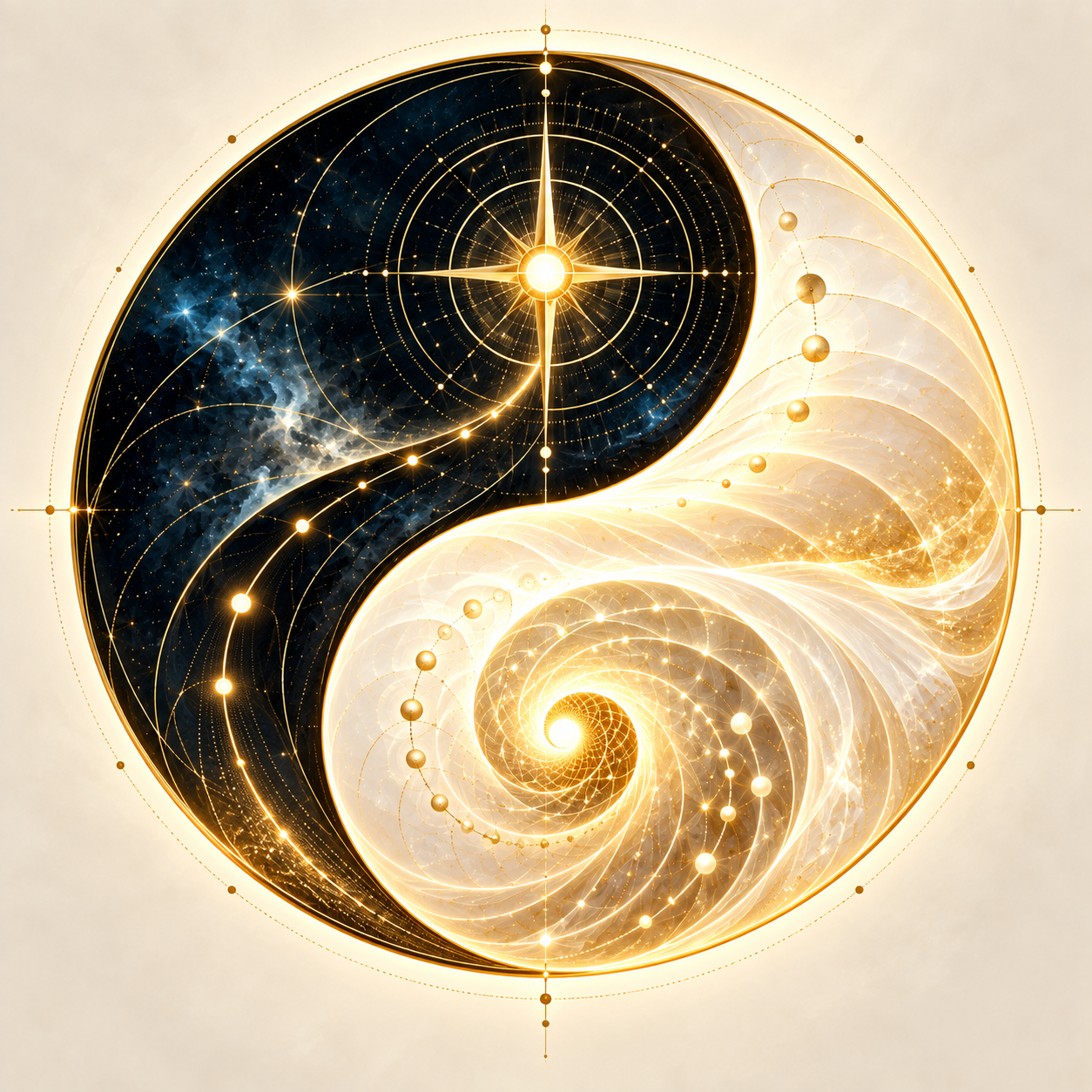
Imagine looking through a window on a cold morning when the glass is covered with mist. A dark line outside may look like a crack in the glass, while several blurred shapes seem unrelated. After a patch is wiped clear, the supposed crack turns out to be a path, one shape is recognizable as a tree beside it, and another is the house the path leads to. Nothing outside has moved, but seeing one part clearly has changed the meaning of the others. The problem was never a lack of things to see; it was that the view made their relationship difficult to recognize.
Consider someone who has long felt responsible for keeping other people happy. They apologize whenever a friend seems disappointed, agree to extra work rather than refuse a request, and become uneasy when a family member is upset. Each situation may seem to have its own explanation until the person heals the fear that someone else's unhappiness means their relationship is in danger. The friend can now be disappointed without requiring an apology, the request can be declined, and the family member's mood no longer has to be fixed. Comparing the old reactions with the new ones reveals what joined these seemingly separate experiences: the same fear had shaped each response. That recognition can change how the person lives and become an explanation that helps someone else understand a similar pattern. To see how experience can lead to a new understanding and then to something newly created, it helps to examine what the mind can do with information it already possesses.
What the mind already has, and what it can use
A new idea usually contains pieces of older ones. A person who invents a way to solve a problem draws upon things they have seen, tried, remembered, or learned, even when the finished idea looks unlike anything that came before it. Creativity, in its everyday sense, is the ability to arrange existing information in a new and meaningful way. In research, a creative idea is generally expected to be both new and suited to its purpose. A strange idea is not automatically useful, just as a familiar idea is not automatically original. Yet possessing the necessary information and being able to use it are not the same thing.
Biological Awakening Theory examined this difference by showing how the same person can have an ability in one state and struggle to use it in another. Under pressure, a familiar answer may be difficult to reach, although it becomes available again after the pressure lifts. In experiments, Isen, Daubman, and Nowicki found that people placed in a pleasant mood were more likely to solve problems that required an unusual connection between familiar things. The participants did not have to acquire new facts for their existing knowledge to become more useful. Other researchers found that learned associations which no longer appeared in ordinary responses could become detectable when they altered inhibition, the signals by which some brain cells reduce the activity of others. These experiments concern different processes, but together they show why having information and being able to access or use it must be treated as different questions. They do not establish that psychological healing switches off a particular brain mechanism; they show that the conditions under which the mind operates can change what its existing information allows it to do. (Isen et al., 1987; Barron et al., 2016)
Memory provides another piece of this picture. In a 2015 experiment, Madore, Addis, and Schacter asked people to recall specific details of past experiences before trying to think of several possible uses for everyday objects. Generating different answers rather than searching for one is called divergent thinking. Those who had recalled their experiences in detail produced more ideas than people in comparison conditions, suggesting that making past experience easier to reach can sometimes help people form new combinations from what they already know. A 2026 review bringing together 21 samples found small benefits in some measures of how many or how varied the ideas were, although the effects weakened or disappeared in some analyses that considered missing or unpublished studies, and originality did not improve reliably. (Madore et al., 2015; Tomás et al., 2026) The important point is not that recalling every detail creates originality. A person may possess a memory, a piece of knowledge, and an ability to connect them, yet not be able to bring all three together in every state. Life supplies the material, while the conditions of the mind help determine which relationships become available. This is also why two people can encounter the same event and see different possibilities: each has a different history of experience to draw upon, and each approaches that history through a different present state.
What changes when a person heals
A difficult experience can leave behind more than a memory of what happened. It may also leave an expectation about what will happen next. Someone who has repeatedly been dismissed may begin hearing rejection in an uncertain reply. Someone who has learned that disagreement leads to punishment may become tense during an ordinary difference of opinion. Their reactions are understandable attempts at protection, but an old danger can begin shaping how a new event is seen. The person is no longer responding only to what is happening now; their earlier experience is adding a layer of meaning to it.
Stress can affect thinking in measurable ways. In a review that combined the results of many experiments, Shields, Sazma, and Yonelinas found that short-term stress could interfere with working memory and cognitive flexibility. Working memory is the ability to hold something in mind while using it, as when someone remembers a few instructions long enough to carry them out. Cognitive flexibility is the ability to consider a different explanation or change a plan when new information appears. If someone is trying to connect an observation from today with a memory from years ago, both abilities can matter. (Shields et al., 2016)
An alarm is helpful when there is a fire, but it becomes distracting if it keeps sounding long after the danger has passed. In a similar way, the mind's protective responses are useful when protection is needed, yet can occupy attention when they continue unnecessarily. Healing, as used in this theory, means becoming able to meet experiences with less of the old fear, avoidance, or defensive meaning that once accompanied them. It does not mean forgetting what happened or losing the ability to recognize real danger. The event can remain in memory while its hold on present perception changes.
That change can create a kind of learning that was unavailable before the healing occurred. Suppose a person used to feel ashamed whenever someone disagreed with them. After working through that shame, they hear a disagreement and find that the old reaction no longer appears. Because they remember what disagreement used to feel like, they can compare the two states and notice that the other person's words were never the whole cause of the shame. The earlier reaction depended partly on something being carried inside them. Without the change, the old reaction might have seemed like a simple fact about the world; the difference between before and after makes its workings visible.
This is not merely the use of pain as material for a story after the suffering has ended. The act of healing can reveal how an earlier response was built. A person learns not only that they once felt fear, but what they interpreted as threatening, how the feeling shaped their choices, and what changed when that interpretation no longer controlled them. The contrast itself becomes evidence from their own experience. A lifted weight teaches something about the weight that was being carried, even though the weight was difficult to judge while it was always there. In this way, painful experience can supply information, healing can make a hidden relationship visible, and the resulting insight can become useful beyond the original event.
Healing can also provide the missing comparison that turns a familiar experience into a new understanding. A person who once responded to disagreement with shame may notice, after healing, that disagreement no longer changes their sense of worth. Because both experiences belong to the same person, the difference helps reveal how the earlier response was formed. The insight may then illuminate other situations that once seemed unrelated, such as the need to please others or the fear of making mistakes. What is learned through healing becomes a way of recognizing patterns beyond the original pain, and those patterns can become the basis for explanations, new ways of relating, and creative work.
Peace makes room for attention
When a room is full of loud conversations, it is difficult to follow one quiet voice. The quiet voice does not have to become louder for it to be heard; some of the competing noise can simply fall away. Fear, constant self-criticism, worry, and repeated mental arguments can act like competing conversations. They may take up attention that could otherwise be used to notice a new detail or consider a different possibility.
Here peace does not mean feeling sleepy, remaining still, or never becoming excited. A person can be peaceful while learning something difficult, playing energetically, or responding firmly to a real problem. Peace means that the mind and body are not having to maintain more internal struggle than the present moment requires. A healthy response to danger still belongs in that picture. What can fall away is the extra struggle that continues when it no longer helps. In the language of this theory, peace supports the brain's best available functioning because less attention is tied up in unnecessary interference. This is a proposal about freedom to respond, not a claim that one calm state is the best state for every task or that all brain activity can be reduced to a single measure of peace.
Awareness adds something different. Someone might pass the same small detail each day without ever noticing it, then see it clearly the moment their attention turns toward it. Mindfulness is a practice of deliberately paying attention to present experience, including thoughts and feelings, with less immediate judgment or automatic reaction. It is not the same thing as healing, but studies of mindfulness offer one way to examine whether changing attention can affect creativity.
In 2023, Hughes and colleagues combined findings from studies of mindfulness and creative performance. In studies that compared a mindfulness group with a control group, the average effect was d = 0.42. The letter d describes the size of a difference between groups in units of how spread out their scores are; it is not a claim that creativity rose by 42 percent. By commonly used research guidelines, 0.42 lies between a small and a medium-sized effect and is close to medium. In studies that measured people before and after an intervention, the average was d = 0.59, a medium-sized change. The second number deserves more caution because people can improve between tests for reasons besides the intervention, such as practice with the task. The results varied with the kind and length of mindfulness practice and the creative task being measured. (Hughes et al., 2023; Cohen, 1988) Those numbers matter because creativity depends on many things, including experience, knowledge, ability, and circumstances. Changing how people attended to their experience was associated with a noticeable difference in creative performance, even though the change was far from a guarantee of extraordinary ideas. The study does not show that mindfulness is the same as healing or that every peaceful person becomes creative. It does show that the way a person attends to what is happening can make a meaningful difference to what they are able to produce. What is already present can become easier to see and use.
Why some subjects keep calling for attention
Attention does not settle on everything equally. A person interested in music may notice a change in tone that another person passes over. Someone fascinated by relationships may pay attention to how a conversation shifts when one person feels misunderstood. As a subject becomes important to someone, they return to it repeatedly, remember more of what they encounter, and ask questions that lead to further information. Even when two people live through similar events, their interests may draw out very different lessons.
Psychologists call the wish to do something because it is interesting or satisfying in itself intrinsic motivation. It is different from working only to gain praise, avoid punishment, or receive a reward. In a 2013 meta-analysis, which means a study that combines results from several earlier studies to look for an overall pattern, de Jesus and colleagues examined 26 samples involving 6,435 people. They found an average relationship of r = 0.30 between intrinsic motivation and creative products. The letter r describes how strongly two things tend to vary together; it is not a 30 percent increase in creativity and does not prove that one causes the other. On widely used guidelines for this kind of research, 0.30 is a moderate relationship. For an outcome shaped by many different factors, it is meaningful that people who were more interested in the activity also tended to produce more creative work. A later, larger review involving 191 samples and 51,659 people found that intrinsic motivation contributed to creativity even when other forms of motivation were considered. (de Jesus et al., 2013; Liu et al., 2016)
A familiar example makes the process easier to see. A child who loves a particular story will often return to it, remember details, ask new questions, and begin inventing variations without needing to be instructed. The interest keeps bringing the child back to the same material, and each return offers another chance to notice a connection. Adults do something similar with the subjects that matter most to them. Passion, in this theory, is not merely an enjoyable feeling; it repeatedly gathers relevant information. It helps explain why a person can become unusually knowledgeable about one subject without setting out to memorize it all.
This does not mean every intense interest must be a sign of destiny. It means that what someone continually cares about can shape what information they collect and what they later have the materials to create. The deeper possibility comes into view only when those interests, life experiences, and later creations begin to point in the same direction.
When scattered pieces begin to fit
Imagine having only a few pieces of a picture spread out on a table. It may be hard to tell where any one piece belongs. Once several pieces are joined, a new one can be placed more easily because it now has edges and colors to match. Each connection does more than finish one small part of the picture; it also helps the next connection happen. Knowledge can develop in a similar way. A person learns something, uses it to understand an experience, and then carries that new understanding into the next question. Brain research gives a possible basis for this movement. There is no single creativity switch in the brain. Researchers have found that creative thinking can involve cooperation between systems that help us recall and imagine things and systems that help us focus, compare, and decide what fits. These systems are often called the default network and executive-control network. The names matter less than the simple point: ideas need room to arise, but they also need to be examined and shaped if they are to become a useful explanation or creation. (Beaty et al., 2019)
A person might notice a repeated reaction in several relationships and finally understand what links them. That understanding becomes a new idea. The next time a similar reaction occurs, the idea helps them recognize it faster, perhaps revealing another layer they had missed. The newer insight can then connect with something learned from a book, another person's experience, or a change noticed during healing. The first discovery becomes a tool for making the second. Here integration simply means bringing separate pieces together so that they can be understood as part of a larger whole.
This helps explain why the arrival of ideas may become faster after years of slow learning. Not every new experience has to be understood from the beginning because earlier discoveries provide places for it to fit. The Purpose of Creation calls this the Creative Expansion Principle: a meaningful new connection can become part of the material that makes further connections possible. The principle describes a proposed way creative growth can build upon itself; it does not promise that anyone's output will always accelerate or that every fast-arriving idea will be sound.
As understanding grows, ideas can begin arriving in clusters rather than one at a time. Someone who has already worked through several difficult experiences may recognize the same pattern in a new conversation, connect it to something learned earlier, and see how both belong within a larger explanation. Developing that explanation creates another point of connection, so the next experience may become easier to understand still. In periods of especially close attention, healing, and sustained interest, many previously gathered pieces may begin fitting together over a short span of time. What feels like a sudden rush of ideas can therefore reflect a long history of experience becoming newly accessible and organized, with each fresh insight helping to make the next one possible.
What the creations reveal about their creator
Imagine a person who spends years making many different things: helping a friend understand a conflict, writing about behavior, teaching a child how to name a feeling, and building a tool that makes learning easier. These activities look different when each is considered alone. Seen together, they may reveal a shared direction: helping people understand what they experience. The separate activities are like different sentences that keep returning to the same subject.
That repeated direction is more informative than any one occupation or project. A person may enjoy writing, but what continually draws them back could be the wish to make confusing experiences understandable. The writing is one way of expressing that wish, and another form may become possible later. In this theory, purpose refers to the deeper direction that repeatedly becomes visible through what a person is drawn to understand, develop, and contribute. It is not necessarily one job, one achievement, or one project that must remain unchanged for life.
Healing can help distinguish that underlying direction from an urgent need to prove something. Someone might work endlessly for recognition because being unnoticed once felt unbearable. After healing that fear, the need for recognition may weaken while the enjoyment of sharing ideas remains. The activity looks similar from the outside, but the reason for doing it has changed. A person who creates because the work matters to them is not in the same position as someone who feels they must achieve it before they can feel worthy. This distinction does not make every remaining interest a true calling; it gives the person another way to examine which desires endure when old pressures lose their hold.
The direction is also not the whole story. Creating something changes the creator. A person who writes an explanation can read it back and discover a gap they had not noticed. Building a helpful tool can reveal a new problem worth solving. Teaching someone else can expose a question the teacher has never answered. What begins as an expression of an interest becomes a new experience that changes the interest itself. Purpose, then, can be discovered through recurring patterns in a life and created through the choices and work that develop those patterns into something new. A direction may feel familiar long before its eventual forms become imaginable.
The past contributes to that process without having to decide every detail of the future. A person can recognize a lifelong attraction to understanding people while still having many possible ways to express it through writing, research, parenting, teaching, or creating new methods. Their later work may reveal abilities and questions that could not have been known at the start. In this way the person makes the work, and the work helps make the person.
What the pattern suggests about intention
There is a further question once these connections are viewed across an entire life. Why do certain experiences, interests, periods of healing, and creative contributions so often seem to meet at the same underlying question? A painful experience can become understandable through healing, the contrast can reveal a principle, an old interest can provide the language for expressing it, and earlier creations can supply the tools for turning it into something useful. From the person's point of view, the pieces can seem to have been arriving long before their eventual use was clear.
The Purpose of Creation interprets such repeated convergence as a sign of developmental intentionality. By that phrase, it means that the growth of an individual consciousness has an organizing direction and that experiences may take part in preparing it for the particular things it later creates. Within the theory, this pattern is not treated as mere coincidence or as meaning invented only after unrelated events have occurred. The claim is that the pieces of a life may belong to a larger process through which purpose is both revealed and brought into being.
An ordinary cause and a larger meaning need not exclude one another. A meeting may occur through everyday circumstances and still become important to the way a life develops. An illness has biological causes and should not be treated as something a person ought to welcome, yet the knowledge gained during recovery may later become central to a creative contribution. The theory's claim is not that every painful event should be praised or that a person must decode a secret message in everything that happens. It is that the repeated meeting of experience, healing, interest, and later creation may reflect an intentional pattern that is easier to recognize once enough of the life has unfolded.
This proposal reaches beyond what a personal story or a laboratory study can establish. A pattern that feels deeply meaningful does not by itself show what caused the events that formed it, and the theory does not identify a proven external mechanism arranging them. Its spiritual claim is nonetheless clear: when a life repeatedly supplies material that becomes essential to the person's particular creative development, the convergence is understood as part of an organizing purpose rather than dismissed as accidental. Seen this way, life can be understood as a kind of curriculum, not because every lesson must be pleasant or every event consciously chosen, but because experience and healing contribute to what consciousness becomes able to understand and create.
Creation beyond the individual
The process does not stop when a person finishes a project. An idea shared with someone else can help that person make a new choice. A method can be improved by its next user. A family can create different habits for the children who grow up within it. A discovery can give later generations a starting point that its original creator never had. Each new form becomes part of the world that others experience, learn from, and change.
This widens the meaning of creativity. It includes art and invention, but it also includes creating a healthier relationship, a fairer way of organizing work, a more helpful explanation, or a different pattern of living than the one a person inherited. None of these has to be famous or enormous to change what becomes possible afterward. A new way of responding to a child may alter what that child learns about love or conflict, and the effect can continue far beyond the moment in which the choice was made.
Every person encounters the world from a somewhat different place, with different memories, abilities, relationships, and interests. Because the pieces are different, the arrangements they can create may also be different. From this perspective, individuality is not only a fact of being separate people; it allows new possibilities to arise from perspectives that are not identical. The larger spiritual proposal now becomes visible. If consciousness can experience the world, become aware of how that experience changes it, and use what it learns to create a different future, perhaps creation is not merely one activity consciousness happens to perform. Perhaps creation is part of what consciousness is here to do.
Under that proposal, the universe is not a finished object that conscious beings only observe. Their understanding, choices, relationships, and inventions become part of what the world is next. Each creation changes the conditions under which further creation occurs, so consciousness participates in the ongoing development of the reality it experiences. Personal purpose is the distinctive way a life contributes to that wider process, while healing and awareness help the person see more clearly what they have received and what they are capable of making from it.
From understanding to creation
The path toward this larger idea begins with changes that can already be observed. Research shows that bringing details of past experience to mind can help people generate possibilities, that stress can interfere with the mental abilities used to hold and compare information, and that training attention through mindfulness can produce meaningful improvements in some measures of creativity. Across thousands of participants, genuine interest in an activity has also been associated with more creative work, while research on creativity and meaning describes how creating can help people connect what they have lived with what they want to bring into the world. (Madore et al., 2015; Shields et al., 2016; Hughes et al., 2023; de Jesus et al., 2013; Liu et al., 2016; Kaufman, 2018) Read together, these findings give the theory a concrete starting point: experience provides material, a person's state affects how freely that material can be used, and interest helps determine where attention returns and what it learns to connect. Healing adds something especially important to this process because it changes what a person can see within themselves. When a painful reaction resolves, the difference between how life felt before and after healing reveals something about the fear, belief, or need that had been shaping their experience. As more of these patterns become conscious and resolve, the person becomes less driven by the need to protect themselves, prove their worth, or repeat what is familiar. Their attention becomes freer to follow what genuinely interests them, and the knowledge gathered through those interests can begin taking shape as new ideas, relationships, explanations, and other creations. What a person repeatedly feels drawn to create can then reveal a common underlying purpose that was difficult to recognize while their choices were being directed by unresolved pain.
Creation is not the end of that process because what a person creates also changes them. Each new understanding can reveal another pattern within themselves, each new experience can provide material for further insight, and each act of creation can open possibilities that were not available before. Healing makes purpose easier to recognize, purpose gives direction to creation, and creation develops the consciousness that made it possible. The Purpose of Creation proposes that this relationship is an intentional process rather than a series of coincidences: life provides the experiences through which consciousness learns, healing reveals what those experiences have to teach, and creation allows that understanding to become something new. As the process continues, consciousness becomes increasingly aware of itself, increasingly free from the patterns that once controlled it, and increasingly capable of creating from that freedom. In this theory, enlightenment is the culmination of that development, when consciousness no longer creates primarily from unresolved need but from a clear understanding of itself and its purpose.
Rate This Theory
All ratings are anonymous
Help others by sharing
Comments
(0)AnonymousNo comments yet. Be the first to share your thoughts!
Spiritual theories are speculative frameworks offered for exploration. They are not treatments, and they are not a substitute for the tested methods in the Healing Library.