
Sacred Geometry Theory
Spiritual Exploration
Spiritual Exploration
Sacred Geometry Theory
A Theory Bridging Geometry, Biological Transformation, and the Progression of Consciousness

Introduction
Walk into a room where a chair has been bothering you for weeks. It is a perfectly good chair, but something about where it sits makes the space feel awkward. One afternoon you move it beside the window, take a few steps back, and notice how different the room feels. Nothing new has been purchased. The walls, furniture, and colors are the same. Yet the room seems more open, and you feel better being in it. You have probably experienced something similar while getting dressed: the outfit looks wrong until you turn up your sleeves or change the way your shirt sits, and suddenly you feel at ease with yourself and how you look in the mirror. You may not have a sentence that explains the difference. You know it by how it feels.
Someone might call the rearranged room a breath of fresh air. In the Chinese tradition of feng shui, people speak of arranging a place in relation to the flow of qi, or life energy. The language is different, but it points toward an everyday experience: the same things, placed differently, can change how it feels to inhabit a space. [1] It is tempting to leave this as a matter of taste. But if shifting a chair or changing the shape of an outfit can alter our experience so quickly, it is worth looking at what happens inside us when the shapes around us change.
What the body and brain notice about shape
Researchers have studied this question by placing people in computer-generated rooms while they faced a stressful task. Some rooms appeared tightly enclosed, with little space to see beyond their walls; others had large openings that made the same kind of room feel more open. The people viewing the more enclosed rooms showed a greater rise in cortisol, a hormone involved in the body's stress response. The challenge had not become a different task, but the visible layout around the person changed part of the body's reaction to it. Even the apparent shape of a room, viewed through a screen, changed part of the body's stress response. [2]
The outline of a familiar object can affect the brain as well. Scientists showed people everyday objects in rounded and sharp-edged versions while measuring activity inside their brains. The sharper versions produced a greater response in the amygdala, a part of the brain involved in detecting possible danger and preparing for fear-related reactions. An ordinary change in an object's outline had reached a system involved in how we respond to threat. The finding is striking because the objects were otherwise familiar: a change in shape was enough to change the measured neural response. [3]
Now picture a butterfly with two matching wings. That is one kind of symmetry: its left and right sides mirror each other. A more intricate drawing can match across several lines at once, so that it looks balanced from left to right, from top to bottom, and along several directions through the middle. In an experiment, scientists showed people patterns with increasing numbers of these matching directions and recorded electrical signals from the brain. As the number of symmetrical relationships increased, a particular brain response became stronger and arrived sooner. The brain was not merely labeling each picture as symmetrical; it was responding more strongly to the richer arrangement. Other experiments have found different responses to rings gathered around a center, lines radiating like bicycle spokes, and parallel stripes. How the parts of a drawing fit together affects what happens inside the person looking at it. [4, 5]
Fractals are patterns in which similar shapes or details appear again and again at different sizes. Think of a tree: its trunk divides into large branches, which divide into smaller branches, which divide again into twigs. The same branching arrangement appears at several sizes. Researchers have compared pictures with different amounts of this repeated detail and found differences in how viewers respond to them. An image made from a few large forms can affect us differently from an intricate design containing many smaller forms that repeat related patterns. [6]
In another experiment, researchers asked people to look at a computer screen whose otherwise blank area flashed rapidly between light and dark. Although there were no circles or fan-shaped patterns drawn in that area, participants began seeing geometric shapes there anyway. The researchers then placed small, real geometric drawings beside the flickering area to see what would happen. What participants saw in the blank space did not match the drawings: real circles led them to see moving, fan-shaped patterns, while real fan shapes led them to see circles. The patterns appearing in their visual experience were different from the patterns displayed on the screen, yet changing the real drawing changed which imagined pattern appeared. Geometry shown outside the person was influencing the geometry they experienced within. [7]
Color changes the experience without changing the outlines at all. The same painting in soft blue and gray can feel entirely different from the same arrangement in bright red and gold. In an experiment with 62 participants, brighter and more vivid colors were associated with greater excitement and with stronger changes in skin conductance, an indicator of bodily activation; the researchers also measured heart-rate responses. Color is not geometry, but color, brightness, and contrast help determine how the geometry is encountered and felt. [8]
We encounter these effects in places where nobody thinks to look for geometry. A webpage can contain useful words and images and still feel crowded, confusing, calm, or inviting. Change the spacing, the order of sections, the size of an image, or the placement of a button, and the same information becomes easier or harder to follow. Its design need not resemble an ancient diagram. The arrangement we experience every day is already affecting how our attention moves through what we see.
When arranging something becomes a way of expressing yourself
The difference between an outfit that looks fine and one that feels like you introduces another side of the experience. Clothing can express confidence, playfulness, privacy, or some other part of how you feel without requiring you to describe that part in words. A room can do this too. You place a chair where you want to sit and think, leave an open path through the room, or move a picture to the place where seeing it feels right. The space begins to reflect something about the person living in it.
Art makes the same process easier to watch. Someone starts painting with a feeling they cannot yet explain. They move a shape, change a line, leave room around one part of the picture, and discover that another part no longer seems right. Each adjustment changes how the work feels to them. As they pay attention to smaller details, relationships that were invisible at the beginning become obvious. The creator is not necessarily following a formula. They are letting a feeling guide the arrangement until something they recognize within themselves has found a visible form. Making the work can be part of discovering that feeling, not merely showing it to someone else after the discovery is finished.
Sometimes the recognition is powerful enough to bring a person to tears. Imagine an artist stepping back from a picture and suddenly crying because the arrangement finally expresses a truth they had been carrying without knowing how to say it. The painting has given physical form to something they knew inwardly but could not yet express. As they recognize that personal truth in its shapes, colors, and arrangement, the design resonates with them: they may feel an immediate sense of inner peace or joy, or the recognition may move them to tears. The act of making the image helped them discover what felt true, and seeing it expressed can bring about a real emotional and bodily response.
When a simple symbol affects living things
Imagine a child drawing a wandering line on a scrap of paper. Now picture placing that little drawing near a dish of living cells and watching their growth change. Picture placing a similar symbol in a home and finding that the people there sleep differently. Outdoors, imagine adding small geometric designs to an area that animals had left, then seeing those animals return. A few lines on a surface seem far too simple to affect living things or the places they inhabit. Yet changing an environment by introducing carefully designed geometric symbols is precisely what Ibrahim Karim's BioGeometry work set out to explore.
In BioGeometry Signatures, Karim describes specially arranged two-dimensional line symbols, called BioSignatures. Picture a line that goes straight, bends, doubles back, forms a loop, and stops. To an unfamiliar observer it might look like a quick doodle; to Karim, the particular route of the line is central. He called the proposed interaction “resonance of shape.” Think of two guitar strings tuned to the same note: plucking one can make the other vibrate because their physical structures respond together, producing sound. Karim proposes that a geometric symbol could produce a corresponding response in a living system through the precise organization of its lines. Its bends, distances, loops, and connections form a particular structure; when that structure resonates with the organization of a nearby living system, the system responds. In this proposal, the arrangement of lines matters in the way a string's tuning matters to the music it produces. Changing the structure changes the resonance and therefore the response. [9]
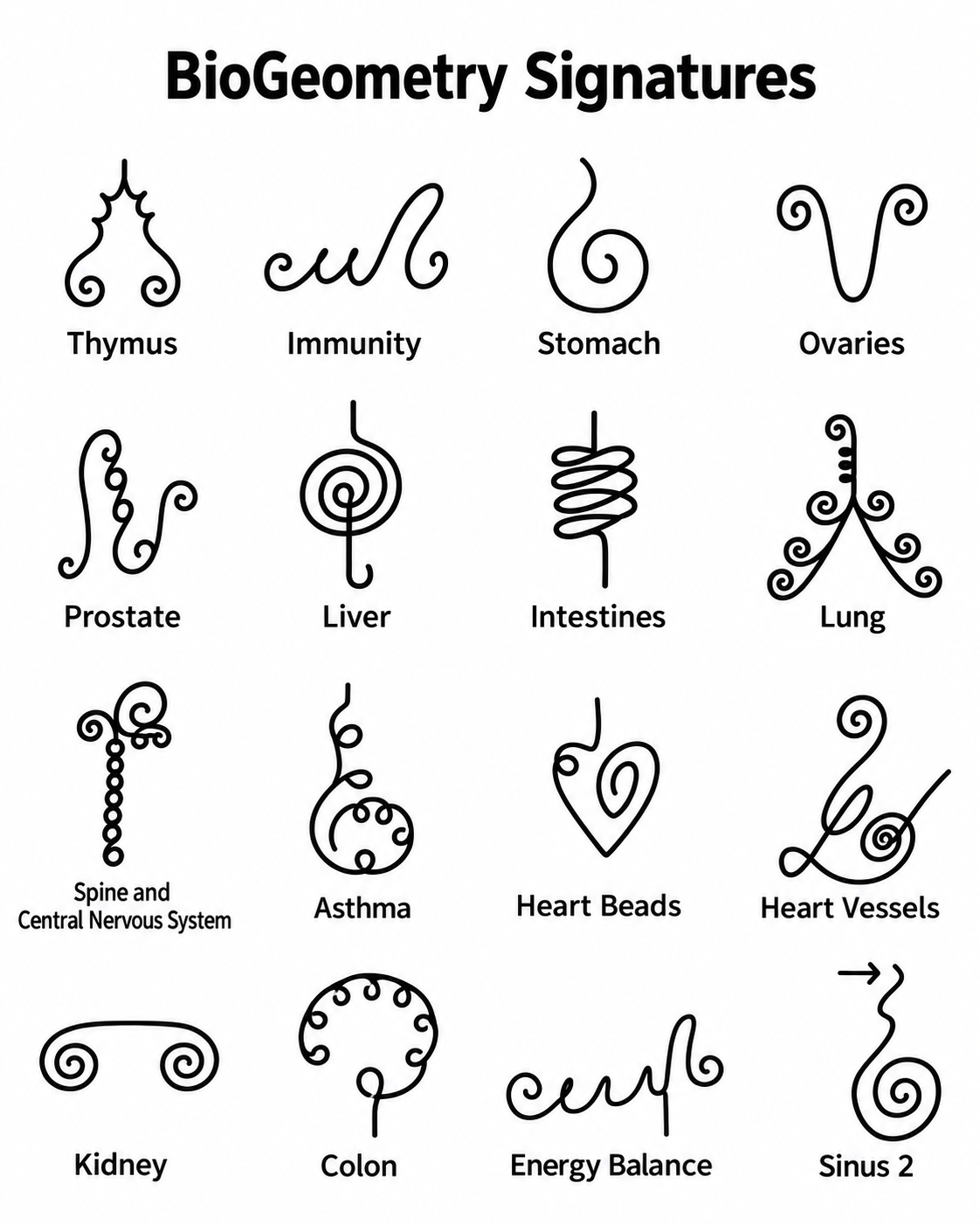
Karim and collaborators investigated that question in settings where the response was not simply someone's opinion of a pleasing picture. BioGeometry's historical account describes Karim chairing a committee at Egypt's National Research Centre in the 1990s to study how geometric forms influenced living systems, including microorganisms. Picture a small culture of living cells, with a specially designed line symbol introduced into the surroundings while researchers observe whether the cells grow or function differently. The BioGeometry account reports changes in biological activity following such geometric interventions. Consider how surprising the subject of this work is: a design that could look like an ordinary doodle was studied as something that might affect a living cell. Karim went on to receive patents and inventor awards for his work. What received this serious attention was not a medicine or a complicated machine, but the idea that a particular arrangement of simple lines could produce a tangible effect in a living system. The practical question could hardly be more direct: can introducing a particular arrangement of lines into an organism's environment change what that organism actually does? [10, 11]
In the Swiss village of Hemberg, residents living near a mobile-phone antenna reported headaches, troubled sleep, and other problems; local accounts also described birds and bats leaving the area. With the involvement of a Swiss mediation authority and Swisscom, Karim's team introduced specially designed BioGeometry symbols near the antenna and in selected homes. The antenna remained in use. The project's report describes residents subsequently reporting better sleep, fewer headaches, and more energy, and it records residents' accounts of birds and bats returning after about a year away. Picture what had changed in the surroundings: small symbolic designs had been added to the places where people lived. The reported changes concerned people's daily functioning and the wildlife observed there, not simply whether residents liked the look of the symbols. [12]
Other BioGeometry projects examined animals and crops. In an Egyptian poultry project the intervention included deliberately placed colors in the chickens' surroundings. The project account reports that chicks reached a body weight of about 1.5 kilograms in 35 days, compared with a cited breed benchmark of 45 days, and describes about a 10 percent improvement in the efficiency with which feed became body weight. Agricultural reports describe changes in apple harvests and pests, and sweet-potato plots with reported yields of 120 to 160 percent of comparison plots, with one plot reaching 190 percent. These interventions were not identical: the work involved line symbols, color placement, and other deliberately designed environmental arrangements. What joins them is the question of whether changing the design of an environment can change the biological functioning of what lives in it. [13, 14]
When the body becomes the arrangement
You can often tell something about your own feelings by noticing the position your body has taken. When overwhelmed, you may curl onto your side with your knees close to your chest. When you feel guarded, you may fold your arms. A nervous leg may bounce under the table; when a tense conversation ends, your shoulders may finally drop. Such positions do not carry the same meaning for every person, but we recognize the larger idea: feelings can find expression in the way the body holds itself. Much of that expression happens before we have deliberately chosen a pose or found the words to explain the feeling.
Our body language also communicates with other people. Anthropologist Ray Birdwhistell estimated that visible bodily cues, including facial expressions, gestures, posture, and movement, convey around 65 to 70 percent of the social meaning in a face-to-face conversation. This estimate concerns the visible body, not tone of voice. [48]
The relationship also runs in the other direction. In one experiment, 74 adults were assigned to sit upright or slumped while preparing for a stressful speaking task. Compared with the slumped group, those sitting upright reported better mood, higher self-esteem, and less fear; the researchers also recorded differences in bodily stress responses and the words participants used while speaking. [42] In another experiment, 61 people experiencing depressive symptoms were asked to sit either upright or in their usual posture during a stressful task. Those assigned the upright position reported more positive emotion and less fatigue, and their posture was associated with changes in how they spoke. [44] An even larger experiment involving 3,878 participants across 19 countries found that deliberately forming a smiling expression could increase or initiate feelings of happiness. [45] Our bodies do not simply display how we already feel. The position of the body and face can also help change the experience from within.
Now consider someone who notices a tight, guarded feeling and instinctively wants to open their arms or lift their head; another person may need to fold inward and feel protected before anything can change. The position may be a physical expression of something the person has not yet consciously understood. When they follow that need, the body gives form to it. A lifted chin might accompany a wish to speak; an open chest might express a readiness to face something; drawing the knees inward might express a need for shelter. These are possibilities to discover from within, not a dictionary assigning one fixed meaning to every gesture. The person feels which position is needed, just as they may feel which arrangement of a room or painting finally expresses them.
This relationship gives us a way into a much older spiritual tradition. In Hinduism, yoga is not simply the stretching routine that many Westerners know from a studio class. It includes paths of spiritual practice directed toward liberation, or moksha: a profound change in how a person understands and experiences existence. People may approach that goal through Karma yoga, the practice of selfless action; Bhakti yoga, love and devotion; Jnana yoga, inquiry and knowledge of the self; or Raja yoga, which emphasizes disciplined attention and meditation. An influential yoga teacher named Patanjali described one path as eight connected practices, often called the eight limbs of yoga. They cover how a person treats others, how they care for their own habits, how they position the body, how they work with the breath, how they turn attention away from distractions, how they concentrate, how they meditate, and how they enter samadhi, a state of deep meditative absorption. The physical-posture practice is called asana. In that larger path, positioning the body is one part of spiritual development rather than the whole of yoga. Different yoga paths emphasize different practices, but they share the aim of spiritual transformation. [46, 47]
Hatha yoga is a tradition that gives particular attention to the body through postures, breath, deliberate hand gestures, and muscular locks as part of spiritual practice. This makes the arrangement of the body especially visible. A practitioner deliberately forms a posture, or asana, with the spine, limbs, and head, holds it while breathing, and attends to what that position brings forward. A forward fold brings the body inward; a backbend opens it; a seated posture changes how the head, spine, and pelvis balance. Different muscles work, breathing feels different, and attention may settle on sensations that were unnoticed before. Smaller arrangements matter too: a mudra gives the hands and fingers a chosen shape, while a bandha is a muscular lock that changes tension within the body. The practitioner is not studying an image from outside: their own body forms the geometry, expresses an internal need, and experiences the result from within.
Traditional Hatha yoga links postures, breathing, bodily locks, and gestures with the movement of prana, the awakening of kundalini, and practices directed toward samadhi and spiritual liberation. [15] Whatever language is used to describe the experience, the striking connection is physical and immediate: a position can express an internal need, change breathing and muscular activity, guide attention toward a sensation, and become part of an energetic or emotional release. The shape of the body can function as a personal symbol that is both expressed and felt, giving a person another way to encounter a truth that has not yet become a sentence.
The many ways spiritual traditions give meaning a form
Across many religions, people have used carefully arranged shapes as part of spiritual practice. In Tibetan Buddhism, a mandala is a picture made for meditation. It can show a sacred place with figures, doorways, and colors arranged in particular positions. A person may study it or imagine moving through it during meditation, and different practices use different mandalas. [16, 17]
In Hindu traditions, a yantra is a geometric design used in worship or contemplation. It may contain points, triangles, circles, and sacred syllables, with each part placed deliberately. Hand gestures also carry particular meanings in Hindu, Buddhist, and Jain traditions. These practices give spiritual ideas a visible or physical form through the way their parts are arranged. [18, 28]
In Diné (Navajo) healing ceremonies, practitioners arrange colored sand into designs connected with sacred stories and chants. Some ceremonies place the person receiving the healing at the center of the sandpainting. They are not simply admiring an image; they are physically situated within a symbolic arrangement used in a practice directed toward a return to hózhó, or balance. [19, 20] Jain cosmological diagrams give visible shape to the structure of existence and the path to spiritual release. Some Christians use a walking labyrinth as a form of prayer, especially at churches or retreat centers. A labyrinth is not a puzzle with wrong turns; it has one winding path leading toward its center. At places such as Chartres Cathedral, worshippers and visitors can walk that path slowly while praying or reflecting. Their movement through a carefully laid-out shape becomes part of the spiritual practice. Ancient Egypt's labyrinth complex at Hawara, described by Herodotus, likewise shows that an intricate built path can be a designed experience, although its historical use need not have been the same as Christian prayer. [21, 22, 23, 43]
The deliberate arrangement can become as large as an entire temple. Hindu temple plans could begin with measured squares and grids that determine the placement of entrances and shrines. At Borobudur in Java, a pilgrim moves upward from square terraces to circular ones, passing many stupas on the way to the summit: the path through the building gives physical shape to spiritual progression. In Islamic art and architecture, carefully constructed stars, polygons, and perforated screens transform the surrounding space through repeated forms and patterned light. In Jewish mysticism, the Tree of Life is a diagram connecting ten sefirot, or ten qualities through which the divine is understood, such as wisdom and understanding. Their positions and the paths between them carry spiritual meaning. In Shinto, a torii is a gateway that marks the entrance to a sacred space. The practices differ, but each gives a role to where things stand in relation to one another, and to where the human body stands within them. [24, 25, 26, 27, 29, 30, 32]
Sometimes the placement was calculated in relation to the sky itself. At Abu Simbel in Egypt, sunlight reaches figures deep inside the sanctuary on two mornings of the year because the passage faces the sun in a particular direction. The Great Pyramid's sides were set remarkably close to the four cardinal directions; proposed methods of achieving that accuracy include careful observations of the sky. At Newgrange in Ireland, the winter-solstice sunrise travels through a narrow opening and lights a chamber at the end of a long passage. Stonehenge frames the midsummer sunrise and midwinter sunset. The building's position was not incidental to the event: change the direction of the passage or stones and the moment of light changes too. [31, 34, 35, 36, 37]
At Chankillo in Peru, thirteen towers along a ridge create a horizon against which sunrise and sunset can be followed through the year, making an astonishingly precise calendar from stone and sky. At the Maya Temple of Kukulcan, seasonal light and shadow create the appearance of a serpent descending the stairway; architectural sightlines at nearby El Caracol are associated with observations of Venus. These structures show how angle, number, position, season, and movement can be designed together so that a person enters a space or arrives at a particular time and encounters a meaningful event. [38, 39, 40]
There is no single religious design in this collection. Some are drawn, some are made of sand, some are formed by a living body, and some require a person to walk through stone passages as the sun moves across the sky. Their diversity matters.
Different people and traditions have given different arrangements to healing, reflection, worship, transformation, and spiritual development. It invites us to consider whether the arrangement that speaks most deeply to a person might depend on the kind of change they are undergoing.
The design that fits the person who is changing
Return to the room that once felt perfect. After a significant period of change, you may walk into it and notice that the furniture now feels wrong, even though nothing has moved. Or you may look at an artwork you once loved because it spoke directly to you, only to find that it no longer says quite the same thing. The work did not lose its quality. You changed, and the things that symbolized your inner life at one stage no longer express the same truth at another. Sometimes even a person you were close to came to symbolize safety, freedom, or a particular chapter in your growth, and that meaning changes as you do. This does not turn another person into an object or a geometric pattern; it illustrates how the meanings we recognize around us can evolve with our lives.
Someone making art can experience this change in real time. The painting that felt right last month may need a different line today. Rather than deciding in advance that a circle, star, or particular proportion must work, the creator follows a felt sense of what belongs. Each choice brings another relationship into view. The exact shapes, their spacing, their balance, their colors, and their symbolic associations gradually become a personal expression. That is why the finished arrangement need not be a small or simple diagram. It could contain many interlocking parts that matter because they speak together, like an entire room that comes to feel right only when the placement of its parts finally fits the person living there.
Sacred Geometry Theory: symbolic organization and the progression of consciousness
Sacred geometry is an idea found in spiritual and religious traditions around the world. It begins with the belief that certain shapes, patterns, and arrangements carry meaning beyond their physical appearance. A circle might represent unity, a symmetrical design might express balance, or the arrangement of a sacred building might reflect a relationship between earthly life and the heavens. People have used such designs in art, architecture, and spiritual practices because of what they believe those designs represent.
The name itself helps explain the idea. Geometry concerns shapes and how their parts fit together, while sacred refers to what is regarded as spiritually significant. In its familiar sense, sacred geometry is geometry considered sacred because of the spiritual meaning expressed through its design.
The experiences and findings explored here invite a broader understanding. Geometry is also a physical arrangement through which meaning can be expressed and felt. It can appear in a drawing, artwork, clothing, a room, an ancient structure, or the position of the body. The first part of Sacred Geometry Theory is that the shapes and arrangements around us, including those we create ourselves, can influence us biologically. Research on spatial enclosure, sharp outlines, symmetry, repeated detail, color, and posture shows that the way things are arranged can alter specific brain responses, bodily reactions, attention, and feeling. Karim's reported BioGeometry experiments extend this question to designed symbols and environments affecting other living systems. [2, 3, 4, 6, 8, 10, 12, 13, 14, 42]
The second part begins where meaning enters the picture. Emotional resonance is the felt recognition that an arrangement expresses something personally true, sometimes before the person could explain that truth in words. The artist who cries on seeing their finished painting gives us a familiar example: symbolic expression can trigger something within the person who creates or encounters it. A personally resonant geometry joins an outer arrangement with an inner truth. In the theory, this match can be more powerful than simple liking or disliking. It is a response to something the person needed to recognize, express, or bring into conscious awareness.
The earlier finding about symmetry matters here for a new reason. Across many religious and spiritual traditions, spiritual development involves finding balance within oneself: bringing conflicting feelings, opposing qualities, or different parts of one's life into harmony. Symmetry is balance expressed through geometry. Its separate parts are arranged in relation to one another so that they form a unified whole. A symmetrical design could therefore become a physical symbol of the balance a person is seeking within themselves. The brain study adds another connection. When researchers increased the number of symmetrical relationships within a pattern, they measured a stronger and earlier response to its symmetry. [4] The arrangement of a design can affect the brain, while its balance can also carry personal spiritual meaning. In Sacred Geometry Theory, a person could express their own developing inner balance through a design whose shapes, colors, proportions, and relationships feel right together. The geometry would not merely depict balance; creating or encountering it could become part of the person's process of finding that balance within themselves.
The geometry would be personal because the truth it expresses is personal. Different individuals do not have to respond to the same diagram; a person's own arrangement could also change as they develop. Some may discover it through making art, others through the way a room is arranged, a symbol they draw, a meaningful built space, or a posture their body seems to need. The act of creation matters as much as the finished image: paying close attention to what feels wrong or right may bring an unconscious truth into view while the arrangement is still taking shape. Once expressed, that truth can return to the creator through what they see or physically feel, deepening the response.
From an emotional release to a different state
A person who begins crying when a painting finally expresses what they have been carrying has already crossed an important line: an arrangement of forms has triggered a recognizable emotional and physical change. Sacred Geometry Theory takes that experience one step further. When a person is nearing a deeper change, a sufficiently resonant design could be one of the things that initiates a new stage in how they experience themselves and the world. It need not be the last step in the process or supply the whole transformation. It could bring something already developing within the person into motion.
Nature offers familiar pictures of what a transition means, though the processes behind them are different. These examples show how an accumulating change can reach a point at which the whole system behaves in a new way:
Water: heating continues gradually until liquid water begins turning into steam. The new state is different from the one that came before.
A magnet: above a certain temperature, its tiny magnetic regions no longer remain ordered in the same way. Crossing that threshold changes the material’s overall magnetic behavior.
A developing organism: a caterpillar transforms inside its chrysalis and emerges as a butterfly. After a period of development, its body and the way it moves through the world have changed dramatically.
A person: something that once spoke to an earlier stage of life may stop resonating after a period of growth. A new symbol, practice, insight, or experience may help bring an emerging way of being into conscious expression.
In this theory, the larger transition is a progression in consciousness. A shift can begin with a newly felt truth, an emotional release, or a change in how the person experiences themselves; deeper progressions can include what spiritual traditions call enlightenment. Enlightenment is not the name for every strong emotion. It names the more far-reaching transformation toward which the theory is directed. A resonant arrangement is sacred because of what its expression can help initiate within someone: not merely a better-looking picture, but a change in the way consciousness experiences and understands itself.
What the theory brings together
Everyday experience: the same room or outfit can feel different when the arrangement changes.
Biology: visual geometry, color, spatial layout, and bodily position can change measurable responses in the brain and body.
Physical environments: Karim’s BioGeometry reports describe line symbols and other deliberately designed interventions associated with changes in microorganisms, animals, crops, and residents’ experiences.
Symbolic expression: making art or arranging a space can give an inner truth a visible form, while a bodily pose can physically express and influence that same inner experience.
Spiritual practice: different cultures have developed different diagrams, sandpaintings, postures, labyrinths, and precisely aligned structures for healing, contemplation, and transformation.
Personal resonance: a design can speak to one person at one stage of life and cease to speak to them after they change; the relevant arrangement is therefore personal and can evolve.
Progression: a sufficiently resonant creation or encounter can initiate an inner change, and Sacred Geometry Theory extends that principle toward major shifts in consciousness and enlightenment.
What begins with the feeling that a chair, an outfit, or a painting finally fits leads to a much larger idea. The shapes and arrangements around us can affect biological functioning; color and bodily posture can change how those forms are experienced; and religious traditions have long used symbolic drawings, gestures, paths, and precisely arranged buildings in practices directed toward spiritual change. As people grow, the design that once spoke to them may no longer express what they are becoming. Through the act of creating, they can discover an inner truth, give it a visible or bodily form, and feel its meaning return to them as an emotional and physical response. Sacred Geometry Theory brings those threads together: a personally resonant arrangement can be one of the things that initiates a change in consciousness, with the ultimate aim of the profound progression called enlightenment. In that theory, the name sacred geometry finally makes sense. It is not sacred merely because its shape is ancient or beautiful; it would be sacred because personal truth, expressed through form and recognized through emotional resonance, catalyzes a change in consciousness - ultimately, a transformation as far-reaching as enlightenment.
Rate This Theory
All ratings are anonymous
Help others by sharing
Comments
(0)AnonymousNo comments yet. Be the first to share your thoughts!
Spiritual theories are speculative frameworks offered for exploration. They are not treatments, and they are not a substitute for the tested methods in the Healing Library.