
The Tree of Life and the Sea of Consciousness
Spiritual Exploration
Spiritual Exploration
The Tree of Life and the Sea of Consciousness
The Infinite Progression Toward Divinity
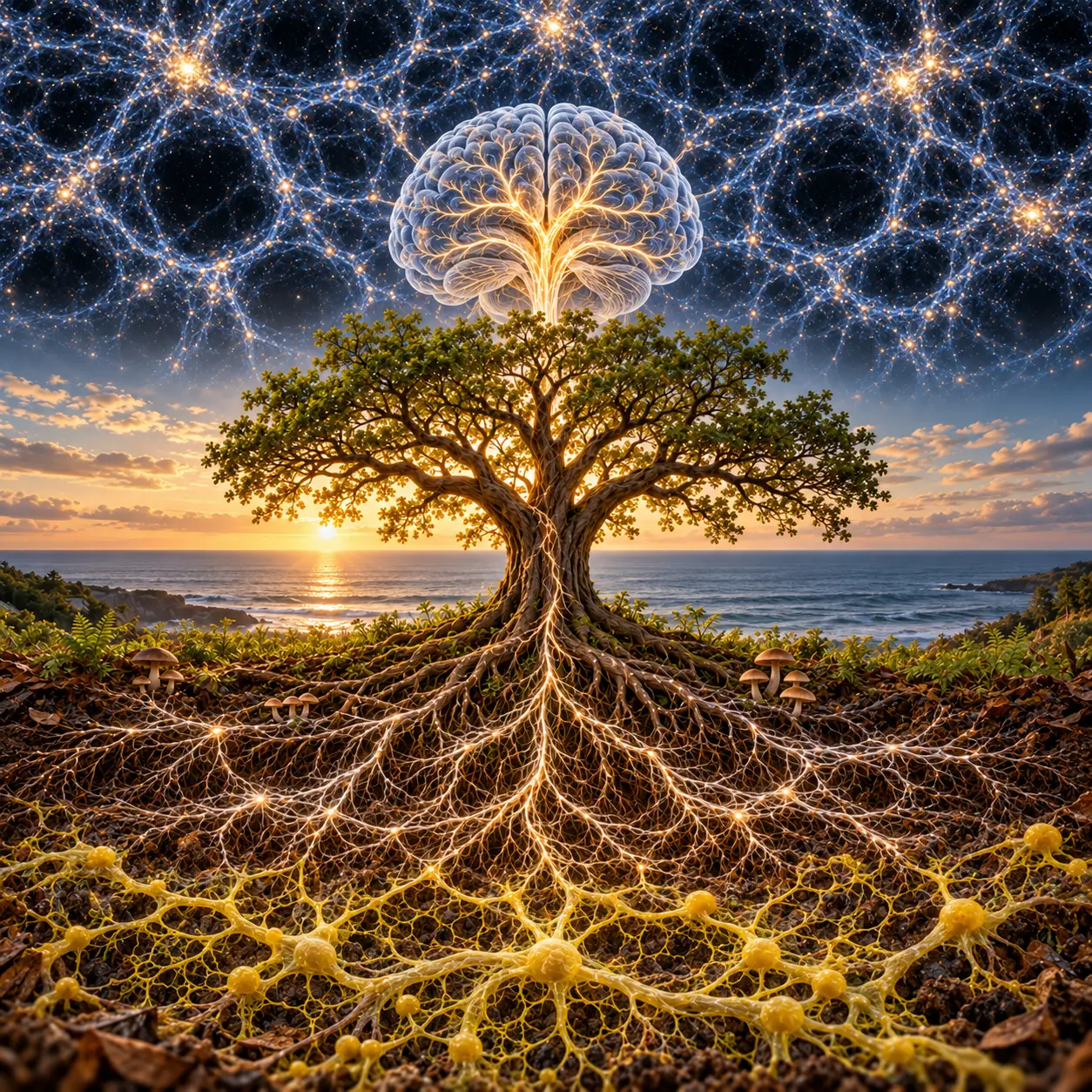
1. The Sea and the Drop
Imagine standing beside the ocean. One wave rises and travels toward the shore while another follows a different course. Each has its own size, shape, and journey, yet neither is made of anything separate from the water around it. A wave is one way the ocean moves.
Now imagine lifting a drop from its surface. The drop has its own shape and location. It might land on a stone, evaporate into the air, gather in a cloud, or fall as rain. Its form and surroundings change, but it remains water throughout its journey. Being an individual drop never requires it to stop belonging to the same underlying substance as the sea.
The ocean is also constantly changing through the movement of its parts. Waves carry disturbances away from where they began, currents move water between distant regions, and whirlpools gather surrounding water into concentrated motion. What happens in one place changes the conditions elsewhere. The ocean has countless distinct movements, yet it remains one connected body of water.
Our bodies give us another example of this relationship. Each cell is a living unit with its own boundary and functions, yet trillions of cells work together to sustain a person. The brain contains specialized cells called neurons, which send signals through branching connections. We experience ourselves as one person rather than as billions of independent cells having unrelated lives. Their combined organization makes possible something that cannot be explained by looking at a single neuron in isolation.
This raises a question about the boundaries of our own experience. Could an individual consciousness be a distinct expression of something larger, just as a wave is a distinct movement of the ocean? Could we each have our own genuine perspective while belonging to a conscious reality that extends beyond us?
Philosophers have explored nearby possibilities. Panpsychism asks whether experience, even in an extremely elementary form, belongs to the fundamental nature of reality. Cosmopsychism asks whether individual minds might arise within a more fundamental consciousness of the universe as a whole. Both invite us to consider whether the limits of one person's awareness are also the limits of consciousness itself. [1]
The ocean gives us a picture of individuality within unity, but a picture alone cannot explain how the relationship works. To understand what might allow distinct parts to contribute to a larger whole, we need to look at what actually happens when living things connect. A remarkable example comes from an organism so simple that it has no brain, yet can build a network, learn from experience, and pass an acquired response to another organism.
2. When Individual Parts Become a Larger System
A living network that changes through experience
A slime mold called Physarum polycephalum can look like a patch of yellow material spreading across a damp surface. During its active growing stage, it is one enormous cell containing many nuclei, the compartments that hold genetic instructions. Instead of moving as a single compact lump, it extends a network of living tubes through its surroundings. Material flows through those tubes, bringing different regions into one connected system.
In 2010, researchers placed food at positions corresponding to cities around Tokyo and allowed the organism to grow between them. The network that formed compared surprisingly well with the Tokyo railway system in transport efficiency, cost, and the ability to keep working when a connection was disrupted. The organism was not imagining a railway. Each region responded to local conditions, and together those responses produced routes useful to the entire network. [2]
The structure tells us something important about the relationship between a part and a whole. No single part needed to know the complete route for the connected organism to produce one. The larger pattern arose through the interaction of its smaller regions.
What happens when that network gains experience? As the slime mold travels, it leaves behind a thin coating that it can later detect. By recognizing areas it has already explored, it can avoid wasting effort on the same unproductive paths. Its previous movement changes the environment, and that change helps guide its future movement. The route is shaped by experience rather than remaining fixed from the beginning. [3]
It can also learn to respond differently to a harmless substance it initially avoids. After repeated encounters, the organism becomes less reluctant to cross it. Researchers demonstrated this change in 2016 and described it as habituation, a form of learning in which a repeated, harmless stimulus produces a weaker response. It resembles the way a familiar background noise gradually stops demanding our attention. [4]
Then researchers asked what would happen if an organism that had learned this response joined one that had never encountered the substance. Slime molds can physically fuse, creating one continuous living system. After remaining connected for sufficient time, the previously untrained organism acquired the learned response and could retain it after separation. [5]
Follow what has happened. A network explored its environment, altered its pathways through experience, learned a response, and then made that acquired response available to another organism when the two became one connected system. The crucial finding is not simply that a creature without a brain can learn. What one part of life acquires through experience can change what a larger integrated system is able to do.
This gives us a physical example of the relationship suggested by the ocean and the drop. An individual journey produces something that can become available beyond the individual. The next question is whether sharing requires two organisms to fuse into one body, or whether separate living parts can coordinate while remaining distinct.
Separate cells working together
Bacteria provide the next example. They are individual cells, but they often live in densely packed communities called biofilms, where cells attach to a surface and to one another. In certain biofilms, scientists found electrical signals moving across the community through potassium ions, which are electrically charged particles involved in regulating cells. These signals help regions separated by many cells coordinate their activity. [6]
The bacteria do not have to merge into one enormous cell. They remain separate, but a signal from one region changes what happens elsewhere. A community can therefore regulate its activity through relationships between its members, rather than relying on a central brain directing them all.
Plants reveal the same principle within a larger body made of many cells. When one leaf is injured, the response need not stay in that leaf. Researchers have observed signals involving glutamate, a chemical messenger, and moving changes in calcium ions, electrically charged particles that help carry information through the plant. Other leaves can then activate defenses before they have been damaged themselves. [7]
The connection to the brain becomes easier to see here. A signal begins in one location and changes activity somewhere else, allowing different regions to respond as parts of one organism. The brain accomplishes extraordinarily more complex tasks with its neurons, but the basic idea of distant parts sharing information and coordinating a response extends beyond animals with nervous systems.
This brings us to a larger question. We can understand a plant as one body, but could a living network also extend across the boundaries of separate organisms?
A forest has connections we cannot see from above
Walk through a forest and each tree appears to stand on its own. Beneath the soil, however, fungi grow fine threads called hyphae. Together these threads form networks known as mycelium. Through relationships called mycorrhizae, fungi connect with plant roots and exchange resources with them. A fungal network can link more than one plant, creating physical pathways across the apparent boundaries of individual trees.
What difference can that underground network make to the trees themselves? Imagine two plants growing beside each other, with one receiving more sunlight than the other. Sunlight lets a plant make sugars from carbon dioxide, and those carbon-rich substances help it build new tissue and fuel its life. The plant in the shade cannot make as much of this material on its own. If resources can move between neighboring plants, the conditions experienced by one plant can affect what is available to another.
Forest ecologist Suzanne Simard and colleagues followed this movement in a field study of paper birch and Douglas fir. They used specially marked carbon atoms so they could track where material produced by one tree went. Carbon moved in both directions, but the Douglas fir seedlings gained more from neighboring birch than they gave back. Their average net gain was equivalent to about 6% of the labelled carbon they took up through photosynthesis, and the amount changed with the firs' level of shade. Evidence from a third tree species helped the researchers identify fungal connections as the main route. The documentary Intelligent Trees, featuring Simard and forester Peter Wohlleben, makes these hidden relationships easier to picture. [8]
The finding changes the way we see a forest. The resources available to a tree need not be determined entirely by the sunlight reaching its own leaves or the soil touched by its own roots. Its development can be influenced by what other organisms produce and transfer through a shared network. An apparently separate tree participates in a larger biological system, and the connections between its members can change what each is able to sustain.
We began with a slime mold in which learning could become available through physical fusion. Bacteria then showed how separate cells coordinate without merging, and plants showed how a local event can change the response of a whole organism. The forest adds the next step: the boundaries of one living body do not necessarily mark the boundaries of the network that helps sustain it. Connections can extend between organisms, allowing what happens in one life to matter to another.
Now imagine stepping back so far that the entire forest, the Earth, and even our galaxy disappear into the distance. The branching pattern appears again.
The pattern returns at the largest scale
Galaxies gather into clusters and long connecting strands, with immense regions of comparatively empty space between them. Astronomers call this enormous structure the cosmic web. Much of the matter shaping it is dark matter, material whose presence is detected through its gravitational effects rather than ordinary visible light.
In 2020, astrophysicist Franco Vazza and neurosurgeon Alberto Feletti compared measurable features of the cosmic web with networks of neurons. They found similarities in aspects of their spatial distribution and organization. [9]
That same year, astronomers used an algorithm inspired by slime-mold growth to investigate the cosmic web. Given the positions of about 37,000 galaxies, the method produced a three-dimensional model of possible connecting filaments. Observations from the Hubble Space Telescope were then used to study gas associated with the predicted structure. The way a tiny organism builds a network had become a useful mathematical guide to the structure of the universe. [10]
Imagine a tree drawn on paper. Its branches appear to spread left and right, but the real tree extends toward you, away from you, and in directions hidden from a single viewpoint. The network of a slime mold, the connections of a brain, the living relationships of a forest, and the cosmic web all make more sense when pictured as three-dimensional systems whose pathways develop and interact.
The important recurring feature is not merely a similar silhouette. Connections allow individual regions to affect a larger organization, and the organization changes what becomes possible for its parts. We already experience one such relationship personally: countless neurons contribute to the experience of being one person. The possibility that consciousness may be expressed through successively larger organizations becomes easier to imagine once we have seen how nature repeatedly builds them.
What makes this resemblance more intriguing is that even these vastly different structures are made from the same basic kinds of matter. Their shapes and their scales differ, but the closer we look at what makes them, the more the image of the ocean returns, this time through physics rather than biology.
3. The Sea Beneath Matter
Press your hand against a table. It feels as though two solid surfaces are meeting, each made of material packed so tightly that nothing can pass through. But imagine enlarging just one atom of the table until it fills an entire room. Almost all its mass would be gathered in a center smaller than a grain of dust, called the nucleus. The electrons around it would not be little solid pieces filling the rest of the room. Quantum physics describes them through states spread across the much larger surrounding region. The atom that seemed solid from the outside is nothing like the densely filled object we imagined. [11]
Why, then, does your hand stop at the table? Think of the resistance you can feel when you bring the matching ends of two magnets together. Something can push back without a visible wall standing between the objects. In the table, electrical interactions and quantum rules governing electrons prevent the atoms in your hand and the wood from being forced into the same arrangement. Its solidity is real, but it comes from the way matter interacts, not from an interior packed with tiny solid pieces. [11]
Imagine dropping a pebble into a perfectly still pond. Circular ripples spread outward across its surface, each carrying energy through the water. Because we are watching from above, we see the movement across a relatively flat, two-dimensional surface.
Now imagine that a similar disturbance could extend in every direction, not merely outward across a surface but upward, downward, forward, and backward through the space surrounding us. Rather than a circle expanding across a pond, we could picture an expanding sphere of activity.
This brings us closer to how physicists describe the underlying structure of matter. A field extends throughout three-dimensional space and can have different values and activity at different locations. Quantum field theory describes fundamental particles as excitations, or ripples, within these fields. An electron is an excitation of the electron field, while a particle of light, called a photon, is an excitation of the electromagnetic field. [11]
These fields overlap and interact, and their excitations give rise to the matter, light, and physical interactions that make up the world we experience. What appears to us as a universe filled with separate, solid objects is therefore something far more dynamic beneath its familiar appearance. [11]
This brings the ocean metaphor full circle. The reality we experience is not simply a collection of independent objects occupying empty space. Beneath their apparent separation lies an interacting physical reality whose distinct forms arise through patterns of wave-like activity.
And that opens the central question: if what appears physically separate arises within a more fundamental, interconnected reality, could our seemingly separate experiences of consciousness also be individual expressions of a greater whole?
The diversity of those expressions depends on the forms matter can take. To understand how the universe gathers matter into structures capable of sustaining further development, we can follow the currents that shape its movement: gravity.
4. The Currents and the Memory of Nature
Gravity changes where the universe can flow
Water follows the shape of the land, but over time it can also carve channels that alter where later water travels. What is already there shapes the route, and movement changes the conditions for what comes next.
Einstein's theory of general relativity describes space and time together as spacetime. Matter and energy affect the geometry of spacetime, and that geometry influences how matter and light travel. As matter gathers into new structures, the gravitational conditions around it also change.
This means gravity does more than pull existing objects toward one another. It continually influences the paths along which the universe develops. Across enormous spans of time, these relationships help form the clusters and filaments of the cosmic web. Gravity shapes the currents of the sea, and the material moving through those currents helps reshape them.
Gravity helps matter gather and creates pathways along which the universe develops. But the formation of a pathway is only part of the story. For a new kind of structure to develop from what came before it, the conditions must also allow that structure to hold together long enough for something further to grow from it.
Stability makes the next stage possible
Before a house can support another floor, the structure beneath it must be strong enough to hold what comes next. Nature also develops through changes that make new kinds of organization possible.
For hundreds of thousands of years after the Big Bang, the universe was too hot for electrons to remain bound to atomic nuclei. As it expanded and cooled, neutral atoms could form, and light could move much more freely through space. This transition occurred about 380,000 years after the Big Bang. [12]
The significance is not that every system must become electrically neutral. Rather, a new stage becomes possible when conditions allow its structure to remain coherent. A living cell needs to maintain the internal conditions that support its activity. A relationship needs enough stability to endure difficulty. A person needs enough inner coherence to bring conflicting experiences together and understand them.
Stability and change work together. A system preserves enough of its organization to remain itself while changing enough to develop. But if what develops in one system matters to what comes afterward, can nature retain patterns beyond an individual memory or physical trace?
Could nature remember its earlier forms?
Imagine people repeatedly crossing the same patch of ground. At first there is no path, but each journey changes the grass and soil until the route becomes easier for the next person to follow. The earlier journeys have altered the conditions for later ones.
Biologist Rupert Sheldrake proposed a much wider possibility called morphic resonance. His hypothesis suggests that similar self-organizing systems may be influenced by patterns established by previous similar systems across space and time. Repetition may make a familiar pattern easier to express again, as though nature carries a memory of its earlier forms. [13]
The proposal becomes more interesting when we examine what researchers actually found. A crystal is a repeating arrangement of atoms or molecules, like a wall built from the same brick pattern. Melting point is the temperature at which a solid melts. Sheldrake examined historical chemical records to ask whether the reported melting points of relatively new crystalline compounds changed after those compounds had been made repeatedly. He found, for example, that saccharin was reported at 220°C in 1902 and 229°C in 1996, while phenolphthalein rose from a reported 252°C in 1907 to 262°C in 1989. The newer compound 18-crown-6 was reported at 39°C in its early records and 45°C in 1989. He then arranged independent measurements of forty contemporary chemical samples at Imperial College; these generally agreed with their listed values to within one or two degrees. [13]
His interpretation was that repeatedly forming a crystal may strengthen its organizing pattern, allowing later examples to become more stable. Historical records do not control every difference in purity, crystal form, or measurement practice, so the values establish the reported changes rather than their underlying cause. The important question they make concrete is whether repetition might leave a lasting influence on how matter organizes itself.
An even closer connection to learning appears in a series of rat experiments, begun long before Sheldrake proposed morphic resonance. Starting in 1920, William McDougall trained white rats to escape a water tank by choosing an unlit exit rather than a brightly lit exit associated with an electric shock. Across thirty-two generations, the average number of wrong choices fell from more than 56 in the first eight generations to about 20 in the final eight. McDougall initially explored whether acquired learning could be inherited by offspring. [14]
The experiment was investigated again in different laboratories. At Melbourne University, W. E. Agar and colleagues followed fifty generations over approximately twenty years and observed extended periods of improved learning not only among descendants of trained rats but also among descendants of rats whose parents had not undergone the training. Their final report noted that the improvement was not sustained. An earlier eighteen-generation study in Edinburgh did not show a systematic improvement. These differences are part of the actual experimental record. Sheldrake later drew attention to the improvement in untrained lines because it raises the possibility that learning patterns could become more accessible beyond direct parental training. [14]
Sheldrake and Pamela Smart also tested a different kind of connection between separate people. A participant knew four possible callers, and the experimenter randomly selected one to telephone. The participant had to identify the caller before answering. Random guessing should produce 25% correct answers; across 271 videotaped trials, participants correctly identified 122 callers, or 45%. In trials involving familiar callers the reported success rate was 61%, compared with 20% for unfamiliar callers. This work asks whether established relationships can involve forms of information exchange beyond the ordinary cues available to the person receiving the call. [15]
The three lines of investigation approach the question from different directions: physical patterns, learned behavior across generations, and information associated with relationships. Their reported findings do not all test the same mechanism, but they show why the idea of memory extending beyond one individual system deserves a substantive explanation rather than a passing mention. We have already seen learning carried through direct fusion in a slime mold and resources moving between trees through shared connections. Morphic resonance asks whether an additional continuity might exist even when such an ordinary pathway is absent.
If the larger reality retains patterns through its individual expressions, the sea would not simply produce new waves. What those waves experienced could influence the conditions in which later waves develop.
This gives the image of a growing tree a deeper meaning. Its branches need not be only different directions of movement; their experiences may contribute to the development of something larger than any one branch.
5. The Two Trees of Life
The tree of possible experience
Look at a tree from one side and its branches form what seems like a flat picture. Walk around it and entirely different branches come into view. Its roots extend into directions hidden below the soil, while its branches spread outward into the space around it. What we see from one angle is only one view of a larger living structure.
Our lives also develop through possibilities that branch. A conversation changes a relationship, a realization changes a decision, and that decision affects the experiences we encounter next. Each path creates conditions for further development, much as every new branch changes where the tree can grow.
Think of an ordinary moment when your life could go in two directions. Someone invites you somewhere, and you can say yes or no. If you go, you may meet someone, hear something, or encounter an experience that changes what happens next. If you stay home, another sequence of events unfolds. Now imagine that both versions continue to exist. Each reaches further moments with different possible outcomes, and each of those paths branches again. Instead of one straight line extending from the past into the future, reality begins to resemble an enormous tree, with countless versions of events unfolding at the same time.
The earlier ocean image showed how particles can arise as ripples in underlying fields. Now another question about quantum reality gives the branches of the tree a different meaning: when several physical outcomes are possible, what becomes of the outcomes we do not experience? In the many-worlds interpretation, the larger quantum state continues to contain the different outcomes as branches of one reality, rather than preserving only the outcome witnessed by one observer. A person in each branch experiences one continuous history, unaware of the other versions. The branching arises from quantum processes; imagining an everyday choice simply helps us grasp what different histories might mean for an entire life. [16]
From the perspective of one leaf, there is only its own branch and the world visible around it. From the perspective of the whole tree, there are countless branches developing simultaneously, each carrying a different history. The sea can now be pictured as the underlying expanse of possibilities, while the tree gives those possibilities different paths through which they are experienced. One life reveals only a part of what the larger reality may contain.
Think of a radio in a room. Several broadcasts may be present around it, yet you hear only the station to which the receiver is tuned. Turning the dial does not create the other music; it changes which existing signal becomes accessible. In a similar way, ordinary awareness may be tuned to one experienced path while other possibilities remain beyond its reach. The further spiritual possibility is that consciousness could learn to tune beyond its familiar perspective and gain access to other patterns already present in the sea. This is an extension of the branching picture, not a demonstrated way of moving between quantum worlds. It gives the distinction between a larger reality and our limited experience of it a form we can imagine.
The larger Self and its branches
Imagine meeting yourself at ten years old. Your younger self knows things you may have forgotten, while you understand experiences that younger version has yet to encounter. The two perspectives are distinct, but they belong to one developing life.
Atemporal Learning Self Theory extends this relationship beyond the ordinary sequence of earlier and later. Different developmental states may be connected within a larger Self. Earlier states contribute the experiences from which later states grow, while later states may also influence earlier ones. The pattern may extend beyond one biological lifetime through recurring archetypes, recognizable arrangements of values, tendencies, strengths, and challenges expressed through different people.
Now return to the many-worlds picture and the radio that reveals only one station at a time. Imagine different versions of a life unfolding along different branches. In one, a relationship changes everything; in another, the encounter never happens. One version reaches a realization early, while another arrives at it through entirely different circumstances. Each experiences another part of what the sea contains. The larger Self could encompass those perspectives rather than being only one older version of us at the end of a single lifetime. If consciousness can widen its access and integrate what its different expressions learn, the whole could come to recognize more of itself than any individual branch can reveal alone.
Yet this tree is not meant to branch forever within the same state. As its different paths develop, their experiences become part of an increasingly complete understanding. At a threshold of integration, that accumulated learning culminates in a burst of transformation: a new, larger state of consciousness emerges, capable of encompassing the development of the entire preceding tree. This new state becomes the seed of another tree, whose branches begin exploring possibilities that did not exist at the previous level.
Each possible path is therefore more than an alternate ending. It is a distinct experience through which consciousness discovers another aspect of itself. The repeated movement from branching experience to integration and a new state of consciousness is the Ouroboros. Yet gathering more experience does not automatically create a new, stable state. The different parts must also become capable of belonging to one whole.
The Kabbalistic Tree of Life: A path toward divinity
Think of someone who gives everything to others but cannot protect their own needs. Now imagine someone who protects themselves so completely that nobody can get close. One has developed generosity, the other restraint, yet neither can sustain the full experience of love until both qualities become part of the same person. Their growth depends not on becoming more generous or more guarded, but on bringing what appears to be opposite into balance.
We have encountered a physical version of this need for stability. In the early universe, extreme heat prevented electrons from remaining bound to atomic nuclei. Only when conditions changed could neutral atoms persist, creating possibilities for further physical development. The next stage needed a form that could hold together. Inner development has its own version of this requirement: a person cannot build a more inclusive understanding of themselves while remaining at war with the very feelings, needs, and experiences that understanding must contain.
Kabbalah, a tradition of Jewish mysticism, approaches the relationship between human life and God through a Tree of Life containing ten interconnected sefirot, or divine attributes. Its spiritual tradition includes devekut, often translated as cleaving to God or communion with the divine. The Tree is therefore connected to a path of spiritual transformation, not simply a diagram of choices. [17]
Three of its sefirot illuminate the importance of balance. Chesed is associated with lovingkindness and generosity; Gevurah with strength, limits, and restraint; and Tiferet with the harmony that brings these qualities into relationship. A person learning to love needs both the openness to embrace others and the steadiness to remain themselves. When those qualities support rather than oppose each other, a more complete way of being becomes possible. [17]
In Jewish mysticism, the divine refers to God. In the larger vision developed here, divinity means the progressively unified consciousness of the whole: one being coming to recognize, understand, and love every expression of itself. Because each individual is part of that being, rejecting some of its expressions would leave the whole divided. Love allows those parts to be welcomed without erasing what makes each of them distinct. That is why the growth of consciousness and progression toward divinity are the same movement.
The Kabbalistic Tree of Life gives this progression its essential inner condition. Just as the early universe needed a sufficiently stable physical organization before new structures could emerge, consciousness needs enough balance to hold what its many branches have learned. Love of self preserves each expression; love of others allows the greater Self to include the rest. Their integration creates the coherence needed for the next, larger state of consciousness to emerge.
The natural Tree of Life shows the paths through which consciousness encounters itself, while the Kabbalistic Tree shows why the integration of those experiences is a spiritual development rather than mere accumulation. When what was separate can finally belong to one understanding, growth may reach a threshold where something entirely new becomes possible.
6. Compression, Illumination, and the Cosmic Ouroboros
When experience creates pressure on an old understanding
Imagine trying to understand something important about yourself. An argument leaves you troubled, a relationship reveals a familiar reaction, and another experience challenges a belief you have carried for years. At first the events seem unrelated. You try to understand each one separately, but the same difficulty keeps returning. The more experiences accumulate, the harder it becomes to fit them into your old explanation.
Then a connection becomes clear. Suddenly, the experiences tell one story, and what once felt confusing becomes understandable. The insight may arrive in a moment even though everything that prepared it took years.
Researchers call this the aha moment, or sudden insight. In a 2004 experiment involving verbal problems, participants who reported insight showed a brief burst of high-frequency brain activity shortly before indicating that they had found a solution. Their understanding became conscious suddenly after a longer period of processing information. [18]
This offers a way to picture the compression of the self. Previously separated experiences press against an understanding that can no longer contain them. As the experiences are brought together, pressure builds on the old way of seeing oneself until a new pattern becomes visible. That recognition can feel like a burst of clarity, because the person is no longer trying to hold together explanations that conflict. What changes is not merely how much they know, but the way their experiences are organized and understood.
The tree follows the same proposed progression. Its branches explore different possibilities and gather different experiences. When their development becomes integrated, the preceding state provides the conditions for a transformation into a more inclusive consciousness. The new state becomes the seed of another tree rather than simply another branch of the old one.
The extraordinary light around a black hole
Now picture an enormous amount of material moving toward a black hole. A black hole is a region of such extreme gravity that light cannot escape once it passes a boundary called the event horizon. Material approaching an actively feeding black hole often circles around it in a rotating accretion disk, a gathering of gas spiraling inward.
As the gas moves inward, gravitational energy is converted into heat. The crowded, compressed material can become so hot that it releases extraordinary amounts of light. Some active black-hole systems are called quasars, and their surrounding disks can shine more brightly than all the stars of their host galaxies. The black hole itself is dark; the brilliance comes from the material being drawn toward it. [19]
This is the connection to development: under intense gravitational pressure, matter gathers, heats, and illuminates its surroundings. The light is an outward expression of the physical processes taking place as material concentrates. What was moving inward becomes visible through an extraordinary release of energy.
Our inner experiences can follow a recognizable pattern. Events that remained separate for years begin pressing against an old understanding of the self. As they come together, the pressure exposes what that understanding could never explain, and a sudden insight illuminates the connection between them. The burst of clarity marks a transformation: the person can now live from an understanding that was unavailable before.
The physical process around a black hole and the experience of insight are different, but the image reveals why compression matters to the proposed progression: pressure can precede illumination, and illumination can accompany the emergence of a new state. Enlightenment, in this picture, unfolds through successive integrations of experience, sometimes culminating in bursts of understanding that become the foundation for the next stage of development.
Could one universe begin another?
The brilliant activity around a feeding black hole leads to another question: could a region of extraordinary concentration also mark the beginning of another cosmic cycle?
Think of a seed. It does not contain a finished tree hidden inside it, but it carries the beginnings of a new organism. The new tree develops through different circumstances while retaining a relationship to the one that came before.
Physicist Lee Smolin explored a speculative model called cosmological natural selection, in which black holes could give rise to descendant universes whose physical characteristics are related to those of their parent universes. Under this picture, a universe develops stars and black holes, and some black holes may begin new cosmic environments. [20]
Follow the larger movement. A universe emerges and expands. As it cools, stable physical structures become possible, and gravity shapes matter into stars, galaxies, and the cosmic web. Some regions eventually develop black holes. If black holes can give rise to descendant universes, extreme concentration may become the beginning of another cycle of physical development.
For that cycle to represent learning rather than simple repetition, something must carry forward. Smolin's model considers inherited physical properties. If the conscious sea is more fundamental than any one universe, the experiences of one cosmic cycle might contribute to a larger continuity of development. The physical possibility of descendant universes and the proposed continuity of conscious learning are distinct parts of this larger picture.
The Ouroboros, the ancient image of a serpent forming a circle by taking its own tail into its mouth, symbolizes this recurring movement. Each tree explores possibilities through its branches, reaches a threshold through integration, and gives rise to a new state. That state becomes the beginning of a larger tree. Consciousness moves through the infinite sea not by extending one tree forever, but through successive transformations that open possibilities unavailable before.
7. Love and the Development of the Whole
Think of a part of yourself you once refused to acknowledge: a feeling, a need, or a memory that did not fit your understanding of who you were. Ignoring it might have kept it out of view, but it remained part of your experience. When you finally recognized it, you did not become a different person by throwing that part away; you became more able to understand yourself as a whole.
Now extend that relationship to the ocean. If every individual consciousness is an expression of one larger being, each life encounters something the others cannot. Their differences are how the greater Self explores its own possibilities. To exclude another expression is therefore to exclude something belonging to the same larger reality, leaving its understanding of itself incomplete.
Love is the means of overcoming that division. Love of self gives each perspective the stability to remain distinct, while love of others allows those different perspectives to be recognized as belonging to one whole. The greater being becomes more inclusive not by absorbing its individual expressions until their differences vanish, but by coming to know and love those differences as parts of itself.
Every experience that can be integrated expands what the whole is able to recognize. As more of its expressions come into relationship, the larger consciousness develops the coherence required to sustain another state. That state begins a new tree, whose branches encounter possibilities that the previous one could not reach. The movement toward divinity is therefore a recurring process of self-discovery through love, not a destination reached after learning is finished.
Conclusion: The Infinite Sea of Consciousness
What appears separate can belong to a far larger reality. A slime mold's acquired response can pass through physical integration, trees exchange resources across their individual boundaries, and the interactions of countless neurons sustain one person's experience. Even the apparently solid matter making up these systems is described at its foundations through ripples in fields extending across space, while gravity shapes that matter into the branching cosmic web. The ocean image now connects two observations: recognizable forms arise within an underlying reality, and the relationships among those forms change what the larger system can become. What if individual consciousnesses are expressions of a greater being learning through them?
Imagine each life as a branch of a tree growing within an infinite sea whose possibilities extend beyond the one path we can ordinarily experience. Every branch explores possibilities the others cannot, allowing the larger Self to encounter more of itself. As that learning becomes integrated, the tree approaches a threshold: a burst of transformation gives rise to a new, more inclusive state of consciousness. This state becomes the seed of another tree, and the process begins again at a level previously unavailable. Consciousness is this progression through the infinite sea, each tree growing through its branches and giving rise to the next.
If all those branches belong to one being, rejecting any expression means remaining divided from part of oneself. Love of self preserves each individual's distinctness; love of others allows the whole to recognize those differences as its own. This is why love is the nature of divinity, rather than something added to it. The balance described by the Kabbalistic Tree of Life gives that integration the stability needed for further growth: as consciousness becomes capable of embracing more of itself, it progresses into a larger, divine state.
Personal insight lets us recognize this movement within ourselves. Experiences once held apart can gather under pressure until a moment of illumination changes what we understand. The extraordinary light around some feeding black holes offers a cosmic image of concentration and release, while the possibility of descendant universes extends the image of one beginning becoming another.
If every consciousness is an expression of one greater being, then healing is the process through which that being comes to understand and love the parts of itself that were previously divided. Each act of integration makes a more complete state of consciousness possible, until everything learned through its individual expressions gives rise to something greater. The infinite sea is not searching for something outside itself. It is discovering what it has always contained, one experience, one realization, and one transformation at a time.
Rate This Theory
All ratings are anonymous
Help others by sharing
Comments
(0)AnonymousNo comments yet. Be the first to share your thoughts!
Spiritual theories are speculative frameworks offered for exploration. They are not treatments, and they are not a substitute for the tested methods in the Healing Library.