
The Spiritual Purpose of Pets
Spiritual Exploration
Spiritual Exploration
The Spiritual Purpose of Pets
Love, Symbolism, and the Evolution of Consciousness
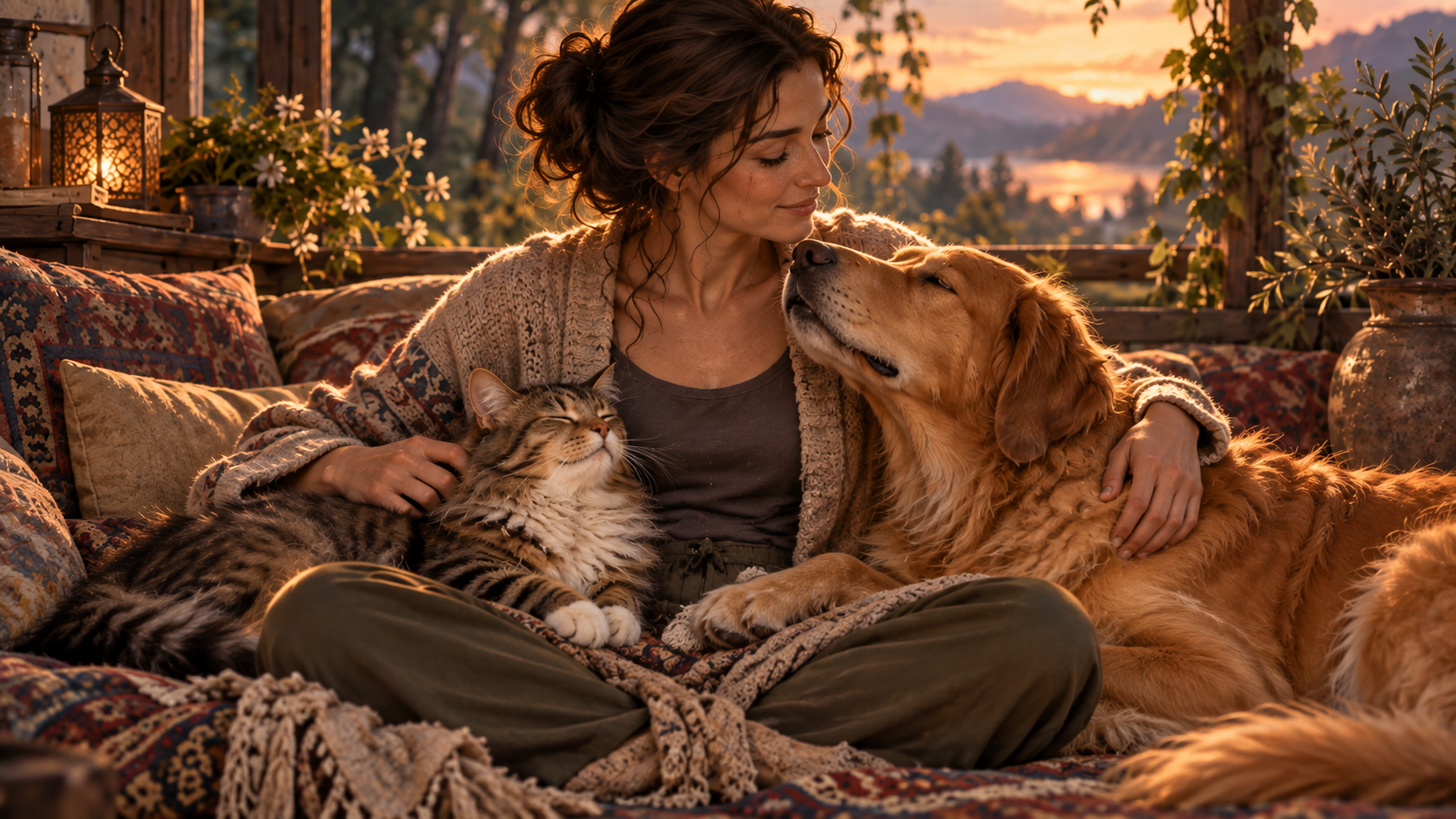
People will often make room in their lives for an animal in ways they would never make room for an object. They get up in the middle of the night when it is frightened, arrange their day around its needs, learn the difference between its ordinary sounds, and sometimes recognize that something is wrong before they could explain how they know. A cat can spend hours elsewhere in the house and still be missed. A dog can greet someone who has only been gone for ten minutes as though the reunion matters enormously. The animals are different, but neither relationship feels quite like possession. Something has happened between two living beings.
Companionship is the familiar explanation. Yet companionship describes what the relationship gives us more readily than what living inside it asks of us. The animal cannot explain an uncomfortable feeling in words, agree with our reasons for being busy, or promise that its next action will make emotional sense to us. We have to learn its way of expressing itself, and it has to learn ours. More importantly, the two of us do not stop being separate beings simply because we love one another. A person may want affection when a cat wants quiet; a dog may need attention when the person would prefer to remain alone. The relationship works only when another life becomes real enough to influence our own behavior.
Imagine two doors opening into the same home. One opens inward and gives us somewhere secure to stand; the other opens outward and lets us welcome someone else. A home needs both, even though we do not always use both doors equally. Love appears to have something like these two directions. It can be directed toward the person experiencing it, through self-acceptance, self-respect, and the freedom to remain oneself. It can also move outward, through compassionate attention and unconditional care for another being. At first, those abilities seem as though they should arrive together, but psychological research suggests they can develop at very different rates.
The Spiritual Purpose of Pets Theory explores the possibility that the animals with whom people form their closest bonds are living symbols of these directions. A symbol is something familiar that helps us recognize a larger idea, much as a picture of a heart can communicate affection without being an actual human heart. The deeper claim is not that every member of a species behaves alike or consciously arrives with a lesson to deliver. It is that different ways of relating may make different principles of love easier to recognize, and that the animal toward which a person naturally gravitates may reveal something about the direction in which their existing strengths can grow. Before deciding what particular animals might represent, however, it helps to see what science already knows about the bonds themselves.
1. When Another Animal Becomes Someone We Depend On
Consider a child trying something unfamiliar while a trusted adult is nearby. The adult may not solve the problem, but simply knowing that help is available can make it easier for the child to explore. Researchers call that person a secure base: a familiar source of safety from which someone can move into the world. An attachment bond is the lasting relationship that makes this kind of safety possible, and it is not limited to affection or the enjoyment of company. The presence of a particular being changes what we feel able to do.
Researchers found a remarkably similar pattern in dogs. Horn and colleagues (2013) gave dogs a food-related problem to work on while changing who was in the room. The dogs spent more time working when their owners were present, whether the owners encouraged them or remained silent. An unfamiliar person did not produce the same increase. The person mattered not because they provided instructions, but because the dog had a relationship with them. The result makes the bond visible in behavior: the animal was more willing to engage with an uncertain task when its familiar human was there.
Cats have sometimes been described as animals that merely tolerate human company, but an experiment by Vitale and colleagues (2019) gives a more complicated picture. The researchers adapted an attachment test originally used with young children, observing how cats responded when their caregiver left and returned. They found distinct patterns of secure and insecure attachment in cats, including cats that used their human as a source of security. A cat's independence therefore does not establish an absence of love or attachment. It shows that an attachment can exist without requiring constant togetherness, just as a close human relationship does not stop existing whenever two people are in separate rooms.
Both findings change the starting question. If animals themselves behave differently because of the relationship, a pet is not simply a blank surface upon which the human imagines meaning. The animal is a participant. Its nature, history, preferences, and responses help create the particular relationship that the human experiences, which is why different animals may offer different ways of encountering love.
2. The Relationship Reaches the Body
People know what it feels like to enter a room and become calmer because someone they trust is there. They may not have chosen to relax, and the other person may not have said anything. Their breathing slows, their muscles loosen, or an upsetting experience becomes easier to bear. Scientists call this regulation when the body's systems adjust toward a more manageable state; when two beings help influence one another's states, the process can be described as co-regulation. Pets can take part in that process as well.
An especially clear experiment examined what happened when dogs and their owners looked at one another. Nagasawa and colleagues (2015) measured oxytocin, a chemical messenger involved in several kinds of social bonding. A messenger like this is not a magical ingredient that produces love on its own; it is one part of the body's complicated way of supporting attachment. Longer mutual gazing was associated with increased oxytocin in the owners, followed by more affectionate interaction and increased oxytocin in the dogs. The researchers also found evidence that giving oxytocin to dogs could increase their gazing behavior, which was linked to a rise in their owners' oxytocin. In their tested comparison, the same gaze-related pattern was not seen with wolves and their human carers. The important point is that an ordinary moment of connection could participate in a measurable two-way biological process.
Another study approached the relationship through stress rather than affection. Sundman and colleagues (2019) measured cortisol in the hair of dogs and their owners. Cortisol is a hormone involved in the body's stress response, and its accumulation in hair can provide a picture of stress exposure over several months rather than at a single moment. The researchers discovered that dogs and their owners tended to have similar long-term cortisol patterns. This suggests that when an owner experiences prolonged stress, their dog may experience it too. Although the study could not establish exactly how much of this influence traveled from the human to the dog, since both also share an environment, it reveals something important about their relationship: our emotional difficulties may not remain entirely our own. The anxiety we carry into our interactions with our pets may affect them as well, just as their emotional states can affect us.
A 2026 review by Bargigli and colleagues then examined 37 studies in which researchers measured humans and their animals at the same time, principally dogs and horses. Sixteen found significant evidence that physiological changes were linked, another sixteen found partial evidence, and five found none. These links were more consistently detected in studies that followed the changing signals across time, but the studies were too different to conclude that every person and animal become biologically synchronized. The finding is more useful when stated carefully: a relationship across species can sometimes be observed as coordination between bodies, and the conditions under which it happens remain worth investigating.
3. Two Species, Two Ways of Meeting Us
A relationship is shaped not only by the strength of a bond but by the way each participant approaches the other. Think about how different conversation feels with someone who enjoys sitting quietly beside you and someone who eagerly wants to share everything that has happened. Neither person loves less. The two relationships simply invite different responses, and cats and dogs provide a familiar example of this difference on a much larger scale.
Domestic cats vary enormously. Some seek constant company, some enjoy touch for a little while, and others prefer to stay nearby without being handled. Their history as a species helps explain why social life can take different forms: cats can live in groups under certain conditions or spend much of their lives more independently (Finka, 2022). That variety makes it particularly important to notice what the individual cat is asking for rather than assume that closeness must always look the same. In observations of human-cat interactions at home, Turner (1991) found that interactions tended to last longer when a higher share of successful attempts to begin them came from the cat. The result does not mean a human must never initiate affection; it suggests that allowing the animal to participate in choosing when an encounter happens can change the relationship itself.
A later experiment made that kind of attention visible in a tiny facial movement. Cats responded to people who slowly narrowed their eyes and blinked by producing more of these movements themselves. When an unfamiliar researcher offered the slow-blink expression, cats were more willing to approach than when the researcher maintained a neutral expression (Humphrey et al., 2020). It is an easy image to remember: a human becomes better able to communicate by changing their behavior to fit the animal's language, rather than demanding that the animal respond in a human way. There is an everyday principle in this finding. An invitation becomes more meaningful when the other being remains free to accept it.
Dogs provide a different picture. They have become particularly responsive to human social signals through their long history of living alongside us. In an experiment by Albuquerque and colleagues (2016), dogs saw images of human or dog faces while hearing sounds that either matched or conflicted with the emotion shown. They tended to look longer when a face and a sound expressed matching positive or negative emotions, indicating that they could combine information from different senses. A dog therefore does more than react to a single familiar word or sound; it can attend to the emotional meaning carried by a person's face and voice together. Alongside their use of a familiar owner as a secure base, this helps explain why life with a dog can feel like a continuous exchange of attention.
A cat can seek constant contact and a dog can enjoy independence, so these studies do not license a rigid division between every individual animal. What they reveal is a contrast in the patterns that many people notice: the cat often makes us pay close attention to another being's choice to approach or withdraw, while the dog often invites us into a more overt and repeated exchange of emotional connection. Those different encounters provide the groundwork for two different symbols of love.
4. What the Cat Makes Visible About Love of Self
Suppose someone approaches a cat because they want affection, and the cat gets up and walks away. Nothing in that event necessarily tells the person whether the cat loves them. The animal may simply be finished with contact. Yet the human may experience the withdrawal as rejection, and a familiar conflict appears: they want to feel close, but they are trying to obtain closeness by refusing another being's choice. The cat has turned an otherwise abstract problem into something that can be observed.
There is another possible response. The person can recognize that a boundary is not a verdict about their worth, allow the animal to leave, and remain at ease with themselves. This does not mean suppressing affection or becoming distant. It means learning that one's own stability does not have to rise and fall with every change in another being's availability. The cat's autonomy offers a particularly clear symbol of this principle because the animal can remain affectionate while also retaining its own preferences. In that sense, the cat represents love of self: the ability to remain fully oneself even inside a close relationship.
Psychology has a closely related idea called self-compassion, which means responding to one's own mistakes, pain, and limits with the same kind of understanding one might offer someone else. It is different from believing that one is always right, never needs to change, or deserves special treatment. A review by Zessin and colleagues (2015) brought together 79 samples containing more than 16,000 people and found an overall correlation of about .47 between self-compassion and well-being. A correlation is a way of describing how consistently two measures tend to rise and fall together; it does not tell us that one caused the other, and .47 is not a percentage of people who improved. Here it means that people who reported greater kindness toward themselves also tended to report meaningfully better psychological well-being.
That association becomes more interesting when we ask whether self-compassion can change. In a randomized trial, meaning an experiment in which people were assigned by chance to different groups, Neff and Germer (2013) compared an eight-week training program with a group waiting to receive it. Participants in the training reported greater gains in self-compassion and well-being, with improvements maintained in later follow-ups. This was a relatively small study, but its design makes it more informative about change than simply asking people how compassionate they already are. The capacity represented by the cat, then, is not just a pleasant personality description. Its psychological counterpart can be developed through repeated experience and practice.
The cat is not scientifically proven to teach self-compassion, and not every cat owner becomes more self-loving. The symbolic link rests on a more specific observation: the animal's independence repeatedly places the human in situations where love and autonomy must coexist. That makes an inward principle visible in a living form, rather than leaving it as a phrase about having boundaries or loving oneself.
5. What the Dog Makes Visible About Loving Others Fully
A dog can present a very different everyday demand. It may need attention when its person is tired, may become frightened when the person feels calm, or may greet the person with a joy that has little to do with how productive or impressive their day has been. The human gradually learns to take another being's experience seriously on its own terms. Caring is no longer only a feeling that occurs when circumstances are pleasant; it becomes a repeated willingness to notice, respond, and remain present.
The biological findings about mutual gaze help explain why this outward attention can feel rewarding, but the lesson is not reducible to a bonding hormone. The dog has needs that must be met whether or not it produces a satisfying emotional response in return. Its food, comfort, movement, and safety are not payments exchanged for affection. To love another being fully means that its welfare matters even when caring is inconvenient, while still recognizing that healthy care does not require neglecting one's own needs. Under the theory, this is the spiritual principle symbolized by the dog: unconditional love toward others.
Research on children provides a possible developmental connection. Hawkins and colleagues (2017) studied more than a thousand children and found that stronger reported attachment to pets was associated with compassion, humane behavior, and caring attitudes toward animals. These relationships were measured at the same time, so it would be a mistake to conclude that owning a pet automatically creates empathy. A child who is already compassionate may also form a stronger bond. A 2023 review of 29 studies by Groenewoud and colleagues found some similar positive links involving empathy, support, and quality of life, but results were mixed and most studies could not determine which came first. The meaningful scientific point is that the quality of the relationship matters more than a simple yes-or-no question about whether an animal lives in the home.
Love of others also has a psychological counterpart that can be practiced deliberately. Compassion-focused meditation asks people to attend to the needs and suffering of others and cultivate a caring response. A review by Luberto and colleagues (2018) found improvements in compassion, empathy, and some observable helpful behavior across relevant studies, while Kreplin and colleagues (2018) showed why caution matters: some reported effects were smaller or disappeared in better-controlled comparisons. The research does not establish that a particular pet produces unconditional love, but it supports the possibility that outward-directed care is an ability that can be developed rather than a quality that some people possess permanently and others do not.
The deeper lesson is learning to love another being without requiring that love to be returned in a particular way. Caring for a dog means becoming attentive to its happiness, suffering, comfort, and needs because its well-being matters independently of what it provides us. That love is expressed through patience, protection, generosity, and everyday acts of care, but its significance extends beyond those behaviors. It is the development of a capacity to love another being fully, without requiring affection, approval, gratitude, or anything else in exchange. Under this theory, that is the principle the dog symbolizes: unconditional love toward others.
6. Why the Two Directions Are Not Automatically the Same
It may still seem unnecessary to separate inward and outward love. Surely a person who is gentle with themselves will be gentle with everyone else, and someone who cares deeply for others will offer the same care inward. Ordinary experience already gives us reasons to question that assumption. Some people are generous with everyone around them but speak to themselves with harshness they would never direct at a friend. Others can defend their own needs confidently while having difficulty recognizing the needs of another person. The two abilities can travel together, but they do not have to.
In 2026, Chio and colleagues brought together 193 studies from 31 cultural settings, covering more than 82,000 people, to examine self-compassion and compassion for others. Their overall correlation was only .19, a small relationship. In plain language, knowing how a person treats themselves provides surprisingly limited information about how compassionately they treat other people. The researchers also found that the relationship between the two forms of compassion varied across cultures, and that their greater alignment was associated with more favorable patterns of well-being. This distinction matters because it challenges the assumption that someone who loves themselves will naturally be equally capable of loving others, or that someone who is deeply compassionate toward others will necessarily extend that same compassion toward themselves. The research suggests that these are two different abilities, each capable of developing independently. A person can therefore possess considerable strength in one while still having room to grow in the other.
The difference between these capacities also clarifies why the two animal symbols considered earlier are not interchangeable. The cat brings self-acceptance and autonomy into focus, while the dog gives a familiar image of love directed toward another being. Neither capacity can be inferred simply from the presence of the other, which makes the next question worth asking: why do certain people feel so naturally drawn to one of these symbols?
7. Why We May Recognize Our Own Path in an Animal
Some people describe themselves as cat people or dog people long before they can give a satisfying explanation. Their preference may be influenced by childhood, the animals they encountered, where they live, and what caring for a particular species requires. Those influences are real without necessarily exhausting the question of why their life took that particular shape or why one way of relating resonates so strongly with them. The theory proposes that preferences can have spiritual causes whose deeper workings we have not yet identified; an account of the visible steps through which a preference formed would not, by itself, resolve that larger possibility.
Research has at least found that the preference is not unrelated to the person. Gosling, Sandy, and Potter (2010) studied 4,565 people who identified as dog people, cat people, both, or neither and completed a personality questionnaire. On average, those identifying as dog people scored higher on extraversion, agreeableness, and conscientiousness, while those identifying as cat people scored higher on openness and neuroticism. Extraversion describes comfort with social activity, agreeableness concerns cooperation, conscientiousness concerns organization and dependability, openness concerns curiosity and receptiveness to experience, and neuroticism refers to a greater tendency to experience difficult emotions. These are group averages from a self-selected online sample, not a rule for judging individual owners, and none of the measurements is a spiritual score. What makes the study relevant is the simpler finding beneath the statistics: people's declared connection to an animal was associated with differences in the way they described themselves.
Under the theory, resonance would mean recognizing in an animal a principle that already feels familiar. Someone who naturally values solitude, authenticity, freedom, and an internally grounded identity may recognize that orientation in the cat, while someone whose strongest qualities are responsiveness, warm connection, and caring for other beings may recognize theirs in the dog. This is not the claim that a person must own one species or that their preference can diagnose their spiritual condition. A symbol is closer to a familiar song: we can respond to it before we have worked out why its pattern feels right to us. The attraction can be meaningful without providing a complete explanation of its origins.
This leads to a different account of growth from the idea that people must always begin by correcting their greatest weakness. Sometimes learning begins where we already have a strength. A person who finds reading easy can use that ability to discover subjects that would otherwise remain difficult to reach; the strength becomes an entrance, not a prison. In the same way, the inwardly oriented person may deepen self-understanding until self-love becomes increasingly free from fear and outside approval, while the outwardly oriented person may deepen compassion until care for another being becomes increasingly unconditional. Their starting points differ because their natural strengths differ, not because only one path can lead somewhere meaningful.
8. The Animal Can Also Reveal What Remains Unresolved
A symbol does not only reflect what is already developed. It can make the limits of a strength easier to see. A person may think they respect independence until an affectionate cat refuses contact, or believe they are naturally patient until a worried dog needs reassurance on a particularly exhausting evening. These moments are too ordinary to look like spiritual lessons, yet they can make a hidden reaction visible in a way that an abstract statement about love cannot. The animal is not consciously examining the person. Its ordinary needs simply give the person's existing responses somewhere to appear.
A study involving 2,724 Finnish pet owners and their dogs and cats found that characteristics of both humans and animals were associated with anxious and avoidant pet-attachment patterns (Ståhl et al., 2023). Anxious attachment means being especially worried about the security of a bond, whereas avoidant attachment involves discomfort with closeness or greater emotional distance. The study linked poorer owner well-being and a tendency to experience more negative emotions with anxious attachment to pets, while aspects of the animals' behavior also mattered. Its sample was mostly women and its survey design cannot tell us the direction of cause, but the central point is important: people carry patterns into their relationships with pets, and the animals contribute their own behavior to the relationship as well.
That makes a pet relationship something more useful than a flattering reflection of an identity. The person attracted to an independent animal may have to discover whether their own independence is freedom or a way of avoiding closeness; the person attracted to an openly affectionate animal may have to discover whether their generosity remains freely chosen or sometimes becomes a way of securing approval. The principle that begins as a natural strength can reveal its limits through experience. Growth does not require abandoning the preferred path, but it may eventually require noticing what that path has not yet taught.
9. Other Animals, Other Possible Symbols
Cats and dogs provide a particularly clear contrast, but there is no reason to assume that all symbolic relationships with animals must fit inside two categories. Different creatures live in different bodies, perceive the world differently, and make different demands on their human companions. A horse's size and sensitivity can place unusual emphasis on trust and communication rather than trying to control through force. A bird may bring the tension between closeness and freedom into focus, while the vulnerability of a small animal can turn care into an especially clear question about how a person uses the power they hold over another life. An animal whose expression of affection is unfamiliar can also ask whether love requires the other being to communicate in the way we prefer.
These are proposed symbols, not established scientific lessons assigned to species. The strongest research on physiological interaction still focuses largely on dogs and horses, as the 2026 co-modulation review makes clear. The broader idea is that each animal's actual nature shapes the relationship and therefore changes which human capacities are repeatedly called upon. The symbol becomes meaningful because there is a living being behind it, not because a human has attached an attractive story to an animal from a distance.
10. A Lesson Neither Path Can Avoid
There is one experience that almost every deeply attached pet owner eventually faces regardless of species. The animal grows old, becomes ill, or dies, often while the human remains alive. People know that this may happen from the beginning, yet they bring the animal home, learn its habits, and allow it to become part of their daily life anyway. They do not usually choose to love less simply because the relationship may last fewer years than their own life.
Researchers examining pet bereavement, meaning grief following the loss of an animal, have found that it can involve intense sadness, guilt, disrupted routines, and a sense that others fail to understand the size of the loss. In a review of 17 qualitative studies, Cleary and colleagues (2022) described grief experiences that resembled important aspects of mourning a human loved one. The research does not prove that every relationship is equally deep, but it demonstrates that cross-species attachment can become important enough that its loss reorganizes a person's world.
The spiritual symbolism here differs from either the cat's independence or the dog's outward affection. Loving an animal often requires accepting from the beginning that care will not make it permanent. A person may eventually learn that the value of a bond does not depend on being able to keep it forever, and that preventing all future attachment would also prevent the love that made the loss meaningful. The animal's life gives impermanence, the fact that things do not remain unchanged, a face that someone knows and loves. It is a lesson that neither inward nor outward love can avoid.
11. Two Paths Toward Enlightenment
The two directions of love explored throughout this paper have a much older parallel in spiritual traditions. Across cultures, people have approached spiritual development in remarkably different ways. Some withdraw from ordinary distractions to meditate, understand themselves, and discover a deeper truth within. Others approach transformation through love, compassion, service, and learning to care for beings beyond themselves. Although these approaches can initially seem very different, several traditions describe them as complementary ways of moving toward spiritual realization.
One particularly clear example appears in Hindu philosophy. In the Bhagavad Gita, Krishna describes two approaches to spiritual development: Jnana Yoga, the path of knowledge, and Karma Yoga, the path of action (3.3). Jnana Yoga emphasizes understanding the true nature of the self and reality, while Karma Yoga emphasizes acting in the world without becoming attached to personal rewards. The Gita also develops Bhakti Yoga, a path centered on love and a relationship with the divine. These approaches differ in how people practice, yet each offers a way of moving beyond the limitations of ordinary self-centered experience. The distinction is especially interesting because it recognizes that people may approach spiritual realization through different natural inclinations rather than following one identical path.
Buddhism offers another expression of this relationship through wisdom and compassion. Wisdom involves understanding the nature of experience, recognizing the causes of suffering, and gradually becoming free from the patterns that keep a person trapped within it. Compassion concerns the suffering of others and the development of a genuine desire for their well-being. In Mahayana Buddhism, these qualities are brought together through the bodhisattva ideal, in which the pursuit of awakening is inseparable from concern for other living beings. Buddhist lovingkindness practices extend this concern without limiting it to those who are familiar, agreeable, or capable of giving something in return. The direction of love gradually expands until it includes all beings.
Christianity offers another interesting parallel through the distinction between contemplative and active spiritual life. Contemplation emphasizes inward stillness, prayer, reflection, and developing a deeper relationship with God, while the active life emphasizes expressing love through service and care for others. The biblical story of Mary and Martha (Luke 10:38-42) became an important symbol of these approaches, with Mary representing contemplation and Martha representing action. Later Christian mystics explored how these two ways of living might complement one another rather than remain separate paths.
An even more direct connection appears when Jesus is asked which commandment is greatest. In Matthew 22:37-40, he identifies two: love God with all your heart, soul, and mind, and love your neighbor as yourself. He then explains that the entirety of the Law and the Prophets rests upon these two commandments. Love of God and love of others are therefore placed at the very center of Christian spiritual life.
But there is another way to interpret these commandments when considered through the possibility that human beings are themselves expressions of God. If we are part of the divine, then loving God cannot be entirely separate from loving ourselves, because we are also loving something God created. Under this interpretation, the first commandment contains an inward direction of love: recognizing and loving the divine within ourselves. The second extends that love outward, recognizing the same divine worth in other people and learning to love them as we love ourselves.
This is a speculative interpretation rather than a claim about the conventional Christian understanding of the commandments, but it reveals an interesting connection. What initially appears to be love directed toward God and love directed toward other people may also describe two complementary directions of spiritual development: learning to love ourselves completely while learning to extend that same love unconditionally toward others.
These traditions do not describe identical beliefs or define their ultimate spiritual destinations in precisely the same way. Nevertheless, they preserve a recurring relationship between development directed inward and love expressed outward. One approach emphasizes understanding and transforming the self, while the other emphasizes extending love beyond the self. Their relationship also raises an interesting possibility: perhaps the direction a person naturally favors reflects the particular abilities through which they are most capable of beginning their spiritual development.
This is where the symbolism of cats and dogs becomes especially meaningful.
The cat embodies many of the qualities associated with the inward approach. Its independence, boundaries, comfort with solitude, and ability to maintain affection without surrendering autonomy make it a natural symbol of self-love. The person who resonates with this principle may already possess a strong inclination toward introspection, authenticity, independence, and understanding themselves. Their spiritual development may therefore progress most naturally by refining those existing strengths until love of self becomes increasingly complete.
The dog represents the complementary direction. Its social responsiveness, connection with humans, and the opportunities its relationship creates for compassion make it a natural symbol of unconditional love toward others. Someone who resonates with this principle may already possess a strong inclination toward caregiving, emotional openness, generosity, and connection. Their development may progress most naturally through strengthening their ability to love another being fully, without making that love dependent upon affection, approval, gratitude, or anything received in return.
Under the Spiritual Purpose of Pets Theory, this suggests that our natural attraction toward particular animals may sometimes reveal the direction of spiritual development with which we already resonate. Rather than beginning by overcoming our greatest weaknesses, we may begin with our strongest qualities, following the path that already feels familiar until those qualities become increasingly developed.
The significance of the religious parallels is that these two directions need not represent separate final destinations. A person may approach spiritual realization through inward understanding or through outward love, but the deepest development of either eventually invites the other. Complete self-love does not require excluding others, just as unconditional love toward others does not require abandoning oneself. The two capacities can become increasingly compatible until neither needs to diminish the other.
Seen through this framework, cats and dogs become symbols of two complementary paths toward enlightenment. One represents the development of complete love of self, while the other represents the development of unconditional love toward others. We may naturally gravitate toward whichever principle already resonates most strongly with us, allowing our greatest strengths to become the starting point for spiritual development.
Their eventual convergence suggests a larger possibility about the evolution of consciousness: that enlightenment may involve reaching a state in which love directed inward and love directed outward are no longer experienced as competing demands, but as two expressions of the same increasingly complete capacity to love.
Conclusion
A pet is a living animal before it is a symbol, with needs, preferences, and a life that matters independently of the meaning a person gives it. That is what makes the symbolism worth exploring. The human does not merely imagine a lesson; they enter a relationship in which attachment, communication, care, limits, regulation, and loss become real experiences. Research supports many of these underlying processes, while the question of an ultimate spiritual purpose remains a theory about why such experiences may belong to the development of consciousness.
Cats can symbolize love of self because they make the coexistence of affection and autonomy so visible. Dogs can symbolize unconditional love toward others because their characteristic social responsiveness invites care, connection, and repeated attention to another being's life. People may recognize their natural strengths in one principle and begin their growth there, with the deeper causes of that resonance still unknown. The larger possibility is that the two directions are not rivals. One teaches us to love ourselves completely, the other to love others completely, and their eventual integration may be part of what the evolution of consciousness is moving toward.
Rate This Theory
All ratings are anonymous
Help others by sharing
Comments
(0)AnonymousNo comments yet. Be the first to share your thoughts!
Spiritual theories are speculative frameworks offered for exploration. They are not treatments, and they are not a substitute for the tested methods in the Healing Library.