
The Genius in All of Us
by David Shenk

Link blocked? Copy it and paste in a new browser tab.
Your Rating
All ratings are anonymous
Help others by sharing
David Shenk's The Genius in All of Us challenges the widespread assumption that genius is an innate, fixed, genetic quality. Drawing on decades of scientific research, the book demonstrates that this perspective is not only incomplete but fundamentally misleading. If genius is not something a person is born with, the central question becomes: how is it made?
This is not to suggest that prodigies and savants do not exist—they do. However, extraordinary early ability does not guarantee extraordinary adult achievement. Several longitudinal studies tracking child prodigies, including children scoring above 180 on standardized IQ tests, found that none of these children became extraordinary adults. Shenk argues the most likely explanation is that these children learned to avoid failure under the immense pressure of their prodigy status and, consequently, failed to push themselves to develop their talents further. Their relationship with failure proved more predictive of long-term success than raw ability itself. Even Michael Jordan was cut from his high school basketball team, yet his subsequent career was defined by a reputation as the hardest-practicing player on every roster—always training to strengthen his weakest areas of performance.
In other words, "talent is not a thing; it's a process." Genius is a process. Genes play a role, but not in the way most people assume. Most geniuses are made through painstaking time, effort, and deliberate practice.
"We do not inherit traits directly from our genes. Instead, we develop traits through the dynamic process of gene-environment interaction." Genes function less like blueprints and more like volume knobs—turned up or down depending on environmental conditions. The following studies illustrate this principle:
Gene-Environment Interaction Studies
- Although genes are often cited as the primary determinant of intelligence, twin studies reveal that genes account for nearly 0% of intelligence when environment is controlled.
- The number of words spoken to a child before age three has been shown to be a significant predictor of intelligence. One study found a 32-million-word gap by age four between children in welfare homes and those in the general population.
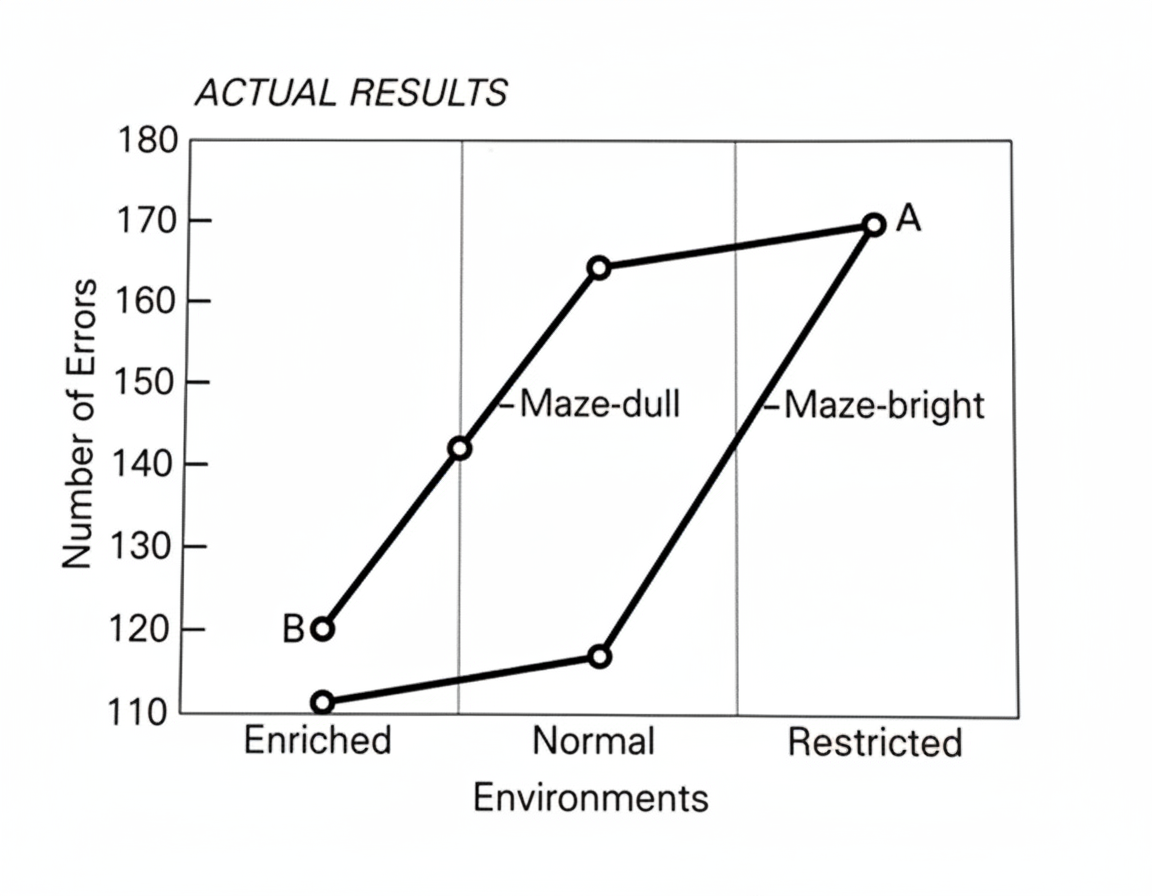
- In a landmark study on rats, environment proved to be the great equalizer of intelligence. "Smart" and "dumb" genetic strains (classified by maze performance) were raised in enriched environments (painted walls, ramps, mirrors, swings, slides, bells, and other stimulating objects), normal environments (standard walls with some exercise and sensory items), or restricted environments (no mental stimulation—only food and water). The "dumb" strain raised in enriched environments performed equally to the "smart" strain, and the "smart" strain raised in restricted environments performed equally to the "dumb" strain.
- Cloning does not produce a perfect match in personality or ability. Cloned cats in 2001 demonstrated that clones develop as essentially separate entities shaped by their unique environmental conditions.
- "Most surprisingly of all, height experts have determined that, biologically, very few ethnic groups are truly destined to be smaller or taller than other groups." Factors such as diet and disease play a far larger role than genetics.
- Even physical birth location has been shown to impact overall development. Observable differences were found in mice across different countries despite painstaking efforts to make environmental conditions as consistent as possible.
- "The temperature surrounding turtle and crocodile eggs determined their gender."
- "Young, yellow-skinned grasshoppers became permanently black skinned for camouflage if exposed to a blackened (burnt) environment at a certain age."
- "Locusts living in a crowded environment developed vastly more musculature (suitable for migration) than locusts living in less crowded conditions."
Genes influence development, but environment plays an equally significant role. Shenk argues that the traditional nature-versus-nurture debate is an outdated framework and that "we need to replace 'nature/nurture' with 'dynamic development' as the two inseparably interact." The interaction of genes and environment shapes who a person becomes. Importantly, this does not mean that development is permanently stunted by an impoverished early environment. This is where the concept of genius as a process becomes essential.
"In recent years, a mountain of scientific evidence has emerged that overwhelmingly suggests a completely different paradigm: not talent scarcity, but latent talent abundance." The following quotes and studies speak to this point:
Latent Talent Abundance
- "Some assert that an individual's intelligence is a fixed quantity which cannot be increased. We must protest and react against this brutal pessimism." —Alfred Binet, inventor of the original IQ test
- "98 percent of IQ test takers today score better than the average test taker in 1900."
- Robert Sternberg, a leading researcher in the study of human intelligence, stated: "Intelligence represents a set of competencies in development."
- "Artists have a vested interest in our believing in the flash of revelation, the so-called inspiration... [shining] down from heavens as a ray of grace. In reality, the imagination of the good artist or thinker produces continuously good, mediocre, and bad things, but his judgment, trained and sharpened to a fine point, rejects, selects, connects... All great artists and thinkers [are] great workers, indefatigable not only in inventing, but also in rejecting, sifting, transforming, ordering." —Friedrich Nietzsche
- Deliberate practice, the capacity to tolerate and move past failure, and a desire to surpass one's personal bests are major factors distinguishing those considered geniuses. Malcolm Gladwell's Outliers cites the finding that experts typically accumulate 10,000 hours of practice in their chosen skill.
- How did Kenyans become so dominant in distance running? "Kalenjin kids tend to run long distances as a practical matter, an average of eight to twelve kilometers per day from age seven." A common joke among elite runners: "How can the rest of the world defuse Kenyan running superiority? Buy them school buses."
- Steven Kotler's The Rise of Superman documents how extreme sports athletes over the past fifty years have repeatedly obliterated world records and achieved feats deemed impossible by both the public and professionals. Once one person demonstrated that the "unachievable" was achievable, it opened the door for others to follow.
- "It's not that I'm so smart, it's that I stay with problems longer." —Albert Einstein
While genes and environment both contribute to intelligence, genius is most often the accumulated result of sustained dedication to a particular field. Anyone can develop extraordinary ability by persisting in a chosen domain and committing to it at an exceptional level. Moreover, how a person perceives failure largely dictates the extent to which growth toward genius is possible. "Failure should be seen as a learning opportunity rather than a revelation of students' innate limits." Failure is the mechanism through which learning occurs. Avoiding failure is avoiding learning. Those who achieve genius are those who view failure as something that can be overcome and mastered—not as an insurmountable genetic barrier.
Shenk concludes with practical suggestions for parents—and, by extension, for anyone seeking to cultivate talent:
Suggestions for Cultivating Talent
- Believe — Believe in the capacity to develop passions and achieve mastery in any chosen domain through sustained effort.
- Support, Don't Smother — Allow room for failure and support growth. It is important to guard against projecting personal expectations onto others. Neutral support—encouragement regardless of outcome or direction—is the most effective approach.
- Pace and Persist — Burnout occurs when external pressure and pace overwhelm intrinsic passion. The desire to learn must be cultivated internally, not imposed externally. Persistence is essential.
- Embrace Failure — This may be the single most important takeaway. Developing a growth mindset—one that views failure as information rather than identity—is critical. Think Again by Adam Grant and Being Wrong by Kathryn Schulz are valuable resources for shifting from a fixed mindset to a growth-oriented paradigm. Mindset naturally shapes communication with everyone, including children.