
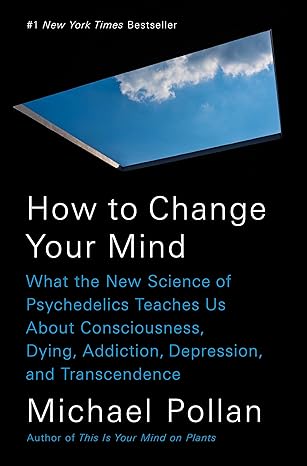
How to Change Your Mind
by Michael Pollan
Link blocked? Copy it and paste in a new browser tab.
Your Rating
All ratings are anonymous
Help others by sharing
The book covers three areas: the history of psychedelics since the development of LSD, the impact of psychedelics through both scientific studies and extensive anecdotal accounts, and the neuroscience behind how psychedelics affect the brain. This summary focuses primarily on the practical impact rather than the historical narrative. The book is particularly valuable for those interested in first-hand accounts of psychedelic experiences.
The true method of knowledge is experiment.
In brief historical context, LSD was created by Albert Hofmann in 1943 by accident. It was researched for many years and the body of evidence supporting LSD's ability to create transcendental experiences and produce significant improvements in mental health grew increasingly robust. Despite overwhelmingly positive results, a series of negative incidents and news stories fueled a movement that ultimately resulted in its prohibition.
This wasn't the first time in history that psychedelics have been banned despite their overwhelmingly positive impacts. One of the first battles in the war on drugs occurred when Cortes met the Aztecs. The Aztecs were already well acquainted with psilocybin and they commonly used it to gain access to the divine. "The Nahuatl word for the mushrooms - flesh of the gods - must have sounded to Spanish ears like a direct challenge to the Christian sacrament, which of course was also understood to be the flesh of the gods, or rather of the one God. Yet the mushroom sacrament enjoyed an undeniable advantage over the Christian version." The Catholic Church subsequently engaged in interrogation and torture of the native peoples in order to control their use of psilocybin in response to the perceived threat. "The Roman Catholic Church might have been the first institution to fully recognize the threat to its authority posed by a psychedelic plant, but it certainly wouldn't be the last." The book, The Immortality Key: The Secret History of the Religion with No Name by Brian Muraresku covers other historical accounts of psychedelic's ability to connect people with the divine.
As history and culture have patterned, one of the primary branches of research on LSD was its ability to create mystical states. Mystical states are defined by four markers according to William James, a researcher on mystical experiences:
Four Markers of Mystical States
- Ineffability: It defies expression.
- They bring states of knowledge that carry authority.
- Transiency: The impact of the experience persists even after it's over.
- Passivity: A feeling of surrendering to a superior force.
How effective was LSD at creating mystical experiences? Roland Griffiths, one of the early scientific researchers of LSD, reported that 70% of participants had a mystical experience. "As a scientific phenomenon, if you can create a condition in which 70 percent of people will say they have had one of the most meaningful experiences of their lives... well, as a scientist that's just incredible." Griffiths compared the banning of LSD to making "Gothic cathedrals illegal, or museums, or sunsets"—the types of experiences that tend to elicit awe. Notably, very few participants reported negative experiences, or "bad trips," as long as they were guided through the process. The most common outcomes included an increase in love, greater openness, heightened sensitivity to others, and the acquisition of subjectively profound insight or knowledge.
Remarkably, although many participants were non-religious, they consistently reported experiences that led them to believe there was something beyond the material world, even if they did not necessarily attribute it to God or a divine being. A clearly biological catalyst—a plant—was producing experiences that participants described as transcending the substance itself. As the author noted: "Here was a curious paradox. The same phenomenon that pointed to a materialist explanation for spiritual and religious belief gave people an experience so powerful it convinced them of the existence of a nonmaterial reality - the very basis of religious belief."
The impact of psychedelics is so significant that one theory of human evolution—the stoned-ape theory—places them as a central component. "Psilocybes gave our hominid ancestors 'access to realms of supernatural power,' 'catalyzed the emergence of human self-reflection,' and 'brought us out of the animal mind and into the world of articulated speech and imagination.'" The author reflected on his own experience with mushrooms: "if those dried-up little scraps of fungus taught me anything, it is that there are other, stranger forms of consciousness available to us, and, whatever they mean, their very existence, to quote William James again, 'forbid[s] a premature closing of our accounts with reality.'" Whether or not psychedelics played a role in ancestral evolution, they consistently provide an evolution of thought.
The Default Mode Network
Psychedelics work by impacting a part of the brain called the Default Mode Network, or DMN, the default mode of the brain that lights up when daydreaming, ruminating, and reflecting occurs. The default mode is most active when "we are engaged in higher-level 'metacognitive' processes such as self-reflection, mental time travel, mental constructions (such as the self or ego), moral reasoning, and 'theory of the mind' - the ability to attribute mental states to others, as when we try to imagine 'what it is like' to be someone else." Psychedelics deactivate this part of the mind causing altered states of consciousness including feelings of oneness or ecstasy. The deactivation of the DMN can also be achieved through meditation, certain breathing exercises, "sensory deprivation, fasting, prayer, overwhelming experiences of awe, extreme sports, near-death experiences," etc.
The deactivation of the DMN introduces entropy into the mind. The lessening of the ego's grip and the resulting entropy allow rigid thought patterns accumulated over a lifetime to disintegrate and reorganize—a significant factor in psychological conditions such as addiction, depression, eating disorders, and other diagnoses characterized by rigid thinking. As the book describes, "the brain as a whole becomes more integrated as new connections spring up among regions that ordinarily kept mainly to themselves or were linked only via the central hub of the DMN. ...The various networks of the brain became less specialized." Children have been shown to exhibit brain patterns with less DMN activity, and studies indicate this gives them an advantage in solving unconventional problems compared with adults. In the book's phrasing, "babies and children are basically tripping all the time."
Besides inducing mystical experiences, psychedelic studies in the 50's were used to treat addiction, depression, obsessive-compulsive disorder, schizophrenia, autism, and end-of-life anxiety with more than 40,000 participants and 1,000 clinical papers. The founder of Alcoholics Anonymous sought to introduce LSD to AA due to its effectiveness and the American Psychiatric Association hailed it as a new wonder drug. Here are some statistics on how effective psychedelics are as healing agents:
Effectiveness of Psychedelics as Healing Agents
- 1
A study on psychedelic's impact on smoking cessation had an 80% success rate of abstinence after a 6 month follow-up and 67% at the year mark. The nicotine patch has a 22% success rate in comparison determined by a meta-analysis of nicotine abstinence in the National Library of Medicine.
- 2
LSD's impact on alcoholism was studied with 700 participants and 50% of the participants got sober and remained sober for months after the study. The standard success rate of treatment for alcoholism is 35% in comparison as found in a study in the National Library of Medicine.
- 3
"80% of cancer patients showed clinically significant reductions in standard measures of anxiety and depression, an effect that endured for at least six months after their psilocybin session." Many of them lost their fear of death entirely.
These results are notable. Current studies on psychedelics continue to show highly efficacious outcomes with substances including psilocybin, LSD, MDMA, and ibogaine.
The Johns Hopkins experiment shows - proves - that under controlled, experimental conditions, psilocybin can occasion genuine mystical experiences. It uses science, which modernity trusts, to undermine modernity's secularism. In doing so, it offers hope of nothing less than a re-sacralization of the natural and social world, a spiritual revival that is our best defense against not only soullessness, but against religious fanaticism. And it does so in the very teeth of the unscientific prejudices built into our current drug laws.
The banning of a substance for scientific study is nearly unprecedented in our modern world, especially when it has consistently produced such impressive outcomes. The bias against drugs (psychedelics) is not only scientifically unsubstantiated, but is also religiously unsubstantiated, the irony being that it simultaneously benefits both seemingly contradictory fields yet both have chosen bias over conscious experimentation.