
Joy Theory
In-Depth Explanation
In-Depth Explanation
Joy Theory
Joy Theory is complex, far more complex than it seems at first glance. I will give a simple version for those that want only a base level understanding and a scientific explanation for those that really want to dive into the science behind the theory.
How This Theory Can Benefit You
1. Increased Awareness and Insight
- I've had a few clients comment on how they didn't recognize their emotional reactions as much before doing this treatment method. The quick shifting of emotions during the session helped them get more in tune with their emotions and how each emotion feels distinct compared to others.
- This method creates awareness in what clients pay attention to throughout their day when not in session. Emotional awareness is the key to long-term happiness.
- This method typically results in a lot of powerful insights.
2. Influence of Joy
- I've had many clients react negatively to feeling joy because it feels scary. Google summarizes: "Brené Brown [a world-famous researcher on vulnerability] states that joy is the most vulnerable emotion because it requires a deep connection to something fragile and fleeting, which can trigger a fear that it will be taken away, a phenomenon she calls 'foreboding joy.'" I have definitely seen this in session. For those that experienced foreboding joy it was simultaneously informative and disconcerting to them because it helped them recognize their own discomfort with higher level positive emotions and the level of fear present in their lives. This is crucial information.
- Other clients started to recognize that they don't focus on joy very often in their life, don't even know what joy feels like, or don't know what that would look like in their life. Again, this is extremely important because if you don't focus on joy, you will never attain it as a stable state.
3. Power of Choice
- The most important single understanding of any is this: that our emotional state is a choice. That IS NOT to say that you should numb, neglect, ignore, repress, or any other word suggesting that a person shouldn't feel their emotions. That isn't healthy. Nor is it saying that your emotional reactions aren't instinctual. What this is saying is that you recognize, through the meditation, that you can change your emotional state at will by working through the negative emotions in a healthy way, and it's not even that hard to do! This information is by far the most impactful because it helps you understand the amount of power you have over how you feel on a moment to moment basis.
4. Joy is a Mindset
- Joy is not something that just happens to you, it is a state created by conscious effort. It is a choice, a choice that is made at every moment. Circumstances do not have to change in order for you to feel joy. If you think you can't feel joy in your present circumstances, that is a lie you are telling to yourself. If Viktor Frankl can do it in a German concentration camp, I bet you can.
"Everything can be taken from a man but one thing: the last of the human freedoms—to choose one's attitude in any given set of circumstances, to choose one's own way."
— Viktor Frankl
Joy Theory - The Basics
Joy Theory at its most basic level includes a few core concepts: physiology and neuroscience, emotion and its relationship to energy and changing physiology, visual meditation, and bilateral stimulation.
The physiology of the body and neuroscience help us determine how the body functions which is vital to understand if we are to know how to most effectively go about changing it. The brain is set up so that our survival functions take first priority (the lizard brain), then our emotions (the mid-brain), and then our logical processes (prefrontal cortex). Why? Because emotions help us survive. Consider hunting in a jungle and seeing a tiger. The split second it takes to recognize danger could be life-saving, the outcome potentially being very different if we had to analyze whether it was a nice tiger or not or whether or not it was currently hungry for man flesh. Where this was very adaptive in early evolution, nowadays we are rarely faced with life or death scenarios but our brain hasn't developed to acknowledge the difference. If this information wasn't enough, science has confirmed that without emotions humans are essentially unable to make decisions.
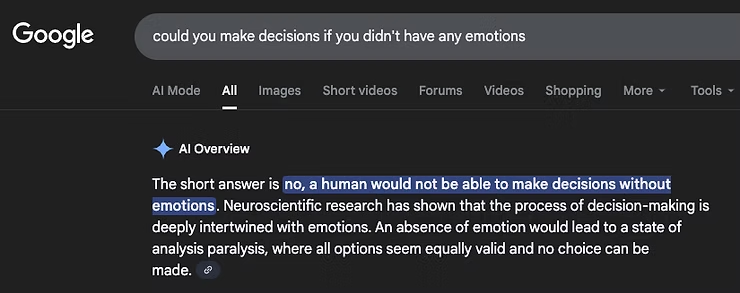
(click to enlarge)
This information is largely credited to Antonio Damasio. He did a case study of a person named Elliott who was unable to experience emotion after a surgery removing a brain tumor although all of his other functions remained intact. Elliott could reason and narrow down possible choices, he just couldn't make decisions. The case study doesn't technically prove that making decisions without emotion is impossible, because it's just one study and is an extremely rare case, but it does very strongly suggest that humans can't make decisions without emotions.
The way the brain works, and therefore the way humanity works, is emotions first, logic second. In other words, when it comes to just about anything but narrowing down options, emotions trump logic. Emotions are the faster path to change just like taking a cross-country flight is faster than taking a road trip.
The impact of emotion on physiology cannot be understated. It is absolutely massive. Positive emotions create positive impacts in the body and negative emotions create negative impacts in the body physiologically. Peace scientifically provides the greatest physiological impact followed by joy, hope, love, and gratitude which is shown in the chart below.
"L" - Low positive impact.
"M" - Medium positive impact.
"H" - High positive impact.
Asterisk - Mixed results which could go higher or lower than the indicated level.
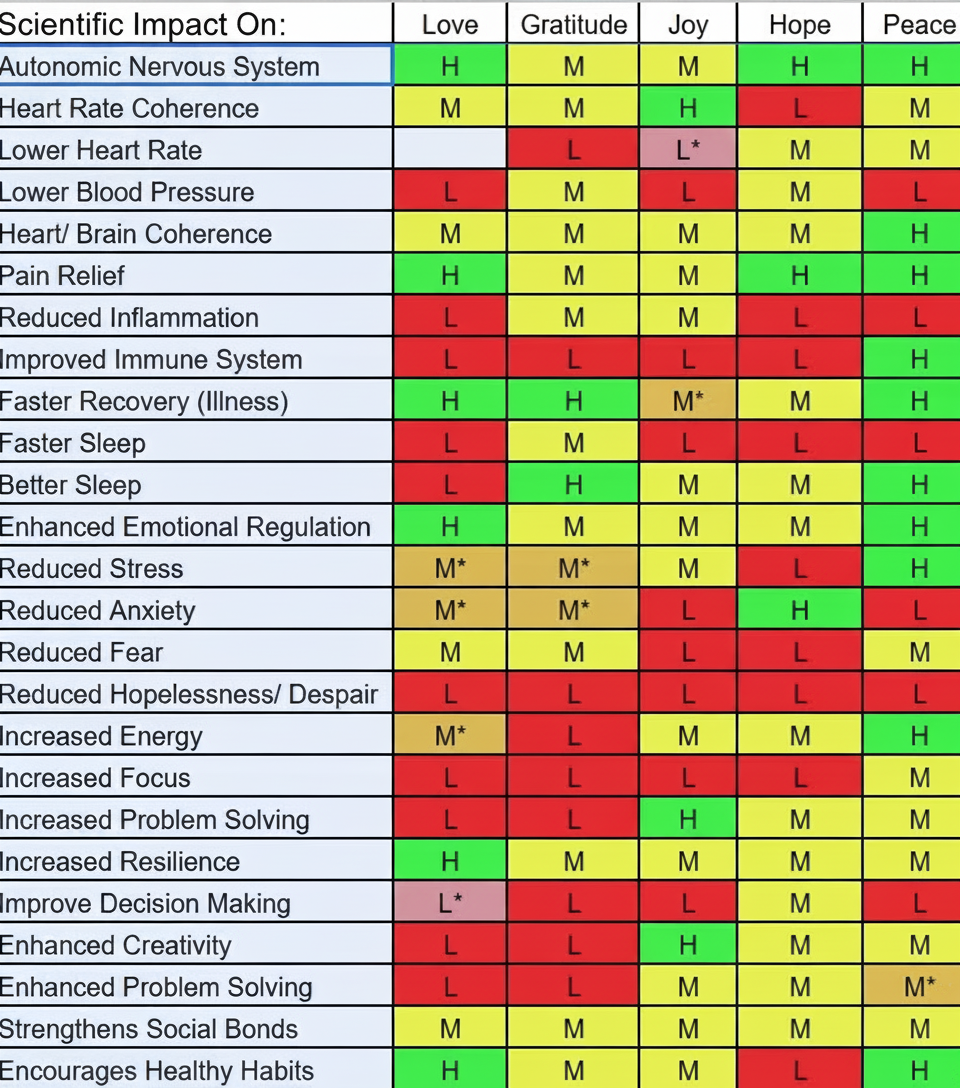
(click to enlarge)
Emotions also impact energy levels. The heart secretes hormones and emotion has been shown to alter the chemical processes that impact energy levels. Moreover, it's easy to recognize that a person's energy level when depressed versus joyful are substantially different. This theory uses the idea of emotions as energy in order to harness high emotional energy states to help create change in the body and mind. More energy = more power to change just like pulling a wagon with eleven horses is more effective than pulling it with one.
The brain has a difficult time distinguishing between reality and imagination, so much so that professional athletes use visual meditation to train in their chosen sport. Studies have even shown that kids learning piano physically versus via visual mediation show nearly no differences in physical playing ability over a few months period. Instead of training the body for sports or music, we are training it to experience emotions, specifically positive ones, by means of visualization.
When you engage in visualization I would recommend not visualizing past experiences. In the visualization we are trying to seek out overarching patterns, similar things that would trigger you in the present, rather than trying to rewrite the past. Change your general patterns, not specific occurrences in the past that demonstrate that pattern. A simple way to do this is to imagine a person that did something that bothered you and then separate the thing that bothered you from the person. The thing they did that bothered you is the pattern.
In order to change energy states you use visual mediation to visualize yourself in a triggering situation and imagine yourself emotionally reacting differently. It's difficult to jump from a low emotional state, such as shame, anger, or grief, to a high emotional state instantaneously just like going from never running to running a marathon without any training would most likely be impossible. For that reason it's useful to use a gradient based system of emotion that helps you work your way up through to get to the higher emotional states. The emotion tier list is as follows:
- Neutrality (not always applicable)
- Acceptance
- Love
- Joy, hope, and gratitude
So instead of reacting negatively to the stimulus, you imagine yourself reacting neutrally to start. Once you imagine yourself reacting neutrally, and feel that emotionally, then you imagine yourself reacting from a place of acceptance, then love, then joy, hope, and gratitude. Feeling the emotion is the key; if you don't feel it, you won't change. Joy, hope, and gratitude should all be used if possible because they all physiologically impact the body differently, but if not, use the ones that are applicable. Sometimes joy may not be what makes sense to aim for, like with loss, where hoping the best for that person and feeling gratitude for your time with them would be more appropriate. Use your discretion and creativity to reach these higher emotional states. I consider peace as a natural result of being in these higher emotional states, but if you want to intentionally aim for peace, go for it.
In each state you should feel the emotion towards yourself first and then apply it to the other people involved (if there are any). Feeling the emotion towards yourself means that you are not allowing your self concept to be impacted by the trigger, which triggered you solely because of an internal lack of self-concept. A person who knows they are smart doesn't get offended when someone calls them an idiot, they brush it off because it's objectively untrue. If someone told Einstein that he was an idiot, I don't think he broke down in an existential crisis. This concept applies across all negative reactions. Feeling the emotion towards yourself is the most critical part of this process, and the trickiest.
Side-step for more in-depth psychoeducation. The reason you are triggered by something is because you are requiring someone else to act a certain way, or things to be a certain way, in order for you to maintain your emotional stability. This is a recipe for emotional distress. You can't control other people or life, you can only control yourself, and if you can't control yourself your only option is to try and control the people around you. Nobody likes to be controlled. In order for this process to work you need to emotionally provide yourself what you wanted someone else, or the world, to emotionally provide for you, no excuses. The final result of this process is the recognition that people and circumstances only impact you because you give them the power to do so.
Joy Theory uses bilateral stimulation to help with emotional processing. You can read more about bilateral stimulation here.
Bringing these concepts all together we are simply using emotion, the most powerful process in the body, to change physiology and neurology with the aid of visual meditation and bilateral stimulation.
Steps to Do Joy Theory
- Choose a negative belief or an idea or concept that negatively impacts you. If you don't really know what beliefs are or how to identify them, read up on it here. The post is a different theory but the concepts are foundational to Joy Theory and are helpful to know if you intend on doing this yourself.
- Use visualization to imagine yourself reacting differently to the same stimulus. The key here is not to just imagine it, it's about actually feeling different while the visualization is occurring. Feeling is fundamental and irreplaceable in bringing about change.
- Start on the emotional gradient scale. If neutrality doesn't make sense in the situation, start with acceptance.
- Neutrality means to see the stimulus as neither positive or negative, just an unemotional fact, with about the same amount of feeling you have when you see an unimpressive table and say "that's a table." For example, if you are working through someone judging you, neutrality means being able to say "they are judging me" and feel no reaction about it, positive or negative. It just is.
- Neutrality also doesn't mean lying to yourself. If you would like to know more about how to become aware of your emotions, and therefore if you are truly neutral, you can read about how to identify emotions using the subconscious.
- Sometimes neutrality is too hard to reach and a lower level emotion needs to be reached first. In this case try to feel desire, anger, pride, or courage before stepping into neutrality.
- Moving through both acceptance and love is a two part process: first, focus on providing the emotion for yourself and second, providing it to others. There are a couple things to note. First, under no circumstances should you be lying to yourself. Repressing, ignoring, denying, numbing, pretending, or any variation of this concept only hurts you. Second, if you are triggered it is a you problem, no matter what it is. Being self-righteous is self-delusion and self-righteousness is not achieving these emotional states, it is the distortion of them. You know you are being self-righteous if you are thinking negatively about someone. In extreme situations you should aim for forgiveness. Forgiveness is about doing what is best for you, it's not about them deserving it.
- Acceptance first means accepting the circumstances, then yourself, and then applying it to others.
- Examples of accepting circumstances although still focused on feeling it emotionally, not just saying it:
- "I don't like what is happening, but that's okay."
- "I accept that this is happening."
- "I am okay with what is happening."
- Accepting yourself is more challenging and more nuanced. Applying the emotions to yourself is the trickiest aspect of this theory because it requires learning to think differently and expertly reframing how you choose to take things. As an expert on this, it can even be challenging for me to make this make sense sometimes. Here are some examples of acceptance:
- "I like and accept myself so its okay if that person doesn't like me."
- "I can mess up and still not think less of myself because I accept that I'm imperfect and am doing my best and that's all I can do. All I can do is do better in the future."
- "I understand that this person not liking me says more about them than me because I know I am a good person that is trying their best, even if I mess up sometimes."
- Once you accept yourself you can extend that to others.
- "I accept that this person's behavior is their problem, not mine."
- "I can accept and understand their rude behavior, I have also been rude at times."
- Examples of accepting circumstances although still focused on feeling it emotionally, not just saying it:
- Love - Loving yourself and then applying it to others is a deeper level of acceptance. Once that is accomplished, you can apply it to others. Here are some examples:
- Loving self:
- "I love myself, flaws and all. I will keep working on my flaws but I won't judge myself negatively for them."
- "I see my worth and value even when things go negatively for me."
- Loving others typically means feeling compassion for people.
- "I love them even though they aren't perfect and want to treat them accordingly even if they don't treat me how I treat them." (Note that this doesn't mean you can't have boundaries with someone you love.)
- "I understand that their behavior is a reflection on their own fears and insecurities and I feel compassion for what they must be struggling with."
- "I can understand why they reacted that way and I take accountability for my part in it and will do better next time."
- Loving self:
- Joy, hope, and gratitude are the ultimate steps in taking your emotional power back (as applicable). Joy is proclaiming that you get to decide how you feel about yourself, not anyone else, and deciding that you want to feel joy. Being able to retain joyfulness in a visual meditation with the initial stimulus is how you know that you've reclaimed your power. Joy is not defensive and will dutifully consider feedback, but that doesn't mean that others get to dictate what you do or how you view yourself or a situation. Joy also allows for simultaneous states of other emotions including sadness. Hope is hope for the future and wishing the best for yourself and others. Gratitude is being grateful for the time you had or what you learned from the person or experience.
Once this process is done you should be good to go! If you are unsure, visualize a variation of the thing you are trying to work through and check if you react negatively to it. If any step in this process elicits a negative reaction, you aren't done yet. Being done means feeling only positive feelings while visualizing the stimulus, although positive emotions can possibly be felt in tandem with low-grade sadness or grief (for example a breakup, death, or other objectively sad or extreme event).
Unfortunately this process doesn't always work seamlessly. Most of the time it doesn't work due to not being able to conceptualize reacting differently, the most challenging part of this theory. If it isn't working for you, try using a different theory to heal yourself.
Joy Theory: The Science Behind the Scenes
1) Quantum Physics
Quantum physics states that quantum particles (electrons, photons, atoms, etc.) are always in what is called wave-particle duality: At times they operate as a wave and at times they operate as a particle. I'll use a plasma globe to explain how that works.
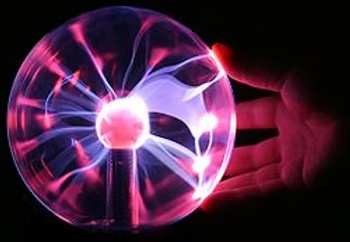
Without touching the plasma globe the various plasma tentacles drift all around the sphere (all 3 dimensional waves are spherical) and the individual tentacles could be at any point in the sphere at any point in time. Although you can distinguish the energy tentacles in plasma globes, quantum particles would fill all parts of the sphere simultaneously in their wave form, a concept called superposition. Quantum particle's natural state is a spherical wave in superposition but that changes when the quantum particle is measured. This is how quantum physics describes it in a quick 49 second video.
The particle function of quantum particles, as described in the video, happens when a quantum particle is measured. Measurement collapses the entire wave into a single particle, kind of like the plasma globe being touched. This same concept is called "collapsing the wave function."
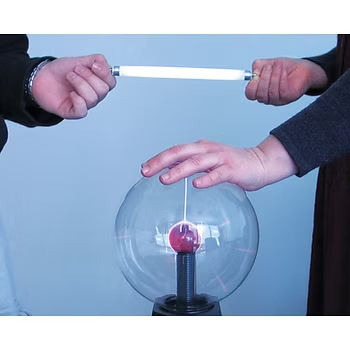
The mechanism that collapses the wave function is a controversial topic in quantum physics. Most quantum physicists right now believe that it is due to decoherence, a word meaning that the wave function collapsed due to coming into contact with something in the natural environment, such as photons of light. Another group of physicists believe that the collapse is due to human consciousness. Regardless of which it is, what matters right now is that the natural state of a quantum particle is a wave because all waves have frequency.
2) Spirituality
Higher frequencies have more compressed wavelengths meaning that they have more energy in less space and, therefore, have higher energy levels as a result. More energy means more power just like more wood on a fire means a bigger fire except that frequency is exponential, meaning that the higher the frequency is, the larger the difference between it and lower frequencies becomes. Here is a chart of the electromagnetic frequencies of visible light, with purple having the highest frequency and red the lowest.
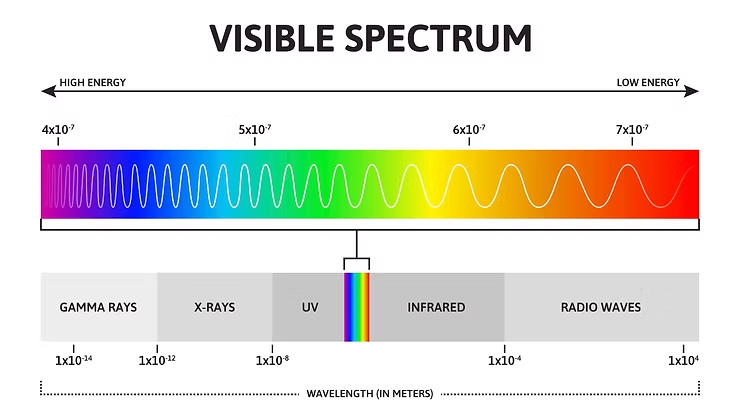
Spirituality takes the concept of electromagnetic waves and frequency and applies it to emotions with positive emotions having higher frequency and more energy than lower frequency negative emotions. This is where the disagreement between quantum physicists on what collapses a wave function becomes more important. Obviously not everyone believes in enlightenment, although most religions do including the big 5 (Christianity, Judaism, Islam, Hinduism, and Buddhism) although they call it different things: one calls it Moksha, the other enlightenment and Buddha hood, while the other three call it being a prophet. If the wave function collapses due to consciousness, that would have some pretty crucial implications beyond the possibility that this heightened state occurs due to physiological changes in the body based on emotion; a change in frequency.
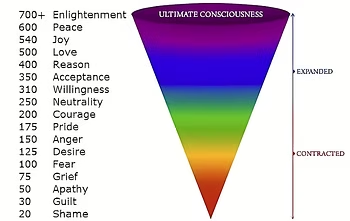
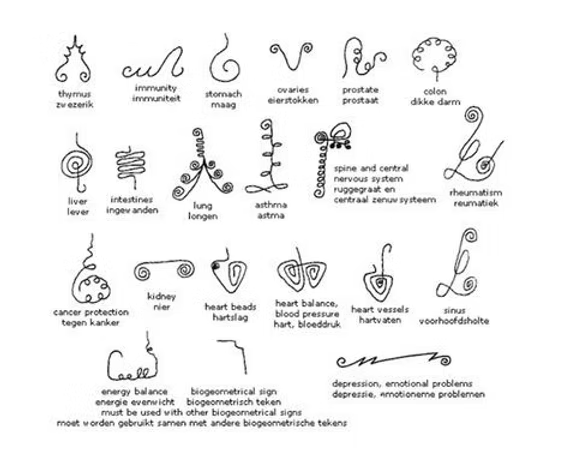
The concept of emotions having frequency is pseudoscience but that doesn't make it necessarily incorrect and I'll explain why. Scientists have attempted to measure the frequency of emotions, but have not identified frequency related to it, which is what makes it pseudoscience. That being said, the idea that emotions impact energy is easy to validate. Shame is less fun and less energizing than joy and people have less energy when depressed than when they're happy. This shift in energy is factual and is the shift in frequency that spirituality is referring to, or so I believe. The book Biogeometry Symbols by Dr. Ibrahim Karim, who has held many prestigious health-based positions worldwide and won an international award for his work on biogeometry, scientifically shows that even squiggly lines have frequency. If squiggly lines can have frequency, emotions can.
Another way to validate this concept is by understanding the impact of emotion on cells. We know that emotions impact cell health and the body: positive emotions impact the body in positive ways and negative ones impact the body in negative ways. Here is a summary of how positive emotions impact the body from the National Institute of Health. If the cells of the body respond to emotions, which are made up of quantum particles, which are most often in a wave state, then emotions have to have a frequency, or at least the changes emotions make in the body do. Even if emotions aren't frequencies in themselves, they 100% trigger it in the body. In fact, the word emotion means "energy in motion," which can be understood as the expansion and contraction of the body which would then result in a different atomic frequency. Emotions should have a frequency based on these ideas on an electromagnetic level, a concept that will be addressed shortly.
3) Acoustics
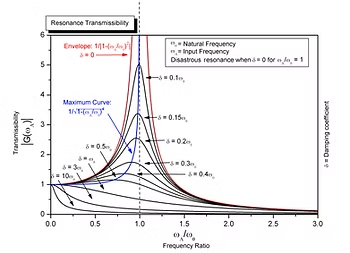
Now that we've established that emotions likely have frequencies, or at least cause frequency changes in the body, we will talk about resonance. A frequency can create something called resonance when it reaches the preferred frequency, or optimal frequency, of the system it is in. Complex systems can have many preferred frequencies. When resonance occurs, the amplitude or overall energy of the wave increases dramatically. The amount it increases is actually insane. Here is a 3 minute video on it.
For those that refuse to watch the video here are the most important concepts. The first is that there is a very small bell curve in which resonance is maxed, a concept called the peak of a resonance curve shown below.

The peak resonance is the perfect amount of matched frequencies to enhance the resonance to its absolute maximum capacity and power for that frequency. There is a very narrow window for resonance to occur.
The video shows how dramatic resonance can be and here are pictures showing the impact of resonance.
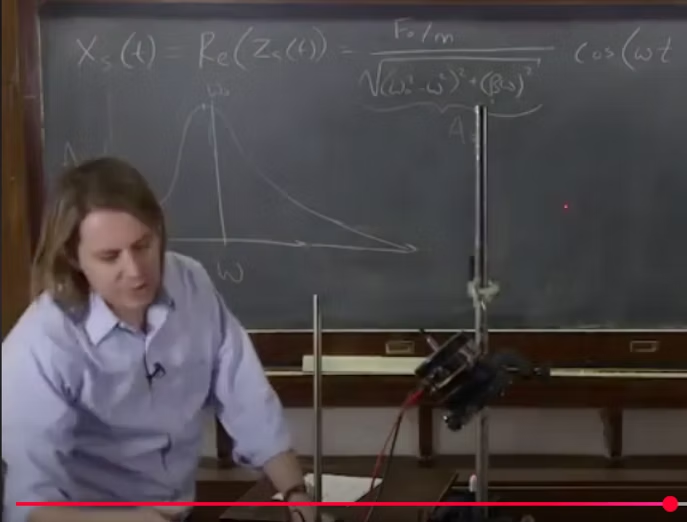
The red dot is the current amplitude, or power, of the current resonant state. This red dot is not currently in the peak resonance bell curve, it is before or after the curve begins or ends, at one of its smallest points.
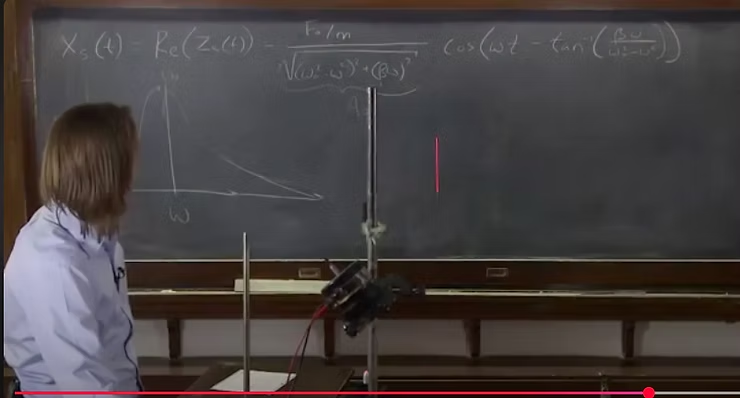
This is the impact of resonance at the peak of the resonance bell curve. The red dot became a red line and is WAY bigger!
The difference is enormous! It's almost like resonance makes 1+1=11
The body has multiple preferred frequency states depending on the organs or cells. Here is a study from Harvard showing the resonant frequency of the human body at 5-10 hertz. This study from Scientific Research: An Academic Publisher says that the liver has a frequency of 50-60 hertz. This article from Research Gate has this chart:
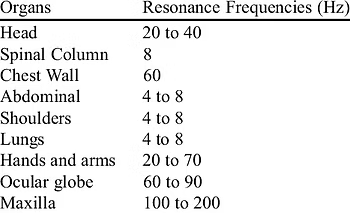
Now take the concept of organs having resonance and merge it with the idea that the body has multiple preferred frequencies (like those of our organs) but applied to preferred states of positive emotions. Telomeres, the part of DNA responsible for aging, shorten due to stress meaning that they age faster. This says to me that the body's preferred state is a lack of stress, or peace as shown in the emotional frequency diagram earlier. More positive emotional states are higher degrees of peace. As the body resonates at more positive emotional states it should have more power within it, which could account for the positive benefits in physical health seen from positive emotions. More energy = more power to change just like if a team of eleven horses can pull more than one horse can. If we can harness the emotional energy of a high frequency emotion through resonance with the body, then there is the potential for a large amount of emotional (or physical) change based on the principles of resonance.
4) Physiology
In constructing and testing Joy Theory I came to realize that Joy doesn't always fit as the preferred emotion in certain situations and in its place I started to use gratitude and hope when applicable. This made me wonder if I was on the right track with the emotions I was choosing to use in this theory and, in order to check myself, I decided to research the top 5 emotions in terms of their overall positive impact on physiology and psychology. According the ChatGPT the top 5 emotions based on overall benefit are (in this order): Love, gratitude, joy, hope, and peace. I then researched each in turn to decipher what specific impacts each emotion had on overall functioning.
The simplest extraction from the data is that positive emotions have positive impacts. When I hypothesized that emotions may be possible resonant states for the body, I think anything that helps the body and mind in a positive fashion indicates some kind of resonance, or at least optimal functioning. After looking at this chart I find it pretty impossible to argue otherwise. I didn't expect every emotion on the chart to have such overwhelmingly positive impacts on the brain and body.
"L" - Low positive impact.
"M" - Medium positive impact.
"H" - High positive impact.
Asterisk - Mixed results which could go higher or lower than the indicated level.
(click to enlarge)
While this information may not be 100% accurate due to the brevity of my searches, it does give reliable enough information which was provided by AI. With this new assortment of information we have more distinct results. Here is a breakdown of the information:
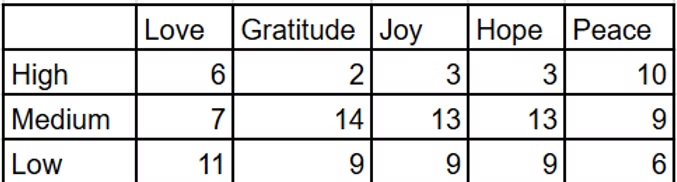
Peace is easily the most impactful emotion, love is arguably second despite its lower amount of mediums and higher number of lows, joy and hope are tied, and gratitude comes in last place. Although, if we give a base weight of 3 to high, 2 to medium, and 1 to low then joy and hope rank higher than love by one point. Love also has the most M*s, meaning possible high impacts with a chance of low impact, and has one rating with a chance of negative impact as well as one with no impact at all. It also has the most low impacts. Another factor to keep in mind is that joy is typically regarded as a temporary state in these findings rather than a permanent state, which is the overall purpose of Joy Theory. With that in mind I would rate joy and hope as higher than love due to their higher reliability. Either way, love is a basic step in the standardized process, so it technically doesn't matter either way.
5) Neuroscience and Electromagnetism
The idea of the human biofield came out of left field while watching the documentary "Through the Wormhole," episode 7. It's the emerging science of measuring the electromagnetic fields and infrared radiation emitted by the body such as the brain, which emits a small energy field named the biofield. The heart is the strongest contributor to the biofield in the body, emitting an electrical field 60 times greater than that of the brain and a magnetic field 100 times more powerful, extending out 3 feet or more from the body. The strength of the field is an indicator of energetic power, meaning that the heart is far more powerful than the brain, at least energetically. The heart is actually wild, this information blew my mind. You can read about the heart here even though it's 104 pages so keep that in mind (I read about half of them) or just read my key takeaway summary.
Before elaborating on the findings, I want to say a few things. First, the journal that published this study is an independent publisher which means that their articles do not need to be peer researched before publication. Generally, that is not a good sign as far as trustworthiness is concerned. But, I asked google about them and they said they are cool research wise. Second, ironically as the article started discussing the soul and the heart in junction, I experienced a subconscious repulsion. The irony is not lost on me, but I write this to demonstrate my own subconscious biases against spirituality being a part of science. Being skeptical of spirituality runs deep... and it's still incredibly surprising to keep finding science that substantiates spiritual claims.
Here is my summary of key points from the article:
- The heart is stronger than the brain in terms of influence when it comes to emotion. "The neural connections that transmit information from the emotional centers to the cognitive centers in the brain are stronger and more numerous than those that convey information from the cognitive to the emotional centers. This fundamental asymmetry accounts for the powerful influence of input from the emotional system on cognitive functions such as attention, perception and memory as well as higher-order thought processes. Conversely, the comparatively limited influence of input from the cognitive system on emotional processing helps explain why it is generally difficult to willfully modulate emotions through thought alone." The heart is often referred to as the heart brain for this reason.
- The heart produces hormones including oxytocin, the love chemical, equally as much as the brain does. Emotions, besides being stronger than thought, are tied physiologically to the biological processes of energy. "Emotions and resilience are closely related because emotions are the primary drivers of many key physiological processes involved in energy regulation." Negative emotions literally influence energy regulatory functions in the body negatively.
- Coherence is when two wave states become synchronized albeit at different frequencies. In other words, they become more symmetrically and harmonically patterned. Coherence has overwhelmingly positive effects including enhanced cognitive functioning such as clearer thinking and better decision making, emotional resilience and stress management, and increased physical and emotional well-being. All of the top 5 positive emotions (peace, joy, hope, love, and gratitude) enhance heart-brain coherence with peace being the only one that significantly impacts it which you read about here. I still don't think peace should be the focus of the theory because for myself I feel much more energy when I'm joyful than when I'm peaceful. True peace would be an attainment of a homeostatic state of joy.
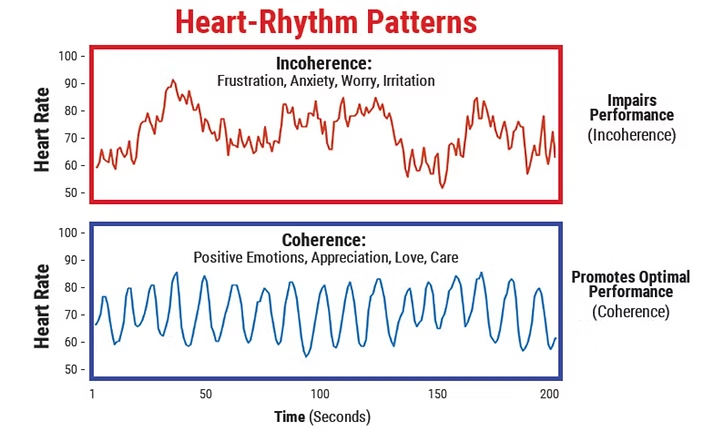
- It's scientifically verified that heart and brain rhythms synchronize among groups of people. This is generally triggered by synchronized activity such as choir or drum circles, emotional closeness and connection, having a shared focus or experience, and experiencing positive emotions. In other words, who you are around quite literally changes your physiology based on their electromagnetic output and group synchronization. This can also account for automatic magnetic and repulsive responses to people.
- Here is a list of how emotion based interventions have impacted health and well-being:
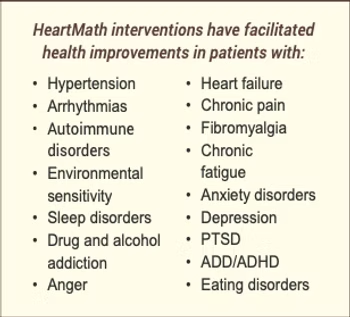
The evidence is pretty clear that positive emotions positively impact us neurologically. What this also suggests though is that light has healing potential. Since the brain and heart both emit electromagnetic fields, that means that they should respond to electromagnetic waves, or in other words, the visible light spectrum.
This concept can then be applied the same way emotions will be, which is through the use of visual meditation which will be covered after explaining one more neurological and electromagnetic concept.
Bilateral stimulation is done in the background during this entire process, the process by which EMDR works, one of the top 5 trauma therapies in the world. Bilateral stimulation is done by stimulating alternating sides of the brain in a back and forth pattern which can be done by sight with watching a ball go back and forth across your horizontal axis, by sound by having sound alternate between left and right ear, or touch by tapping your thighs, knees, arms, toes, or any other part of your body as long as it's alternating. Here is an article by the National Library of Medicine that goes over how bilateral stimulation is used to instill positive beliefs during EMDR, creating a shift towards positive emotions. Bilateral stimulation allows the brain to break down information into smaller packets which allows for easier processing. My assumption is that the principles of acoustics make this possible. Below is a picture of a wavelength:
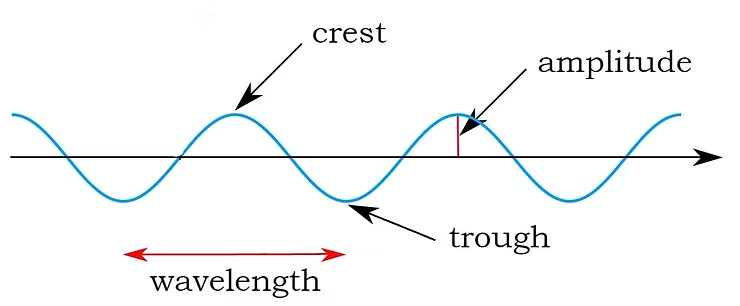
When wavelengths are in a physical environment the crest and trough are measured by physical direction. Consider this pendulum. When it goes to the right it is represented in the graph by the upper half of the wavelength. When it goes left it is represented in the graph by the lower half of the wavelength.
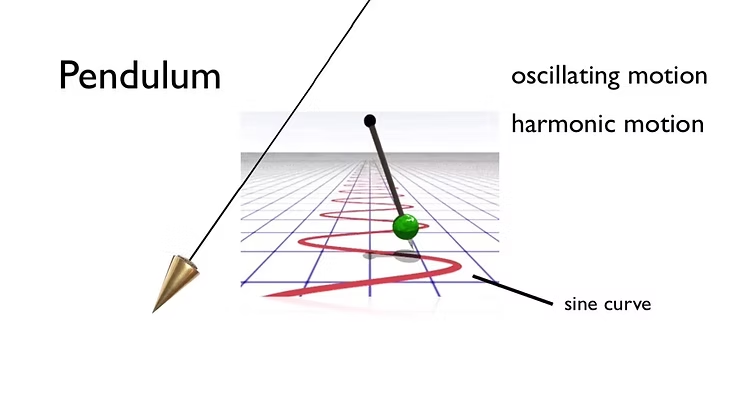
The alternating pattern forms the basis of waves, how literally everything in the observable universe works. Bilateral stimulation creates a wavelength in the brain by alternating left and right side activation, which is the smallest packet of information possible, hence why it works.
6) Visual Meditation
The brain struggles deciphering between reality and imagination. This is an article on the idea by the University College London, one of the top 10 universities in the world. Professional athletes often use visual meditation to improve their physical performance. Here is a study published by Research Gate. If professional athletes use visual meditation to enhance physical performance, why not use it to become an expert on experiencing joy? Studies published by the National Library of Medicine show that visual meditations and love-kindness meditations make the brain produce higher frequency brain waves which corroborates the ideas of joy meditation and frequency. Additionally, meditation and guided imagery has been found to increase theta waves, responsible for memory, learning, and creativity, all helpful in creating new emotional patterns. Visualizing yourself being in a state of joy, or one of the lower options if necessary, could train your brain to feel joy, enhance your neural pathways making it easier to do in the future, and create harmonic resonance leading to more physical, emotional, and psychological energy.
Moreover this indicates that visualizing colors of light have the potential to heal. The way that I use this method is to have the client imagine a healing ball of light above their head, whatever color they feel called to. I don't choose the color because your intuition should attract you to the electromagnetic state that is manifested through the body in the same way that having an iron deficiency makes you crave a steak. It doesn't happen consciously, it happens subconsciously on a physiological and electromagnetic level. Regardless, once the color is chosen I have the client imagine the light flowing into their body from the top of their head, filling their body with the light. I've had clients completely heal themselves using this technique alone.
And that concludes the science behind Joy Theory. May you be joyful!
Rate This Theory
All ratings are anonymous
Help others by sharing