
Defense Mechanisms
Psychological Concepts
Defense Mechanisms
"The most common way people give up their power is by thinking they don't have any."
— Alice Walker
Defense mechanisms are the mind's automatic protection system. They operate below conscious awareness, shielding the psyche from experiences it perceives as too threatening to face directly — unbearable emotions, intolerable truths about the self, or realities that conflict with one's self-concept.
The concept originates with Sigmund Freud, who identified repression as the foundational defense, and was systematized by his daughter Anna Freud (1936), who catalogued a comprehensive taxonomy of ego defenses. George Vaillant (1977) later organized defenses into a hierarchy ranging from psychotic (most distorting) to mature (most adaptive), demonstrating that the level of defense a person primarily relies on is one of the strongest predictors of mental health, relationship quality, and life satisfaction.
The critical insight is this: defense mechanisms are not character flaws. They are adaptive strategies that served a purpose — often developed in childhood when the psyche had limited resources for coping with overwhelming experience. A child who learns to deny painful realities is not weak; they are surviving. The problem arises when these childhood adaptations persist into adulthood, long after the original threat has passed. What once protected now imprisons. What once preserved the self now prevents the self from growing.
The Paradox of Protection
Defense mechanisms create safety by distorting reality. This is their function and their cost.
Every defense mechanism trades long-term growth for short-term relief. The more rigidly a defense is employed, the higher the cumulative cost — and the less the person recognizes they are paying it.
Vaillant's longitudinal research — tracking Harvard graduates over several decades — revealed that the maturity of a person's characteristic defense style predicted physical health, career success, relationship stability, and subjective well-being more reliably than childhood environment, education, or IQ (Vaillant, 1977). People who relied primarily on mature defenses (humor, sublimation, anticipation) thrived. Those who relied on immature defenses (projection, passive aggression, acting out) struggled — not because life treated them worse, but because their psychological filters systematically distorted the information they received about reality.
This finding underscores a fundamental principle: healing is not primarily about changing external circumstances. It is about upgrading the internal system that interprets those circumstances. Defense mechanisms are the operating system of emotional life. When the operating system is outdated, even good input produces distorted output.
Why This Matters
The following is a comprehensive catalogue of defense mechanisms, organized from the most primitive and reality-distorting to the most mature and adaptive. Each serves a protective function; each carries a cost:
Signs & Indicators
Signs That Defenses May Be Operating
- Strong emotional reactions that feel disproportionate to the situation
- Repeatedly encountering the same problem or conflict pattern across different relationships
- Difficulty accepting feedback without becoming defensive, dismissive, or counterattacking
- A persistent gap between how you see yourself and how others describe you
- Physical symptoms that intensify during emotional stress without medical explanation
- Feeling exhausted by interactions that others find straightforward
- Relationships that remain superficial despite genuine desire for deeper connection
- Strong negative reactions to specific qualities in others that seem to carry unusual emotional charge
1. Denial
Actively refusing to acknowledge reality when the truth feels too threatening to accept. The mind simply acts as though the painful fact does not exist. A person whose partner is clearly unfaithful insists everything is fine. A parent whose child has a serious problem refuses to see any evidence of it.
Denial is among the most primitive defenses because it requires the wholesale rejection of external reality. It provides immediate relief but at a devastating cost: problems that are denied cannot be addressed, and they invariably worsen.
2. Avoidance
Distracting oneself — through busyness, substances, entertainment, or any absorbing activity — in order to not confront something uncomfortable. Unlike denial, the person may be dimly aware that a problem exists; they simply refuse to engage with it.
Avoidance is self-reinforcing: each successful avoidance reduces anxiety in the short term, which negatively reinforces the pattern and makes future avoidance more likely. Over time, the range of avoided situations expands until the person's world has contracted significantly.
3. Repression
The subconscious removal of a thought, memory, or desire from conscious awareness. Unlike suppression (which is deliberate), repression operates automatically — the person genuinely does not remember or cannot access the repressed material.
Repression is the foundational defense in psychoanalytic theory. Freud argued that repressed material does not disappear but continues to exert influence from the unconscious — manifesting as anxiety, physical symptoms, dreams, or seemingly inexplicable emotional reactions. The person is affected by something they cannot name because the naming itself has been blocked.
4. Suppression
The conscious, deliberate decision to set aside a thought, feeling, or desire — not because it has been resolved, but because engaging with it feels undesirable or threatening. "I'm not going to think about that right now."
Suppression occupies an interesting middle ground: it is more mature than repression because it involves conscious choice, but it becomes problematic when habitually used to avoid processing rather than to postpone it. Wegner's (1987) ironic process research demonstrated that suppressed thoughts rebound with greater intensity — the very act of trying not to think about something keeps it perpetually activated in the mind.
5. Regression
Reverting to behaviors characteristic of an earlier developmental stage when confronted with stress or anxiety that overwhelms current coping resources. An adult who throws tantrums when frustrated. A teenager who begins wetting the bed during a family crisis. A competent professional who becomes helpless and clingy when facing personal conflict.
Regression reveals the developmental level at which a person's coping resources were exceeded. The behavior they regress to is often a clue to the age at which significant emotional learning was disrupted.
6. Projection
Attributing one's own unacceptable thoughts, feelings, or desires to another person. The mechanism is elegant in its self-deception: by placing the unwanted quality "out there," the person avoids confronting it within themselves.
A person harboring desires for infidelity accuses their partner of cheating. Someone uncomfortable with their own aggression perceives hostility in everyone around them. A parent who resents the sacrifices of parenthood accuses their children of being ungrateful.
Projection is one of the most relationally destructive defenses because it forces others to carry psychological material that does not belong to them. It is also deeply connected to the concept of the shadow — Jung's term for the disowned parts of the self that are projected onto others and then attacked.
Projection deserves special attention because of how pervasive and damaging it is — and how invisible it remains to the person doing it. It is arguably the single defense mechanism most responsible for interpersonal conflict, failed relationships, and cycles of blame that never resolve. Because projection feels like perception ("I'm not projecting — they really are that way"), it is extraordinarily resistant to self-correction without deliberate awareness. For a deeper exploration of how projection operates, how to recognize it in yourself and others, and how to begin dismantling it, see the dedicated resource on projection.
7. Displacement
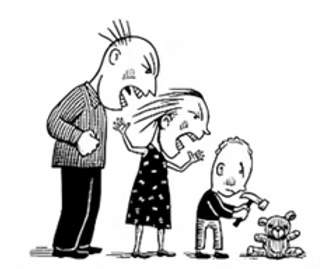
Redirecting emotional responses from the original source — which feels too threatening to confront — onto a safer, less powerful target. The classic example: a person humiliated by their boss comes home and yells at their spouse. The spouse snaps at the child. The child kicks the dog.
Displacement preserves the relationship with the threatening source by sacrificing the relationship with the safer target. The emotion is real; the target is wrong. This is why displaced anger often feels confusing to the recipient — they sense the intensity is disproportionate to the situation because it is. The anger belongs somewhere else.
8. Reaction Formation
Converting an unacceptable impulse into its exact opposite. The person does not merely suppress the unwanted desire — they actively proclaim and perform the opposite, often with conspicuous intensity.
A person with unacknowledged homosexual desires becomes vocally homophobic. Someone who deeply resents a family member becomes excessively attentive and self-sacrificing toward them. A person terrified of vulnerability adopts a persona of aggressive independence.
The telltale sign of reaction formation is excess — the behavior is performed with an intensity that exceeds what the situation warrants, because it must be strong enough to overpower the impulse it conceals.
9. Sublimation
Channeling socially unacceptable impulses into socially valued activities. A person with aggressive urges becomes a surgeon or a competitive athlete. Someone with voyeuristic tendencies becomes a filmmaker or photographer. A person processing grief writes poetry that moves others.
Sublimation is widely considered the most mature and adaptive defense mechanism. The impulse is neither denied nor acted upon destructively — it is transformed into something productive. Vaillant (1977) described sublimation as "alchemy" — the conversion of lead into gold. The original impulse is honored rather than suppressed, but its expression is refined.
10. Intellectualization
Retreating into abstract thinking, analysis, and logic to create emotional distance from a threatening experience. A person diagnosed with a serious illness immediately researches survival statistics rather than allowing themselves to feel afraid. Someone going through a divorce discusses "attachment theory" and "relational dynamics" instead of grieving.
Intellectualization is seductive because it mimics insight. The person appears to be engaging with the problem — they can describe it eloquently, cite research, explain the mechanisms — but the emotional core remains untouched. Understanding without feeling is not healing; it is a sophisticated form of avoidance.
11. Rationalization
Constructing a logical-sounding justification for behavior driven by unacknowledged motives. The person creates a plausible narrative that makes their actions seem reasonable, sparing themselves the discomfort of confronting the true motivation.
"I didn't get the job because the interviewer was biased" (rather than confronting inadequate preparation). "I yelled at my child because they need discipline" (rather than acknowledging loss of emotional control). "The relationship ended because we grew apart" (rather than examining one's own contribution to the rupture).
Rationalization is particularly insidious because the justifications often contain a grain of truth — just enough to make them plausible while obscuring the deeper, more uncomfortable reality.
What makes rationalization especially dangerous is that it doesn't just protect the original behavior — it escalates it. Once a person has constructed a justification for their actions, they now need reality to conform to that justification. This creates a self-reinforcing cycle: the rationalization demands further rationalizations, each one pulling the person further from the truth and deeper into a distorted version of events. The Arbinger Institute's Leadership and Self-Deception offers one of the clearest illustrations of this process. The book describes how a single act of self-betrayal — choosing not to do what you know you should — triggers a cascade of rationalization where you inflate your own virtues, inflate the other person's faults, and inflate the severity of the situation, all to justify the original choice. The result is that a small moment of dishonesty with yourself compounds into a rigid, self-righteous posture that damages every relationship it touches.
12. Compartmentalization
Separating conflicting aspects of one's life, beliefs, or self-concept into isolated mental "boxes" that are prevented from interacting. A person who is ethical in business but dishonest in relationships. Someone who advocates for compassion publicly while treating their family harshly.
Compartmentalization allows a person to hold contradictory beliefs or engage in contradictory behaviors without experiencing the cognitive dissonance that would normally force reconciliation. The walls between compartments prevent the uncomfortable confrontation between who the person believes they are and how they actually behave.
13. Compensation
Focusing excessively on one area of life to offset or distract from perceived deficiency or pain in another. A person unhappy in their marriage pours themselves into career achievement. Someone who feels physically inadequate develops exceptional intellectual ability. A parent who feels guilty about emotional absence compensates with material generosity.
Compensation creates the appearance of balance while the underlying deficiency remains unaddressed. The overperformance in one domain masks the neglect of another — and often, the compensating behavior is itself a clue to the wound it is covering.
14. Isolation of Affect
Separating the emotional content of an experience from the factual content, allowing the person to discuss events that should carry emotional weight with clinical detachment. A trauma survivor describes horrific events in a flat, matter-of-fact tone. A person recounts a devastating betrayal as though narrating a documentary.
The facts are accessible; the feelings are not. This defense allows continued functioning in the face of overwhelming experience, but it prevents the emotional processing necessary for healing. The disconnect between what is being said and how it is being said is often striking to observers.
15. Acting Out
Expressing unconscious emotional conflicts through behavior rather than words or conscious awareness. Rather than recognizing and articulating anger, a person slams doors. Rather than processing abandonment anxiety, a teenager shoplifts. Rather than confronting grief, a person engages in reckless sexual behavior.
Acting out bypasses the cognitive processing system entirely — emotion is converted directly into action. The person may not even recognize the connection between the behavior and the underlying emotional state. When asked why they did it, they often genuinely don't know.
16. Conversion
The transformation of psychological distress into physical symptoms that have no medical cause. Paralysis, blindness, seizures, chronic pain, or numbness that cannot be explained by any neurological or physiological condition.
Conversion was one of the earliest phenomena Freud studied — his work with "hysterical" patients revealed that their physical symptoms symbolically represented psychological conflicts they could not express. Modern research on psychosomatic illness continues to document the body's capacity to express what the mind cannot bear to feel. The body becomes the theater in which the psychological drama is performed.
17. Identification
Adopting the characteristics, values, or behaviors of another person — typically someone perceived as powerful — in order to manage anxiety or gain acceptance. A child who mirrors an abusive parent's personality to avoid becoming a target. An employee who adopts their boss's mannerisms and opinions. Someone entering a new social group who abandons their authentic preferences in favor of the group's.
Identification can be adaptive (modeling positive qualities) or destructive (identification with the aggressor, where a victim takes on the characteristics of their abuser). In its defensive form, it represents a sacrifice of authentic selfhood in exchange for perceived safety.
18. Schizoid Fantasy
Retreating into an elaborate internal fantasy world as a substitute for engaging with reality. A person in a dying relationship who sustains themselves on fantasies of reconciliation rather than addressing the actual problems. Someone who lives primarily through daydreams of achievement, romance, or revenge rather than taking action in the real world.
Schizoid fantasy provides unlimited control — in the fantasy, the person is always safe, always powerful, always loved. The real world, by contrast, is unpredictable and threatening. The defense trades authentic but risky engagement for imagined but safe satisfaction.
19. Splitting
Perceiving people, situations, or aspects of the self in all-or-nothing terms — entirely good or entirely bad — with no capacity to integrate contradictory qualities into a coherent, nuanced whole. A partner is idealized one week and devalued the next. A friend who disappoints once is reclassified as an enemy.
Splitting reflects a developmental failure in what object relations theorists call "whole object relations" — the capacity to hold both positive and negative qualities of a person in mind simultaneously. In its absence, people oscillate between idealization and devaluation, unable to sustain a stable view of others (or themselves) that accommodates complexity.
20. Anticipation
Attempting to prepare for and neutralize future threats before they materialize. Rehearsing difficult conversations obsessively. Planning for every conceivable negative outcome. Living in the future rather than the present.
Anticipation is considered a relatively mature defense because it involves realistic assessment rather than distortion. However, when deployed rigidly, it becomes a form of chronic anxiety disguised as responsibility. The person may appear conscientious and prepared, but the underlying driver is fear — the belief that if they can predict and prevent every possible problem, they will be safe.
21. Humor
Using comedy, wit, or irony to deflect from painful emotions, uncomfortable truths, or threatening situations. The class clown who jokes to avoid vulnerability. The person who makes light of their own suffering to prevent others from seeing their pain. Self-deprecating humor as a preemptive strike against anticipated criticism.
Humor is one of Vaillant's mature defenses because it acknowledges the threatening reality rather than distorting it — but when used defensively, it prevents genuine emotional engagement. The laughter becomes a wall. The person who is always funny may be the person who is never truly known.
22. Sexualization
Using sexual behavior, fantasy, or seduction to manage anxiety, distract from emotional pain, or gain a sense of power and control. A person who pursues sexual encounters not from genuine desire but from a need to feel wanted, powerful, or distracted from inner emptiness.
Sexualization transforms a painful internal state into an interpersonal transaction — loneliness becomes seduction, powerlessness becomes conquest, worthlessness becomes desirability. The relief is temporary because the underlying emotional need is never addressed through the sexual behavior.
23. Dissociation
Disconnecting from one's thoughts, feelings, sense of identity, or perception of surroundings to escape overwhelming distress. Feeling detached from one's body during a stressful conversation. "Spacing out" during conflict. Feeling as though events are happening to someone else.
Dissociation exists on a spectrum from mild (daydreaming) to severe (dissociative identity disorder). In its defensive form, it represents the psyche's last resort — when fight and flight are both impossible, the mind simply leaves. It is common in trauma survivors and reflects the nervous system's capacity to protect awareness from experiences that would otherwise shatter it.
24. Passive Aggression
Expressing anger, resentment, or hostility indirectly rather than directly — through procrastination, "forgetting," subtle sabotage, or feigned incompetence. A person who agrees to a request but consistently fails to follow through. Someone who gives the silent treatment rather than naming their frustration. Sarcasm disguised as humor.
Passive aggression develops when direct expression of anger is perceived as too dangerous — typically because early experiences taught that open conflict leads to punishment, abandonment, or overwhelming retaliation. The anger does not disappear; it goes underground and finds covert expression. The person can maintain the appearance of compliance while expressing hostility in ways that are difficult to confront.
25. Undoing
Attempting to "cancel out" unacceptable thoughts, feelings, or behaviors through compensatory opposite actions. Being excessively generous to someone after having hostile thoughts about them. Compulsive apologizing. Ritualistic behaviors intended to neutralize guilt or anxiety.
Undoing is closely related to the psychology of obsessive-compulsive patterns. The person cannot tolerate the existence of the unacceptable thought or action, so they attempt to erase it through symbolic reversal. The reversal, however, does not address the original impulse — it merely suppresses the awareness of it temporarily, requiring repeated "undoing" to maintain the suppression.
26. Somatization
Experiencing psychological distress as physical symptoms without any identifiable medical cause. Chronic headaches that emerge during periods of unacknowledged anxiety. Stomach problems that flare during relational conflict. Back pain that intensifies when emotional burdens feel unmanageable.
Somatization is related to conversion but tends to involve less dramatic, more chronic symptoms. The body becomes the spokesperson for emotions the mind cannot or will not express. Research consistently demonstrates that individuals with alexithymia — difficulty identifying and describing emotions — are significantly more likely to present with somatic complaints (Taylor et al., 1997).
27. Introjection
Internalizing the values, attitudes, criticisms, or expectations of others as one's own — without critical examination of whether they actually fit. A child absorbs a parent's critical voice and it becomes their inner critic. A person adopts a partner's worldview wholesale, losing their own perspective in the process.
Introjection differs from healthy internalization in that the material is swallowed whole rather than digested. It remains a foreign body within the psyche — the person experiences the introjected beliefs as their own, but they carry a quality of rigidity and self-alienation that reveals their external origin. The inner critic that says "you're worthless" is often speaking in someone else's voice.
28. Devaluation
Diminishing the importance or worth of a person, experience, or goal that threatens one's self-esteem or triggers vulnerability. "I didn't want that job anyway." Dismissing someone who rejected you as "not that great." Belittling achievements you failed to attain.
Devaluation protects self-esteem by reducing the significance of the threat. If the thing wasn't valuable, then failing to obtain it doesn't reflect poorly on the self. But the protection is purchased at the cost of honest self-assessment — and over time, habitual devaluation erodes the capacity to genuinely value anything, creating a flattened emotional landscape.
29. Idealization
Attributing exaggerated positive qualities to another person, often as a defense against acknowledging their flaws or one's own disappointment. Placing a partner, therapist, mentor, or public figure on a pedestal that no human can sustain.
Idealization serves multiple protective functions: it provides a sense of safety ("this person will save me"), avoids the anxiety of ambiguity ("they are perfect, so I don't need to evaluate them critically"), and deflects from one's own perceived inadequacy ("if I am connected to someone extraordinary, I must be valuable too"). The inevitable crash — when the idealized figure reveals their humanity — often triggers the opposite defense: devaluation.
30. Magical Thinking
Believing that one's thoughts, wishes, or rituals can influence external events without any causal mechanism. "If I worry enough about it, it won't happen." Superstitious behavior as anxiety management. Believing that thinking a thought is morally equivalent to performing the action.
Magical thinking provides an illusion of control in situations where actual control is absent. It is developmentally normal in childhood (Piaget documented this as characteristic of preoperational thought) but becomes a defense mechanism when it persists into adulthood as a strategy for managing anxiety about uncertainty and helplessness.
Vaillant's Defense Hierarchy
George Vaillant organized defenses into four levels, from most pathological to most mature:
The goal of psychological development is not to eliminate defenses but to move up the hierarchy — replacing primitive, reality-distorting defenses with mature, reality-acknowledging ones.
The Courage Requirement
"The cave you fear to enter holds the treasure you seek." — Joseph Campbell
Every defense mechanism exists because something felt too threatening to face directly. Healing requires voluntarily approaching precisely what the defense was designed to avoid — the rejected emotion, the unacceptable truth, the intolerable vulnerability. This is why genuine healing always requires courage. The defense kept you safe; dismantling it means stepping into the very experience you've been protecting yourself from.
The Hidden Cost of Chronic Defense
Defense mechanisms are designed for temporary protection — circuit breakers for overwhelming moments. When they become permanent fixtures of personality, they exact a profound toll:
"People will do anything, no matter how absurd, to avoid facing their own souls."
— Carl Jung
From Unconscious Defense to Conscious Choice
The goal is not to eliminate defense mechanisms — they are a necessary part of psychological functioning. The goal is to develop awareness of when they are operating, understand what they are protecting, and gradually expand the capacity to face what was previously too threatening to confront.
How to Apply
- 1Identify Your Default Defenses: Every person has a characteristic defense style — a small set of mechanisms they rely on most heavily. Review the list above and honestly assess which ones you recognize as habitual patterns. Ask trusted others what they observe: "When I'm stressed or threatened, what do you see me do?" Others often see defenses more clearly than the person deploying them.
- 2Trace the Defense to Its Origin: For each identified defense, ask: "When did I learn this? What was happening in my life when this became necessary?" Defenses are almost always adaptive responses to specific developmental circumstances. Understanding the original context transforms the defense from a character flaw into a survival strategy that can be honored for what it accomplished — and then updated.
- 3Identify What the Defense Protects Against: Every defense guards against a specific feared experience. Projection guards against unacceptable self-knowledge. Intellectualization guards against overwhelming emotion. Avoidance guards against anticipated pain. Name the fear. The more precisely the feared experience can be identified, the more directly it can be addressed.
- 4Build Tolerance Gradually: Defenses exist because the defended-against experience was once genuinely overwhelming. Dismantling defenses without building the capacity to tolerate what they were blocking is retraumatizing, not healing. The work is gradual: small exposures to the feared experience, increasing in intensity as tolerance grows. This is the same principle underlying exposure therapy and desensitization.
- 5Replace Primitive Defenses with Mature Ones: Moving up Vaillant's hierarchy doesn't mean becoming defenseless — it means defending more skillfully. Converting projection into self-reflection. Converting acting out into sublimation. Converting denial into conscious acknowledgment with humor. The mature defenses do not distort reality; they manage it with grace.
- 6Practice Vulnerability in Safe Contexts: Defense mechanisms are relationship strategies — they govern what is hidden and what is revealed. Healing happens in relationship. Finding safe contexts in which to practice lowering defenses — with a therapist, a trusted friend, a supportive partner — builds the experiential evidence that vulnerability is survivable. Each successful experience of being seen without catastrophe weakens the case for chronic defense.
The curious paradox is that when I accept myself just as I am, then I can change.